Showing posts with label characterization. Show all posts

Saturday, January 16, 2021

Communing With Your Characters By Shea E. Butler

I am relatively new to the publishing world, having been published for the first time in the November 2019 issue of Mystery Weekly Magazine (a short story titled “Giving Up The Ghost”). Since then, I’ve had short stories published three more times, twice in anthologies and again in Mystery Weekly Magazine (as Sally Field once said, “You like me.”) But I’ve also sold several television scripts, written several feature film scripts and a comic book. They are all vastly different animals in terms of format and structure, as well as character and story arcs. One thing they do have in common, however, is that they all have characters who talked to me.

What, you may ask, do I mean by that? Exactly what I said. They all have characters who talked to me. Creating interesting, multi-faceted characters who are each unique, well-rounded individuals, and who speak and act like real people, is hard. Okay, let’s be real. Writing is hard. But writing great characters that engage your readers is especially hard. We all have our own way of creating those characters and keeping them within their story line and doing what you want (and need) them to do to move the plot and story forward. But they don’t always do what you want them to do. At least, mine don’t, and I have some lively conversations with them trying to convince them to do so.

Do you commune with your characters? I do. In fact, it isn’t until I do start communing with them, whether via a dream, talking out loud with or shouting at them, free form writing or daydreaming about them and what they’d do or say, that I feel like they are really coming alive and popping.

I will freely admit that I’ve gotten some strange looks as I’ve communed with my various characters. Like the time I was sitting by myself at Starbucks writing and having a very lively argument with one of my characters. Out loud, no less. I was totally engrossed in my conversation and unaware of the odd looks thrown my way. Finally, one of the other patrons asked me if I was okay. I was a bit impatient as my conversation with my character had been interrupted. I hurriedly said I was fine and went back to my conversation. Yes, I do tend to be stubborn. I wanted to win that argument with my character. After all, I had created him. But the concerned and genuinely nice patron wasn’t going anywhere. However, as soon as I explained that I was a writer and that I had an ornery character who was insistent that he wouldn’t fall in love with the woman I plotted out for him to fall in love with (Nick told me he had a crush on the guy who lived in the apartment across the hall from him), the worried look left the woman’s face and she burst out laughing. Seemed that she, too, was a writer and totally understood. In fact, thanks to my more-stubborn-than-me (yup, I lost that argument thankfully) character, not only was a new plot line developed for my story, a wonderful friendship was born.

Just like we’re told to have pen and paper next to our beds so we can write down our dreams when we wake up, I use said pen and paper to write down the conversations I have with my characters when I dream about them and the various situations I put them in. I do the same in the car for those times I’m stuck in L.A. traffic and my imagination wanders into the world of my newest story. Helpful to have when my characters start communing with me about what they’d say or not say and what they’d do or not do. I believe (okay, hope) that the drivers next to me think I’m singing along to the radio and not talking to myself. If not, perhaps I’ll make another new friend!

Sometimes, while riding my horse, my mind will also wander into the world of my most current story. My characters will pop up and start going on tangents, straying from their well-thought-out story arcs. Some good (like my character Nick’s new romance), some bad. Riding a horse in the middle of Griffith Park is not conducive to writing down new ideas for your story or dialogue for a character. But not being able to jot down the essence and specifics of an idea or the snappy dialogue your character just gifted you with, is the pits. So, if you see a woman riding a horse in Griffith Park and dictating into her phone a plot point or some spiffy dialogue her character insisted upon, that’d be me. Handy little tool, that cell phone.

I love it when my characters begin talking to me. That’s when that little sizzle of excitement starts tickling my tummy and I know that I’m cooking. I know that all my hard work and laborious plotting and character development is working. I know that I’m racing around the back stretch and the finish line is just around the corner. That’s when the fun really starts.

Do your characters talk to you as you write? I’d love to hear how, when and where they do so. I am always curious about how other writers write, whether they are plotters or pantsers, outliners or freeformers, and I am especially curious about how other writers build and create their characters and bring them to life. Let me know.

Shea E. Butler is, at heart, a storyteller. She’s a storyteller in many different fields: a television writer, a published author and an award-winning director/writer/producer for her short films and web series. She was that kid who huddled under the covers after “lights out” reading a book by flashlight. Born in Cairo, Egypt to American parents living abroad, Shea currently divides her time between Vancouver and Los Angeles. Her love for traveling and exploring worlds and cultures, both past, present, and future, was ignited at a young age. Shea’s most awe-inspiring trip was a horseback riding safari through the Okavango Delta in Botswana. Nothing like being charged by two lions to get your creative juices flowing!

Shea is currently working on her first novel and has a short story appearing on the SHORTZ phone app (chat stories) at end of January called “9-1-1.”

Shea’s Website: www.thebutlerdiditproductions.com

Neon  Nights
Shea’s most recent published work is “Neon Nights,” a short story which explores the age-old question, does the end justify the means? A burnt out, big city detective now working in a small southern town, has to ask herself just that when a serial killer and the FBI come to town.  Sammi’s fractured, tough but vulnerable, having seen too much working the city streets, but she still wants to do the right thing. But what, exactly, is the right thing? “Neon Nights” was published in the September 2020 issue of Mystery Weekly Magazine (available at https://www.amazon.com/dp/B08GV97SWV/)

Sunday, January 13, 2019

About this New Year's Thing . . .


Happy New Year, everyone. Yes, I know it’s January 13, but this is my first Writers Who Kill blog for the year, so it still feels like a new year. For those who make resolutions, there’s probably a 50/50 chance you’re keeping all of them. And for those who celebrate the new year using other calendars: Chinese, Hebrew, Hirji, and so many others I have no clue about, I don’t apologize for my celebration of the Gregorian calendar. Nor do I put my version of keeping track of time ahead of yours. It is, however, the way I see the world.

This “how I see the world” is important to understanding how deeply buried our preconceived notions can be. And when we turn to the author business of creating characters, we must also keep in mind that people act from their beliefs, regardless of facts.

Taking calendars as an example, embedded in my use of the Gregorian calendar is Christianity. In its original form, the current calendar year would be referred to as AD 2019. The AD comes from the medieval Latin anno Domini, meaning “in the year of our Lord”, referring to the year attributed to the birth of Jesus Christ. (Scholars don’t agree on when Jesus was born, but most think it was several years before the Gregorian calendar starts counting. The Gregorian Calendar is a modification of the earlier Julian calendar done to more accurately reflect leap years.)

Sometime during my lifetime, a movement occurred to secularize naming of years and change AD to CE, which stands for “Common Era.” Turns out, like many things “I know,” the actual timing of this movement is not as I remembered. The first reference may have been 1615 used by the astronomer Johannes Kepler. Scientists were the first adopters.

The Latin equivalent of anno Domini is ante Cristum natum (before the birth of Christ). Unlike the AD, which stuck, ADN did not, and many languages rejected the Latin and substituted the words in their own language. In English this became Before Christ, shortened to BC and occurring after the numerical date, so the year before AD 1 is 1 BC. Poor zero never got a chance to strut his stuff. BC, morphs to BCE (before Common Era) in the secularized version.

Yet even dressing up dates with the new CE and BCE tags, does not eliminate their Christian origins. The origins are obfuscated, but no less present. Scratch the surface the tiniest bit and the Christian origins sparkle beneath the clothing we’ve put on dates.

People and characters often hold truths that are not fact-based. My false recollection that the use of CE was introduced during my lifetime is a small, and probably inconsequential, example. But it does suggest we need to periodically question the basis of our understandings.

In discussing Trump’s Wall with someone of a more conservative persuasion than I hold, I referred to the first line in Robert Frost’s “Mending Wall”:

Something there is that doesn’t love a wall,

I was told I had missed the whole point of the poem, which she claimed was contained in the last line:

“Good fences make good neighbors.”

And this illustrates our differences more clearly than I could have earlier articulated: my strong attachment to the poem’s first line, hers to its last. I argue context: the narrator does NOT agree with the “Good fences make good neighbors.” statement handed down from neighbor father to neighbor son, spoken reverently without reflection upon the rationale behind the saying or when it may or may not be justified.

That, of course, is my point of view and it fits my personality, I often challenge “truths” to test their limits. My math background makes me dig for the hidden assumptions that support the “facts.”

Others prefer to follow the well-worn path espoused by those before them. Testing these known truths is irrational and counterproductive.

The problem with unchallenged misunderstandings in ourselves or others is they become bedrock truths. I would have great difficulty thinking that today belongs to the year 5779 (Hebrew Calendar). Conceptually, I understand it’s just a different number system that mathematically maps calendar days one-to-one from my current system. No day is lost, none added. It’s a matter of convenience, I say, and ignore the cultural significance of the choice.

I often see errors in fact made by people espousing all shades of political views. When I have specific expertise (usually actuarial or financial), I’ll often try to provide a correct explanation. This reflection on the New Year and its cultural bias has made me realize maybe I should have a New Year’s resolution.

I hereby resolve to try to be more conscious of my inherent biases before touting my opinion.

But, I already know as soon as I enter the world of Facebook, I’m more likely to find the speck in your eye than the beam in mine. How long will your resolution last?

* * * * * * * *
James M. Jackson authors the Seamus McCree mystery series. Empty Promises, the fifth novel in the series—this one set in the deep woods of Michigan’s Upper Peninsula—is now available. You can sign up for his newsletter and find more information about Jim and his books at https://jamesmjackson.com.


Sunday, November 18, 2018

Characterization: Judging vs. Perceiving

I often refer to Myers-Briggs personality types when I want to understand how real people or fictional characters act and react in certain situations. An individual’s profile is determined based on four poles: (Introvert/Extrovert, Sensing/Intuiting, Thinking/Feeling, Judging/Perceiving). Each of the four pairs provides insights, but one of the most interesting is Judging versus Perceiving.

The way I find it easiest to understand the dichotomy of this pair is to answer this question:

Do you feel more comfortable after you’ve made a decision (J) or before the decision is made (P)?

Judging people (not to be confused with judgmental people, which this is not) are usually task oriented, put off play until work is done, make lists, are comfortable when decisions are made, and hate having the pressure of looming deadlines so will carefully schedule their work. Sometimes they focus on the goal so heavily they miss (or ignore) new information which could impact them.

Perceivers like to keep their options open. They often don’t make plans and will decide when they must (and sometimes they will miss out because they didn’t decide). They tend to work in bursts of energy, often becoming more energized as a deadline nears.

My better half, Jan, is a big-time J. I am normally a strong P with the distinction that when a decision needs to be made, I make it and move on. Until that point, my theory is why not collect as much data as you can? (Pure P thinking.) Jan, of course, is going crazy while I check out “just one more thing.”

One reason we read novels is to learn how characters act under stress. Stress can be physical (someone’s trying to kidnap me!) and those confrontations can rev our endorphins in sympathy with the character. But if the only stress is action-oriented, most readers soon become bored (unless we channel our inner teenage boy). Mental stress comes in all shapes and sizes and can hold our interest throughout a novel.

Jan and I are currently looking at a major decision, and I can attest to the building tension when a J and a P must jointly make a decision (assuming neither one is the type who rolls over and capitulates with “whatever you want, dear).

It’s also interesting to see what happens when the author forces a P character to make a decision before they can gather what the P thinks is enough data. After they have been forced to make it, how long will they rehash their decision before they accept it? What form does their regret take? What happens in their dreams?

Or consider the mental punishment of not allowing a J who has decided what should be done to enact it. Or what happens when against advice (probably from a P) that they should consider other information before deciding, they go ahead, only to discover they have made a huge error?

As an author, I find satisfaction in torturing my characters and seeing if they grow stronger or crumble under the stress. As a reader, I want to know what’s going to happen.

In real life, it’s not quite as enjoyable, but it’s easier for me to cope when I can reflect on everyone’s style and how that drives the way they see the world.

Sunday, October 23, 2016

The Road Less Traveled


by Julie Tollefson

If you fly over my home state of Kansas, you’ll see a checkerboard landscape of farmland. If you drive through on one of the main interstates, you’ll likely get the impression that so many have of Kansas—that it is flat and monotonous.

It’s true that we don’t have the mountains of Colorado or the oceans of California, but we do have treasures. To find them, you have to get off the highway.

Western Ribbonsnake.
Exploring these out of the way places is something my husband and I enjoy for somewhat different reasons. His first love is herpetology, an affinity for reptiles and amphibians that I’ve grown to appreciate (but not fully understand) in the 28 years we’ve been together. He’ll jump at any chance he can get to cruise the back roads in search of snakes. Literally. Herping (aka snake hunting or road cruising) means slow drives on lonely roads punctuated by slamming on the brakes when you spot a snake in the road, leaping from the car, and chasing down critters before they slither into the underbrush just so you can oooh and aaah, take a few photos, and then release them back into the wild.

Butterfly on liatris.
His approach to these outings is more, um, energetic than mine. I like the scenery. The wildflowers half-hidden in unusual rock formations and the russet swathes of big and little bluestem grasses in the fall. A butterfly feeding on liatris. A stroll through woodlands or prairie at a pace well short of “hike.”

An additional benefit, for me, is the wealth of material I collect for my writing, from scene setting to character development. In August, our desire to escape for a day took us to Wabaunsee County in the northeastern corner of the state. At the Friendly Cooker, a diner where we had lunch, we eavesdropped on the folks around us (lots of characters in small-town diners!) and got the last two pieces of delicious strawberry rhubarb pie free because it was near closing time and the manager felt generous. We spent the rest of the day hiking a little-known prairie area managed by the Audubon Society, its path lined with boulders deposited by glaciers during the last Ice Age, and exploring roads most people don’t know exist.

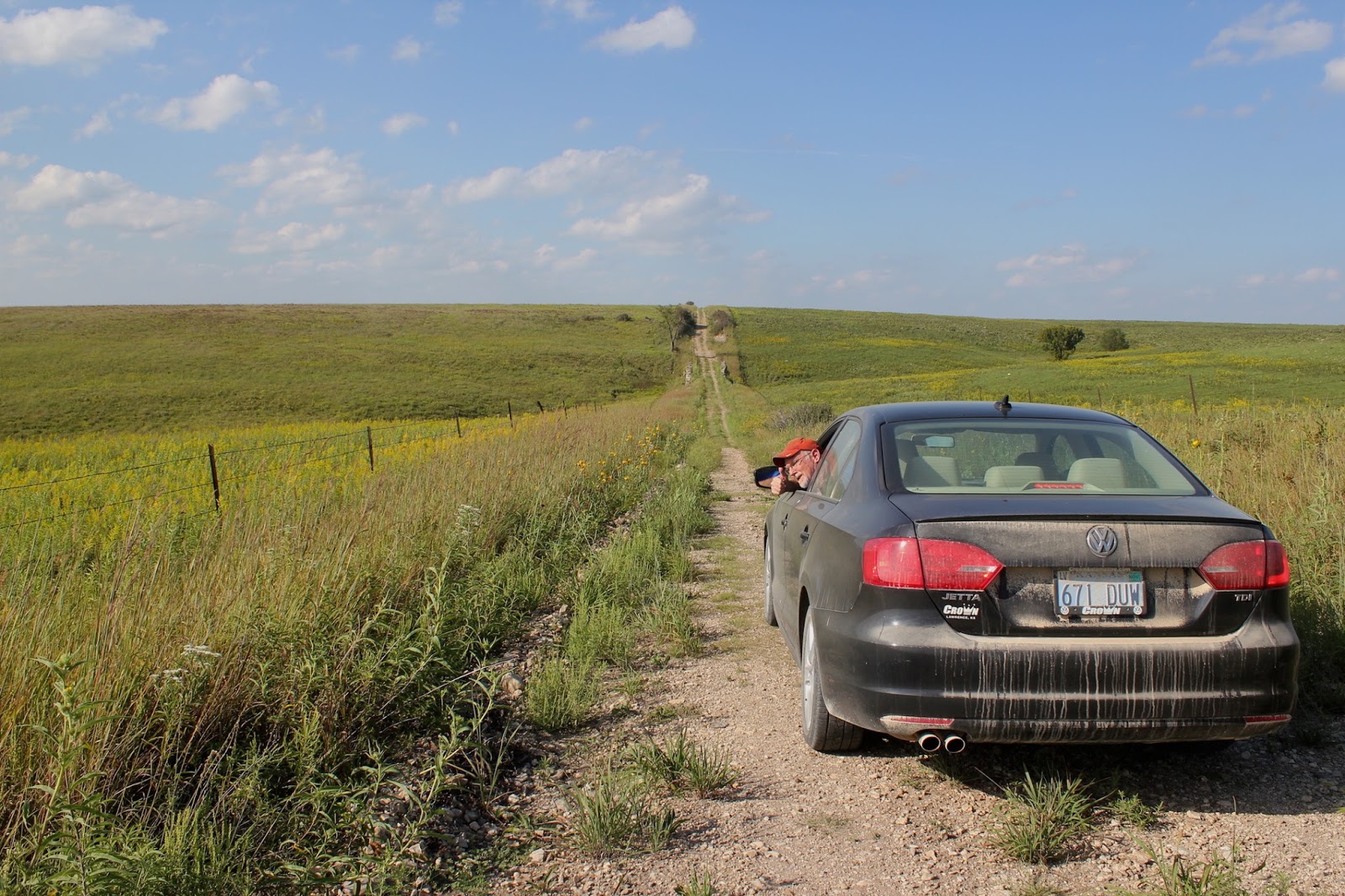
The real adventure of the day came when we chose to follow a dirt “road” marked on our trusty Kansas Gazetteer but obviously little used. The farther along we drove, the narrower the road became and the taller the weeds. At one point, the weeds growing in the center of the road trail were taller than my car. Someday, that road will find a place in my fiction.

The "road" narrowed and the weeds grew taller on the other side of that hill.

What are your favorite roads less traveled?

Monday, November 16, 2015

Lazy Writing

by Linda Rodriguez

My husband and I have been binge-watching Prime Suspect on Netflix lately. Helen Mirren is awesome, as always, but the ensemble cast is of extremely high quality, also, and the writing is superb. Until. (You knew there had to be an “until” hanging around there somewhere, didn’t you?)

Suddenly, one episode begins with Mirren’s character DCI Jane Tennison doing something so out of character and just plain stupid (for a very smart, savvy character) that both husband and I are screaming, “What? Jane would never do that!” This out-of-character action she has taken is an obvious set-up to provide lots of conflict later for Jane, but between us, we came up with four different ways the author could have set up the exact same conflict without having Jane commit an action totally wrong for her character.

Normally, I don’t even worry about this in movies or TV shows because I usually simply can’t hold them to as high a standard as I do books, but this series is so well-written that I do expect that kind of intelligent writing. It’s happened before in books by excellent writers, as well. I can understand the impulse behind it because I think there are times we all are frustrated in our plotting and tempted by the lazy way to put our protagonists where they need to be.

The writer of one of the strongest, best-written mystery series around (who shall remain nameless because she’s never done it again) did this in one of her books, causing her protagonist to violate the essence of the character the writer had spent four books building up in order to allow that protagonist to learn something the author needed the protagonist to know and to create conflict for the protagonist. It was darned near a throw-the-book-against-the-wall moment for me, and if this author hadn’t already built up so much respect, I would have.

I finished that book, in which the character went right back to being the person delineated in the previous books, and have continued reading that author. Although we stopped midway in the Prime Suspect episode, the others have been so good that we will probably give it a chance and finish it. But I have stopped reading some less-stellar authors’ series when they’ve pulled that kind of boner. If you can’t believe in a character’s reality, it pretty much blows the whole show, I think.

How do you feel about a major character making a move that’s not just a surprise but completely wrong and out of character? Do you just shrug and move on, or does it bother you as it does me?

Sunday, September 20, 2015

Dialogue and Critical Thinking

Chances are, dear readers, you have a vague idea who the two cartoon princesses are in the photo collage above. If not, a hint: Anna and Elsa, stars of Disney’s massive hit FROZEN.

FROZEN is a movie loved by many and its songs are ones you can probably hum along with even if you haven’t seen the movie or bumped into a five-year-old singing “Let it Go” at the top of her lungs in the cereal aisle at the grocery store.

But what you may not have noticed—at least I didn’t until I saw this post on Tumblr—was that Anna and Elsa haven’t done themselves many favors in critical thought department.

The above collage has the caption: “These two run a country.”

Yes, they run a tiny kingdom, but they are constantly, painfully saying, “What?” “Wait?” and combinations of those and other “I’m really confused and don’t understand what you’re saying” expressions.
Obviously, many people saw that movie and never noticed these princesses’ penchant for speaking before thinking. I sure didn’t.

BUT, fill a whole book with conversations where your character is constantly exclaiming, “Wait, what?” and you likely won’t have your reader thinking the character is nearly as smart or interesting or worthy of any sort of praise whatsoever.

Case in point: I once read a manuscript blind for someone where the main character was supposed to be this special person with knowledge that could save an empire (yes, it was dystopian). But this main character was constantly and I mean CONSTANTLY having things explained to her. She never was able to put two and two together. Even worse, it was always men in this world explaining things. Not exactly what many young girls would want to read, even though this would-be author was aiming it straight at the high school set.

After reading probably a thousand variations of “Wait, what?” I knew there was no way I was ever truly going to trust that this character could save her people or was worth any of the praise dripped on her. And I wanted to like her. I really did. But there was no way we were going to be friends. And I felt disappointed with the whole manuscript.

So, this is a challenge to you. When you’re revising, see how many times you rely on a crutch such as “Wait, what?” to get to the heart of whatever information needs to be discovered in a scene. You might surprise yourself at how easily you let your character get away with something completely against his or her character.

Sunday, February 8, 2015

Putting Friendships to Paper


So, a confession: I’m on my eighth manuscript (or so) and I’m, for the very first time, writing a true friendship.
Seriously.
It’s funny, because writing friendship is something I totally did not realize I didn’t do until I made the conscious decision to include it.
The second I decided it belonged in this manuscript, the fact that I hadn’t really done it before slapped me right in the face.
That said, I don’t believe my previous main characters were friendless losers.
Nor were they loners.
Not even close.
Every single one of them had friends and family and people they talked to to make the story go round (duh). I mean, this is obvious. Even infamous loner Jack Reacher has people he can talk to. (Though, “Reacher said nothing,” might be one of the series’ most famous lines.)
But, as is the case with many mysteries, the friendships I examined in the past were that of coworkers. You know, people working together on a case, or who join forces to catch a killer. A coworker relationship is a level of friendship, of course, but it’s completely distinct when compared to people who are simply friends.
Plus, in my manuscripts as in many others, there’s often an element of romantic tension coloring the main friendship/working relationship. And that, whether it’s between coworkers or true friends, changes everything about the friendship you’re examining.
But this time around, my main character has a true best friend.
The kind who’d have matching half-heart necklaces if they were a bit younger.
They’re just a couple of girlfriends, who do things girlfriends do.
They call each other. They shop. They dish on boys.
Heck, I have an entire scene where they’re at a pizza joint on a Saturday night. It’s integral to the story, but the scene is really about their friendship (and demonstrating the nature of it) as much as it is about moving the main plot forward.
For some reason, the chance to write this sort of relationship feels liberating. It’s so different from writing boss-underling, coworker-coworker, worker-new worker, will-they-or-won’t-they-get-together “friends.” It’s fun. It’s fresh. And it reminds me of the girls I love and feel grateful to call friends.
How do you approach friendship in your manuscripts? Is there room for it, or does it hang out on the sidelines?

Sunday, November 9, 2014

A Tale of Teeth and Character


It is oh so lovely to be back at the WWK after a few weeks of being off and busy with my new baby. Thanks so much to Kait Carson for filling in—I really hope you enjoyed Kait’s posts as much as I did.

What have I been up to? Well, as any new mother will tell you, there’s a lot of time spent sitting around. My baby girl (as well as my son a few years ago) absolutely loves to strand me on the couch.

And I don’t mind, because baby snuggles are the best, even if I haven’t moved in three hours because I’m terrified of waking up the wee one. Though, honestly, because this is my second baby, I’m a little less terrified and more apt to get up/eat/shower/be a normal human being than I was with my first one.

That said, when I am on the couch, enjoying baby snuggles, my iPhone has been my very best friend. I didn’t have one with Baby No. 1, and I tell you, it’s done wonders in that I A. Don’t feel as alone (Thank you, text messages!) and B. Can catch up with what’s going on in the world.

Thus, while on the couch the other day, I read my friend Sarah Smarsh’s fabulous “Aeon” magazine piece about having poor teeth in rich America: http://aeon.co/magazine/health/the-shame-of-poor-teeth-in-a-rich-world/

You need to read the article because it’s fantastic, but, basically, Sarah does a fine job breaking down what imperfect teeth mean in our view of a person and how dental insurance and basic dental care often divide the classes in our country.

And, when we’re talking characters—in books, TV and the movies—most often if a character has bad teeth, he/she is a villain.

And it’s true.

Think about it.

Charlize Theron’s serial killer in “Monster.” The crazy Bible beater on “Orange is the New Black.” Any meth addict you’ve ever met in an episode of “CSI.”

In fact, the only character I can think of who was a hero and had purposely bad teeth is Austin Powers. But even then his teeth were awful mainly as an ongoing joke about the British and their famously horrible chompers.

When mulling this over as a writer, I can’t help but think about how in both books I’ve read and in my own writing, a love interest almost always has an amazing smile.

I’m not sure I’ve ever done this on purpose—in my mind’s eye, I just happen to see this handsome character with handsome teeth to match.

I didn’t realize I was saying something about his socio-economic class, but I suppose I was. My guys all have dental insurance and grew up flossing, whether I planned that or not.

What are subtle ways we define a character when we describe how he or she looks? Have you ever used a character's teeth as a tell?

Sunday, September 14, 2014

Characterization in Just a Few Words


So, I haven’t talked about it here, but I’m due with a baby this month (in fact, I may have already had her—the perks of working ahead!). After this post, the lovely Kait Carson will cover for me for a few weeks while I become acclimated to having a second little person around, running my life.

Anyhow, the thing with being pregnant is that it seems to be a condition wherein you not only grow another human being but you also weather some of the strangest comments you’ll ever receive in your life.

The first time around, it was the birth horror stories—I’ll spare you a recounting of all the tales of woe I heard. This time, the theme seems to be quite the mixture of random comments about how “good” I look, that actually make me wonder how “bad” I look normally. Also, sometimes, I’ll get unsolicited musings on parenthood (“Girls are just great until they turn thirteen. Then they’re automatically gremlins.”) or a comment about how far apart my kids are (“That’s quite a gap!” they say about the five-and-a-half years).

I realize that sometimes people just don’t know what to say, but they think they have to make a comment. And that seems to usually result in a certain brand of uncensored thought that can tell you quite a bit about the person in the space of a few small words.

This was the case with a certain coworker who mentioned the other day that I was waddling. He caught me away from my desk and wanted to hand me something “as you walk by” and then, for no reason whatsoever, amended that statement with “as you waddle by.”

Not exactly someone who is nine months’ pregnant wants to hear. I mean, I’ve made waddling jokes, of course, but unless I say it first, I don’t think anyone else should point out that I’ve achieved the penguin stage of pregnancy.

I was so flustered, I just said, “Yes, as I waddle by” and took the papers. By the time I returned to my desk, I was so livid, I ended up tweeting about it. Still mad, I went to the girl who sits next to me and vented to her, and, without me even mentioning the person’s name, she knew exactly who had said it.

How’s that for instant characterization?

As I became a bit less mad, I thought about how she was able to pick out in a single try who among our 200 coworkers had said that to me. My conclusion: The comment went to the very heart of his character.

As a writer, that’s something we always hope for—to create a character so unique he or she is recognizable in the space of four words. In real life? I suppose it’s a double-edge sword.

What do you think makes your characters instantly recognizable?

P.S. Oh, and don’t worry, I’ll update or comment on this post to let you know if I’m still waddling around or not.

Monday, May 26, 2014

Baby, You Can Drive My Car - Characterization on Wheels


As I sat in the mechanic’s waiting room, I considered that, for some lucky people, cars transcend mere transportation. For those who can afford it, their wheels are a fashion statement, an accessory, an image they present to the world.

Writers show who a character is by what they say, think, do, and what others say about them. Some authors also show us a character’s personality by what what the character drives. Picture James Bond dodging assassins' bullets as he corkscrews down an alpine highway in his Aston Martin; Nancy Drew speeding down Main Street in River Heights in her roadster; Mickey Haller of Michael Connelly’s Lincoln Lawyer in the back seat of his chauffeur-driven Lincoln Town Car. Then picture Bond in a Prius; Nancy in a rehabbed hearse with Grateful Dead bumper stickers; the Lincoln Lawyer in a rusting minivan. Doesn’t work, does it? For some characters, their vehicles are an extension of their personality.

What else would an erudite, opera loving Oxford detective drive? Look at this photo of the maroon Jaguar MKII driven in the Inspector Morse series. The book series opened with Morse driving a Lancia, but the Jag was chosen for the TV series and made its way into the books. Try to picture Morse in a Mini or a muscle car or even a Range Rover. No, I can’t picture it either.

Janet Evanovich’s Stephanie Plum drives a series of lemons she calls “POS” cars that do more than underscore Stephanie’s precarious financial situation. Her readers look forward to the disasters that await her cars, turning her wheels into plot points that often throw her into the vehicles (and arms) of her dangerously desirable rescuer, Ranger. Ranger’s cars are all gleaming black Porches and SUVs, underscoring his mysterious, hypermasculine competence.

Like Stephanie, Sue Grafton’s Kinsey Milhone’s broken down VW shows us not only Kinsey’s precarious financial situation, but also her toughness. Kinsey and the car keep going, even when life and the road get difficult.

For many characters, their personalities are reflected in the different kinds of wheels they use to get around. Jessica Fletcher, the author/sleuth star of Murder, She Wrote, doesn’t drive, and travels around Cabot Cove by bike. This quirk underscores her can-do personality.  Jessica gets around, literally, under her own steam. On the Criminal Element blog, Donald Bain said he forgot this and had Jessica rent a car in his first book in the Murder, She Wrote series. Fans did not let him forget it.

In the television show Colombo, the famously rumpled detective drives a car almost as unimpressive-looking as he is. The humble Peugeot Cabriolet brims with personality, and surpasses mere characterization to become a character, an ally, to Colombo. Many a suspect lays eyes on the car and immediately thinks that only a loser would drive such a heap. The detective and his car tag team suspects, driving them them into the trap of low expectations.

What does your main character drive?

Sunday, March 2, 2014

Characterization and Structure, 'True Detective' Style


Last week on Writers Who Kill, Linda Rodriguez happened to post about all the fabulous things writers can learn from watching (or reading) George R.R. Martin’s Game of Thrones. If you haven’t checked out her blog, do so, it’s awesome.

I wanted to expand on this theme because I, too, have taken away quite a bit from that show and those books (as mentioned briefly back in June with a big, fat picture of Kit Harington’s Jon Snow), but this time, I wanted to discuss another show that has a heaping amount of little gold writer nuggets scattered within its weekly hour: True Detective.

Honestly, I barely watch TV. If it’s not a sport or The Daily Show, I probably won’t have time for it. I have made time for Game of Thrones and House of Cards, but mostly because we don’t feel beholden to watching them at any certain time. With a five-year-old and a 4:15 weekday wake-up call, I’m only good for an hour of TV and usually on a Friday or Saturday night when I can “sleep in” until some amazingly late hour like 6:30.

So, when True Detective launched earlier this year, I didn’t bother. I mean, I knew about it. But I know about a lot of shows I’d like to watch but can’t totally commit time to sitting down and enjoying.
But then the messages started coming in from friends.

You need to watch True Detective RIGHT NOW.

Have you seen True Detective? Totally thought of you.

Why aren’t you watching True Detective, Henning?! Seriously.

So, I caved.

And I’m increasingly happy I have.

While not based on a book, (though there are tons of references to 1895’s The King in Yellow) this show has two huge teach-by-example lessons for writers: A. Building Characters and B. Narrative Structure.
Okay, there are probably many more lessons to be learned here, but these are the two I’m picking. Because they are major, clear cut, and immensely helpful.

Building Characters: The show centers around a long-time Louisiana state detective named Hart (Woody Harrelson) and his brand new partner Cohle (Matthew McConaughey). The guys pair up just in time to chase down a possible serial killer who has murdered at least one woman and left her on display in a way that’s about as creepy as you can get (it involves antlers).

But the crime doesn’t dominate the series. The characterization of Hart and Cohle is most definitely the center of attention. We learn bits and pieces about them in eyedropper helpings. It’s intoxicating and interesting because, as a viewer, you are always waiting for that next bit of information to drop, especially about the very broken, unusual Cohle.

As a writer, this is fabulous to watch and absorb because we all know that the “info dump” is basically the death of a good scene. Especially when the dumping involves characterization. As writers, it’s so important to let the reader learn just enough early on to become invested rather than overwhelmed, and then feed them with bits of information as the story progresses. Seeing this done so masterfully on screen is most definitely helpful when sitting down to write (or revise the info dump away).

Narrative Structure: The second big lesson here is on structure. True Detective doesn’t take place linearly. Rather, it effectively sets up the past and present in a sort of cat-and-mouse situation where both inform each other. The original crime took place in 1995, but in the present, both Cohle and Hart are being interviewed by detectives about that case. As with many interviews, neither man is telling the whole truth, but here, the viewer understands what really happened and what they aren’t saying. This creates a fabulous element of dramatic irony—we know quite a bit that the detectives in the interview room don’t know—and that’s a ton of fun.

As writers, this is important because we can see tension being built between the past and present. Even if you use a more traditional, linear structure, it’s easy to watch the brilliant writing here and realize how past actions must affect the outcome, even if they aren’t directly related to the main plot thread. And in mystery, the past probably means everything, no?


What TV shows have you learned from as a writer? (And don’t say Murder She Wrote!)

Note: Warren Bull has also written about TV shows and writing in the WWK space, most notably on Burn Notice and The Closer.