Showing posts with label Setting. Show all posts

Monday, August 10, 2026

When Your Setting Starts Killing People, You Know You’re Doing Something Right

A Guest Post by Mindy Quigley


You may have heard writers describe moments when their characters take over the story. This has certainly happened to me. I’ll think I know which way a scene needs to go, only to have the folks on the page inform me they have other plans.

Something that gets less attention is what happens when a book’s setting starts taking over the plot. 

I certainly didn’t expect Geneva Bay, the charming Wisconsin lakeside resort where my books take place, to start murdering people. But—surprise!—it did just that. 

When I first pitched the Deep Dish Mysteries, I had no intention of setting the books in small-town Wisconsin. The books feature deep-dish pizza and a detective descended from Al Capone, so obviously they belonged in Chicago. I envisioned my fictional pizzeria in Hyde Park, where I could draw on the neighborhood’s fascinating history and the city’s unseemly connection with organized crime.

My publisher had other ideas. They loved the concept, but wanted it set in a small, tightly knit community—a place where readers could take a mental vacation. 

I tried to argue that Chicago is, in fact, a great place for a vacation, but finally relented, moving the whole shebang to “Geneva Bay,” a lightly-fictionalized version of Lake Geneva.

As it turned out, Lake Geneva had everything I needed. It’s a short drive from Chicago, and its history is deeply intertwined with the city. Wealthy Chicagoans flock there in the summer, and during Prohibition, the area served as a convenient booze-smuggling pitstop. Gangsters, including Al Capone, also reportedly used the area as a place to lie low when things got too hot in Chicago.

I soon realized that my publisher had done me a huge favor. The town wasn’t just a backdrop: as I got to know it, it became a murder-mystery-generating machine.

The early books’ plots were driven primarily by the characters. Take the first book. Main character Delilah O’Leary discovers her elderly aunt holding a literal smoking gun over the corpse of her seemingly beloved caregiver, upping the stakes. In the sequel, Delilah herself becomes a prime suspect after a murder takes place in a juice bar owned by her ex-fiancĂ©’s new girlfriend. 

By the fourth book, though, Geneva Bay had started suggesting plot twists of its own.

Sleep in Heavenly Pizza takes place during the U.S. Snow Sculpting Invitational, a real event Lake Geneva hosts each winter. Huge mounds of snow are transformed into oversized artwork over the course of a few days. Watching the sculptors work, I began to wonder: What would happen if they carved back the snow only to unearth a corpse? 

I hadn’t simply found a fun place to hide a corpse (though it is fun!). The entire mystery grew out of the setting: the town’s winter attractions, its wealthy seasonal residents, its unpredictable weather. The murder couldn’t be uprooted and plunked down in another place. It became a wheredunnit. Only Geneva Bay could’ve pulled it off. 

By the time I started writing At Death’s Dough, the fifth Deep Dish Mystery, the setting was again at the top of my mind.

In this book, Delilah’s great-aunt, an enthusiastic ice fisher, takes her out onto the frozen lake, where—well, you can probably guess what happens next.

The gruesome discovery plunges Delilah into a mystery involving a real-life, century-old crime, the Capone family, and a trail of clues that may lead to a priceless treasure. All of those elements are unique to Lake Geneva/Geneva Bay.  

At Death’s Dough won the 2026 Agatha Award for Best Contemporary Novel, which was a particularly satisfying development for a book that began with the question, “How might this cute-as-a-button place kill someone (again) and why?”

At long last, the audiobook of At Death’s Dough is now available, narrated by the super talented Holly Adams. 

So if you’re fed up with the summer heat and looking for a book to transport you, I invite you to visit the frosty shores of a scenic Wisconsin lake. 

Just watch your step. Geneva Bay is a dangerous town.


Agatha Award-winning author Mindy Quigley writes twisty, character-driven crime fiction with a sharp, snappy sense of humor. Her Deep Dish Mysteries were a Woman’s World book club pick and have been featured in Parade and the Seattle Times.

Before turning to full-time fiction writing, Mindy spent more than a decade managing veterinary clinical research studies. That followed an unusual career path that took her from the U.S. to the U.K., where she studied British colonial history, worked as the personal assistant to the scientist who cloned Dolly the sheep, and project managed a neurology research clinic founded by J.K. Rowling.

She now lives in small-town Virginia with her Civil War historian husband and their children. For a lifelong dog owner, she spends an awful lot of time thinking about cats.


Saturday, April 18, 2026

Small Towns, The Perfect Mystery Setting - by Judy L. Murray

“It is my belief, Watson, founded upon my experience, that the lowest and vilest alleys in London do not present a more dreadful record of sin than does the smiling and beautiful countryside.” Sherlock Holmes, The Adventure of the Copper Beeches by Arthur Conan Doyle

The English may think they have the corner on dangerous villages, but we prolific American writers also create lots of small-town settings that affect our characters’ lives and charm our readers. We know small towns make for perfect incidents of murrrr-der whether we choose the Chesapeake Bay, the Midwest, or the Colorado mountains.

Cabot Cove, the beloved hometown of Jessica Fletcher of Murder She Wrote, will always be one of the most famous mystery series locations, proving that cozies belong in villages. With boats in the harbor, a country doctor, and a small-time sheriff, Jessica’s travails became a genre theme. Over the years small towns as a location evolved into private jokes among authors. After all, how many murders can any one town handle?

What makes small towns the perfect cozy setting? Being from a small town in Pennsylvania, I think of local shops, teachers who taught generations, three-person sheriff departments, and two traffic lights. The anonymity a killer might count as an advantage in a big city is far less likely in a small town. Local killers have a harder time dreaming up alibis because everyone knows each other’s business, for good and for bad. If he’s new to the community, he’ll stand out like a red Maserati parked next to an old pickup truck.

Readers enjoy a small-town sense of community. They get emotionally involved with a book’s familiar cast of characters, even the annoying ones. Parks, shops, and libraries where characters meet to discuss the latest news are endearing. It adds to the shock and concern of a murder just discovered. Who did it? Why? Is the killer one of us? Gossip and accusations fly. Townspeople are less likely to set bad news aside and continue their lives untouched. Some will circle the wagons. Some will spill the beans. Someone decides to do some sleuthing.

The bakery, the church, and the hardware store all form an even smaller microcosm within the town setting. It’s here where co-workers become family even when not related. They are dependable and close-knit. They either welcome a newcomer or regard the newcomer with suspicion.

A crime in a small village provides a different element of fear, unlike a crime in a big city of strangers. The person killed isn’t a stranger. They know the victim personally. And the killer is highly likely to be someone they know. Secrets are closely guarded and loyalties are long, even when misguided. The town buzz is fodder for useless clues and valuable insight.

Amateur sleuths in small towns tend to nosey into solving crimes and step on the law’s toes. They’re good at talking among the locals to flush out clues. The small police force with limited resources may initially discount our sleuths’ abilities but grudgingly come around to their intrusions and deductions.

Although we might joke about the frequency of small-town crimes like in Cabot Cove, as readers we’re perfectly happy to set those doubts aside. We fall in love with the odd mix of characters. We stay up at night turning pages while we sort through the drama, the danger, the clues and the missteps. We hope we can ferret out the killer before the sleuth. Much like the all-too-famous line about Vegas, what happens in small towns stays in small towns. Until the next dead body. And that’s part of the fun.

Monday, March 10, 2025

Where Has Your Book Taken You?

 Hello from Shari Randall!


One reason I set my Lobster Shack Mysteries in Mystic, Connecticut (called Mystic Bay in the books) is because the area has so much of that hard-to-define quality called charm. Its combination of historical interest and natural beauty makes it a place people yearn to visit. Over the years I've felt like an unofficial ambassador for not just this area of coastal Connecticut, but for New England, too. Nothing makes me happier than a reader who tells me they enjoyed their "visit" in the pages of one of my books.

Setting is such an important part of a story. In some books, the description of the setting is so vivid that we feel immersed in the place. That's one of the reasons we readers love books, isn't it? We can travel in books without leaving our cozy armchairs.

Where has your last read taken you? 

Let me know in the comments. 


Shari Randall is the author of the Lobster Shack Mysteries  and, as Meri Allen, the Ice Cream Shop Mysteries. The last place she visited in a book? Ireland.

Friday, May 24, 2024

Connection by Nancy L. Eady

 My daughter first came to live with us when she was three years and one month old. We went from childless couple to parents with one month’s notice. Since the first month after she was with us was December, the transition was even more hectic. It’s not every new father who rushes down to Toys R’ Us because the last shipload of swing sets pre-Christmas arrived at the store at midnight unexpectedly. The swing set was one of only three things she said she wanted for Christmas, and the hardest.  

In the midst of all of that, I can still remember how we would drive places with her in her child seat in the back and she would suddenly sing out, “I saw something!” The standard reply was “What did you see?” The answer was usually something undifferentiated like “A tree!” Or maybe it only sounded like that because, y’all, speaking three-year-old is NOT easy. She must have thought we were the dumbest people on earth the first month she lived with us because every time she spoke we’d stare at her blankly and then ask her to say whatever it was again. Looking back, though, I realize the “I-saw-something” game was one way she was trying to connect with us. 

As authors, our goal is to connect with our readers. One way to do this is to use short descriptions of the small items we (or our characters) collect around us. If your character doesn’t have a small collection of detritus that surrounds their personal space, then that says something about them too. My personal assumption would be “neat freak,” but since I am chronically unorganized, that is judgmental on my part. 

For example, my chest of drawers in the bedroom has a few objects on it. If I was writing about a character and tossed out something about her “moving the miniature enameled vases she bought at the antique store on her and her husband’s last visit with her in-laws before they died” while dusting, haven’t I given my reader something to connect to? Or perhaps she could be about to move, coping with keeping a house show-ready, cooking dinner and thinking about how empty the kitchen counters look since the realtor forced her to pack away her glass collection of red, blue and yellow roosters. Again, I hope, connection. What about a man who opens the spare room closet to find something for his wife, discovering one of the collars for a dog he loved that died years earlier? He fingers the faded red collar, then gently lays it aside on a sewing table to start pulling out boxes. I think I like him most of all three. 

Now, my reactions to the above descriptions are generally positive because I have positive connections with the subject matter. I loved my in-laws, am fond of my rooster collection and recently found an old collar one of my dogs who died used. They could equally spark negative feelings for a person who has negative connections with the subject matter, such as having a toxic relationship with their in-laws, being virulently anti-clutter and anti-collections, or loathing dogs. The descriptions could also create confusion if the emotion involved and the character’s actions are diametrically opposed, such as a description involving a positive emotion being applied to a serial killer. The point of the description, though, is still met because the reader’s connection to it elicits a reaction which is what I, as the writer, am hoping to achieve. 

What are the techniques you use in your writing to connect with your readers? 


Tuesday, July 19, 2022

Sharing the Writing Experience

by Paula Gail Benson


Earlier this year, I wrote about two Sisters in Crime Chapters (Capitol Crimes and Palmetto) planning and executing a virtual program. Last month, I mentioned a cooperative effort between the Palmetto Chapter of Sisters in Crime and the Southeast Chapter of Mystery Writers of America (SEMWA), Mystery in the Midlands, which began as an in-person event, then has been virtual the last three years because of Covid. Needless to say, I’ve spent a lot of this year working with authors I did not know, as well as  trying to figure out the most meaningful and economical ways of sharing information that both writers and readers could appreciate.

Planning these events takes a lot of work. It really helps to have dedicated, supportive folks pulling together.

Both times, we had that. I’ve been particularly grateful to get to know the members in the Capitol Crimes Chapter (which is across the country from me) and to learn more about the SEMWA board members who don’t live near me. While our energies were directed toward the projects, we still had time to talk with each other about our own writing. It always amazes me to hear the types of work and methods of approach that other authors have. Not only does it give me ideas about how to improve my craft, it also gives me a larger “to be read” list!

Clockwise from top left: Shawn, Dana, Joseph, and Alan

During this past weekend, that happened with the third virtual Mystery in the Midlands. We had three panels and a keynote interview. Our ten participating authors were all superstars. Dana Kaye, our moderator and facilitator, made  her work look effortless and took care of all the technical concerns as well as asking wonderful questions.

The first panel featured short story authors and editors. Alan Orloff, whose Young Adult novel I Play One on TV, won this year’s Agatha and is nominated for the Anthony, spoke about the need to leave gaps so that readers can make leaps. Shawn Reilly Simmons, an Agatha and Anthony winner and editor at Level Best Books, gave an example of finding a name for a character from a wine bottle. Amazingly, Shawn writes her own stories while editing other authors’. Joseph S. Walker, who has written more than fifty stories while working full-time as a college professor, emphasized the importance of  well-chosen details for developing a sense of place in a short story. All three recommended reading stories written by Edgar, Derringer, Agatha, and Anthony award winning author Art Taylor.

Hank and David
For the keynote, marvelous David Heska Wanbli Weiden, whose debut novel Winter Counts was a multiple award winner, was interviewed by the incredible Hank Phillippi Ryan. This segment exemplified what happens when two fabulous authors speak craft and career. David revealed that his protagonist in Winter Counts originally died in a short story, but David could not let him go, so he returned in the novel. At first, David thought he was writing about tribal justice, but after eighteen revisions, he realized the theme of the work was identity. He was very pleased that the novel had been read by Congressional aides who have contacted him about possible revisions in federal law.

Raquel, Daryl, and Abby

The cozies panel was delightful with authors Daryl Wood Gerber (Agatha winning author of three series), Raquel V. Reyes (Lefty winning author whose debut novel has just been optioned for the screen), and Abby L. Vandiver (who writes under three names and who as an anthology editor has been nominated for an Anthony). Abby said in her writing and in advice to students she suggested to always have characters eat, spend money, and pee (the three connectors in the human condition). She mentioned that food and pets were definitely relatable. Raquel mentioned that while some people made the recipes in the books, many just liked to read how dishes were put together. Daryl said while ingredients may be the same, the differences in recipe descriptions made them unique and added to the elements in the story.

Hallie, Hank, and John

In the final panel, Hallie Ephron (New York Times bestseller, Edgar Award finalist, and five-time finalist for the Mary Higgins Clark Award), Hank Phillippi Ryan (USA Today bestselling author and five-time Agatha Award-winning author of 13 thrillers and winner of 37 Emmys for investigative reporting in Boston), and John Hart (author of six New York Times bestsellers and the only author in history to win the best novel Edgar Award for consecutive novels) spoke eloquently about setting and suspense. Hank mentioned that setting could be weather or clothing and different in perspective if an adult or child. She showed a sticky note she kept on her computer with the words “Be There.” John said if the writer wasn’t there, the reader wouldn’t be. He encouraged engaging the senses, especially smell, and talked about creating the internal, emotional landscape. Hallie’s novels often take place within a house. She takes into consideration family, relationships, and how a character feels stepping into a place. She emphasized developing an intersection between character and setting.

Dana, Hank holding Winter Counts, and David

Thank you to all those participating in the program, those viewing it, and those who put it all together. Saturday was a great day for learning and sharing.


What meetings and conferences (virtual or in-person) have you found helpful this year?  

Saturday, April 24, 2021

Setting and Place, What’s the Difference, by Kait Carson


It’s the subtle distinctions of writing that can slow you down the most. Take setting and place. To a writer, those two words are related, but not the same. The setting is the overall area where the action takes place. For example, my books are set in Florida. The action of the stories occurs in various places within the setting. My characters may be in Key West (setting) drinking margaritas on Smathers Beach (place).


Key West can be painted in broad strokes. My readers need to see the tropics, pastel-colored houses, salty breezes, steel drum music, a kaleidoscope of ever-changing tourists, a babble of languages. There is no need, unless it’s germane to the story, to describe the contents of the store fronts and bars along Duval Street, or name the individual plantings in the gardens that line the road. Setting is an atmosphere. Vague enough to allow the reader to insert themselves. This is especially important when the setting is a real location.


When I think of Key West Fast Buck Freddie’s springs to mind, and I want to go to The Buttery for dinner. Freddie’s is a CVS now, and The Buttery has been seven or eight restaurants. The last time I was in Key West, the front window sported a “for let” sign and the old girl looked very down at the heels. None of those details are important to the setting of my story. What’s important is the swirl of sounds, smells, and humanity that make up the setting of Key West.


Place is specific and detailed. A well-drawn place is as important as a fully developed character. If my characters are out drinking on Smathers Beach, they’re hiding their margaritas in Yeti mugs and keeping a sharp eye out for law enforcement. Open containers are illegal in Key West. That detail lends the flavor of authenticity to the scene and can be used as a plot point. Readers need to feel the sand under their feet, the tickle of sea foam as it covers their toes, the dribble of perspiration from their hairline, and the sizzle of the sun on their shoulders. Place is where the heart of the action occurs.


If showing up is eighty percent of life, it’s one hundred percent of place. To be effective, your characters and your readers need to intimately occupy the place of a story. When place is well done, a reader should look up from the book and be startled to see their own living room.


What books or stories have you read that transport you to the place of the action?

Monday, April 12, 2021

Home, Sweet Setting

By Shari Randall

When she beta-read my last book, a friend told me that I seemed more interested in describing houses and settings than I was in describing people. At first I was taken aback, but after reflection, I saw her point. I adore all those tv shows about houses – buying houses, selling houses, decorating houses, rehabbing houses, even haunted houses. With my husband’s military career, we’ve bought and sold plenty of houses. I love a good house tour or decorator showcase. Even dollhouses fascinate me. When I was a little girl, my favorite toy was my Barbie Dream House. Although my kids flew the nest years ago, I still have custody of their dollhouses and, sorry kids, I don’t think you’re getting them back.

Why do houses intrigue me so? Perhaps a psychologist could explain. Maybe the dollhouse my dad built for me and my sisters, a replica of our own red Cape Cod home, set me on this path. Perhaps homes reflect the people in them and the writer in me has stumbled upon a different form of characterization?

With COVID restrictions, I haven’t been able to travel to scout potential story locations and buildings as much as I’d like. Lucky for me that my corner of Connecticut is chock full of intriguing places, places that fire my imagination and will make great settings for my books.

 
One of my characters likes to “collect castles” and so do I. Gillette’s Castle, set on a hill called the Seventh Sister overlooking the Connecticut River, is one of my favorite places to visit. Designed by William Gillette, an actor famous for his portrayal of Sherlock Holmes, the castle’s dĂ©cor, construction, and grounds reflect the eccentric brilliance of its owner. This place inspired another pocket-sized castle in an upcoming, as-yet-untitled book.
This yellow charmer is slated to be the childhood home of the main character in my upcoming book, THE ROCKY ROAD TO RUIN.
This mini-castle is tucked into a neighborhood a block from the ocean. Not your typical beach house, is it? I can only imagine the character who built it. I feel a story coming on!


Writers: People or places – which do you find easier to describe?


Shari Randall is the Agatha Award-winning author of the Lobster Shack Mysteries.

Monday, August 10, 2020

Welcome to Penniman!

by Shari Randall

I just finished the first book in my new Ice Cream Shop Mystery series and my editor loves it. Whew! That's the good news. The bad news? ROCKY ROAD TO RUIN won't be available until next summer. Still, I wanted to take you to the dream New England village where I've set it. Welcome to Penniman!

Penniman is a combination of some of my favorite places, places I've been, and places I'd like to go. There are several Connecticut towns that have the charm and history I wanted for my setting, but not all of them had every element I required so I had to "build" my own village.

I find it useful to make a Pinterest vision board where I keep photos of places that I've visited and actors  I've cast in the roles of my characters. (A girl can dream!) You can find it on Pinterest @sharirandallwrites.

Just outside of town is Fairweather Farms, where my main character Riley Rhodes takes over as manager of the Udderly Delicious Ice Cream Shop. I haven't been able to find a photo that matches my vision of the ice cream shop where my characters work. Maybe it only exists in my imagination! I imagine a former farm shed that was painted purple when it was renovated into the shop. This one is close, but it needs a coat of paint.

Penniman has lots of gray stone walls - it is Connecticut, after all --  and the farm has fields of sunflowers.


The ice cream is luscious!


There's a Town Green with a war memorial

charming shops

Riley's family home,

and a suitably haunted historic house.

Did I mention the covered bridge?


What's your favorite setting for a mystery?


Monday, November 11, 2019

Speaking of Setting

By Shari Randall

I’ve just returned from Bouchercon, the World Mystery Conference in Dallas, Texas. While there I danced the Cotton Eyed Joe on the same floor as Sandra Brown, saw James Patterson, enjoyed catching up with old friends, had tea presided over by Princess Diana’s chef, and sat on a panel called The Perfect Setting. 

This is the second time I’ve been on a panel discussing setting. Conference planners putting me on a setting panel makes perfect sense to me. The New England setting of my Lobster Shack mystery series is specific. Say “New England” and we all picture Angela Lansbury riding a bike along the waterfront of Cabot Cove. We can see weathered buildings hung with colorful buoys, white churches with tall columns framed by oaks and maples ablaze with orange and garnet leaves. We can hear the ocean, seabirds, and laconic locals. 

I always learn so much from panels and this one was no different. Our moderator, SJ Rozan, provided new insight by talking about the emotional setting of a book, the way the characters react to and interact with the physical location of a story. She pointed out that a setting has not just a physical dimension but also an emotional one. Think of visiting an ice cream parlor. Most of us have good memories of sharing this simple treat with parents or grandparents. This nostalgia is evoked by the setting.

Another thing I learned is that I envy authors who have maps and floor plans in their books. How I delight in seeing an artist’s vision of the setting of a book: Middle Earth in the Lord of the Rings, Nether Monkslip in G. M. Malliet’s Max Tudor series, the Art Deco floor plan for one of the stately homes in Agatha Christie’s novels. When I was ten years old, I pondered for hours the floor plan of the train in Murder on the Orient Express.

One of my dreams is having a map in one of my books.

What settings do you enjoy in the books you read? 

Monday, March 25, 2019

DISNEY by Nancy Eady

          My family and I are going to Disney World soon. Most families take such trips to please the younger members of the family, but we go there for me. It is not the most relaxing place, of course; the planning I put into a Disney World trip rivals the effort I used to put into law school exams. But "The Happiest Place on Earth" is one of my happiest places, too. 
          I started attending Disney parks when I was in elementary school back in the early to mid-1970’s (a/k/a The Dark Ages to those individuals born never knowing the hardships we suffered without smart phones and Google.)  We lived in San Diego then, and visited Disneyland a few times. My memories of those trips are happy ones. I may be one of the few people who remember using tickets for the rides, rather than a single admission price for everything. The tickets were graded A through E, and cost different amounts. “A” tickets were for the smallest, slowest, least thrilling rides, and “E” tickets were for the most popular, most thrilling rides. Visitors bought ticket books at kiosks in the park with differing amounts of all 5 tickets in them.
            From the first visit, I was hooked. Disney keeps their parks scrupulously clean, and their service is impeccable. I’ve never had a bad visit to any of them.
            These days, since we live in the Southeast, we travel to Disney World. As I’ve gotten older and done more writing, I’ve discovered a second reason I love Disney parks – their total immersion in a story. Every ride at a Disney park has its own story. Every area of each park has a theme, and that theme is reflected even in the most minute details.
            When you wait in line for a ride (and trust me, you will be waiting in line for a lot of rides), the story behind each ride is set out around you in the decorations and displays designed to keep you distracted from the fact that you just spent 60 minutes standing in line for a five-minute ride.  The ambience created by the attention to detail is unique to each ride. I not only ride the rides for fun, but also to study the setting and details for the rides and try to glean lessons from Disney’s story telling methods to my own writing.
          The new Pandora area at Animal Kingdom is a perfect example of the attention to detail.  Based on the world of the movie “Avatar,”  called Pandora, rock formations float in the sky, and exotic flora and fauna line the pathways.  Pandora is especially striking at night – just like in the movie, the vegetation emits an otherworldly bioluminescent glow.  As you get near one of the two main rides in Pandora, called Flights of Passage, the line transforms into a hiking trail alongside a waterfall.  As you travel along the hiking trail, you learn that 100 years have passed since the time of the original movie.  A group of the Na’vi and humans are working to clean up pollution left by a mining company that threatens the entire planet.  You go through a deserted control room left by the mining company, but as you exit the deserted control room, you see that Pandora’s vegetation is beginning to reclaim the building.  By the time you reach the ride, a simulated flight on an animal called a banshee, you are completely immersed.  What a wonderful way to tell a tale!
            What places do you visit that help you tell stories?  

Monday, February 25, 2019

Memory Triggers by Nancy Eady

The best writers in any genre use setting to create moods with a few deft sentences.  Their ability to create moods through language is amazing given the many different ways memories are evoked in people.  

Take the example of a blooming pear tree.  February is winding to a close here in the deep South, and Spring is making an unseasonably warm appearance with the trees, shrubs and flowers blooming in swift succession.

The first signs of spring are the daffodils and the forsythia bushes, better known as yellowbells.  Shortly after or while they are blooming, the tulip trees burst out with their pink and white blooms, and then the pear trees.

The flowers of pear trees are white and small compared to the large tulip tree blooms but they still show up because nothing else much is blooming and because they fill up the entire tree.  A pear tree in bloom throws itself into the process.  It doesn’t dally, shilly-shally, or shyly peek forward a bloom at a time.  It personifies the verb “to blossom.”

Pear trees always remind me of my dad-in-law, who passed away in 2001.  This is an odd association in some ways, because he didn’t particularly love spring flowers or pears.  Like most people, he was always glad to see signs that spring was coming, but he didn’t rejoice in the flowers the way I do, the way that makes my teenage daughter look at me sideways and say, “Mom, get a grip.”

So where does the association come from?  For the five years I was in law school (I went part time, three nights a week with two summers off), he and my Mom-in-law fed me supper every night I had class – and they were happy to do so.  They enjoyed having me there.  One day in March in the mid-90’s during supper, Mark’s Dad mentioned to me that he had seen some of the white flowered trees blooming in a field.  He said they were dogwoods, but I was pretty sure it was too early for the dogwoods to have started.  So I drove by the field that afternoon on my way to school, and realized that he was talking about the wild pear trees that had colonized the abandoned field and turned what would otherwise have been an eyesore into an attractive harbinger of spring.

I don’t know what makes that memory stand out, but ever since then, when I see the pear trees in bloom, I not only celebrate the nearness of spring, but also remember fondly a man who meant a great deal to me.

What sights and sounds do you see that trigger memories in you?

Sunday, February 5, 2017

The Beauty of Small-Town Life

by Julie Tollefson

I grew up in a small town, population around 30,000. The kind of place where everyone knows your family going back generations and wherever you go and whatever you do as a teen, you know someone’s mom sees and notices. 

After high school, on the cusp of adulthood, I was ready to get out.  No provincial life for me. As a journalist, I would travel the world, immerse myself in different cultures, uncover hidden truths. Oh, yes, I was ready for the adventures ahead.

So it’s a bit of a surprise that as an adult, more than three decades removed from the small town of my youth, I live in a rural area outside an even smaller town of about 5,000. I travel a bit for pleasure, and the hidden truths I uncover all lurk in the pages of my fiction, populated by people who inhabit small towns bearing a striking resemblance to the places I’ve lived.

I recently had a conversation with a writer friend about the pros and cons of living in a place where a five-minute trip to the grocery store takes 45 minutes because you chat with three people in the parking lot, another in the produce section, two in the canned goods aisle, and a couple more between the checkout stand and the door. The kid who takes carry-out orders at the gas station pizza place greets you by name when he answers the phone and knows your favorite combinations as well as what kind of car you drive. 

There are days when I almost yearn for anonymity, to be able to run errands without combing my hair or to slip into the town’s one swanky bar unnoticed for a quiet cocktail at the end of a long day. But for every one of those days, many more remind me of the value of the bonds forged in small towns, a lesson brought home poignantly last Monday when so many teachers requested time off to attend the funeral of a friend and colleague that the district opted to cancel all classes in all three buildings—elementary, middle, and high school—for the day.

I love that. 

The deep feelings, strong relationships, and quirky traits unique to each small town make for a terrific bank of experiences to draw on in creating fiction. 


In your reading or writing, are you drawn to small towns or big cities? What details about a place make stories come alive for you?

Sunday, October 23, 2016

The Road Less Traveled


by Julie Tollefson

If you fly over my home state of Kansas, you’ll see a checkerboard landscape of farmland. If you drive through on one of the main interstates, you’ll likely get the impression that so many have of Kansas—that it is flat and monotonous.

It’s true that we don’t have the mountains of Colorado or the oceans of California, but we do have treasures. To find them, you have to get off the highway.

Western Ribbonsnake.
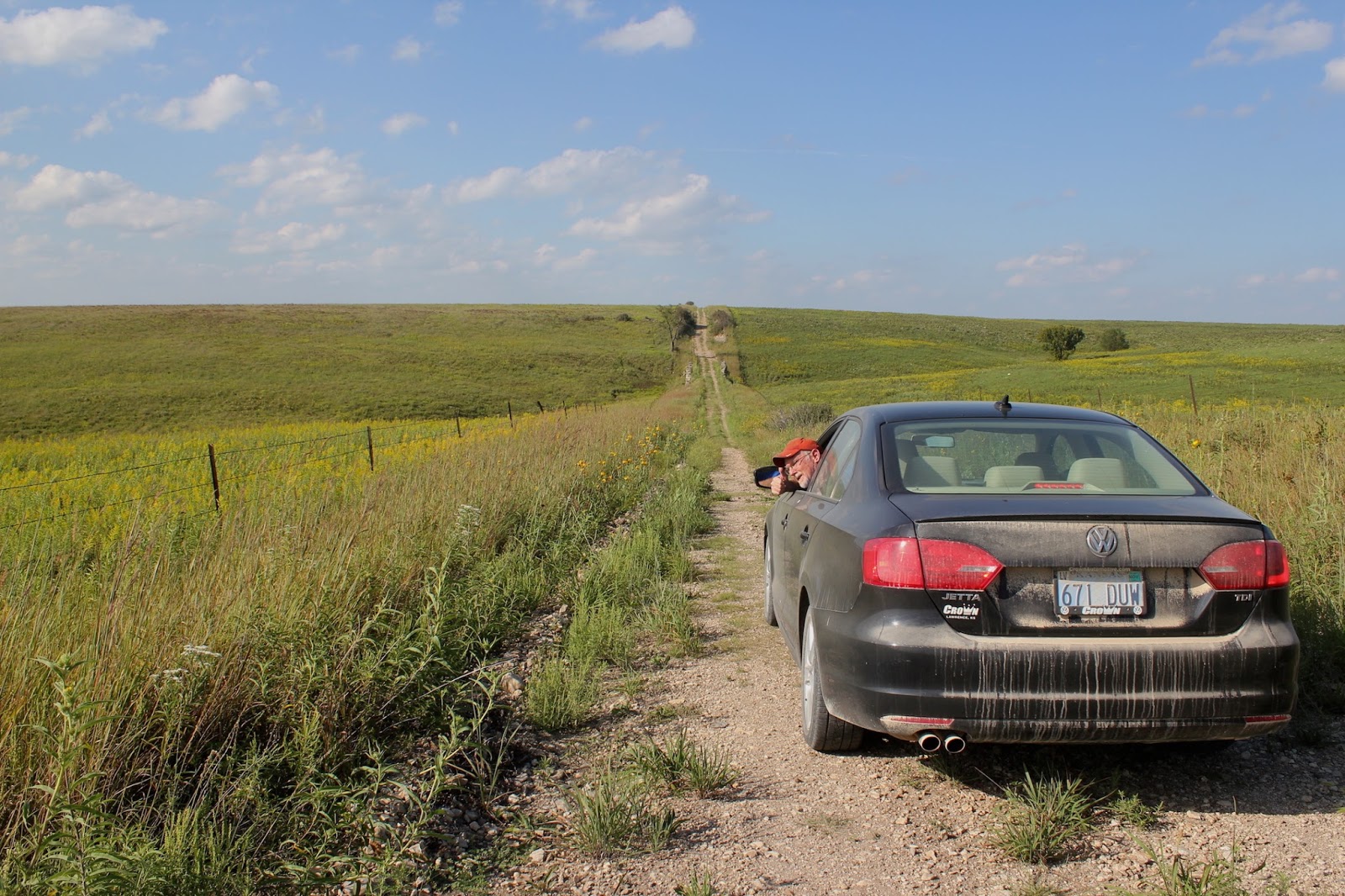
Exploring these out of the way places is something my husband and I enjoy for somewhat different reasons. His first love is herpetology, an affinity for reptiles and amphibians that I’ve grown to appreciate (but not fully understand) in the 28 years we’ve been together. He’ll jump at any chance he can get to cruise the back roads in search of snakes. Literally. Herping (aka snake hunting or road cruising) means slow drives on lonely roads punctuated by slamming on the brakes when you spot a snake in the road, leaping from the car, and chasing down critters before they slither into the underbrush just so you can oooh and aaah, take a few photos, and then release them back into the wild.

Butterfly on liatris.
His approach to these outings is more, um, energetic than mine. I like the scenery. The wildflowers half-hidden in unusual rock formations and the russet swathes of big and little bluestem grasses in the fall. A butterfly feeding on liatris. A stroll through woodlands or prairie at a pace well short of “hike.”

An additional benefit, for me, is the wealth of material I collect for my writing, from scene setting to character development. In August, our desire to escape for a day took us to Wabaunsee County in the northeastern corner of the state. At the Friendly Cooker, a diner where we had lunch, we eavesdropped on the folks around us (lots of characters in small-town diners!) and got the last two pieces of delicious strawberry rhubarb pie free because it was near closing time and the manager felt generous. We spent the rest of the day hiking a little-known prairie area managed by the Audubon Society, its path lined with boulders deposited by glaciers during the last Ice Age, and exploring roads most people don’t know exist.

The real adventure of the day came when we chose to follow a dirt “road” marked on our trusty Kansas Gazetteer but obviously little used. The farther along we drove, the narrower the road became and the taller the weeds. At one point, the weeds growing in the center of the road trail were taller than my car. Someday, that road will find a place in my fiction.

The "road" narrowed and the weeds grew taller on the other side of that hill.

What are your favorite roads less traveled?

Tuesday, March 15, 2016

Giving Voice to My Characters

In my stories, I often try to give voice to some people who live on the fringes of society and aren’t often featured in popular fiction.

Many writers put a great deal of imagination into creating characters, but I find I tend to use people I have known, and most of my characters are composites. I also draw on my background for most of my settings. I try to get into the protagonist’s head, put him or her in a setting with which I am familiar, and then sit back to see how the characters react to the situation in which they find themselves.

Because I have worked in a variety of settings, I am comfortable placing my characters as laborers or forklift drivers on the midnight shift in a steel fabrication plant, or operating a massive glass melter in a fiberglass manufacturing facility.

I have also worked supervising an inmate work crew in a large medium security prison and moved into teaching special education at inner city public schools and alternative schools, both public and private, and those settings show up, too.

The protagonist in my Jesse Damon crime novel series is not based on any one specific person. After twenty
years in prison on a murder conviction, he is released on parole, and finding it tough going just to survive. I draw on several of the young inmates who were assigned to my crew. Some prison counselors put a great
deal of thought into the institutional work positions they offer inmates, all of which pay in the neighborhood of a dollar a day. After I got a reputation for being a “mother” figure, I was often assigned people who had been convicted as adults for crimes committed when they were in their mid teens, and many of them told me their stories in great detail.
                                                                                                                                                                                                                              
Anthony was convicted of rape when he was fourteen. “I’d never do anything she didn’t want to do. She
was my girlfriend. But when she got pregnant, she told the preacher I’d forced her.”

“My sister was gonna tell my mom that I’d been drinking. I was so mad. I grabbed her by the neck and shook her. And then she was dead. Now I’m locked up. For life. My mom lost both her kids in one stupid minute.”

“I loved her,” Gilbert said. “I still do. But I was seventeen and she was only fifteen. Her father reported that I’d raped her, and she was afraid to go against him. As soon as she turned eighteen and moved out, she started writing me.” He showed me some of the letters, where she apologized to him for not having the courage to stand up to her father. But she didn’t offer to testify now, either.

“When I was a little kid, my dad would boost me through windows so I could pass stuff out the window to him. We did that for years. Then one time somebody was home when we didn’t expect it. I got caught. I never told them about my dad. They had my fingerprints from lots of burglaries. I waited and waited for my dad to come visit me in jail, or at least write me a note. I never heard from him again.”
                                                                                                  
Other people who cry out to me to be in fiction include my uncles, who came back from war traumatized. Despite some attempts of family to help them, they couldn’t hold down a job, became homeless and drifted into alcohol and drug dependency. And girls I knew who made poor choices in mates, marrying men who turned out to be abusive, to be told by their families, “You made your bed. Now lie in it.” People devastated by injury or illness, job loss or the dissolution of their family.

So many of these people do their best, just to try to maintain a reasonable life. And so many of them fail. I want to give their voices a chance to be heard.

How about your characters? Do you deliberately develop them, or do they spring from people who have been in your life?


Saturday, May 23, 2015

Location, location: choosing setting for books by Anna Castle


Stories happen somewhere in the world. Characters come from somewhere too. You might have to select a number of locations, all things considered, for your next mystery. You’ll spend a fair amount of time in your main setting, especially if you’re writing a novel. Why not pick a place you like?
This is a corollary to my take on the old adage, “Write what you know.” Better advice, in my view, is to write what you want to know. Follow your curiosity, your whims, and your fantasies. The enthusiasm will fuel your writing. Besides, you might need to visit that location for research. You might as well go some place fun.

Settings help define your genre. Cozies take place in small worlds, even if they’re nestled inside a big city. These will often be appealing locales, places the reader might like to visit. Noir has an edgy urban sensibility, even when the action takes place in darkest Montana. They take their readers into dark alleys and dangerous dens. Traditional private investigators can be found in every corner of the globe and even on board ships at sea.

Sometimes another factor will limit your location options. Francis Bacon was a real person known to have occupied specific places, so my historical series is constrained to London and environs. Alas, I have thus been obliged to spend weeks in that dreary backwater! The characters I invent myself come from Areas of Outstanding Natural Beauty. I’m planning ahead for future books and looking forward to some outstanding rambles.

When I can’t travel, I’m still OK with my UK setting, because the inhabitants of those green and lovely islands have posted pictures of every square inch on the Internet. Try Flickr for setting research. You might not be able to use the photos in your blog, but you can browse them for details for that one great, scene-setting paragraph. I use landscape changes to mark the passage of time, so I bookmark gardening sites and lists of seasonal produce in England sorted by month. Warning: you’ll find more pictures of beauty spots than mean streets in Flickr, although some of its contributors are pretty adventurous.

When I decided to write a cozy series, I went looking for my own small world. Since I enjoy academic mysteries, I considered my alma mater, the University of Texas at Austin. Unfortunately, UT has the population of a mid-sized city and its own police force; not exactly cozy. The social sub-cultures I inhabit didn’t ring bells for me, so I decided to follow in Agatha Christie’s far-reaching footsteps and invent my own small town. Now, where to put it?

Well, I like to hike. I love flowers and the beauties of the natural world. Lucky for me, I live on the eastern edge of the Texas Hill Country, with its charming old towns and spectacular wildflowers. Austin is a boom town, one of the fastest growing cities in America. Growth has its pros and cons... hey, conflict! Just what we need in our mystery novels! I decided to put my small town out at the western edge of the Hill Country, too far for a day trip from the big cities. All my characters have big dreams; now my town does too. Lost Hat wants to put itself on the map as a tourist destination, if only it can figure out an angle.

When you’re location shopping, follow your whimsy. You might start with this list of mysteries by location, although just because it’s been done before doesn’t mean you can’t do it too—and better. Then you can try searching for “Most popular destinations in Iowa” or wherever it is you want to hang out. Search for images of “San Francisco Tenderloin district” or “wine country France” in Flickr or Google images and zoom in on whatever catches your eye.

You could pull out your bucket list and pick a place you’ve been meaning to go. Traveling with a book in your head is enormous fun. But even if you’re only travelling by keyboard on the information superhighway, places that tickle your fancy will inspire you more than the ones that make you yawn.

Anna Castle writes the Francis Bacon mysteries and the Lost Hat, Texas mysteries. She’s earned a series of degrees—BA Classics, MS Computer Science, and Ph.D Linguistics—and has had a corresponding series of careers—waitressing, software engineering, assistant professor, and archivist. Writing fiction combines her lifelong love of stories and learning. Find out more at www.annacastle.com.

When the Internet service provider in a small town in Texas blackmails one client too many, murder follows. Photographer Penelope Trigg has to rattle every skeleton in every closet in Lost Hat to find the  killer and keep herself out of jail.