Showing posts with label Julie Tollefson. Show all posts

Sunday, May 27, 2018

Working and Reworking that Opening Number


by Julie Tollefson

I recently wrote the first 444 words of a new story. I love beginnings, when anything is possible. I find so much optimism in plotting murder.

That story has grown to 6,500 words and now has a middle, a climax, and a denouement. And I'm still polishing the beginning.

In January, Lin-Manuel Miranda, the genius behind the mega-hit musical Hamilton, tweeted:
Pro tip: You’re always working on the opening #. Everything you add: check back on that opening #. Accept it. This is a few days before we opened?

That tweet referred to one of his earlier tweets, from a decade ago, in which he said he “is, as ever, working on the opening number."

Now I'm in no way comparing my writing to Miranda's, but I do relate to the process. As my stories develop and I get to know my characters, I uncover themes that I can make stronger if I tweak the opening scene. I discover plot points that could be hinted at early on. Truths can be made clearer with changes in the beginning.

Sometimes I'll make the change as soon as I realize it's necessary, but often I'll make notes to myself so I don't break the current flow of words. A good friend of mine, though, has mastered the revise-as-you-go strategy. As a result, by the time she reaches "The End," her opening scenes are clean, tight, and a balance of tension and foreshadowing that pulls the reader into the story and keeps 'em there.

This same friend reacted in horror when I confessed that I love revision. For me, revision is writing. It's where themes become clear, logic falls into place, and story fully emerges. Revision is where I'm comfortable, where I feel most like a writer.

Last week, I sat at my favorite coffee shop (Hello, Myers Hotel Bar!) and reworked my first scene again. An hour and a half of concentrated writing/revising time later, I had a net word count of negative 22. But the resulting scene is so much better and I'm much closer to achieving the vision I have for this story.

This is my last regular post for Writers Who Kill. I've enjoyed the last two and a half years of sharing Sundays with Jim and hope to return in the future to make a guest appearance or two. You can still find me on Twitter (@jtollefson), the web (http://julietollefson.com), and Instagram (julie.tollefson). Hope to see you around! In the meantime, you can bet I'll continue to work on my opening number. 

Sunday, May 13, 2018

A Picture is Worth ...


by Julie Tollefson

In the past couple of weeks, my day job and my fiction writing worlds have collided in the best possible way. My colleagues and I at the Kansas Geological Survey are revamping our online photo library, and I’ve spent hours sorting through hundreds of photos of Kansas landscapes and other geology-related subjects, some of which date back decades.

It’s a task that dovetails nicely with my fiction writing interests. Kansas, the land and its quirks, figures prominently in nearly every story I write. Yeah, I know that when most people think of Kansas, they imagine fields of wheat and corn as far as the eye can see, flat and monotonous. But we also have plenty of unusual, out-of-the way places that inspire dark thoughts of murder and suspense. Over the decades, Survey photographers have documented many of these places.

Take this abandoned house on the High Plains, constructed in the 19th century from local limestone where wood was scarce. Suitable for dumping a body, no?


Or Waconda Spring. Looks like such a refined place, where ladies in summer dresses sip tea in beautiful gardens. But today? The spring is long gone, submerged under Glen Elder Reservoir. Makes you wonder what ghosts lurk there, eh?


The historical photos in the Survey’s collection are my favorite. The cars! The fashion! These guys in fedoras exiting a Pony Express Station in the mid-1960s—they could be old-timey gangsters.


Some of the images inspire with their ingenuity. Here, someone, um, recycled an old truck to secure the opening to an abandoned lead mine.


We have sinkholes…


…and landslides…


…and the occasional flood.


In short, the Survey’s photo archives are a treasure trove of inspiration, and there’s nothing I enjoy more than drawing on these places close to my heart to craft stories of suspense and mystery.

All photos courtesy of Kansas Geological Survey. To see more, visit our photo archives.

Do you have favorite places in your state that you think deserve wider recognition?


Sunday, April 29, 2018

A Good Night to Celebrate Mystery

by Julie Tollefson

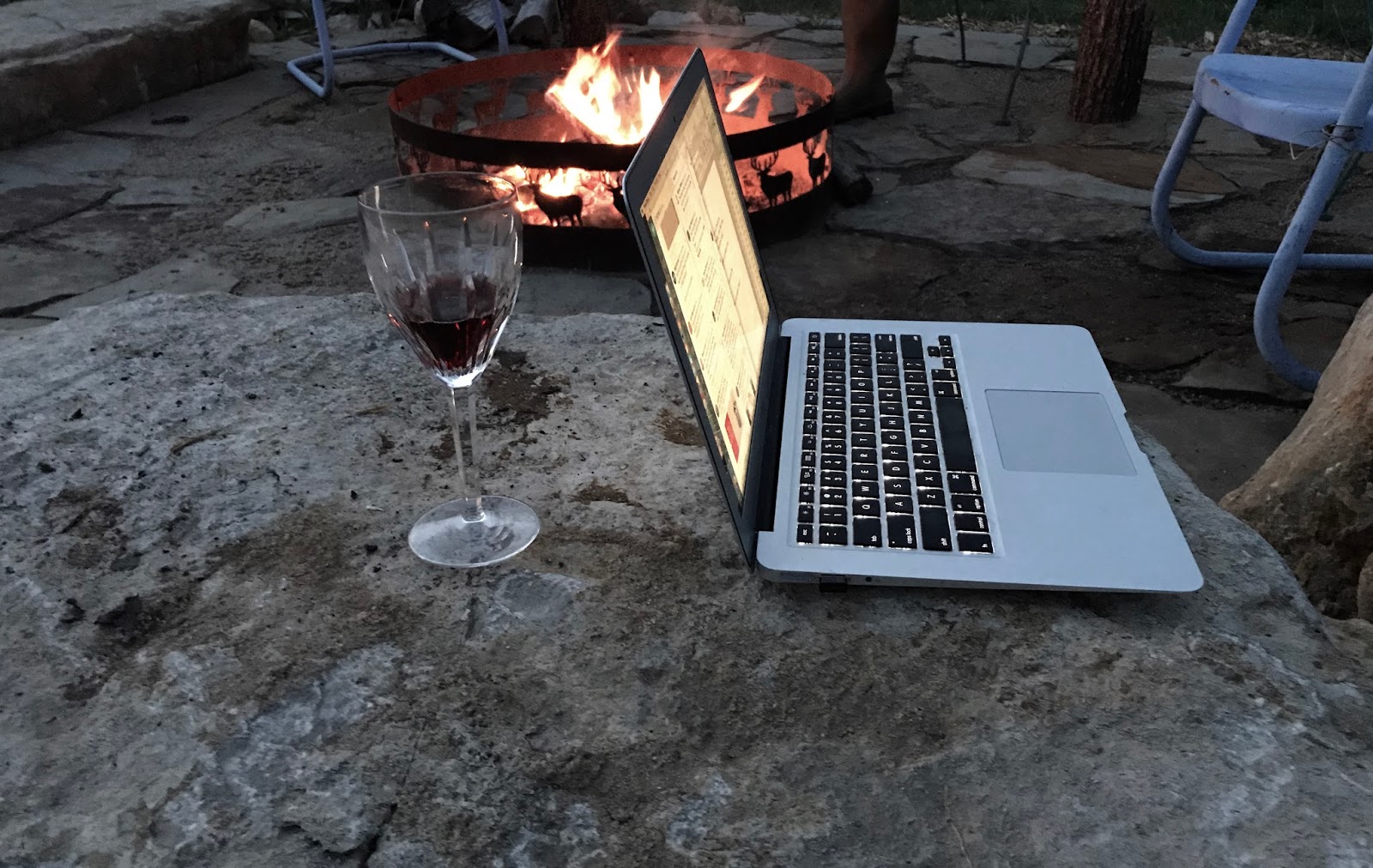
As I write this, the sun slips below the horizon and a wild chorus of coyotes rises so close I squint into the dusk half believing I will see them gathered at the edge of the field. Whippoorwills trill somewhere to the south, and turkeys call in the woods to the north. A pair of barred owls swoops low overhead, and one settles in the ancient locust at my back.

I’m sipping a nice glass of wine, and a fire crackles in the metal-ringed pit at my feet. It’s a very good night.

It’s also Edgars night, the annual fancy dress-up party where Mystery Writers of America presents the Edgar Awards to recognize the best in mystery fiction and nonfiction. Some day, I will attend the Edgars in person, but tonight, I’m keeping an eye on the action via Twitter.

I have a special interest in the awards this year. My favorite bookstore, the Raven in Lawrence, Kansas, received the Raven Award in recognition of outstanding achievement in the mystery field outside the realm of creative writing. As if that’s not cool enough, local father-daughter writing team Bill James and Rachel McCarthy James were nominated in the best fact crime category for their book The Man From the Train: The Solving of a Century-Old Serial Killer Mystery, in which they applied modern research tools to the really, really cold case of a traveling axe murderer.

Beyond these local connections, I had the honor of serving as a judge in the best novel category. What an experience! As part of my duties, I read widely—cozies, thrillers, suspense, police procedurals, the whole spectrum of crime fiction—and I can say with absolute certainty that mystery writers produced many fine works last year.

As the moon plays peek-a-boo through light clouds and the barred owl calls its mate back to the old tree, I appreciate the technology that lets me experience the magic of Edgars night virtually. The real deal—trip to New York, little black dress, high heels, and all—is part of my writer’s bucket list, but tonight I’m content to toast the winners from afar in sweatshirt-and-slippers comfort.

My most sincere congratulations to all of the winners and nominees of this year’s Edgar Awards. You can find the complete list here.

Sunday, April 15, 2018

A Midwest Writing Community

by Julie Tollefson

A few times a year, I get to write about writers for a local magazine. It’s one of my favorite assignments. In the last couple of years, I’ve interviewed award-winning science fiction authors, illustrators, poets, and short story writers. Their subjects and settings range widely through Kansas and fantasy worlds, small towns and big cities, quests and epic wars, sentient dinosaur skeletons and meatloaf. Here's a sampling, in no particular order:

 Kansas geography, politics, and culture play pivotal roles in shaping the characters in Becky Mandelbaum’s short fiction collection, Bad Kansas (University of Georgia Press, 2017). “In my experience, Kansas is a complicated place for people, especially younger people, who aren’t sure what the world looks like yet,” Mandelbaum told me. “It either pulls people apart or pushes them together.” Bad Kansas won the 2016 Flannery O’Connor Award for Short Fiction.

Kij Johnson’s The Dream-Quest of Vellitt Boe (Tor.com, 2016)—named one of National Public Radio’s Best Books of 2016 and finalist for a number of best novella awards, including the Hugo and Nebula—takes H.P. Lovecraft’s Dreamlands world and adds strong, powerful women lacking in the original.

The Queens of Innis Lear (Tor, 2018), inspired by author Tessa Gratton's frustrations with Shakepeare's King Lear, tells the story of the King's daughters as they prepare to fight to save their kingdom.

The young heroine in Mary O'Connell’s Dear Reader (Flatiron Books, 2017) believes it’s better to read about experiences than live them. But then her AP English teacher disappears, and disturbing clues appear in a copy of Wuthering Heights, magically transformed into a real-time diary of her teacher’s misadventures.

Karen M. Vaughn’s debut story collection, A Kiss for a Dead Film Star (Brain Mill Press, 2016), bends and warps reality in a style her publisher dubs “psycho-medical-magical realism.” The six stories, though very different, all explore aspects of loss. “It sounds odd,” Vaughn said, “but I almost feel like sometimes I write these stories to inoculate myself against possible tragedy and disaster.”

Good Seeds: A Menominee Indian Food Memoir (Wisconsin Historical Society Press, 2016) is Thomas Pecore Weso's account of family and food in north-central Wisconsin from World War II through the Vietnam era. We would be happier as a society, he says, if we make our meals ceremonial. "We need to sit down and actually eat real food, and we need to have real conversations while we eat real food," he said.

Marilyn Pollack Naron loves illustration, food, and writing, and all three converge in A Meatloaf in Every Oven: Two Chatty Cooks, One Iconic Dish and Dozens of Recipes—from Mom's to Mario Batali's (Grand Central, 2017). Naron illustrated the cookbook, written by Frank Bruni and Jennifer Steinhauer.

Thomas Fox Averill explores how everyday people contributed to early scientific advances as he tells the story of a 19th century woman who turns to fossil hunting after the death of her husband in Found Documents from the Life of Nell Johnson Doerr (University of New Mexico Press, 2018).

Miriam, a gifted cook and singer, wanders the American political, communal, and spiritual desert, from the 1960s through the late 2000s, in Caryn Mirriam-Goldberg's Miriam's Well: A Modern Day Exodus (Ice Cube Press, 2018).

What a lot of talent concentrated in our mid-sized Midwestern community! It’s a great place to be a writer. I hope you’ll check out the work of some of these authors and illustrators. Also check out Lawrence Magazine—each issue’s Bookmarks section features mini-profiles of three bookish people in the Lawrence, Kansas, area.


Who are the local writers and illustrators in your community?

Sunday, April 1, 2018

A 280-Character Theme-Based Writing Exercise

by Julie Tollefson

A few days ago, I searched my work in progress for any line that mentioned "rain." Nothing. My previous WIP? Nope. How about a recent short story? Uh-uh. Apparently, it does not rain in my fictional worlds.

Why so obsessed? I was looking for a line to fit the week’s theme for #1lineWed, a writing game on Twitter sponsored by the Kiss of Death Chapter of Romance Writers of America (Twitter handle: @RWAKissofDeath).

Writers of all genres are invited to play along, sharing a passage from their work that relates to the theme word. The catch is the snippet of work must fit within the 280-character limit of a tweet, with enough room left to add the official hashtag (#1lineWed) that helps others find your contribution to the game.

Some weeks are easier than others, I’ve found. On March 14, when the theme was “wind,” I had enough characters left in my entry to add a couple of other popular writing hashtags—#amwriting and #amwritingmystery:
She laughed, a music so light and bubbly the wind might carry it away. #1linewed #amwriting #amwritingmystery
The same for February 28 and its theme, “heavy”:
The owl called again, this time closer, more urgent. The beat of its heavy wings disrupted the air over her garden. #1linewed #amwriting
And February 21, “light”:
Early morning light, weak and tentative, filtered through branches still barren of leaves, though the swollen buds at their tips hinted at the coming spring. #1linewed
Other weeks take more thought and a bit of creative license to find a sentence or two that works with the theme word. For the March 7 theme, “earth,” I couldn’t find a single reference to earth that worked as an outtake for the game. But I stretched and found this passage:
Its architecture mimicked the limestone-capped bluffs of the region and created the impression that forces of nature—not man—had carved the castle on the hill, as it was known, from the land itself. #1lineWed #amwriting #amwritingmystery
Beyond the fun and challenge of playing the game, #1lineWed can turn into an exercise in revision. Though my search for “rain” turned up empty, the opening scene of a recent short story described a distant storm. The problem? No way would I be able to fit the 630-character passage into a tweet.

So I rewrote it a bit, lost some of the details that are important to the story but not for the tweet, simplified, deleted extraneous words, and came up with 277 characters that have the same flavor as the original passage but fit in the limited space of Twitter:
Far to the south, lightning writhed between & around black, anvil-topped clouds that towered over the High Plains. The storm promised a wild ride for anyone in its path. Here, though, she inhaled deeply, the scents of sagebrush & cattle, of heat & dust. Of childhood. #1lineWed
Though I’d revised and tightened the original passage a dozen times, I still found ways to streamline it for the #1lineWed exercise, and that’s valuable practice any day of the week.


If you’re a writer, how do you hone your skills?

If you’re a reader, do you follow Twitter games like #lineWed? Have you discovered new authors because they talk about their work online?


Find Julie on Twitter (@jtollefson) and Instagram (julie.tollefson).

Sunday, March 18, 2018

A Long Overdue Thank-You Note

by Julie Tollefson

A couple of weeks ago, I shared the stage at an Authors and Appetizers fund raiser with author Pam Eglinski, who writes suspense, historical fiction, and time travel novels. In one of life’s crazy coincidences, Pam’s late husband holds a special place in my memories as someone who changed my thinking and taught me to be a better writer.

Dr. Edmund Eglinski taught art history at the University of Kansas. His class introduced me to great artists and their work, but I remember him as the only professor in my four and a half years of undergraduate education to really teach me how to write a research paper. He reviewed my first attempt and gave thoughtful, comprehensive, direct feedback that showed me the right way to research and write an academic paper.

I never thanked him, in part because at the time, I didn’t realize what a rare and meaningful gift it was to receive such personalized, detailed attention.

Reminiscing about Dr. Eglinski and his influence on my writing brought to mind another individual who made a brief appearance in my life forty years ago. (Oh, my, where did the decades go?) She was a student teacher in my eighth-grade English class, and if memory serves, she only worked with us for a few weeks. But what a lasting impact!

In the most memorable assignment of that period, she asked us to write an essay describing a basketball. I thought the assignment was stupid, and I “forgot” to do it until I panicked about 15 minutes before class. (I’ve always been a rule follower. Skipping class, missing assignments, getting any grade lower than an “A” gave me massive anxiety.) I scribbled something along the lines of “round, orange, with black lines” and turned it in. I knew it wasn’t my best work, but really, the assignment was ridiculous.

Our student teacher, though, as yet too new to the profession to give up on uncooperative, difficult, know-it-all teenagers, pulled me aside for a one-on-one chat about my work. She knew what I was capable of as a writer, she said, and the basketball essay didn’t even come close. She gave me a second chance and guilted me into taking it.

So I sat, with a basketball in my hands and ran my fingers over its uneven surface, its original bumps worn smooth in patches by thousands of bounces on the concrete driveway. I smelled it, dusty and musty and maybe a hint of dog poop from when it bounced astray? I really looked at its color, which wasn’t uniformly orange after all.

Then I wrote a detailed, almost poetic, description about that basketball, and I learned a few things about writing:

1. Don’t settle for easy. My best writing is never easy.

2. Look beyond the obvious and superficial. Sure, a basketball is orange and round, but it might also be a symbol of love between father and daughter who bond over March Madness or a symbol of loss, deflated and abandoned in the weeds beyond the edge of the court at a neighborhood park.

3. Question perception. To me, the assignment was a waste of time, but our student teacher (I wish I could remember her name!) turned it into a lifelong lesson.

4. Writing is rewriting.

All writers have long lists of people to thank for helping them along the publishing path. These two—Dr. Eglinski with his commitment to showing the right way to approach academic papers and a student teacher who refused to accept shoddy writing—gave more than they had to and inspired me to be better as a result.

Who are the people who influenced your life? Have you thanked them?


Sunday, March 4, 2018

One Small Step

by Julie Tollefson

Last week, I had the honor to be one of the featured authors at Authors and Appetizers, a fund-raiser for the Lawrence, Kansas, chapter of Altrusa International. The Lawrence Altrusans support several literacy projects in our area, including a program that gives a new book to every baby born at our local hospital.

I talked about my writing—both fiction and nonfiction—but I also talked about taking risks and overcoming fear to become the person you want to be. I thought I’d share an abridged version of my comments here, too.

I’ve been writing in some form or other as far back as I can remember. In second grade, my apparently cat-obsessed seven- or eight-year-old self wrote an impassioned defense of my kitten and hinted at the kind of fiction writer I would eventually become. I wrote, in part
I think the badist cat there is is a cat napper…So my cat is not bad at all. Oh mother my cat is not bad. A cat napper is the badist one of all. So they are. So they are.
Oh yeah, crime fiction has always been my jam, and I was an early master of padding the word count, a skill that served me well in college.

But my professional writing career began in the nonfiction world of journalism.

I landed my first paying writing gig the summer after I graduated from high school. The Garden City Telegram hired me to type up wedding announcements and society column notices, but the editor also gave me the opportunity to write human interest stories. I remember how proud I felt that summer. I was a “real” journalist writing real stories for a real newspaper.

These stories represent the very beginning of a theme that runs through almost all of my writing even today, in both fiction and nonfiction, and that is a love for this state, from the dry southwest corner where I grew up to the northeast region where I live now, and especially for the people who live here. One thing that summer taught me is every person has a story.

In 2011, after a lot of years of thinking about it but not doing it, I decided to try my hand at fiction. In January that year, instead of making resolutions I wouldn’t keep, I adopted “risk” as my “word of the year,” a guiding concept for stretching beyond my comfort zone. A couple of months later, the Guppy chapter of Sisters in Crime, an international organization that promotes women crime fiction writers, announced that submissions were open for its second anthology of short stories. As the deadline approached, I took a deep breath, hit send, and “Keeping Up Appearances” was one of 22 stories accepted for publication in Fish Nets: The Second Guppy Anthology.

This was huge for me. It was the first piece of fiction I finished. The first piece of fiction I submitted for other people to read. And the first piece of fiction accepted for publication.

And oh my gosh. This fiction thing was a piece of cake, right?

Well, it’s been seven years. In that time, I’ve finished writing a novel that has been nicely rejected by a bunch of agents, and I’ve submitted a dozen or so short stories to different publications, of which four have been published.

And I’ve kept writing, both fiction and nonfiction.

For the last 14 or 15 years, I’ve written regularly for Lawrence Magazine. Like my early Telegram days, Lawrence Mag gives me an opportunity to meet people in our community and tell their stories. The nonfiction work gives me insight into people and places in a way that sitting all day in an office does not. In one of my favorite Lawrence Mag stories, I profiled Thomas Burns, a commercial fisherman and self-taught naturalist who spent years studying the Kaw River and the big catfish that inhabit it. I read his first-person accounts of his life, interviewed his family and friends, and pieced together a picture of a man who loved the river, loved fishing, and, for much of his commercial fishing career, ran afoul of Kansas laws that banned some of his techniques. Evading the law became a game for him. His daughter told me he was a little bit ornery.

But later in his life, the same wildlife officials who tried to curb his illegal fishing turned to him for help when they wanted to understand more about his fishing methods and the river that has always played such a large role in our community.

This story of the complicated relationship between Burns and law enforcement fascinated me and provided a huge real-life lesson for my fiction writing: Good versus evil is a false dichotomy. The best, most interesting characters have layers—some good, some bad. Those shades of gray give a story depth.

You see that love for Kansas that runs through my writing most clearly in my nonfiction, in stories like my profile of Tom Burns. It’s less obvious in my fiction, but it’s there, woven into the fabric of the stories. The opening paragraphs of the novel I’m working on now, tentatively called In the Shadows, grew from many days spent hiking in and exploring Kansas state parks, and then twists those experiences into something dark and dangerous. The first couple paragraphs:
Detective Jameson Brunson examined the scene as he would an Old Master painting. In a dark palette of muted browns and grays, damp tree trunks crowded the site. Early morning light, weak and tentative, filtered through branches still barren of leaves, though the swollen buds at their tips hinted at the coming spring. The air, too, smelled of spring, that peculiar mix of dew and decay that, if odors were colors, would be a shadowy “almost green.”
 One tree, a sycamore, stood out from the rest. Beneath its peeling bark and white trunk, the still form of the girl lay on her back, fully clothed, legs straight, hands folded on her chest. Her long blonde hair, tipped in red, fanned out from her head like a golden halo in a renaissance portrait of the Madonna. She looked peaceful, Snow White in the forest. Except Snow White lived happily ever after, and this girl would never laugh or love again.
I ended my comments to Altrusa with the backstory behind my family’s trip to Australia in the summer of 2016: My mother-in-law was diagnosed with stage 4 ovarian cancer in 2004. One afternoon at hospice, she told me that though she had little interest in travel herself, she regretted that she’d never sent my husband to Australia, a place he’d wanted to visit since he was little. She caught me off guard, so I stammered, “Don’t worry. I’ll make sure he gets there. I promise.”

Now at the time, we had a five-year-old and two busy careers and oh yeah I’m terrified of flying. A trip to Australia seemed totally undoable. But the promise was always there in the back of my mind. Fast forward 12 years. We were getting ready to celebrate our 25th wedding anniversary, and Jake was about to graduate from high school. We told him we’d take him on a trip to celebrate and asked him where he’d like to go. The first word out of his mouth was “Australia.” He didn’t even hesitate.

The promise had come due.

We packed our bags, flew 17 hours to Brisbane, and set off on a three-week adventure Down Under. And it was the best risk-reward undertaking ever. From driving a Barbie car around Magnetic Island, where we saw a koala in the wild, to dinner at the Sydney Opera House to hiking eight miles to see aboriginal art on the sandstone cliffs in Carnarvon Gorge to feeding an orphaned baby kangaroo on a 120,000 acre cattle station in the outback, it was a fabulous trip. I’ve never been happier to keep a promise.

And that brings me back full circle, to the rewards of taking risks, to overcoming fear to live your best life. From submitting that first short story to getting on that plane, the most meaningful moments begin with one small step.

Sunday, February 18, 2018

Books and brews for literacy

by Julie Tollefson

On Wednesday, I have a date.

It’s a first for me. A local civic organization asked me to participate in its third annual Authors and Appetizers fund raiser as a featured author. I get to talk about my writing and hang with people dedicated to promoting literacy in our community. What an honor!


Books and Brews: Short Fiction Picnic Pack.
The organization, the local chapter of Altrusa International, has served the Lawrence, Kansas, community since 1951. Members support a number of community literacy efforts, including my favorite: Born to Read, in which every baby born at our local hospital receives a new book. More than 15,000 babies so far have taken home books courtesy of Altrusa.

The fund-raiser part of the Authors and Appetizers festivities includes a silent auction, and when organizers asked me to contribute I happily agreed. In the months since their request, I’ve thought long and hard about what to donate. I wanted to create a basket or package of items that would represent my writing and would tie into the themes of the talk I intend to give: the beauty of Kansas, travel, nature, and how combinations of those elements appear in both my fiction and nonfiction.

I settled on what I’m calling Books and Brews: Short Fiction Picnic Pack consisting of a small soft-sided cooler, a water bottle and a couple of coozies celebrating Kansas wildlife and parks, plus copies of the four publications in which my short stories have appeared: Flash and Bang: The Short Mystery Fiction Society Anthology, Fish Nets: The Second Guppy Anthology, and two issues of Alfred Hitchcock Mystery Magazine. (And just to make sure someone will bid on it, I’ve included a six pack of craft beer from the first legal brewery to open in Kansas after Prohibition.)

Now comes the hard part: Talking about myself. Wish me luck!


Sunday, February 4, 2018

Risk and Reward and the Writing Life


by Julie Tollefson

Facebook recently reminded me that it’s been a little more than two years since I joined Writers Who Kill and made my first post. I wrote then about risk and reward and how I’ve grown more comfortable, little by little, with taking chances, at least when it comes to my writing.

The message is still relevant, now more than ever. Sometimes, the writing life feels like one step forward and two steps back. In the two years since I joined this blog, Alfred Hitchcock Mystery Magazine bought one of my short stories. Another magazine rejected two more.

As I was thinking about the nature of publishing and the persistence it requires of a writer, I glanced through the acknowledgments of my book club’s January selection, Homegoing by Yaa Gyasi. The novel is an epic, amazing tale that traces many generations through two branches of the same family, one in Ghana and the other in the United States. In her acknowledgments, Gyasi thanked a number of organizations and individuals for supporting her work on the novel over seven years. Seven!

It’s easy to become mired in the negatives—the rejections, the days when the words simply will not flow. Most of last year was not a great year in my writing life. My creativity took a serious hit from the one-two punch of the presidential election followed too closely by my son’s car accident one year ago today.

But I kept writing. Though most of my words fell flat and colorless on the page, I continued to revise and rework and rewrite until something shifted. By the end of the year, I felt like I’d emerged from many dark months of creative hibernation. I began to feel confidence in my writing again and finished a couple of short stories and a novel-length manuscript.

I believe 2018 will be even better, even more productive. I am, deep down, an optimist, and I believe that every turn through the submission-rejection-revision-acceptance cycle of publishing makes me stronger, as a writer and as a person. It’s part of what motivates me to keep writing every day, to continue to take chances, to persist when it would be easier to quit.


What motivates you when you face challenges and barriers to your goals?