Showing posts with label Genres. Show all posts

Monday, June 8, 2026

How I Landed in Cozyworld: A Guest Post by Manju (MJ) Soni

I met Manju Soni through our wonderful Sisters in Crime Connecticut group. Please join me in giving her a warm welcome to Writers Who Kill and Cozyworld. -- Shari Randall

HOW I LANDED IN COZYWORLD BY MANJU (MJ) SONI

I first began writing after signing up for a weekly personal essay class I saw advertised in our local community newspaper. My writing teacher, Beverly, was a quixotic woman in her mid-seventies with a perfect bob and the throaty voice of a chain smoker. She was a voracious reader consuming two books a week and was a cancer survivor, with an incredible memory in spite of surgery for a brain aneurysm. 

As a doctor under apartheid, a system of legalized racism in South Africa, I had seen so much suffering I found I couldn’t get past it when writing. I constantly veered toward writing about patients I had encountered. Like the young mother who had third degree burns from a paraffin stove explosion because they had no access to an electrical grid. She refused to allow her three children, the youngest a toddler, to see her for almost six months as she recovered because she didn’t want them to see her so bandaged up. Or the many young men blinded by riot police shrapnel, and, on a happier note, the old man from a village who gifted my colleague a cow for restoring his vision after cataract surgery. 

Every piece of fiction I wrote seemed trivial and self-indulgent. 

Under Beverly’s kind and sometimes stern guidance, I wrote my part-memoir, nonfiction book DEFYING APARTHEID. I believe it was therapy for the years of subclinical post-traumatic stress syndrome from growing up under an authoritarian regime. 

I then turned my hand to fiction. At first I wrote thrillers, then psychological suspense novels, and then domestic suspense. But none of these went anywhere in spite of my signing with an agent. 

Finally, frustrated, I parted ways with my agent and decided to write something I enjoyed. A plain old mystery with a cast of characters I’d like to see in my own homogeneously white coastal New England town. The latest census says one percent of our town is Asian American, and I know all ten of us!

The result was my debut, THE MASALA CHAI MYSTERY CLUB, due to be published in July 21, 2026. In their starred review, Library Journal said, “This multicultural and multigenerational novel has intrigue, heart, and excellent storytelling that is perfect for readers who enjoy the ’Detective Aunty‘ series by Uzma Jalaluddin or Jesse Q. Sutanto’s Vera Wong and 'Aunties' books.”

When I began to submit my manuscript to agents, I had no idea it was a cozy mystery. I didn’t know this sub-sub-genre existed. But then I hit it lucky with my second agent who during our first call said she liked it because it was a ‘new cozy.’

Looking back, my debut has all the elements of a cozy. The murder takes place off screen. My protagonist is amateur sleuth Neeti Shah, a librarian who has been pushed into early retirement. She wears a saree and teams up with a community of quirky characters to solve the murder of their nasty homeowners association president, which resembles the murder in their latest book club read, THE DUMB WITNESS by Agatha Christie. And there’s chai, appetizers, a cute kid, and an equally cute dog. 

I realize now, trying out various genres is not uncommon. Finding that bridge that connects what one writes with what publishers want to publish is a test of resilience and determination. 

So that’s how I landed in Cozyworld, and I absolutely love it. I attended my first Malice Domestic this year and was blown away by how friendly and welcoming everyone was. It truly is an amazing community of very kind and helpful fellow authors. 

Thank you for having me, and I’m looking forward to this journey of being a cozy author with all of you. Please let me know whether your journey to Cozyworld was as zigzag as mine or as straight as an arrow.

Manju (MJ) Soni grew up in South Africa and wrote DEFYING APARTHEID, a part-memoir, about being a doctor/activist under apartheid. Since then, drawing on her American, African, and Indian background, she's written mystery short fiction. Her debut cozy mystery, THE MASALA CHAI MYSTERY CLUB, which is full of heart and humor, with a saree-wearing librarian protagonist, will be coming out on July 21 with Crooked Lane Books. Preorder here: https://tinyurl.com/2w74j2c4 

Saturday, January 21, 2023

But Is It A Mystery? By Sharon L. Dean

I’ve published two traditional mystery series that I’ve marketed as whodunits or cozy mysteries. Is it a mystery if an author doesn’t kill a character? I argue that there are lots of ways of killing.


On March 28, 2022, I published a piece in Mystery and Suspense Magazine called “The Classics are Mysteries, Too.” Although my fiction will never become a classic, like the books I wrote about, all of the pieces in my new collection Six Old Women and Other Stories are mysteries, though in some I’ve killed no one. What are the backgrounds of my six ninety-three-year-old women in the title story? They’ve chosen to live together on an isolated island. They’re old. How will they die or how will they live in this new environment that they know will be their last exit? Questions get raised in the other pieces in the collection. What happened at that lakeside resort nearly seventy years ago (“Shuffleboard”)? What happened thirty years ago on Cannon Mountain (“Hardscrabble”)? What prompted an old woman and an old man to become recluses (“Pavlov’s Puppies,” “The Man Who Loved Cribbage”)? Can a book be a mystery even if there’s no crime to solve?


Novelist Bobbie Ann Mason once wrote that "a scholar is a version of a sleuth." That was certainly the case when I edited a collection of letters by the nineteenth-century writer Constance Fenimore Woolson. Where would I find the letters? How would I date so many that had no dates? How would I identify the names of so many people, both well-known and obscure? What was Woolson’s relationship to these people and to the events of her world? These were mysteries. I solved many and left others unresolved, especially the mystery of whether Woolson accidentally fell out of a window in Venice or jumped to her death.


I have two outlier novels. Leaving Freedom will be reissued in 2023 by Encircle Publications. It’s a quest novel that was generated by my academic work on Constance Woolson. It has elements of mystery­­––where does my Connie’s mother get a scar on her stomach? What happened to Connie’s Uncle Charlie? The sequel, Finding Freedom, will be even harder to categorize. It’s a last-chance-for-adventure novel as Connie, now eighty years old travels across the United States alone to decide if she should move back to the town of Freedom where she was born.


Think about Moby-Dick for a moment. It isn’t just a sea yarn as Melville originally conceived it. It’s a story about the hunt for the whale Captain Ahab sees as a villain. For him, Moby Dick is the incarnation of evil. But the whale is more than that. He’s a physical representation of the inscrutable universe. He’s a mystery just as the universe and our lives in it are mysteries. Melville is a writer who kills––everyone except Ishmael and the whale.


I don’t like to get locked in genres. I like to let them bleed into one another. I don’t like to go into a bookstore and find a separate section labeled “Literary Fiction.” Mysteries, whatever the subgenre, can be literary fiction as well. Whatever Six Old Women and Other Stories is, I’ll make Amazon happy and categorize it as a mystery and as a collection of haunted stories.


What do you want in a book for it to qualify as a mystery?


Six Old Women

Six old women living on an isolated island in Lake Winnipesaukee, teenagers vacationing on Newfound Lake in 1959, paragliders and skiers on Cannon Mountain, an old woman in a house covered in gypsy moths, a man living off the grid in a shack he built himself. The characters in these stories all keep secrets. They are as tough and rugged as New Hampshire’s iconic Old Man in the Mountain. And like The Old Man who fell in 2003, their pasts survive only in memory. Sometimes that’s a good thing.


Sharon L. Dean grew up in Massachusetts where she was immersed in the literature of New England. She earned undergraduate and graduate degrees at the University of New Hampshire, a state she lived and taught in before moving to Oregon. Although she has given up writing scholarly books that require footnotes, she incorporates much of her academic research as background in her mysteries. She is the author of three Susan Warner mysteries and of a literary novel titled Leaving Freedom. Her Deborah Strong mysteries include The Barn, The Wicked Bible, and Calderwood Cove. Dean continues to write about New England while she is discovering the beauty of the West.

Saturday, January 22, 2022

A Cause to Celebrate by Kait Carson

I consider myself a fiction writer. Currently I spend my days drafting devious plots and killing people (in books and stories). I’ve dabbled in romance, and am noodling around with a paranormal plot.


My adult writing life began with none of these. It began with responding to a call from Chicken Soup for the Soul[1]. They were seeking essays on—dare I say it—menopause. This was back in the days when Jack Canfield was involved with the franchise and Soup books were on everyone’s gift list. That was followed by a sale to the Cup of Comfort series. In my case, Cup of Comfort for Cat Lovers[2]. Both books were published in 2008 and they gave me the confidence to think I could do this writing thing I loved so much.


I soon morphed into fiction writing and then life, and a fuller than full-time job got in the way. It’s been a while since I’ve published anything new. Been writing, just not moving ahead from there. With the arrival of the pandemic, my day job departed. I returned to full-time writing. Here’s the deal with that: 1) it takes a while to write a book 2) writing is like a muscle. Use it or lose it. Oh, it comes back, but I’m the first to admit that my initial drafts were hot messes. I’m getting better now. And having fun again, but I admit to an initial crisis of confidence.


Enter my husband. He innocently came into my office to find out what all the moaning was about. I talk to myself? Do you? Wait, maybe I shouldn’t admit that. Oh, too late. Anyway, my office walls sport the covers from both the Chicken Soup and Cup of Comfort books. After listening to me rant for a bit, my husband pointed at the framed covers and asked why I didn’t write some short essays again. “You know,” he said, “to get your feet wet.”


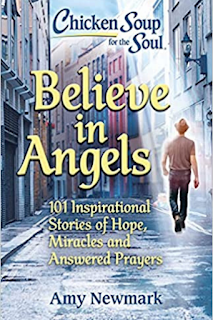
The Cup of Comfort series is now a Simon & Schuster imprint. They may do submission calls, but I wasn’t able to find any. Chicken Soup, on the other hand, has a robust webpage, and it lists multiple submission calls. One topic, Believe in Angels appealed more than the others. I had been touched by an angel when I was in college. The episode probably saved my life. I wrote the essay in one sitting. A few months later, I received an email accepting my essay. The book is releasing on Monday, and if you are so inclined, you can order your copy here. Truly, a cause for celebration!


[1] Written as Kim A. Hoyo

[2] Written as Kim H. Striker


Saturday, October 23, 2021

Genre Swapping by Kait Carson

I’ve been a published author for a long time. Back when the earth was cooling, I sent a letter to the editor of my local paper. I was thirteen at the time, and the paper published it. That led to my receiving a letter from a literary agent. Times were different then. Agents came looking for writers. I knew a good thing when I saw it, and I signed. My parents weren’t involved in the contract, and the agent never knew my age. I had no idea that the arrangement was less than binding.


That contract led to my writing short stories and being published in the teen magazines of the day. Seventeen, Ingenue, and others I can’t recall. All featured what I called my pink and white stories. Why pink and white? They were romances. I was an avid mystery reader, but a prolific romance author. I had a blast. I wish I could find copies of those stories today. They were written under multiple pseudonyms. Not because they had to be, but because that was part of what I thought an author should do at the time. To this day, I’m not sure why my agent never questioned my multiple personalities.


My agent passed away when I was in college. It was also about that time that I stopped writing for publication. It was the 1970s. Change was in the air. Living life was a more immediate need than writing about it. I didn’t put pen to paper for another twenty years. When I did, I discovered two things: short story writers did not need agents anymore, and writing novels was far harder than it looked. At this point, I was reading romances. My first attempt at a novel was a romance. It’s titled Caribbean Knights and it lives under my bed. I visit it occasionally. It’s right next to Circumstances of Death, a romantic mystery. There’s a trend here. The novels never sold. Nor should they have. They were definitely training attempts.


Computers and the Internet were gaining traction at about the same time. Although Facebook and other platforms were still in the future, writers’ groups were developing. It was through a writers’ group that I learned about True Confession magazine. Romance stories with happy, or at least satisfying, endings. Five thousand words or less, please. What, you thought those stories were true? Well, they were, for someone, somewhere. Those that I wrote were all based on at least a kernel of fact. They were fun because they were not bylined. There is something freeing about anonymous authorship.


Now that I was writing again, it seemed that every time I passed the seven thousand word mark, someone died. And not in a good way, either. This romance short story writer had morphed into a mystery/crime novelist. The transformation was handy, since that’s what I was reading. When I learned of NaNoWriMo (the National Novel Writing Month), I decided to try my hand. I wrote the requisite fifty-thousand words during November and refined it for the next three years. The book finally became Death by Blue Water and Henery Press published it in 2014.


There have been a few more books since 2014. Some published, some not. Although they qualify as traditional mysteries, I haven’t forgotten my romance roots. Each of the books features a romantic interest and subplot. These days, I’m considering seeking a literary agent. Very different to my first agent experience. I’m also toying with the idea of writing short romances again. Although the Trues are long gone, there are lots of anthology opportunities. Sometimes it’s fun to explore the joy and wonder of new relationships and bring them to a happy-ever-after ending without anyone dying.

Saturday, June 10, 2017

Murder on the Mind By Joan Leotta


As a writer who hops from genre to genre, looking at my resume will not necessarily provide a clue to my first love in both reading and writing. For that information, you would have to hack into my library card information and television-viewing schedule to learn that mysteries rank number one with me.

What do I find so fascinating about mysteries? Is it the lure of the puzzle? Partly. My preference is for the character-driven mystery, often with a dash of history thrown in--thank you, Ellis Peters and others. I read the more literary efforts of Louise Penny and PD James right along with the popular, less "arty" novels. The way characters confront one another, how they obsessively note minutia, and pile up a trail of clues, fascinates me.

Short stories, I adore them! From bits and pieces on the web to magazines such as Ellery Queen, (to which I aspire) SinC anthologies (made it into one!) and overmydeadbody.com and Kings River Life (both of which have been very kind to my work). I am usually reading at least one mystery along with whatever else I am reading. On the other side of the pen, I am also usually writing or revising at least one mystery story or flash along with whatever else I am writing. At any one time, I usually have four documents in play—a non-fiction piece (food article or CNF), a poem or two, and a piece of writing for children. I usually find that working on the mystery stokes the fires of the other writing in positive directions. Here is what I have observed:

Children—It’s the mystery's demand for action and surprise that fuels my efforts. I write for children, whether it is picture book script (fiction or non-fiction) or poetry,  (all of which I have successfully published in magazines and pictures books; I even win a short story award for a middle grade story). Children are a demanding audience and a writer needs to keep the movement pulsing! In Rosa's Shell, I have a moment where the reader has to wonder—will her Dad be able to help her or not?

Non-Fiction—Writing mysteries puts a large premium on the logic of things. Whether the order is chronological or some other, the internal logic of the piece is sacrosanct. A non-fiction piece in journalism answers, who, what, when, where, and why—and so does a good mystery!

Fiction—"What if?" is the question I add when turning a situation into fiction. Sometimes the pieces I write as non-fiction find their way into my fiction, and sometimes I am inspired to write a piece on an aspect of an issue or piece of history that I researched for my mystery. When did I start doing this? Well, take a look at the little girl recovering from chicken pox. She is working on a little assignment for school that will turn into her first attempt at a mystery.

Romance—This is a popular pairing with mystery. No wonder! Much of romance is about discovery, the very foundation of mystery (discovery of the crime, discovery of who, how, and why they did it)
and more. When I am stuck in a romantic adventure, I think about those elements of mystery to jump-start my efforts. Uh, don’t look for much sex in my romances—I'm strictly a sweet, one kiss, and then marriage writer.

Poetry—no, I do not write crime ballads or mystery poems. But the careful selection of words—and murdering of my favorite when revising—this is the way mystery informs my poetry. The importance of the smallest thing, the deeper meanings behind a simple bite of bread, a sunset, a sunrise, all of this the epiphany of the small, the insights of the small (often a key element in mystery writing). Then again, there can be a more direct connection since while I was writing this, a friend posted on FB that she was researching bloodstain patterns for a poem! Most of the red in my poetry (and other genres) comes from red ink spilling out onto the page as I murder favorite phrases and words.

Joan Leotta is the author of ten books in print, four historical romances (light mystery) that can be read as young adult or new adult  in the Desert Breeze  Legacy of Honor Series, a collection of award –winning short stories, Simply a Smile and four picture books, Whoosh! that tackles fathers and daughters and the importance to a child of time spent with parents, Summer in a Bowl , Rosa and the Red Apron (both of these  deal with children and cooking and children and reading), and Rosa's Shell, a father-daughter beach book.
You can follow Joan on Facebook

Tuesday, November 12, 2013

What Is It?


I’ve worked intermittently on my current novel, Toasting Fear, for a few years. In the meantime, I’ve written and placed many short stories and worked on two other novels. As many of you know, I worked with a critique group while developing Toasting Fear’s first draft, which I’ll never do again since it took too long. I put Toasting Fear on a shelf for a while pondering what I’d do with it. But it wouldn’t leave me alone. Why couldn’t I get it to gel?

Categorizing it gave me fits. At first, I called it a paranormal cozy. There were a few cozy elements but then perhaps not enough to categorize it as such. Then, I realized that in the literary world supernatural and paranormal were two different categories. So, I switched and called it a supernatural, romantic mystery. Unfortunately, there were few spooky moments since I don’t have ghosts. I have angels who refuse to haunt. But there were horror scenes because my angels were battling demons. How could I ever sell this to an agent when I could decide what I was writing? 


At the beginning of the summer, I started reading it again. Then, I started revising. Once I felt confident in the plot, I started wordsmithing—perfecting and polishing. When a new critique group formed from my local writing chapter, I decided to take the plunge and put it out for beta readers.

I must admit, although I made a few grammatical blunders (killer modifiers) that one former English teacher and critique partner caught, the manuscript wasn’t dotted in red. They complimented me on the details, the scenery and characters. I felt good about my efforts except for one thing.

Most of my reviewers couldn’t decide what it was either. After a discussion with one of the reviewers, we concluded that it was an action-adventure. Then another reviewer thought it was a thriller. After researching the structure of thrillers, I admit that supernatural thriller most closely resembles my book.

I did not intend to write a thriller. I shoulda, coulda, woulda written a traditional or a cozy, but the damn muse led me astray. Now that I know what it is, I must revise it to conform to that genre’s structure. The sound you hear is my head knocking against my office wall. I’m a mystery writer—really! 

Monday, October 29, 2012

Unavoidable Genre Blending


I’m not a horror fan, but I find myself constantly running to Edgar Allan Poe as a reference in my writing. There are scenes in mystery writing that require elements of horror. Just as romance is a common element in mystery supporting a subplot, horror, I think, is the second most common genre that is blended with mystery. Not until I took a course in which I submitted my synopsis and the instructor commented on its horror elements, did I realize what I was writing. Consider writing the following scenes without an element of horror.

·      Your protagonist is being chased by the villain
·      Your unsuspecting protagonist finds a body in an unlikely place, charging the atmosphere
·      Your script includes the death scene from the POV of the victim
·      You present the mental state of villain, who is an unlikely murderer
·      Your protagonist realizes the identity of the unlikely murderer, someone who maybe near and dear.

When a writer blends romance or horror into a mystery script, he adds emotion. Mysteries are rather analytical by nature. The sleuth discovers facts, which leads him to supposition until he finds incriminating evidence or entraps the villain using a variety of methods. Action-adventure can be added, but aside from a rush of adrenaline, this ingredient adds little emotion. It may put a character in a dangerous situation, but when the danger is shown and experienced, horror techniques better demonstrate the character’s emotions.

Poe’s techniques are similar to what is now called “deep POV.” When writing a scene, the writer must get inside a character to show his visceral experience, real or imagined. Remember Poe’s “Tell-Tale Heart,” in which the protagonist can hear the victim’s beating heart, driving him crazy. Poe shows his protagonist’s deteriorating mental state, creating horror within his character and readers.

www.xarj.net
People love cheap thrills. Consider the concept of rollercoasters, which puts the rider in a position of helplessness and pushes the envelope of his physical safety. Near Halloween, thrill seekers watch horror films to experience poltergeists, ghosts, homicidal madman and demonic possession. Audiences are scared silly all the while being safely ensconced in a public theater or in their home. It is that anticipation, along with some hokie background music, that pushes people’s scare button and creates suspense.  

As a victim of a dangerous ride at a fair in my youth in which my physical well-being was put into jeopardy, I do not share in the thrill. I have no fascination with horror. But rarely am I attracted to books that don’t blend genres. When I find myself writing horror scenes in every book I write, rather than reinvent the wheel I depend on the originator, Poe, to teach me how to write these scenes.

What writers do you rely upon?   

Monday, November 7, 2011

A Shaker of Margaritas: Cougars on the Prowl

Last year I had the honor and pleasure of having one of my short stories, “Implicated by a Phrase,” published by Mozark Press in the anthology, A Shaker of Margaritas: Hot Flash Mommas.

After dealing with an online editor who arbitrarily changed the title and format of a another short story of mine, I found Mozark Press editor Linda Fisher a professional gem, so when she contacted me last summer about a new anthology, I had no trepidation about submitting a new short story to her. That is, until I read the title, A Shaker of Margaritas: Cougars on the Prowl, the topic of the new stories—cougars—older women hunting for younger male partners.

I’m a crime writer, so my short story in A Shaker of Margaritas: Hot Flash Mommas, featured older women who solved a crime. It wasn’t much of a stretch since many of my main characters are older women (except for my current WIP, oddly enough). After quaking in my boots for a week, I realized that the volume called for romance, and I spent a few weeks writing an atypical story (for me) without crime, no victims allowed, and my first purely romantic short story.

After editing and revising, I called upon the advice of Polly Iyer, who I’ve interviewed here on WWK and who contended for the Daphne Du Maurier Award. Polly knows how to write romance and she edited and advised me. I found that writing romance calls for the use of Deep POV, which reveals the main character’s emotional orientation, and visceral anticipation and response, whereas crime writing relies much more on intellectual observation and internal dialogue.

The result of Ms. Fisher’s request and Polly’s coaching produced, “Rock the Cradle,” my short story in A Shaker of Margaritas: Cougars on the Prowl, which will be released next month. Here is a sample of a few of the stories in this volume. I hope you enjoy it and when released, I’ll send a copy to one of today’s commenters.

  • Will the widow in a new job fall for her boss, who just happened to be a student she tutored many years ago?
  • A photographer engages in phone repartee with a star’s manager, but in person she finds that he is a much younger man catching her by surprise.
  • After her husband leaves her for a younger woman, a recent divorcée spends time with a younger man. Can she find love, or does she find a new identity?
  • A widow accepts an invitation from an old beau and while on the date, she meets a much younger man who is the lead singer in a famous rock band. Will she let their age difference dissuade her from enjoying the moment?
  • A widow coaches her newly divorced friend in the art of dating. The rules she developed fall by the wayside when her star pupil teaches her a few lessons.


Wednesday, October 19, 2011

Interview with Suzanne Adair


Suzanne Adair has shared a fascinating blog on researching historical mysteries with the readers of WWK before. She is the winner of the Patrick D. Smith Literature Award and author of the exciting novels, Paper Woman and The Blacksmith’s Daughter plus a third novel Camp Follower, which was nominated for both the Daphne du Maurier Award and the Sir Walter Raleigh Award. Regulated for Murder follows those works with an equally memorable story that grabs the reader immediately and provides a thrill ride like galloping on a horse through an unknown darkening countryside to escape pursuing marauders. The tension builds throughout as Redcoat Lieutenant, Michael Stoddard uses his fists, weapons, and wits in equal measure. In especially dire straights he is saved by his would-be love interest, the lovely and wise widow Kate Duncan. Stoddard survives to pursue justice in an unjust world.

First, welcome back.

Thanks, Warren I’m glad you invited me.

Second why don’t you tell us a little about your newest novel?

Here's the official blurb:

*****

For ten years, an execution hid murder. Then Michael Stoddard came to town.

Bearing a dispatch from his commander in coastal Wilmington, North Carolina, redcoat Lieutenant Michael Stoddard arrives in Hillsborough in February 1781 in civilian garb. He expects to hand a letter to a courier working for Lord Cornwallis, then ride back to Wilmington the next day. Instead, Michael is greeted by the courier's freshly murdered corpse, a chilling trail of clues leading back to an execution ten years earlier, and a sheriff with a fondness for framing innocents—and plans to deliver Michael up to his nemesis, a psychopathic British officer.

*****

Regulated for Murder is the first title in the Michael Stoddard American Revolution series, a spin-off of my trilogy (Paper Woman, The Blacksmith's Daughter, and Camp Follower). It takes place during an event we never read about in American History texts: the Crown forces occupation of Wilmington, North Carolina, in the year 1781. Possibly we don't hear about this occupation because during much of 1781, the 82nd Regiment commanded by Major James Henry Craig deployed loyalists as an efficient fighting machine while stymieing movement of the Continental Army in North Carolina. The February 1781 murder investigation in Regulated for Murder is anchored in murderous deeds from 1771, which were covered up by Royal Governor Tryon's execution of six men who'd participated in the Regulator Rebellion that year. So you have a historical mystery embedded in a historical mystery.

When is it coming out?

The release date for the electronic version is Friday 14 October 2011. The print version will be released in the Spring of 2012.

I’m curious about why you chose a Redcoat for a hero.

Traitorous, aren't I? In high school history class, I was already aware that my American History textbook wasn't presenting me with a comprehensive picture of the War of American Independence. More than a decade ago, while I was conducting research for my first book, Paper Woman, I found ample evidence that the Crown forces were neither evil nor stupid, as is the cliché. But to my knowledge, no one had told a fictional account of the war from the point of view of a British soldier. I was curious how the war would look from the point of view of someone who was moral and honorable and basically doing his job, except that he wasn't on the victors' side. So I eased myself into it. My first two protagonists (Paper Woman, The Blacksmith's Daughter) were neutral women. The protagonist of Camp Follower was a loyalist woman, and by the time I completed that book, I was ready to take the plunge into the other camp. Ready to take the challenge, also, of writing from a man's point of view.

I noticed you refer to a padlock, which did exist at the time. What other devices or inventions existed then that readers might think of as modern?

What amazes me about the American Revolution is how modern much of it seems. Here are a few examples of "modern" technology from that time.

  • Thomas Jefferson invented a device that copied his letters.

  • We had the ability to grind lenses with a fair amount of accuracy back then, so a number of people wore glasses, and Benjamin Franklin conceived of sunglasses.

  • A few wealthy people had telescopes and compound microscopes, although with the microscope, no one was quite sure what those curious, squiggly things on the slide were.

  • Most people brushed their teeth using a roughed up twig, but toothbrushes did exist. (Toothpaste was baking soda and salt.)

When officers in the army and navy bought a commission, from whom did they buy it? Did the king get his cut of the money? I’ve always wanted to know.

In the 1600s, it was illegal for an officer to purchase a commission. But by the time of King George I, the practice happened so often that regulations were put into place to curb the abuses. (If you can't beat 'em, join 'em.) Tariffs were placed on commissions. The Crown had to approve each transaction. Children could no longer be commissioned. If an officer were in the market to sell his commission, he was supposed to offer it to an officer in the rank just below his. And the government did participate in the purchase and sale of commissions.

In Redcoat: the British Soldier in the Age of Horse and Musket, Richard Holmes says, "About two-thirds of the commissions in the period 1660–1871 were obtained by purchase, the remainder being gained by seniority, through patronage or as a reward for long, gallant or distinguished service...In wartime the demand for officers outstripped the supply of would-be officers who could afford commissions, and in the large army of 1810 as many as four-fifths of all commissions had been obtained by means other than purchase...Non-purchase vacancies occurred when an officer died or was cashiered, or in wartime when new units were raised or existing ones augmented, although the commissions thus granted could not generally be sold."

That business adage applies here: "You can get it fast, or you can get it cheap, but you cannot get it both fast and cheap." The fast track, as you'd expect, was purchase, but only the very wealthy could afford multiple purchases. Thus Michael Stoddard, a commoner, appears stuck at the rank of lieutenant in Regulated for Murder, as his benefactors' pockets have run dry. But the landscape of war changes rapidly, as Michael will learn in the next book of the series.

Is there some question about your writing that you have never been asked, but would like to answer?

Yes, my characters often pursue actions that surprise me, and yes, I've had creepy dreams about Lieutenant Fairfax.

Finally, please promise you will come back in the future and tell us more?

I'd be delighted. Thank you for having me.

Wednesday, September 7, 2011

Munching and Murder by Ron and Janet Benrey

It’s a safe bet that the mystery novel you are currently reading includes one or more home-cooked meals… or will have a key scene or two set in a restaurant… or will have a subplot that whirls around food… or will have a character who is concerned with food — e.g. a professional cook, restaurant owner, butler, or (in two of our novels) the curator of a tea museum.

If the novel is a cozy mystery, food will play an even more important role. You can expect to see food mentioned in the title, a key character who cooks, food as a plot device, and an occasional recipe snuck into the story.

We didn’t set out to incorporate food in our three cozy mystery series, but we ended up doing all of the above — as we realized, to our amusement, when a friend pointed out the high-caloric nature of our fiction.

At first, we countered with the simplest explanation: Our focus on food was automatic because we love good puzzles and we love good eats. How could we help but link the two together in our mysteries?

Moreover, food is one of the bedrock human needs. Most mysteries — including ours — are tales of everyday life gone wrong. Consuming food — a person’s first and (often) last pleasure — is a common denominator shared by every character. Everyone eats — the good, the bad, the eccentric, and the sleuthful.

Our friend remained unconvinced: “Authors of mystery novels wrote about eating long before you two were born or Maslow created his “Hierarchy of Needs.” Food has been a staple in many (most?) mystery novels since Wilkie Collins wrote “The Moonstone” more than 140 years ago. There has to be a really good reason why murder and munching go so well together.”

Happily, we were polishing off hefty helpings of superb Fettuccine Fra Diavolo at the time, definitely in the right frame of mind to muse about other explanations.

For starters, we noted that food is laden with allegory and imagery, and so deserves to be a novelist’s plaything. Although we hardly ever invent figures of speech purposefully (the best ones happen on their own), our “mindsets” obviously include assumptions about food that show up in our writing:

Food lightens the circumstances. It’s hard to be angry after a good meal. For the same reason, a dining scene is calming — even when the reader suspects that one of the diners will keel over from a touch of oleander in his/her tapioca pudding. Consequently, consumption of food is a useful “pacing device.”

Meals represent routine and stability in a mystery — islands of normalcy in a sea of misbehaving characters. People come together at mealtime; the very act of serving food demonstrates caring, even love. Consequently, arguments during meals are especially significant and an interrupted meal signals trouble (as when the CID inspector arrives in the middle of breakfast to interrogate the family).

For the same reasons, restaurants are unforeseen locales for murder — no one expects to be done-in at a restaurant, with the possible exception of Tony Soprano’s colleagues.

Turn things around and it’s obvious why food must be grabbed on the run in a thriller or action-oriented novel. Does anyone remember Jason Bourne or James Bond enjoying a quiet dinner?

Despite the profusion of “Alpha Male” heroes who cook well, they still have the power to surprise. The ability to prepare good food remains an effective symbol that signifies a streak of domesticity (and normalcy) under that gruff knightly exterior. Perhaps this is because most readers still see non-professional cooking (i.e., at home) as “women’s work.”

Speaking of symbols … novelists are advised to show rather than tell. Highlighting different tastes in food is a great way to illuminate the personality of characters with actions rather than words. Pippa Hunnechurch, our first heroine, is a gutsy Brit. We signaled her heritage — and her British bulldog nature — when she vigorously defended fatty roast beef and cholesterol-rich English Trifle. Pippa’s interlocutor was a health-conscious American who saw both foods as anti-heart missiles.

Eating is also a great reason to get diverse characters together and give them a logical opportunity to interact. A meal is an obvious opportunity to convey backstory details, express concerns, even express dislike that will soon ripen into a red herring (as when the aggrieved Miss Higginbotham tosses the clichéd beaker of wine at Lord Frangipane’s face hours before his suspicious demise, and thus transforms herself into a suspect).

Obviously, a “red herring” is yet one more allusion to food in mysteries (in this case, smelly food), although fish cured in brine strong enough to turn its flesh red is not our idea of a treat.

Lastly, food can be a convenient murder weapon — the most bloodless, though not necessarily the most painless. As everyone knows, poison is especially useful for female villains who prefer to murder their victims at a distance.

As we noted earlier, food in cozy mysteries has become… well, obsessive. It’s gone so far that several cozy mystery authors have produced cookbooks.

Our three cozy series are veritable larders. The Pippa Hunnechurch Mysteries are full of food — including the titles (“A Trifle to Die For,” “Bauble and Squeak,” and “The Curry Killing”). Ditto the Royal Tunbridge Wells Mysteries (“Dead as a Scone” and “The Final Crumpet”) and The Glory North Carolina Mysteries (although “Grits and Glory” is the only edible title). And yes, we did weave recipes into several of the novels.

At this point, our friend waxed on “Not only is food prominent in many mystery titles — but it apparently has to be baked into an awful pun. Why is that?”

“That’s easy,” we replied more or less together. “Using a foodstuff pun in the title communicates that the novel is a fun-to-read mystery with no in-your-face violence.”

“I still don’t get it,” our friend said. “Something as grim as murder shouldn’t be paired with something as joyful as… ice cream. It wouldn’t surprise me if someone wrote a mystery titled ‘The Two Scoop Terminator.’”

There seemed nothing more to say — especially because we expected our friend to pay the bill cheerfully. We left the restaurant musing to ourselves: Although few modern mystery novels treat food as solemnly as did the Nero Wolfe series by Rex Stout (his books taught us the right way to make scrambled eggs and cook corn on the cob), perhaps the time has come for mysteries to carry both ingredients and nutrition labels.

Ron and Janet Benrey write cozy mysteries together. Despite their literary togetherness, Ron and Janet have dissimilar backgrounds. Janet has been a literary agent, the editorial director of a small press, an executive recruiter, a book publicist, and—going way back—a professional photographer. Janet earned her degree in Communication (Magna cum Laude) from the University of Pittsburgh.

Ron has been a writer forever—initially on magazines (his first real job was Electronics Editor at Popular Science Magazine), then in corporations (he wrote speeches for senior executives), and then as a novelist. Over the years, Ron has authored ten non-fiction books, including the recently published “Know Your Rights — a Survival Guide for Non-Lawyers” (published by Sterling). Ron holds a bachelor’s degree in electrical engineering from the Massachusetts Institute of Technology, a master’s degree in management from Rensselaer Polytechnic Institute, and a juris doctor from the Duquesne University School of Law. He was a member of the Bar of the Commonwealth of Pennsylvania.

Ron and Janet’s books can be accessed at Amazon.com.