Showing posts with label Nature. Show all posts

Sunday, October 21, 2018

Autumn as a Metaphor

By James M. Jackson

Earlier this week, I crossed the 50,000-word mark in the first draft of my newest novel. I’ve set a target of 1,000 words a day, which I have been meeting and exceeding. I’m enjoying the process of getting to know characters and their challenges, and at this pace, I’ll have the first draft complete by the end of November.

This is a perfect time for me to be working on a first draft: Autumn is a metaphor for my writing process. Hey, you’re thinking: Linda Rodriguez is the acclaimed poet on Writers Who Kill, I’m the numbers guy. Let me try anyway—Autumn is a time for planting seeds, and only in Spring do we discover which ones will grow into something.

With leaves off the trees, my view of the woods changes. The gaudy colors that draw tourists now coat the ground, still a beautiful sight though it will soon be covered by snow. With Summer’s dress stripped by cold and wind, what’s left to observe are the structural bones of the
land.

Rocks, once hidden by ferns and grasses are now visible, poking from morning-frosted ground. I can see the mosses and lichen, indicators of clean air, covering the now visible rock. These rocks are a physical reminder of the region’s geology, of how glaciers scraped topsoil from the ground and dropped erratics (rocks from other areas) as the ice melted.

This is the ancient history of my woods. I can “see” them today without knowing the effect of glaciers, but I can’t know them and understand the hows and whys of their existence without this deep knowledge. Glaciers are to my woods as the Irish Famine is to the McCree family as it brought Seamus McCree’s ancestors to the New World. Nothing that comes after will be the same.

In Summer, the forest appears as a unified whole, composed of many species and generations. With the leaves off, each tree shows its complete form, from which nature will hang a new set of clothes the following Spring. Each tree tells its individual story in straight or twisted trunk, in limbs broken by wind storms or sheared off by the weight of snow storms when they still held their leaves. Some trees lean in toward an opening in the canopy. Those exposed to prevailing winds lean away from it. In the slanting rays of Autumn’s sun, each tree casts its own long shadow across the land.

Some trees are survivors of earlier trauma. Trees that years ago had their central shoot broken have a crook in their trunk where a branch turned upward to become the new central lead. A few seem to grow straight from rocks, their long roots exposed before they plunge into the ground. A half-dozen trees grow in a straight line. Not planted by humans, they came into existence because a long-dead nurse tree that crashed to the ground fed them with its rot, allowing this next generation to fill the space its falling created.

The evergreens stick out from their deciduous brethren: two separate survival strategies on display. The ground and water determining which will work better for this acre or that.

What a dull forest (novel) I would have if every tree (character) were the same. How shallow my understanding if all I can see is their Summer finery.

Plants alone do not make a forest. Without animals, they couldn’t last long. Strategies for animal survival become more obvious as Autumn sets in. Chipmunks and red squirrels forage under my sunflower feeders, stuffing their cheeks with seeds to store for Winter. Bucks and bull moose thrash about leaving scratchings on trees and bushes where they try to scrape off the itchy, drying velvet covering their antlers.

Insect-feeding birds migrate south where they can still find bugs. Geese pass overhead in long, honking skeins. Ducks and kingfishers leave the lake before it freezes over. Sometimes a few stay too late and the ice catches them, forcing them to wait for an Indian Summer to give them one last chance.

Autumn brings with it tiny disasters that suggest how the plants and animals will react when Winter comes: the early snow when leaves are still on the trees; heavy rains that flood low-lying areas; hunters looking for food or trophies. These character tests set the stage for Winter’s ultimate challenge to survive. But that’s a blog for another day, another season.

After my daily writing, planting seeds for the future rewriting that eventually becomes a publishable novel, I often take long rambles in my woods. And every day I learn something new about them.
* * *
James M. Jackson authors the Seamus McCree mystery series. Empty Promises, the fifth novel in the series—this one set in the deep woods of Michigan’s Upper Peninsula—is now available. You can sign up for his newsletter and find more information about Jim and his books at https://jamesmjackson.com.

Thursday, June 28, 2018

SUMMER IS FINALLY HERE


This past week summer finally arrived although I’ve always considered the first day of June summer. I have to admit that although I’ve always enjoyed gardening, this year I’ve totally neglected my gardens largely because March and April were either cold or rainy much of the time, and in May my sister, Catherine, who lives in Washington State, and her husband came to town for two weeks. My sister Elaine had planned activities for all of her siblings to do on the days they were here in Ohio like visiting Zoar Village, hiking in Cuyahoga National Park not far from my home, and Moraine State Park in PA., the Akron Zoo and other places so there was no time for weeding or planting the plants I had bought at the beginning of May.

Part of my back yard.

After being hospitalized with pneumonia in June last year, I didn’t get much gardening done, either, and I decided then not to worry about it. Instead I decided to let nature take over in the several acres of the twelve acres my small farm has with half of it in woods and a nice sized pond out near the woods. My son mows the large open area behind my barn, but I do mow my lawn around the house and on the other side of my driveway where I have gardens, too. And I don’t have a riding mower so I consider that my exercise.


The gate leading into my sad Veggie Garden
Last year I hadn’t planted very many vegetables in the large vegetable garden my son had fenced in for me at least eight years ago. The little I did plant, the rabbits had managed to get under the fence and eat what came up. So this year the vegetable garden has no vegetables planted and the whole area including the raised beds with brick walkways around them is one huge mess of tall weeds. On my list of things to do sometime this summer is to pull up all those horrible weeds, and then put something down like layers of newspapers and cardboard or the black material I bought before to hold down with rocks to cover where I pulled them so next year I can again put in a garden of vegetables and flowers.


The hanger for pots my daughter gave me in front of the barn door.


My little farm has a large red barn and tall beautiful spruce trees in the area behind the house and a few in the front yard, too, with old maple trees, a few oak trees and a large weeping willow beside the house that when it died had to come down. It also has some apple trees, too. In the years that I’ve lived here, I’ve planted several Japanese maples, a dogwood tree, a redbud tree, a few crabapple trees, three magnolia trees, two pear trees, a sweet gum tree, a sycamore, a linden tree, another weeping willow, a blueberry patch and at least a dozen rhododendrons plus azaleas. I have many, many hostas of all kinds and hundreds of daylilies, too.

This is only part of my little goldfish pond.

Years ago I had my grandsons dig out a place to put in a small goldfish pond, and two parents of one of my students (the father was a supervisor of Ohio’s Sea World) who learned that I was going to put one in, came over with their kids, rocks (which I already had a lot of) and put in a lining and brought some water lilies as well as goldfish to finish the little pond close to my house and the patio with a gazebo over it.


My Saint Fiacre bed before I mowed the grass around it.

I had some retired teachers to lunch two weeks ago, and they looked at my backyard and side yard and thought it was so beautiful. You see many people don’t know the difference between weeds and perennials.


Just a few of the many, hostas I have in front of the old orchard.

Since I bought my small farm in 1989 after my divorce, and two years after the elderly man who lived in it since 1938 had died. I finally moved into it in the fall of 1990 after my son had gutted it, replaced the wiring and put up new walls and made the house a nice place to live. He put in a new kitchen. He and one of my cousins and her husband came over and sanded and varnished the hardwood floors throughout my downstairs and upstairs. I hired someone to turn one of the front rooms into a library with built in bookcases on two walls. 

Over the years my son added two rooms and a bathroom upstairs, and turned a sad back porch into a sun room. with
Hydrangeas against the north side of my house.with a hen

I 
love my small farm with two ponies, four hens, two barn cats, and of course, my beautiful collie, Maggie, my house cat Brat Cat, or Pixie, as my daughter wants to call her, my two old African Ring Neck Doves and Pavarotti, my canary who loves broccoli.  I love it even more since I’ve decided to let nature pretty much take over. Yes, I’m still doing some weeding around the edges of my gardens and pulling out weeds that are taking over here and there and mowing my yards although sometimes my son comes down the road on his riding mower to mow my front yard and the old orchard beside my house. Most of the time I mow the front yard before he comes.

Roses and Clematis on an arbor leading to the side yard.

Do you have gardens that you keep weeded?

Have you ever thought of letting nature have its way?

Sunday, February 11, 2018

Year of the Bird

By James M Jackson

Northern Gannetts
National Geographic, the National Audubon Society, the Cornell Lab of Ornithology, BirdLife International, and a hundred other organizations have joined together to proclaim 2018 as the “Year of the Bird.” It’s the one hundredth anniversary of the Migratory Bird Treaty Act, and the participating organizations are calling on us to recommit to protecting birds, not only for today, but for the next one hundred years.

I have been a birder for more than forty years. As you read this blog, I’ll be on a birding tour traveling to Antarctica. Over the decades, I’ve gone from inveterate list-keeper (maintaining records of birds seen by year, state, county, backyard, etc.) to someone who now only keeps a single life list of the birds I’ve seen. For several years I banded birds in conjunction with the National Audubon Society. Nowadays, I enjoy photographing them.

It’s natural that I should be interested in The Year of the Bird, but why should nonbirders?

The expression “canary in the coal mine” came about because birds were brought into the deep mines to act as an early warning against methane and carbon monoxide. Birds, being smaller and perhaps processing more air per ounce of weight, would suffocate before the carbon monoxide killed humans or the methane exploded. If the canary fell off its perch, miners needed to get out in a hurry.

Birds serve the same purpose for humans in the world at large. The title for Rachel Carson’s seminal work, Silent Spring, referred to the massive songbird die-offs in our gardens and woods caused by indiscriminate use of DDT. Birds (like humans) are high on the food chain. Chemicals that don’t naturally break down (DDT is one) accumulate in bodies of those who eat infected prey. Not only could DDT kill outright, in larger species that could survive the direct damage, DDT caused egg shells to thin. Thin shells broke during incubation, and populations of birds such as bald eagles and osprey declined rapidly.

Smoggy Manhattan 1963
It became clear to the public that big business was more interested in profit than in the health of the world. The people (finally) rebelled and politicians (finally) listened.

The Clean Air Act passed in 1963. In 1970 President Nixon created the Environmental Protection Agency. During Republican presidencies, Congress passed the Clean Water Act in 1972 and the Safe Drinking Water Act in 1974. Many other bills passed before and after these that were designed to improve the environment.

In 1963, there were only 417 nesting pairs of bald eagles in the lower forty-eight states. After DDT was banned, their population expanded to more than 8,000 pairs.[i]

The birds benefited and humans benefited.

And big business bided its time, creating myriads of new wonder-chemicals whose properties are not fully understood. Much of the environmental battle today is being fought over the issue of global warming. Rising global temperatures and shrinking ice packs affect many bird populations, but here birds are not an early warning; rather, like the natives of the Maldives, they are casualties of the changes.

Ruby-throated Hummingbird
The less known and potentially more devastating situation is that many songbird populations are plunging. AND WE DON’T KNOW WHY. These species are the canaries of our today’s world. We know some species are losing both breeding and wintering grounds habitat. We know feral cats and human edifices kill larger numbers of birds each year. In some cases, introduced species out compete native species (in the East, the house finch continues to take territory away from endemic purple finches). These are human-caused, but not entirely environmentally based.

However, as a class, insect-eating birds seem to be in significant decline. That leads scientists to wonder if current levels and types of insecticide use have led to significant declines in many insect species that are not the primary targets of the chemicals but are a major food source for birds—and pollinators of plants we need to survive.

I write crime novels and so far have touched only indirectly on these environmental issues. However, the protagonist of my Seamus McCree novels is a birder. He may not have a clue about how to cook, or whether that thing on the arm of a couch is a doily or an antimacassar, but he notices birds wherever he is. When birds go silent in the woods, he knows something is amiss. In Empty Promises (April 2018), it’s because other humans are in the woods. Perhaps in another story, the focus will be about the wider environment.

Seamus and I ask you to consider how in this Year of the Bird you can support our bird friends, which as a bonus might just turn out to be our own species’ salvation.

* * *
James M. Jackson authors the Seamus McCree mystery series. Empty Promises, the fifth novel in the series—this one set in the deep woods of Michigan’s Upper Peninsula—is available for pre-order. You can sign up for his newsletter and find more information about Jim and his books at https://jamesmjackson.com


[i] http://www.nhptv.org/wild/silentspring.asp

Sunday, July 16, 2017

Living on Borrowed Time

Last week a five-minute blast of very high straight winds hit our property in Michigan’s Upper Peninsula. In the hundred feet between our house and cabin and the lake, we lost all or parts of eight large trees: three hemlocks, two spruces, one cedar, and two maples. I haven’t explored the south end of my near-shore property, so there could be more. I have traveled most of the paths that wander through the remainder of my eighty acres looking for damage and found nothing major.

Why the disparity in damage levels, and does this have any larger significance beyond me having serious chainsaw work ahead of me?
  
View of lake 2013. Note density of trees and short understory

When I bought the land in 1997, the trees at the lake’s edge were generally towering white pines and sprawling white cedars. The next tier of forest consisted of black spruce (60%), white pines and white spruce (10%), and deciduous trees (mostly red maple, white birch, quaking aspen – 30%). Beyond that 100-foot line, the deciduous trees became dominant with evergreens accounting for at most a quarter of the trees.

The black spruce were already starting to die from blight. A diseased tree would first exhibit the problem in the fall when many of the needles at the treetop turned yellow. By the next fall, the tree would be dead, and within three years the top would blow off, leaving a twenty-five-foot stub, which generally fell in the following decade. After twenty years of this infestation, perhaps five percent of black spruce near the lake remain.


The understory 2017

The spruce deaths have opened the understory for new growth, and a mass of balsam, pine, and hemlock have reached up to fifteen feet tall. During this period, a few of the white pines, which were already past their prime and on their decline, have also died, losing their needles and dropping branches as the years pass. A third source of destruction occurred when beaver “harvested” up to a third of the large deciduous trees in that first hundred feet, including almost all of those at or very close to the water.

One advantage of all this woods-thinning is that we have a much better view of the lake from our house than when we first built it. The bad news is that when we consider the density of trees taller than twenty-five feet in that first one-hundred feet, there is no forest. Those trees have become a collection of individuals.

More open view of lake 2017 (of course it was foggy the day I took this)

Those of you without significant forest experience may not realize that trees in a forest grow differently compared to the same tree in a suburban yard. Because of the lack of competition in the yard, trees grow out, expanding their canopy using long limbs that require thick trunks. The quest for canopy space in a forest requires rapid vertical growth. Light reaching the floor of a forest signals affected trees to grow tall as quickly as they can so they can grab that small spot in the canopy. Lower limbs are quickly abandoned. Strengthening the trunk takes a back seat to reaching height quickly. This results in tall, thin trees whose trunks are often brittle.

Twenty years ago, high winds that whipped across the lake were met by a dense collection of trees. Pines formed the core of the defensive front. Tall and supple and strong, and backed up by the large numbers of spruce behind them, they forced much of the wind to deflect up and over the forest. Now the big trees are isolated, with large gaps between. High winds are no longer deflected up; they retain their strength, sweeping past the pines, and pounding individual trees with their full force.

The unbroken wind uses the densely packed needles to apply extra leverage to individual trees, causing those cedar and spruce trees with shallow or weakened root systems to tip over. Trees with stronger root systems, like maples, birches, and hemlocks, remain standing, but the unchecked winds apply immense force to their leafed out or needled upper portions. If the trunk has a weaker spot, the winds can rip the tops of those trees off their bases. This is what happened to the hemlocks and maples.

Collectively, the forest—before it was weakened by disease, old age, and beaver—could withstand almost any straight winds with only minor damage to the tall trees. Individually, trees are hard-pressed to sustain the periodic battering we receive in the U.P.

The birch and maple trees initially benefited when the black spruce died and dropped to the forest floor. There was more light for them. Their roots had less competition. When the beaver wreaked its devastation, it didn’t chew down the evergreens, leaving the towering hemlocks to stand alone. When a huge pine died, all the other trees grew faster using the extra light.

The tall trees that remain now claim a disproportionate share of the natural resources. Their leaves or needles gather most of the light. Their extensive root systems, hidden under the ground, absorb most of the water and nutrients.

The tall trees are now this forest’s billionaires. The black spruce were the forest’s middle class: hollowed by a disease that benefited those at the top of the food chain that claimed much of the canopy and feasted on the nutrients released to the soil. The understory trees are the forest’s working poor, struggling to get by on the scraps left by the big trees, but flourishing where they do receive enough light.

Those billionaire trees are living on borrowed time. When the winds come, the eviscerated middle class can no longer support them, and one by one they will be toppled.

Thursday, June 8, 2017

Living with Nature


Nature is taking over my approximately two acres of lawn and gardens. I feel overwhelmed at times as I look at the lawns I mowed the week before with grass that is much higher than it should be and with dandelion greens as well as other plants and wild flowers I didn’t plant like plantains (once used in salads in years gone by.) Also, there is the wood sorrel, which I don’t mind as much because it has a slightly pleasantly sour taste that my chickens, ponies and inside birds enjoy. I’ve nibbled on it before, but it’s been a long time now since I’ve tasted it. Only a few dandelions are still blooming, but something similar called Hawkweed with orange flowers is popping up in my lawn, too.
Ground ivy in my compost bed

I took the time to look up some of the so-called weeds that have found a home on my property. One of those is Gill-over-the-ground, also called ground ivy with blue flowers. It was brought over from Europe, and once used in France to brew beer and in England Gill tea was drank regularly by house painters to combat “painters colic” caused by the lead in the paint. The leaves are rich in vitamin C which is used to counteract lead poisoning. I know my hens and my ponies love eating it when I pull it up and give it to them.


Colts foot in the front & Jerusalem Artichoke that also took over.

Another plant taking over my flower gardens and the mulch pile by my turnaround is Colts foot. In the spring it has yellow flowers, but I find it quite invasive as it spreads by underground roots and is almost impossible to completely get rid of. It was used as a medicinal plant in Europe, and my ponies love it and eat the whole plant that I pull up leaves, roots and all.


Mock orange, clematis & white rose with a few buttercups

One weed that I really hate is buttercups. Yes, they are bright and cheerful, but can be toxic to animals and are taking over my pony pasture and other places. At least my ponies are avoiding eating them. Apparently they have a bitter taste.  The pasture is too rough and with some stones for me to mow with my mower. At times I go out and cut back the weeds, but it’s too large to do much. I toss what I cut in my garbage container along with the dock that grows there, too.


Even though I like making bouquets with them they do take over.


And then there’s the goldenrod. They are really invasive in my flower gardens. I like their flowers, and no they don’t cause hay fever. That is caused by rag weed which is also invasive and has slim flower heads at the same time as the goldenrod.


I just cut this dock down. Hydrangeas are under my kitchen window.


Also there is dock. It doesn’t have flowers, but tall seed heads. The roots go very deep and are hard to dig out. They are in my flower gardens, along the side of the barn, in the pony pasture, too, and everywhere except on the lawns I mow. I especially hate when they show up next to plants like irises and roses that I worry about damaging their roots when I’m trying to dig out the dock plant.


This is a garden just outside my back door.

Other things that have invaded my gardens are the numerous ash tree saplings apparently sent down by the ash tree that died recently probably from the Emerald Ash borer. Maybe it’s an attempt to at least have ash trees survive.


This is my yet to be weeded St. Fiacre bed.

Even worse are the shoots that show up everywhere from the trumpet vine I planted years and years ago because it attracted hummingbirds. Hardly any of the gardens on the north side of my driveway are without those vines coming up, and some even have managed to come to other gardens.  I actually planted one by my potting shed, too. I keep cutting it back as much as I can.


The sidewalk leading to my back door.

Even flowers I’ve planted can become invasive like the black eyed Susans I planted in the garden beside the brick sidewalk leading to my back door. I only planted a few, but there are so many there now. And further towards the house there are mysterious plants I’m not sure if they are peach leaf campanulas or young goldenrod plants.


Not a real rabbit but one given to me.
Then there are the numerous ground covers I’ve planted. English Ivy that has spread around my house, my well house and into my Cook Forest grove, along with Vinca minor with pretty blue flowers that have managed to mix with the ivy here and there. In other areas where the ivy and vinca aren’t there is a smaller three leaved ground cover with variegated leaves that has become quite invasive.  I can’t remember what they are called now because I planted the first of them years ago from plants given to me.


Columbine in one of my side yard gardens.

Some flowers I’ve planted have multiplied in different spots like columbine. I have some in pink, white, blue and purple and some that are variegated. I love them this time of the year, and don’t consider them weeds even though they tend to spread to different parts of the gardens.


a rose and clematis arbor leading into side yeard.

March and April had a lot of rain, and I’m way behind on weeding and getting my flower gardens in order, so after weeks and weeks of stewing over this, I made a decision. Since most people who visit don’t know the difference between a weed and a perennial I’ve planted anyway. I’m going to let nature take over. I will continue mowing, and get rid of those weeds like dock that I really hate, but I’m only going to weed enough to make room for the newest perennials I’ve bought. I’ll pull the tall grass that has popped up in my beds, but other than that I’m going to enjoy the wild natural look of my gardens. I’ll do a little weeding in places around my small goldfish pond and make the path leading to it a little wider.


Because the rabbits totally demolished every vegetable and annual I planted last year in my vegetable garden except for the tomatoes and the marigolds that I planted with them, I’m not sure I’m going to plant a garden there this year, especially since all the raised beds in the fenced in garden now have almost waist high weeds. There are the masses of chives, too, that have spread throughout. Their purple blooms are nice to see. I won’t cut them down. But I may transplant some of them to pots.


Notice the bird house in the Maple where a wren has her nest.


So for now I’m going to enjoy the beautiful peonies, roses, irises, and clematis that are blooming as well as my beautiful mock orange bush, some azaleas still blooming, and the rhododendrons now losing all their beautiful blooms but still with shiny green leaves, the Japanese maple near my house with it’s pretty reddish leaves, and some other perennials starting to come into bloom, and just the incredible greenness of my back yard. Mother Nature is in her glory here, and I’m going to enjoy what she has to offer.


Do you prefer the wild over the neatly manicured lawns and gardens?


Sunday, October 23, 2016

The Road Less Traveled


by Julie Tollefson

If you fly over my home state of Kansas, you’ll see a checkerboard landscape of farmland. If you drive through on one of the main interstates, you’ll likely get the impression that so many have of Kansas—that it is flat and monotonous.

It’s true that we don’t have the mountains of Colorado or the oceans of California, but we do have treasures. To find them, you have to get off the highway.

Western Ribbonsnake.
Exploring these out of the way places is something my husband and I enjoy for somewhat different reasons. His first love is herpetology, an affinity for reptiles and amphibians that I’ve grown to appreciate (but not fully understand) in the 28 years we’ve been together. He’ll jump at any chance he can get to cruise the back roads in search of snakes. Literally. Herping (aka snake hunting or road cruising) means slow drives on lonely roads punctuated by slamming on the brakes when you spot a snake in the road, leaping from the car, and chasing down critters before they slither into the underbrush just so you can oooh and aaah, take a few photos, and then release them back into the wild.

Butterfly on liatris.
His approach to these outings is more, um, energetic than mine. I like the scenery. The wildflowers half-hidden in unusual rock formations and the russet swathes of big and little bluestem grasses in the fall. A butterfly feeding on liatris. A stroll through woodlands or prairie at a pace well short of “hike.”

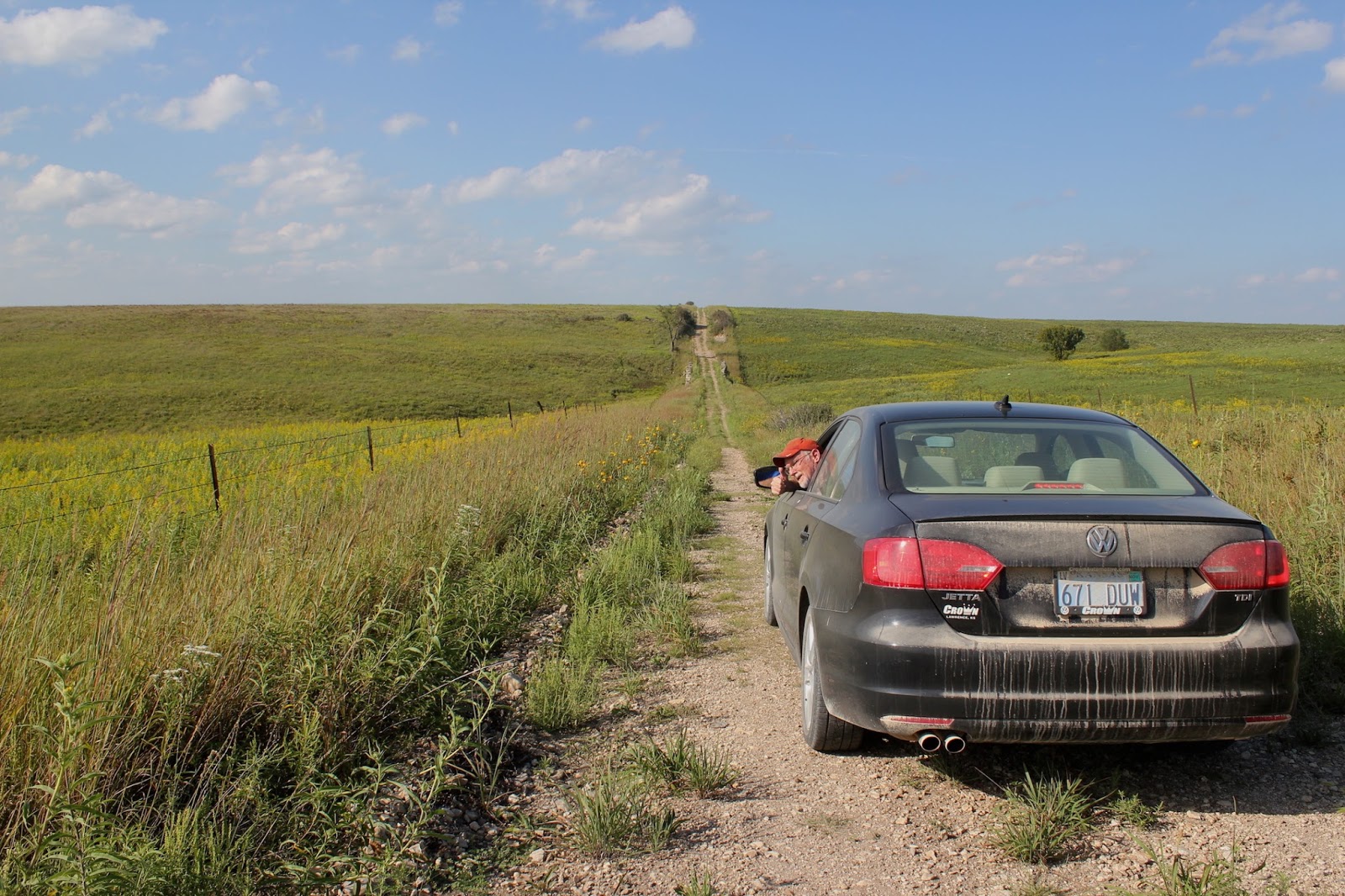
An additional benefit, for me, is the wealth of material I collect for my writing, from scene setting to character development. In August, our desire to escape for a day took us to Wabaunsee County in the northeastern corner of the state. At the Friendly Cooker, a diner where we had lunch, we eavesdropped on the folks around us (lots of characters in small-town diners!) and got the last two pieces of delicious strawberry rhubarb pie free because it was near closing time and the manager felt generous. We spent the rest of the day hiking a little-known prairie area managed by the Audubon Society, its path lined with boulders deposited by glaciers during the last Ice Age, and exploring roads most people don’t know exist.

The real adventure of the day came when we chose to follow a dirt “road” marked on our trusty Kansas Gazetteer but obviously little used. The farther along we drove, the narrower the road became and the taller the weeds. At one point, the weeds growing in the center of the road trail were taller than my car. Someday, that road will find a place in my fiction.

The "road" narrowed and the weeds grew taller on the other side of that hill.

What are your favorite roads less traveled?

Sunday, March 27, 2016

Spring! A Pictorial Celebration

by Julie Tollefson

Some people, I understand, love winter. I personally don’t get that. I spend the winter bundled in layers of unattractive clothing or huddled next to the fire. It’s depressing.

So the warmer temperatures of spring make me downright gleeful. And here in Kansas, spring has arrived. Yay! It’s a perfect time for a stroll through the woods.

In the big picture, tender green shoots poke up through last year’s leaf fall, yet the woods don’t look particularly spring-like yet.


But look more closely, and signs of new growth, new beginnings are everywhere.

In redbud tree buds wrapped in water droplets on a rainy morning.


And bursting open a few days later.


In new leaves and flower bud clusters.


In the first dandelion of the season.

 
And bejeweled spider webs as fog lifts.


I’m still waiting for my favorite sign of spring (shown here in a photo from a few years ago):


These miniature irises—I’ve always called them “baby irises”—came from my Great-Grandma Ida’s yard. For three decades, every time I’ve moved, some of them moved with me. They’re always the first flowers to bloom in my yard, eagerly awaited. The leaves made their appearance last week, and the flowers shouldn’t be far behind.