Showing posts with label Writing. Show all posts

Monday, August 31, 2026

Thoughts on Writing by Nancy L. Eady

The quote, the way I heard it, was “All writers hate writing; all writers love having written,” attributed to Gloria Steinem. Today, a little investigation courtesy of Google has revealed that  the quote is attributed to Dorothy Parker in its original form, which was “I hate writing. I love having written.” Even further investigation, however, shows that no record exists proving Dorothy Parker ever said or wrote the quote attributed to her. 

Regardless of who said it, I disagree. I admit I have days when writing is a chore, when it is all I can do to keep my fingers typing out words, while my brain keeps encouraging me with helpful comments like, “This is the worst writing you’ve ever done.” But there are other days, too. Days when I enter “the zone,” and the words fly from my fingers to the screen, barely keeping up with my brain. It feels like flying. On those days, writing is not a chore. 

The other fallacy in the statement is that each author has individual preferences for what they like about the writing process. Some people love writing the first draft but suffer through the editing that comes next. Other people struggle to crank out the first draft but love the magic they find in the editing process, as they sculpt their raw material into a polished, readable work. And there are others, nuts like me, who have days and times when they enjoy both. 

Writing and editing remind me of counted cross-stitch, a craft I enjoy. In counted cross-stitch, the crafter takes a fabric such as linen or Aida, with a regular, discernible weave to it, chooses a chart of a picture marked up with symbols to stand for certain colors of thread, and then builds the picture on the fabric with tiny “x” stitches by following the chart. I love the building block process of counted cross-stitch, when I’m filling in the basic colors as indicated in the chart. But there is also magic in the finishing details, when back-stitching (a way of stitching straight lines) is used to create additional perspective based upon what structures in the picture are outlined, and in what colors. Writing the rough draft of a story or novel is like filling in the basic building blocks in cross-stitch, and editing adds the finishing details that make the story a marketable project. 

There are parts of writing as a business that I have found few, if any, writers love. “I am writing a synopsis today,” said no writer with glee ever. However, the one solid, basic fact you learn in law school is that every rule has an exception, so I’m sure someone is reading this post in disbelief, thinking “But, Nancy, don’t you know the synopsis is the best part?” 

All of which leads me to wonder, fellow readers, what you think of the quote. Do you hate writing but love having written? Do you prefer bringing that first draft into the world, or is your favorite part when you edit that first draft repeatedly to make it the best work you can present? Or is there some other part of writing that you cherish more? 


Tuesday, May 19, 2026

Centering and Focusing

by Paula Gail Benson

Lately, I’ve been facing days with a lot of tasks coming to me at once. I’ve had to clarify the order and set priorities. Unfortunately, I’ve often been told all matters are urgent and do the best I can. So, I do, and hope for the best.

After a flurry of activity, writing is a much stiller, calmer course. Its quietness in fact can be disconcerting and make me wonder, am I able to do this? Can I be alone with my thoughts and create when no one is imposing requirements upon me?

The empty page becomes a frightening thing because it makes no demands upon me. It simply reflects the demands I make upon myself: to produce, and hopefully to do so brilliantly.

When I dispel the feeling of possible failure and convince myself to write, I begin to recognize what a gift it gives me. The time and words are mine to explore. I can center myself on the topic I select and then focus on the elements as I uncover them.

Thanks to the Internet, I can stop briefly to look up definitions; historical, mechanical, or scientific facts; or verify that I’m remembering something correctly. Then I push myself back to my waiting page and develop what I’ve determined to create.

At this moment, I don’t let the pressure of finishing or summarizing make me frantic or turn to AI. These will be my words carefully considered, my discovery new and fresh.

I may be able to visit a place I’ve never seen or return to a familiar spot. Like an actor, I can walk around in a character’s shoes, focusing on what I might fail to notice in the hustle and bustle of everyday existence—maybe even regretting that I might not ordinarily see it.

With pen in hand, I feel the flow of the creative process through my body. I guess I feel it also when my fingers are poised over a keyboard, just in a different way.

I am centered. I am focused. I pursue the creative process alone, but hopefully I will share the results of that process with others.

How is it for you when you come to write after being involved in another experience?


Friday, March 27, 2026

Acronyms by Nancy L. Eady

In my old job, my employers dubbed me the “tech guru” from my interview forward. This undeserved reputation began at my interview in 1991 when I was the only person in the room who could explain that the three plastic computers sitting on the floor didn’t work because they were LaserJet printers. I enhanced my tech reputation over the years by deploying my secret weapon for fixing 90% of all computer glitches: unplug the computer, then plug it back in. 

It’s odd how consistently that remedy works. When I first started doing it, our “state-of-the-art” computers came with monitors as big as a small moving box, screens of about 12 inches in diameter, no color or pictures, no email, and a whopping half megabyte of RAM. My cell phone today, let alone my laptop or my desk computer, has 2000 times more RAM than those early models. Massive quantities of RAM create computers that are smarter than me. Everyday appliances, such as the television, the refrigerator and the microwave, which contain computer chips, are also smarter than me. Even so, when those devices get a bug in their computing system, at least 90% of the time restarting the computer or device straightens it out. (Unless your bug has already taken you to the blue, green, or black screen of death—a blank monitor with a single blinking cursor in the corner. If that happens, don’t bother unplugging; your electronic device needs professional help ASAP.) 

My mantle was undeserved because I don’t know enough to be a tech guru for a kindergarten, let alone a business. I’m just stubborn enough to force any vendor to explain every acronym and concept until I can explain them to someone else. This tenacity has stood me well in my new job in state government. We deal with various federal agencies regularly, and they love acronyms. Drawing on my earlier technological experience (or more precisely, the lack of it), I ask the person in the meeting or the person sending the email to explain the acronym if I can’t find the explanation on Google. 

Writing is not immune to acronyms, especially if you communicate about your writing online or by email. Common acronyms include WIP (work-in-progress), MS (manuscript), POV (point of view), and MC (main character). What writing acronyms have you come across that struck you as useful? 


Friday, March 13, 2026


Quick Motivators When You Don’t Feel Like Writing

By Heather Weidner

 It’s March, and the weather is finally getting warmer here in Central Virginia. I can’t wait to get outside. I love the spring weather, but sometimes, it’s harder to keep my writing routine on track when there are so many distractions.

 Here are few ideas that might help you get motivated or moving when you don’t feel like writing:

  • Get up earlier than normal to start your writing session. Sometimes, it helps if you finish earlier in the day when there’s still time to do something else.
  • Editing/revising is the hardest part for me. I really have to focus (and stay focused) to make sure all the changes are made. I usually reward myself with a social media break, a walk outside, or a quick research break (scrolling through the internet) after I hit a milestone.
  • Get a good, noise-cancelling headphone set. It’ll block out the world, and you can listen to your choice of music. (I have playlists for every mood (and type of writing task. This is my playlist of songs about writing.)
  • Keep small pieces of chocolate or other favorite treat on your desk for writing sessions. It’s a great pick-me-up, and it’s a nice little reward.
  • Keep some tactile toys on your desk (e.g. stress balls, Slinkies, or fidget toys) for a quick break. Sometimes, these help while you’re working through a plot hole.
  • Take an exercise break when you need to get up and stretch. There are plenty of chair yoga and chair stretch videos online to get your endorphins going.
  • If you have a pet, take a puppy or a kitty break. Sometimes, a burst of activity can get you moving again.
  • Get your phone or your camera and go out and take some pictures. You can always use them for your blog or socials.
  • Work on another creative project. This will engage your brain and your hands.
  • Write some notes or emails to family and friends. It’s a great way to keep in touch, and it kickstarts your writing.
  • Start a celebration journal and keep a log of your milestones and successes.
  • Find an accountability partner who will help you stay on track.
  • Take a 10-minute tidy-your-desk moment. You clear your thoughts and get a clean desk.
  • Create a reward jar. When you reach a milestone, you get to pick a treat.
  • And don’t forget to celebrate when you hit your milestones or make your goals.

 What do you do get yourself motivated?


Through the years, Heather Weidner has been a cop’s kid, technical writer, editor, college professor, software tester, and IT manager. She writes the Pearly Girls Mysteries, the Delanie Fitzgerald Mysteries, The Jules Keene Glamping Mysteries, and The Mermaid Bay Christmas Shoppe Mysteries. 

Her short stories appear in a variety of anthologies, and she has non-fiction pieces in Promophobia and The Secret Ingredient: A Mystery Writers’ Cookbook.

Originally from Virginia Beach, Heather has been a mystery fan since Scooby-Doo and Nancy Drew. She lives in Central Virginia with her husband and a crazy Mini Aussie Shepherd. 


Friday, January 30, 2026

Community by Nancy L. Eady

 Greetings from the frozen tundra, here in the great state of … Alabama? I know it sounds weird, but we have stayed cold all week. Our temperatures at night Monday and Tuesday were in the teens, “warmed” up to the 20s Wednesday and Thursday, but tonight we’re plunging right back into the teens, with a high on Saturday in the 20s! The only difference from last week is that I went back to work, since the roads are dry and ice-free. 

And that is important to me, because work is as much about social contact as it is about the legal issues I tackle. It’s one reason full-time remote work isn’t a good idea for me; I miss the people I work with. Which raises the question of how people who are full-time writers satisfy the deep human need for connection and community? 

I’ve studied this issue. One way writers establish community is when they attend conventions or seminars. I’ve been to Bouchercon twice, which is a convention for mystery readers, and it was a blast! I got to meet many of my fellow writers in person and forced myself out of my shell in doing so. On my bucket list for the future are Malice Domestic, Sleuthfest, Crime Bake, and Killer Nashville. Malice Domestic is held in the Washington D.C./northern Virginia area, and is another reader convention focusing on more traditional mysteries, including cozy mysteries. Sleuthfest, Crime Bake, and Killer Nashville are more geared to help writers improve their craft. Sleuthfest is held in Florida every year; Crime Bake is in the Boston area, and Killer Nashville is held, strangely enough, in Nashville. Once I finish my six-month probationary period at my new job, I am going to plan a trip to at least one of them in the next two years. 

Another way to build community among writers is to join a national writing group, such as Sisters-in-Crime and Mystery Writers of America, and one or more of their subchapters. I belong to Sisters-in-Crime, and their on-line subchapter, the Guppies. Besides the fantastic writing advice that I get through the Guppies’ list-serve and other programs, the best thing about the listserv is the chance to meet the other members. Even if I never meet them in person, I still feel connected.

A third way, old-fashioned but effective, is to join a local writing group that meets (gasp!) in person. To be fair, some subchapters of Sisters-in-Crime and Mystery Writers of America meet in person, but there may be other groups as well. An online Google search or a search through Facebook or your social media of choice may help you find them. 

Those are my ideas for making friends and connections in the writing community. What other ideas do you have? Do you think community is necessary for writers? If you’ve tried any of these ideas, which are your favorites? 


Monday, January 26, 2026

Cold and Ice by Nancy L. Eady

If every television, computer, tablet, and cell phone in your house stopped working last week, you may have missed the giant winter storm that slid through a good portion of the United States Friday and Saturday. When I looked at the watches and warnings for the Deep South on Thursday and Friday, Mississippi, Tennessee, and Georgia were awash with colors showing the possibility of ice and snow. Yet Alabama, smack dab in the middle of those three states, stayed colorless. A low from the Gulf of Mexico centered itself in such a way that warm moisture from the Gulf staved off the worst of the storm for us, although it gifted us with a ton of rain both Saturday and Sunday. The downpour stopped about 3:30 Sunday afternoon.

Even the Gulf low, however, couldn't stave off the Arctic weather we are experiencing now.  By the time the downpour stopped on Sunday, the temperatures were already nose-diving from the earlier high of 53.  Sunday night's low was 18, and Monday night's is going to be even worse, at 12. In a state where a “normal” winter low is between 30 and 50 degrees, such low temperatures shock all of our systems. 

The cold is bad enough on its own, but none of the water left by the rain Sunday afternoon had a chance to run off the roadways into the ditches before the temperature dropped below freezing, so our roads are going to be nightmares today, Monday. Since the temperature today is only expected to reach 33, the ice may not start melting until Tuesday. In a state where a single reported snowflake triggers a wave of closings, ice on the road is deadly. People down here don’t know how to watch for it, how to drive on it, or how to avoid it.

The only upside to the way this storm came through is that we avoided ice accumulations on the trees and power lines. I plan to hunker down until tomorrow, when hopefully it warms up enough to clear the roads. 

There is, as always, at least one silver lining. Even if the roads ice over from the standing water, we have power.  I can use at least some of the time I spend huddling in my house working on my writing. I am looking forward to it. Now I have to settle the debate on whether to work on revising a finished draft or adding new words to the current WIP. I’ll probably just flip a coin to decide. 

Do you like to write when the weather has you cooped up indoors? If not, what is your favorite writing weather? 


Monday, January 19, 2026

Writing Resolutions - Why Bother? by Debra H. Goldstein


Writing Resolutions - Why Bother? - by Debra H. Goldstein

For the past few weeks, we have been inundated with writers of articles and blogs, podcasters, TV interviewers, and even family members discussing New Year’s resolutions. One common theme is how many of the resolutions, like exercising to lose weight or writing 1,000 words a day, aren’t followed through upon. Many reasons are given for individual failures: “I got sick and couldn’t get to the gym,” “I got sick and couldn’t get out of bed long enough to write one word let alone 1,000,” or “I got carried away by the season and set an unrealistic goal for myself.”

The latter often is the case. But, I ask you, why set yourself up to be disappointed? Why bother using time and energy to make a resolution? Why not simply do the act, whether it is exercise or writing, to the best of your ability on any given day?

Some say that making the resolution provides accountability. After all, success reinforces good behavior. That’s wonderful, but what level of accountability does failure instill? Will the exerciser or writer crawl into a ball and opt not to do anything rather than strike out again?

Maybe I’m being cynical about resolutions? What do you think? Would you rather simply do what you can or adhere to a resolution (and will you stick to it)?


Sunday, January 11, 2026

TO PROLOGUE OR NOT TO PROLOGUE

 by Korina Moss

The choice of whether a book should begin with a prologue is often a heated debate. A prologue can be used for several reasons: to provide essential background information in order to set up the central conflict, as is often used in fantasy books; to provide a glimpse into the antagonist’s mind, sometimes used in thrillers; or to reveal information that the protagonist doesn’t yet know, sometimes used in suspense novels. Of course, there are other times one might use a prologue -- as with every “rule” in fiction writing, the reasons are not cut and dry. But should a prologue ever be used in a cozy mystery?

I’m never going to say never. However, the one reason not to use a prologue, which has come across my editing desk, is as a replacement for a slow first chapter. Some writers want to use it as a way to hook the reader with simply an exciting scene, knowing they've filled chapter one with backstory and introductions, and the plot train hasn’t left the station. Although you need to take time to introduce your main characters and set up the initial stakes and the discovery of a murder, this should be done while still moving the plot forward. A prologue can be used for many reasons, but it's not a substitute for keeping your readers entertained in chapter one. 

Readers: Do you like prologues? Writers: Do you like to use them? 

KORINA MOSS is the author of the Cheese Shop Mystery series, which includes the winner of the Agatha Award for Best First Novel, as well as two novels short-listed for Best Contemporary Novel. Listed as one of USA Today’s “Best Cozy Mystery Series,” her books have also been featured in PARADE Magazine, Woman’s World, and Writer’s Digest. Korina is also a freelance developmental editor specializing in cozy mysteries. To learn more or subscribe to her free monthly newsletter, visit her website korinamossauthor.com.


Friday, November 21, 2025

STAYING ON TRACK by Nancy L. Eady

Today is the Friday before Thanksgiving. Since Thanksgiving is always on a Thursday, I tend to think of this Friday as the last quiet before the flurry of the holiday season descends upon us (unless you’re one of those incredibly organized people whose December holiday shopping is done by July 31, in which case I tip my hat to you as one of those people whose organizational skills reach an elite level to which I never can aspire.) While we’re rushing around trying to complete our holiday tasks, it is easy to let our writing time suffer. I’d like to share with you some ideas I had (probably most of them terrible) in exchange for you sharing your (hopefully much better) ideas in the comments below. 

It takes a certain amount of discipline to be a writer, doesn’t it? Especially when we work at other jobs during normal working hours to support our writing habit. If you write regularly, you’ve already developed the self-discipline to do so consistently. Staying on track during the holidays can be as simple as mixing self-discipline with a small dose of understanding as to the realities of the demands on your time during the next four to six weeks. If your calendar for the next six weeks has so many blacked out squares that it looks like the mouth of a six-year-old with ten missing teeth, accept you might not meet your normal quota—but then come up with a quota that you can meet until sanity returns on January 2. 

Another helpful tip is to remember that the word “no” is in the English vocabulary and use it. Pick the events that you truly want to (or must) participate in and give yourself permission to say “no” to others.

Something I suffered from for many years was the illusion that it was my responsibility, and mine only, to ensure that my family had the “perfect” Christmas every year. There is no such thing as a perfect Christmas, and to be honest, our best stories come from the years when Christmas was less than perfect—like the Christmas tree Mom put up in Louisville one year that slowly sagged downwards until it was at a 45-degree angle to the floor by Christmas Eve and held up with fishing wire. It was an artificial tree on its last legs, and my sisters and my husband and I have some of the best pictures of all of us laughing while we took our holiday pictures leaning at an angle to match the tree. Or the Christmas Eve when Kayla, my daughter, was six and Mark’s mother had to go to the ER. Mark, my husband, ended up getting back home about 5:45 a.m. Christmas morning, so we did Kayla’s Santa at 6 a.m. that morning before he went to bed to snatch a few hours of sleep. Her eyes were saucer-wide as Mark told her about seeing Santa driving away from the house as Mark was returning. So, ditch the idea of a perfect Christmas and give yourself permission to spend some of the time writing. 

Something that helps year-round is figuring out when you are at your most creative each day and then trying to structure your writing to take advantage of that peak creativity time. My peak writing time is NOT first thing in the morning. Getting up in time to see the sunrise is vastly overrated, and my brain doesn’t fully engage until I have been heavily caffeinated. So, 5 a.m. would not be my ideal writing time. Lunch is a good time for me, as are late afternoon and mid-evening. Others, though, are eager morning people, and to them, that 4—6 a.m. shift is just ducky. Choose what works for you.  

And remember, you can make astonishing progress with as little as thirty minutes a day if you use them consistently. There was a French author, whose name I don’t remember, who wrote a 400-page tome exclusively using the time he spent waiting for his wife to get ready for dinner. 

If you have a schedule that is interrupted for a day or two, instead of beating yourself over the head about it and losing even more time, simply accept that life happens and pick your schedule back up the next day. 

What ideas do you have for staying on track with your writing during the holiday season?


Monday, October 20, 2025

PIVOT, TWIRL, LUNGE, AND LEAP

PIVOT, TWIRL, LUNGE, AND LEAP by Mary Keliikoa

That headline almost sounds like a fancy dance move, doesn’t it?

As a child I’d wanted to be a dancer, so that’s likely why I gravitate to the terms. But in this case, they’re used to describe my writing journey over the past thirty years. What I left out were a couple of additional words that describe it slightly better: Evolve and adapt.

I started writing when I was in my late twenties. Having just rounded the sun now for the 60th time, that feels like eons ago—and it’s wild to think I’ve been writing for over half my life. It’s wilder to look back and see how many things have changed.

Of course, not all of those years were spent at the keyboard. In my mid-thirties, I stopped writing to open a company with my husband. I tried to maintain a writing schedule at first, but we had retail stores that were open seven days a week, ten hours a day, and that became all-consuming. Despite my best efforts, the writing had to eventually take a backseat. 

Sure, I yearned to get back to that novel I wrote in 1999 and see if it had potential, but the mental bandwidth to dive in and work on it didn’t occur for fifteen years, and shortly after I turned 50. It was that novel, however, DERAILED, that went on to be my debut in 2020 at the age of 55. 

Now nearly a decade later since I returned to my writing, my seventh book has just published, with an eighth coming next year.

The process has been hard some days, gratifying others, head-pounding-ly frustrating on more than one occasion, and all out exhilarating when I’m lucky. It’s also been eye-opening because the other change has taken some time to adapt to: It’s not just about writing anymore.

Back in the day, as I like to call it, there were no social media handles. Google had yet to come into its own. Research was done the old-fashioned way—books, libraries, and picking up the phone. Those methods still occur, but not without a computer search first. There were also no smart phones then, so my PI and detectives had to surveil and interview witnesses in person. The process of catching up to the new norm, and staying there, has been part of the challenge.

I’ve also evolved a fair amount over the years as a writer. Dedicated pantser for most of them, I’ve recently discovered that plotting might not be a dirty word. I know plenty who embrace the plotting life and can’t imagine sitting down to write without a road map. However, my previous attempts to plot often sent me spinning my wheels for days if not weeks. Soon, with my anxiety amped, I’d just give up. But in my recent projects, I’ve worked with an editor who encouraged me to try again. We did deep dives into character, and motivation, which informed the plot. I decided that my suspense novels were becoming too intricate not to have a game plan. 

Did this process take me weeks? No—it took months. Three to be exact—at least for the last few novels I’ve drafted. Was it worth it? Yes. The actual writing took nine weeks because I knew exactly where I was going. At the end of the day, about the same amount of time as if I’d pantsed it, just split differently. I’d like to say I’m a planster now, because the plot still has room for growth, and to pivot, jump, and twirl a bit. All essential in my world.

What is also true is that I never stop learning, never stop growing. At sixty, I’m realizing that the writing is the reward. With thousands of books entering the marketplace each year, AI looming, agents minimizing, publishers less willing to take risks, the fact I show up and write and create is the only thing I can control. And while it’s taken a minute, I’m finding it’s enough.

I’m not saying I’ve given up on directing that dance production I like to call my writing career. I still want to take the literary equivalent of leaps into the stratosphere and make it big.  But maybe I’m evolving and a little more relaxed as I adapt into allowing the writing to take me where it does. 

So, for now, I’m opening the window, throwing my elbow on the ledge (dog in the back seat of course) and letting the wind blow through my hair. I’m here for the journey and excited to see where we’re headed. 

Oh, and the song playing on the radio is The Best is Yet to Come because it is—and I intend to dance to it the entire way.


Eighteen years in the legal field, and an over-active imagination, led Mary Keliikoa to plot murder—novels that is. She is the author of KILLER TRACKS, the third book in the award-winning Misty Pines mystery series, the domestic thriller DON’T ASK, DON’T FOLLOW, and the multi-nominated PI Kelly Pruett mystery series. Her short stories have appeared in Woman's World and the anthology PEACE, LOVE and CRIME.


Friday, September 26, 2025

What is Writing by Nancy L. Eady

I am a champion procrastinator.  To keep that tendency in check, I periodically review what counts as writing, and what does not. 

1)  Sitting down at the computer and typing words that flow from my head is, obviously, writing. 

2)  Sitting down at the computer intending to write but playing games instead is not writing even if I try to con myself by insisting I am considering important plot points while attempting to get three stars on Level 2,341 of Bubble Witch 2.  (If you know how to  get three stars on level 2,341, please use the comment section to give me your secret.)  

3)  Placing a pen or pencil on paper and pouring out words is writing, although hand muscles geared to typing cramp after too much of it.  Writing by hand only occurs when: 

A)  I am bored in a crowded meeting but need to look like I’m paying attention and/or taking notes (I outlined a complete novel during one hellishly dull 8 hour seminar); or 

B)  I mistakenly travel somewhere with none of the electronic gizmos I normally use and I’m desperate.  

4)  Dictating my story into my digital voice recorder while I'm driving, while not winning me "safe driver of the year" award, is writing.  

5)  Thinking about my story is, alas, not writing.  If it were, I'd have a completed work rivaling the unabridged Oxford English Dictionary in length.  (The last published version of the OED was the 2nd edition in 1989; periodically, the OED also publishes single volumes with words that have been added.  Now, the OED is online and is, per its web site, a guide “to the meaning, history and usage of over 500,000 words and phrases across the English-speaking world.")    

6)   Talking about my WIP is not writing.  

7)   Preparing a pitch for a completed work is writing.  In fact, it may be one of the hardest parts of writing. 

8)  Signing up for a writing class without actually attending it is not writing.  

9)  Completing the first writing assignment in a course and then ferrying the rest of the lessons and information into an e-mail folder for that future mythical era where I have time to catch up is not writing.   

10)  Completing a writing course is writing and time well spent.  

11)  Buying books on writing is not writing.  This stricture includes books with topics such as how to complete a novel in 30 days, time management, steps to a writing life, writing exercises and creativity, especially when said books remain on the shelf unopened.  (My husband says I have more time management books than anyone he knows.  He just wishes I'd read at least one of them.)  

12)  Reading such books is writing - to a point.  Reading on how to improve my craft is useful but only if I practice the knowledge I gain by – you guessed it – writing. 

13)  Editing is writing, but I have to keep a close rein on my inner critic, a snarky, surly lass always popping up with the worst comments at the worst time.  

14)  Reading other mysteries is not writing.  I am mesmerized by a good book.  Growing up, my youngest sister would come home from school and talk to me for fifteen minutes before I realized anyone was in the room with me.  My very patient family has learned to say my name three times progressively louder and pull on my arm at least once if they need my attention while I’m reading.  In case of fire, I expect them to save themselves and leave me to my fate.  At least I’ll die happy.  (Reading other people’s work is essential to my development as a writer, so I make time for it.  I just don’t count that time as writing time.)   

What activities do you count as writing versus non-writing? 


Monday, September 22, 2025

Things I've Learned Watching Football by Nancy L. Eady

You’ll never make the team if you don’t try out. 

Never believe your own press. 

You get four tries to make a first down

The individual playmakers get all the attention, but the game is won in the trenches. 

Every team member matters. So does every member of the support staff. 

A team that plays together brilliantly can beat a team with brilliant players. 

It takes six days of practice to play the game on the seventh. 

It takes all four quarters to win the game. 

How you play the game DOES matter. 

Much of this relates to writing, also. What do you think? 


Friday, September 12, 2025


Old Habits are Hard to Break: Avoiding Too Much Backstory

By Heather Weidner

I started my professional career as a technical writer for software and processes and moved on to software testing. Everything I did had to be explained in precise step-by-step detail so that it could be replicated like a recipe. That was a habit I had to break when I started writing fiction. My early drafts had too much description, especially about mundane or routine things.

Readers need to know about your characters, but they do not have to experience every moment or hear about decades of history.

Here’s what I’ve learned about backstory through the years.

• Sprinkle it in your story. Reveal bits about your characters through dialog and what your protagonist experiences instead of from giant, expository paragraphs that interrupt the story’s flow.

• Avoid sounding like a travel brochure or a marketing campaign when you’re describing something, especially a setting. You can describe something unique to the scenery or important to the story, but make sure it fits with the flow of paragraph.

• When you’re talking about characters or setting, don’t stop the action or the momentum of the story to provide details or background. Just about everyone has flown on a plane or gone to the airport. Start the action where the story is and skip the parts that are routine.

• Avoid describing something in minute detail unless it’s important to the story later.

• I do a lot of research ahead of my writing, and I have to fight the urge to add every little fun fact. Research is important, and you learn so many neat things. Don’t waste what you found. Figure out a way to use it in a newsletter article or a blog post. Readers like to know about behind the scenes things or how you research your work. Just don’t bog your story down with stuff that doesn’t really matter.

• I have to know my main characters before I write. I always create a “biography” for them. I keep it in my character list, so I can refer to it later when I need it. It has things like eye/hair color, birthdate, graduation year, friends, pets, and favorites. There is way more information in there than ever makes it to the book. This helps if you write a series that has recurring characters. It also helps me get the ages right, especially if it is a series that spans many years. (My first novel took me five years to write and another two to get published. When I wrote it, the private eye was a Gen Xer who was in her early thirties. Time passed, and I had her a bit younger than she actually would have been when the book finally came out.)

• One quick test for too much detail or history is to look for sections in your book where you would skim or skip over. If you’re bored, chances are your reader will be too.

What other ideas would you add to my list?

Through the years, Heather Weidner has been a cop’s kid, technical writer, editor, college professor, software tester, and IT manager. She writes the Pearly Girls Mysteries, the Delanie Fitzgerald Mysteries, The Jules Keene Glamping Mysteries, and The Mermaid Bay Christmas Shoppe Mysteries. She blogs regularly with the Writers Who Kill.

Originally from Virginia Beach, Heather has been a mystery fan since Scooby-Doo and Nancy Drew. She lives in Central Virginia with her husband and two crazy dogs.


Wednesday, September 10, 2025

Killer Questions - Regrets in Writing


Killer Questions – Regrets in Writing

Writers often have a desire to rewrite passages or pages until the moment of publication. Today, the Writers Who Kill discuss if there is anything they’ve ever put in a book or a short story that they’ve later regretted. 

Connie Berry - I regret that neither I nor any of my editors on A Dream of Death realized that Kate couldn't have used her cell phone to snap photos because she'd already turned it over to the police. How do those things happen???

Grace Topping - After I gave the draft of my first mystery to people to review and provide me feedback, one of them laughed and asked, "Where's the sex?" She regretted that I didn't include any, but I never did. 

Paula G. Benson - I’ve just deleted some dialogue I thought was snappy from a short story. My beta readers said it made the protagonist very unlikeable. The beta readers were right, but I regret losing the repartee.

James M. Jackson - Nope. Not that I couldn't have done many things better, but I'd rather spend time creating a future than regretting a past.

Sarah Burr - There was a time I regretted setting the stage to kill off a character in my Court of Mystery series. It bothered me so much that I had to scramble to find a way for them to survive—which I did! I'm quite proud of the creative problem-solving and mental gymnastics it took to keep them alive.

Annette Dashofy - I can’t pinpoint one thing, but I would love to have a chance to rewrite my earlier books. Somehow, I suspect that’s something a lot of us would like to do.

Kait Carson - Yes, but only in retrospect. I was fortunate to be able to revise the scene when the rights to Death by Sunken Treasure reverted before I re-released it.

Debra H. Goldstein – Of course, but I’m not telling!

Lori Roberts Herbst - Nothing I can think of in terms of content. I’ve had a few mistakes make it into publication, but they’ve all been reparable. The most embarrassing was pointed out to me by a reader in The Netherlands, who noticed that I called a character by the wrong name.

Korina Moss - I don’t think so, but if I went back and read them, I’m sure I’d have changes to make.

Nancy Eady - I wrote a short story once that reflected a little too obviously some struggles I had with a family member.  I never have tried to publish that story or show it to many people because of it. 

Mary Dutta - I’ve had to cut some great lines. I also keep an ex-husband in a drawer who will make it back into a story someday.

Molly MacRae - Not that I can think of. Maybe I have, though, and had such consuming regret that I blanked it from my memory. I wonder what it could have been?

Shari Randall - My editor asked for changes to my first Meri Allen book, The Rocky Road to Ruin, changes to a story line that she felt was too dark for a cozy. I complied, but upon reflection, I wish I'd kept it. The silver lining is that I can use that storyline in another book.

Margaret S. Hamilton - Sexual assault against women. I prefer letting the reader imagine the worst rather than putting every sordid detail on the page. No regrets.

Martha Reed - Yes. I missed including a brilliant story sub-arc in “No Rest for the Wicked,” my third Nantucket Mystery. It occurred to me after publication, dammit. The book is getting five star reviews, so readers don’t seem to notice it’s MIA, but I know the story would be better if I included it. There’s a niggling suggestion in the back of my brain that I should go back and revise it, but I’m always busily engaged in drafting my new next book. I’m not sure if I ever will.

Heather Weidner - None of my female characters and their boyfriends ever married. I guess, it's not to late to have a wedding. 

K.M. Rockwood - Not really. I haven’t mentioned some of my darker stories to sensitive relatives who might be offended.


Friday, August 29, 2025

It's Back! By Nancy L. Eady

This weekend is a huge weekend at our house. Of course, the Labor Day holiday on Monday is enjoyable, but the highlight of the weekend is the start of the 2025 Auburn University football season. (Long-suffering Auburn fans will understand when I say that the unofficial team motto is “We’re Auburn; we make the game exciting no matter who we play.”)

More than just Auburn, it is the “official” start of college football nationwide, except for a handful of games that were played as kickoff classics last weekend. Through January, a football game will be available on TV just about any night, which allows me to read and write and craft while my husband watches TV. Unless it is an Auburn game on TV, I can do a host of things while a football game is on and still follow the game. 

I like this time of year  — the few days before the college season starts. It is ripe with possibilities. Every team is undefeated, and every fan of every team deep in their heart has the hope that maybe this year will be THE year, the year that their team wins the whole shebang to walk away with the 2025-2026 NCAA Division I College Championship. At the end of this weekend, half of the teams will be a step closer to that dream, while the other half of the teams will have taken a step back from it. 

That same sense of possibility exists the moment I open a new document to begin a new story. I don’t know where I will end up, who I will end up with, and what we will have done to get there, but I know at that moment, the moment of beginning, that anything is possible. 

The stretch of time and effort between that moment of beginning and when I have a product I believe is worthy of publication is different. That effort and time are what makes writing “The End” on the last edit of the last draft before you send your baby out into the cold, cruel world to seek its fortune so fulfilling. 

But the best thrill I ever had from writing was the time someone turned to me and, in talking about something I had published in a magazine, said, “I read your story, and it meant a lot to me.” 

What is your favorite part of writing?


Monday, August 18, 2025

When the Words Don't Come by Debra H. Goldstein

 When the Words Don’t Come by Debra H. Goldstein

There are days when I don’t like blogging or adding to my work in progress. Those are the days that a random idea doesn’t pop into my head. I know I need to get words on the page, but whatever I write doesn’t feel right. In the very old days, I probably would have torn the piece of paper out of my electric Smith-Corona and thrown it on the floor, but nowadays, I simply hit delete. 

When I can’t come up with an idea that satisfies me, I have different options open to me. I can take a nap. On my computer, seated in the same position in which I would normally write, I can play card games (solitaire, canasta, or bridge), try my hand at Mah Jongg, read the news, or glance at different social media sites. Most of these don’t spur thoughts in my head, but they are fun. 

Sometimes, out of desperation, I look out the window, surf TV channels, or listen to music. Being truthful, I find these are excellent distractions, but not much fodder for writing. 

It is disappointing when my words don’t flow. Some people would call it writer’s block, but I don’t believe in that. I know that eventually something will come to me. It may not be my best writing, but hopefully with editing and revision, I will be pleased with the final product.

Do you ever live this scenario?


Tuesday, July 15, 2025

Writing through Sadness or Hardship

 by Paula Gail Benson

Sometimes life issues make writing difficult. Whether the situation involves health, loss, or disillusionment, it can take a physical toll that affects the desire and initiative to create. 

Lately, I’ve been going through a time of working through a number of difficult situations. I heard that a former principal used to tell his teachers not to consider challenges as problems, but as opportunities. I found a definition of opportunity as “a set of circumstances that makes it possible to do something.” However, when you are feeling defeated before you start, accomplishment seems impossible.

William Sydney Porter
Wikipedia

As I considered this dilemma, I remembered reading about the life of short story author O. Henry, whose “The Gift of the Magi” and “The Ransom of Red Chief” are considered classics of the form. Henry, born William Sidney Porter, later changed the spelling of his middle name to Sydney. He struggled and faced heartbreak, yet he produced at least 381 stories in his lifetime.

I reviewed the details of O. Henry’s life in Wikipedia to see what I could learn about his perseverance. He was born in North Carolina. His parents married just before the beginning of the United States’ Civil War. His mother passed away when he was three years old. He grew up in his paternal grandmother’s home with his father who was a doctor. By the time he was nineteen, he had qualified to become a pharmacist. He traveled to Texas, hoping to improve his health (he had a persistent cough).

The change in climate did help. In Texas, he became a popular bachelor and fell in love. Her family did not approve, so they eloped. They had a daughter. Eventually, he went to work for a bank. Unfortunately, he did not keep careful records and ultimately was accused of embezzling $854.08 (approximately $32,685.34 in 2025). As he was changing trains on the way to the courthouse, he became scared and ran away to Honduras, which had no extradition treaty with the United States. During his time there, he wrote the novel Cabbages and Kings and, in it, coined the phrase “banana republic.”

Poter as teller in First National Bank in Austin
Wikipedia
Porter family, wife Athol,
daughter Margaret, and author
Wikipedia
 

Upon hearing that his wife was ill, he returned to the United States. He was convicted and his wife passed away while he was imprisoned. He served his sentence in Ohio where, because of his expertise, he worked in the prison pharmacy. While he was incarcerated, he wrote stories under the name O. Henry. To avoid being revealed as an inmate, he sent the stories to a friend in New Orleans who forwarded them to publishers.

He was released early for good behavior and reunited with his daughter. They moved to New York where he wrote one story a week for the New York World Sunday Magazine. He married his childhood sweetheart, who also had become a writer, but she left him after two years. He returned to his native North Carolina and died at the young age of forty-seven.

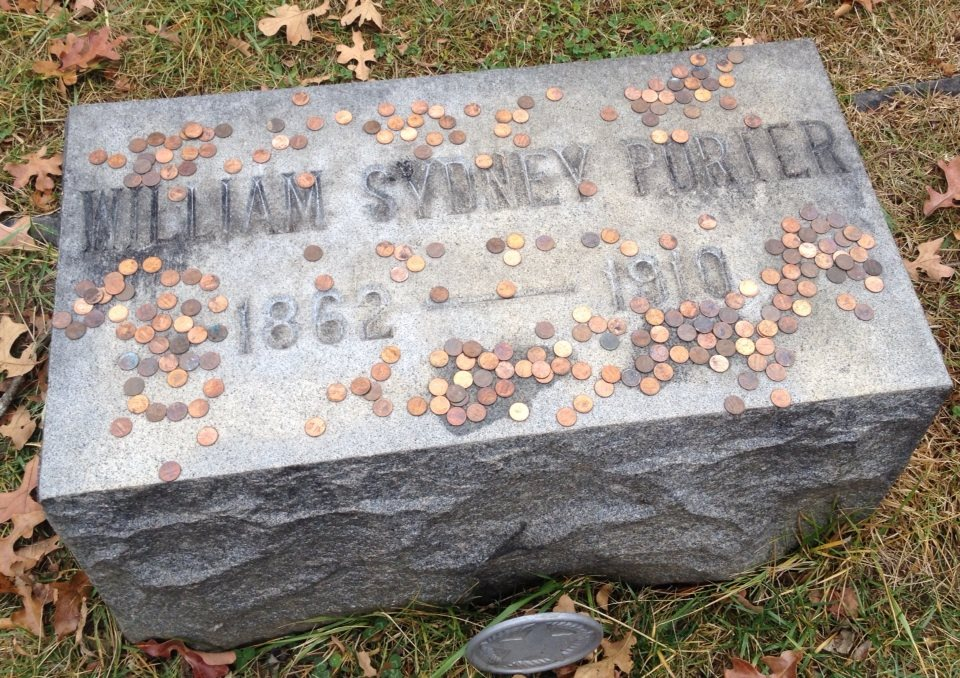
He is buried at Riverside Cemetery in Asheville. His daughter is buried beside him.

Visitors to his grave often leave $1.87, the amount of money his character Della had in savings at the beginning of “The Gift of the Magi.” Cemetery attendants have collected the funds and given them to local libraries.


O. Henry's Grave at Riverside Cemetery
From: Find a Grave

When I consider the hardships O. Henry faced—loss of mother, personal health issues, marrying against his in-law’s wishes, being accused of embezzlement, running away, returning to connect with his wife just before she died, being convicted and serving time in prison, using a pseudonym to avoid revealing he was an inmate, having a short second marriage, and dying early, probably from health-related issues—I am amazed at the collection of his work. The fact that he has touched and continues to influence lives with Della’s story in “The Gift of the Magi” is a tremendous legacy.

Have you ever had to write your way through sadness or hardship? How did you cope?

Friday, July 11, 2025


What I Learned about Writing from The Wizard of Oz

by Heather Weidner


The 1939 MGM version of The Wizard of Oz is my all-time favorite movie. It used to be a once-a-year treat when it aired on TV, but when technology changed, I bought the VHS tape and DVD for on demand viewing. I even took a two-week fun course on it as an undergrad. I’ve lost count of how many times I’ve seen it, but I still find surprises each time I watch it. 

Here’s what I learned as an author from it. 

You Had the Power All Along - You do. You have the grit and determination to fulfill your writing dreams. It’s there. You just need to harness it and figure out your plan. Make a plan and follow it. Don’t give up! Keep writing.  

Use Your Assets - You have the tools to be a writer. Like Dorothy and the gang, you’ve had them all along. You will need to put in the time and energy to hone them, but you have the brain, the heart, and the courage to do it. 

Everyone Needs Friends - The writing life is often a long and solitary journey, and you need friends, mentors, coaches, and cheerleaders. Find your crew and support each other.

People (or Scarecrows, Tinmen, and Cowardly Lions) Are Willing to Help - The Writing Community is full of authors at different stages who are gracious with their time and advice. Find your writing allies and cherish them. Find a writers’ group. Joining Sisters in Crime was the best thing I did for my writing career. 

Be Part of The Group - Make sure that you’re an active participant with the writing community. You don’t have to do everything, but you need to do something. Share ideas, experiences, and contacts. Provide feedback and guidance. Support other writers and look for opportunities to partner with others. 

Sometimes It’s Scary - The witch’s flying monkeys scared me so badly as a kid. (And when I was little, I found it hard to fathom that the lady in the Maxwell House coffee commercials was really the Wicked Witch. But that’s another story.) There are some rough patches and scary stuff along the writing journey. Rejections, bad critiques, and nasty reviews are the worst. Learn what you can from them and keep going. You are not going to be everyone’s cup of tea. 

Be Flexible - You are going to run into all kinds of roadblocks and dead ends. Figure out ways to move forward and to advance your goals. Use your gifts. Be creative and find your way out of the dark places and the haunted forest.

And remember, one encounter and one pair of shoes can change your life.

Through the years, Heather Weidner has been a cop’s kid, technical writer, editor, college professor, software tester, and IT manager. She writes the Pearly Girls Mysteries, the Delanie Fitzgerald Mysteries, The Jules Keene Glamping Mysteries, and The Mermaid Bay Christmas Shoppe Mysteries. 

Her short stories appear in the Virginia is for Mysteries series, 50 Shades of Cabernet, Deadly Southern Charm, Murder by the Glass, First Comes Love, Then Comes Murder, and Crime in the Old Dominion, and she has non-fiction pieces in Promophobia and The Secret Ingredient: A Mystery Writers’ Cookbook.

Originally from Virginia Beach, Heather has been a mystery fan since Scooby-Doo and Nancy Drew. She lives in Central Virginia with her husband and a crazy Jack Russell Terrier.

Monday, May 19, 2025

The Times They Are A-Changing by Debra H. Goldstein


The Times They Are A-Changing
by Debra H. Goldstein

Bob Dylan wrote his anthem styled tribute to the way the world was changing in the 1960’s. It’s lyrics ring true today, but this isn’t a political blog post. Rather, it is an observation of the changes in publishing and how authors are pivoting to stay relevant (and published).

When I began writing seriously a decade ago, my first books were characterized as academic or traditional mysteries. My Sarah Blair series was marketed as being cozy. The first two books I wrote were orphaned by their respective publishers, which necessitated me writing something different or give up writing. That’s when I came up with Sarah Blair, a woman more frightened of the kitchen than murder.

I was thrilled when Kensington made me an offer for my cozy, One Taste Too Many. I felt blessed. I didn’t know how much that was true until I started hearing about another publisher who was phasing out their cozy line of books resulting in authors scrambling for new homes. Most didn’t find one.

Some gave up writing. Others turned to self-publishing. Many began writing stand-alone suspense and light thrillers. Today, authors of these kind of books are pivoting again because they are discovering that the demand is for more over the top action in mysteries and romantasy.

Does it reflect readers’ desire for escapism? Is it a marketing analysis strategy? I don’t know. All I’m certain of is that The Times They Are A-Changing

Hopefully, we’ll find a way to keep you as a reader. But tell us, what kind of books do you want to read and why?


Sunday, May 11, 2025

WRITING AND MOTHERHOOD by Korina Moss


Happy Mother’s Day to all the moms out there! I’m a writer who’s also a mother. Or maybe it’s the other way around. I’ve had some dream-come-true success as a mystery writer, but when all is said and done, being a mom has been the job I take the most pride in. My son is a kind, accepting, empathetic, open-minded, and hard-working young adult. What else could a mom want? Because of his neurodiversity, I spent most of his school years advocating for him so he would be treated just like any other student and have the opportunity to live up to his potential. Now, he is about to finish his junior year in college on a four-year full academic scholarship, awarded in part for the leadership qualities he exhibited in high school. (Yes, I’m unapologetically bragging about my son.) 

One of the reasons I never dove headfirst into my writing when he was younger was because I didn’t have the emotional energy to focus on my creative pursuits while trying to remedy a flawed educational system (albeit with some amazing teachers and staff). But another reason was simply that I enjoyed getting to do all the fun mom stuff—planning birthday parties, making Halloween costumes, going on class field trips—unencumbered by outside responsibilities. So, I continued to be creative on my own terms – writing biweekly humorous essays for a local newspaper, entering (and winning) a statewide short story contest, and tinkering with a cozy mystery novel for nearly a decade. 


My winning story in the Hartford Courant

When my son was sixteen, I received my first publishing contract. Even then, I had a hard time making the switch to a full-time working (now single) mom. Luckily, my first book didn’t release for two more years, so I only had to focus on the research and writing while he was in school (and online schooling during Covid). All the extras that go into being a published author – the marketing, signings, and conferences on top of deadlines -- didn’t come into play until he was in college. 

One of the favorite book dedications I’ve ever read was one that said (I’m paraphrasing): “To my children without whom this book would have been completed two years earlier.”  I applaud any parent, especially a mother (because we seem to have the extra guilt gene), who is able to tap into their creative energy while raising children. I just didn’t have the emotional bandwidth to sustain both. Some moms I know write in the car pick-up line at school. Some get up extra early or write when their kids are in bed. (Or when their kids are lying next to them, during those times their children are sick or unable to sleep.) Some moms even have full-time jobs on top of it all. I have a friend whose manuscript is on submission who has four children. I only have one, so I don’t know how she does it! Mothers are truly amazing. (Yes, fathers are too, but we can talk about them next month on their holiday!)

Son reading before bed while mom writes

When I was in my twenties, I used to be an assistant event planner at a university alumni center, which required juggling many balls at once. I believe I was able to do it so easily because my investment in anything I was juggling was limited, unlike writing and motherhood. Books are like our babies, right? We birth them too. When I’m working on a book, I’m always thinking about the story. It’s like being in a perpetual daydream, which never blended well with motherhood for me. Luckily, there are plenty of moms out there who manage it just fine… or manage it with a lack of sleep, lots of compromise, and perhaps a helpful spouse. But they manage it, nonetheless, with happy, healthy children and a writing career to show for it. 


My Cheese Shop Mystery series

Maybe you thought this post would offer some advice on writing and motherhood. As you can see, I’m not the one to give it. Plenty of moms have balanced the two much better than I ever have. What I have managed to do is let go of regret that I decided to wait to prioritize my writing until I felt I could handle doing both. It’s okay to decide to hold off a writing career or, conversely, to go full speed ahead. It’s also okay to change your mind daily as you experiment with different ways to juggle the two. We each have to decide for ourselves how much we can handle and what we’re willing to compromise or sacrifice. There is no wrong decision. At the end of the day, no matter what has or hasn’t been accomplished, we’re still moms and we’re still writers. 


Readers: What’s your advice for balancing motherhood with writing or other priorities?   


KORINA MOSS is the author of the Cheese Shop Mystery series set in the Sonoma Valley, which includes the winner of the Agatha Award for Best First Novel, Cheddar Off Dead, and finalist for Best Contemporary Novel for Case of the Bleus and Fondue or Die. Listed as one of USA Today’s “Best Cozy Mystery Series,” her books have also been featured in PARADE Magazine, Woman’s World, and Writer’s Digest. Korina is also a freelance developmental editor specializing in cozy and traditional mysteries. To learn more or subscribe to her free monthly #teamcheese newsletter, visit her website korinamossauthor.com.