Showing posts with label suspense. Show all posts

Tuesday, July 19, 2022

Sharing the Writing Experience

by Paula Gail Benson


Earlier this year, I wrote about two Sisters in Crime Chapters (Capitol Crimes and Palmetto) planning and executing a virtual program. Last month, I mentioned a cooperative effort between the Palmetto Chapter of Sisters in Crime and the Southeast Chapter of Mystery Writers of America (SEMWA), Mystery in the Midlands, which began as an in-person event, then has been virtual the last three years because of Covid. Needless to say, I’ve spent a lot of this year working with authors I did not know, as well as  trying to figure out the most meaningful and economical ways of sharing information that both writers and readers could appreciate.

Planning these events takes a lot of work. It really helps to have dedicated, supportive folks pulling together.

Both times, we had that. I’ve been particularly grateful to get to know the members in the Capitol Crimes Chapter (which is across the country from me) and to learn more about the SEMWA board members who don’t live near me. While our energies were directed toward the projects, we still had time to talk with each other about our own writing. It always amazes me to hear the types of work and methods of approach that other authors have. Not only does it give me ideas about how to improve my craft, it also gives me a larger “to be read” list!

Clockwise from top left: Shawn, Dana, Joseph, and Alan

During this past weekend, that happened with the third virtual Mystery in the Midlands. We had three panels and a keynote interview. Our ten participating authors were all superstars. Dana Kaye, our moderator and facilitator, made  her work look effortless and took care of all the technical concerns as well as asking wonderful questions.

The first panel featured short story authors and editors. Alan Orloff, whose Young Adult novel I Play One on TV, won this year’s Agatha and is nominated for the Anthony, spoke about the need to leave gaps so that readers can make leaps. Shawn Reilly Simmons, an Agatha and Anthony winner and editor at Level Best Books, gave an example of finding a name for a character from a wine bottle. Amazingly, Shawn writes her own stories while editing other authors’. Joseph S. Walker, who has written more than fifty stories while working full-time as a college professor, emphasized the importance of  well-chosen details for developing a sense of place in a short story. All three recommended reading stories written by Edgar, Derringer, Agatha, and Anthony award winning author Art Taylor.

Hank and David
For the keynote, marvelous David Heska Wanbli Weiden, whose debut novel Winter Counts was a multiple award winner, was interviewed by the incredible Hank Phillippi Ryan. This segment exemplified what happens when two fabulous authors speak craft and career. David revealed that his protagonist in Winter Counts originally died in a short story, but David could not let him go, so he returned in the novel. At first, David thought he was writing about tribal justice, but after eighteen revisions, he realized the theme of the work was identity. He was very pleased that the novel had been read by Congressional aides who have contacted him about possible revisions in federal law.

Raquel, Daryl, and Abby

The cozies panel was delightful with authors Daryl Wood Gerber (Agatha winning author of three series), Raquel V. Reyes (Lefty winning author whose debut novel has just been optioned for the screen), and Abby L. Vandiver (who writes under three names and who as an anthology editor has been nominated for an Anthony). Abby said in her writing and in advice to students she suggested to always have characters eat, spend money, and pee (the three connectors in the human condition). She mentioned that food and pets were definitely relatable. Raquel mentioned that while some people made the recipes in the books, many just liked to read how dishes were put together. Daryl said while ingredients may be the same, the differences in recipe descriptions made them unique and added to the elements in the story.

Hallie, Hank, and John

In the final panel, Hallie Ephron (New York Times bestseller, Edgar Award finalist, and five-time finalist for the Mary Higgins Clark Award), Hank Phillippi Ryan (USA Today bestselling author and five-time Agatha Award-winning author of 13 thrillers and winner of 37 Emmys for investigative reporting in Boston), and John Hart (author of six New York Times bestsellers and the only author in history to win the best novel Edgar Award for consecutive novels) spoke eloquently about setting and suspense. Hank mentioned that setting could be weather or clothing and different in perspective if an adult or child. She showed a sticky note she kept on her computer with the words “Be There.” John said if the writer wasn’t there, the reader wouldn’t be. He encouraged engaging the senses, especially smell, and talked about creating the internal, emotional landscape. Hallie’s novels often take place within a house. She takes into consideration family, relationships, and how a character feels stepping into a place. She emphasized developing an intersection between character and setting.

Dana, Hank holding Winter Counts, and David

Thank you to all those participating in the program, those viewing it, and those who put it all together. Saturday was a great day for learning and sharing.


What meetings and conferences (virtual or in-person) have you found helpful this year?  

Saturday, November 14, 2020

Innovating With Short Stories by Jennifer J. Chow


I feel like there are authors who excel at short stories. I’ve enjoyed various such authors over the years, from O. Henry to John Updike to Sarah M. Chen. I’ve written a few myself, but it takes a different sort of skill to craft a novel than a short punch of a tale.


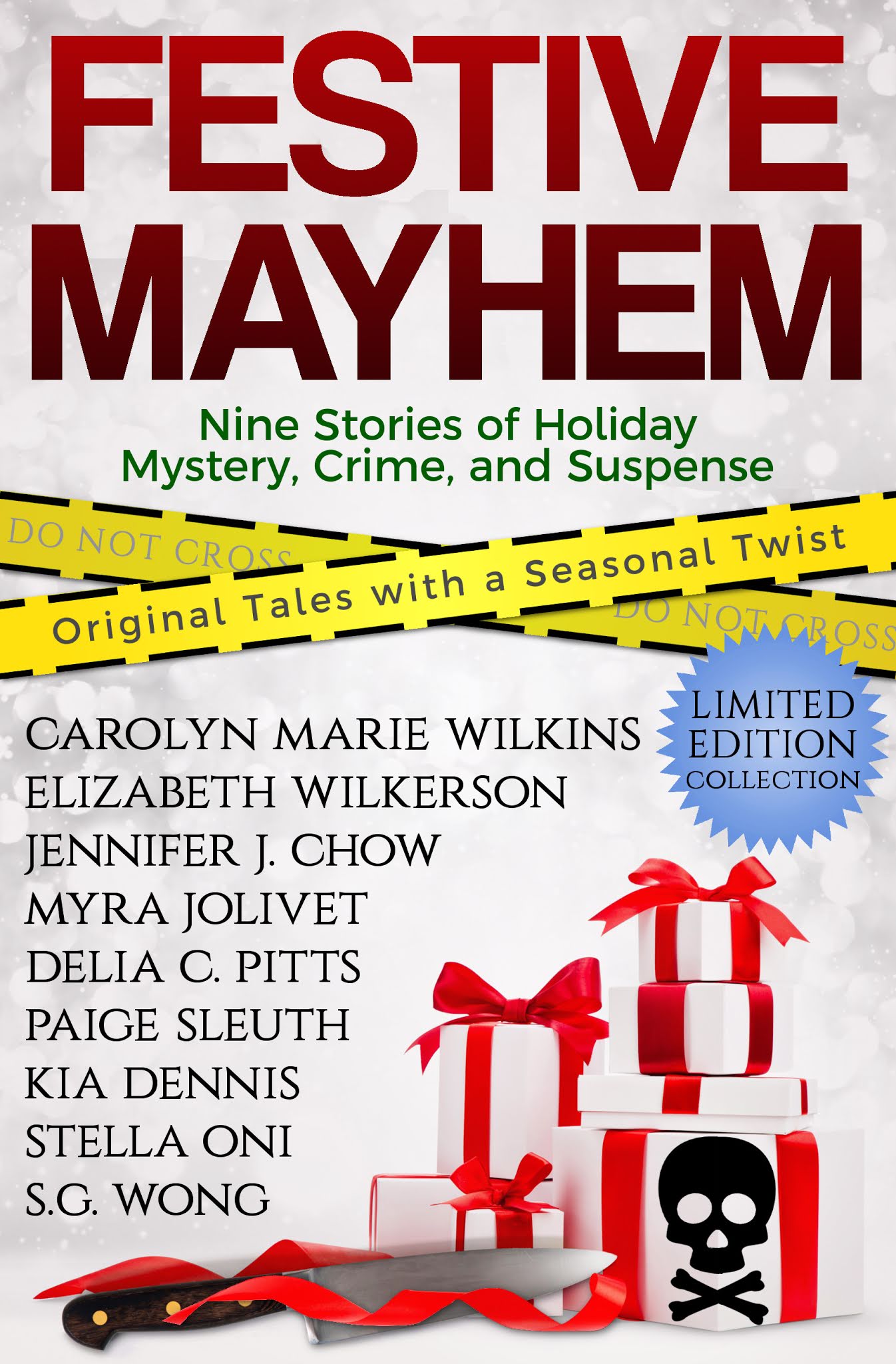
Last year, I decided to challenge myself by writing to a theme and submitting my work. I’m happy to announce that my short stories were accepted by two anthologies. The first, Festive Mayhem, is a collection of holiday-themed tales of suspense and mystery. The stories range in flavor from warm and cozy to downright cold. Here’s a rundown of the works you’ll find in the collection:


• "The New Year's Hex" by Carolyn Marie Wilkins. Carrie McFarland finds her New Year's plans derailed when a psychic vision pulls the 1920s African American amateur sleuth into someone's evil scheme.
• "Pipe Dreams" by S.G. Wong. In this hard-boiled Crescent City short story, infatuation and passion drive Minnie Chen straight into danger as she tries to best the City's most glamorous private detective in a reimagined 1930s-era Chinese Los Angeles.
• "A Christmas Tip" by Elizabeth Wilkerson. A surprise Christmas bonus becomes too tempting for Philadelphia nursing assistant Brianna Byers to resist—even if accepting requires some skillful skirting of the law.
• "The Stranger in the House" by Stella Oni. This London House Mystery prequel stars Elizabeth Ojo, a Nigerian housekeeper at a posh guest house, who finds her Christmas intersecting with that of a mysterious resident in trouble.
• "What Lies Inside" by Kia Dennis. A tormented university professor falls deeper and deeper into a destructive obsession in this harrowing tale of love and longing.
• "A Deadly First" by Delia C. Pitts. Thanksgiving takes a fatal turn when New York private eye SJ Rook finds himself thrust into his first murder case in this darkly atmospheric tale of noir.
• "The Holiday Murder Mélange" by Myra Jolivet. This Sarah Doucette Jean-Louis short story follows the Creole P.I. around the San Francisco Bay Area on her quest to figure out who killed a man outside of her office.
• "Those Holiday Blues" by Jennifer J. Chow. Jasmine, aka "Jazz," can't escape the tragic past when an old boyfriend asks to meet on the anniversary of his mother's death.
• "Holiday Holdup" by Paige Sleuth. In this Cozy Cat Caper Mystery Short, Imogene Little gets tangled up in a Christmas Eve bank robbery orchestrated by none other than Santa Claus himself.


The second anthology releases in fall of 2021. Spearheaded by our very own Abby L. Vandiver, it’ll be published by Crooked Lane Books. The collection will feature original mystery and crime stories from nineteen authors of color. 


(Photo credit: Abby Vandiver)

Although my mystery writing specialty is cozy series, I’ve veered off course for these anthologies. The stories in them are more chilling than my usual fare. I think I needed a break from the same type of writing, and I also wanted to stretch my creative wings. Sometimes I doubt myself and wonder if I should have strayed from my typical writing style. Share your thoughts below.


Do you prefer stories similar to an author’s previous works? Why or why not?

Wednesday, April 26, 2017

An Interview with Susan Bickford by E. B. Davis


Often, when I read first-published books by SinC Guppy members, my assumption of a cozy read is right, especially when the publisher is Kensington. After reading Susan Bickford’s A Short Time To Die, I found that assumption was wrong!

The language can be rough, the concepts—obscene, and the tone—suspenseful. We hope the main character, Marly Shaw, will come out on top. And just when we’re wringing our hands, Susan’s counterpoint POV, Detective Vanessa Alba, provides calming relief, but then—we’re afraid of what she’ll find out.

For a debut author, Susan’s approach is gutsy. I can’t wait to see what she writes next. Please welcome Susan Bickford to WWK.                                 E. B. Davis

You dedicated your book to Kathy Bernhard and George-Ann Formicola. Who were they?

Wheatland Chili, outside Rochester, NY, was quite small—about 100 students in each grade, with a combined junior and senior high school. Georgie, Kathy, and I were in the same homeroom and we giggled and snickered at the back every morning.

On our last day of school freshman year, they went swimming and never came home. The rumors were that they had run off. But two months later their bodies were found nearby, hideously mutilated. Their killer was never identified. It has haunted me all these years—girls who deserved their own futures.

Charon Springs is a town in Central New York State where the central part of your story takes place. Did you base the town on someplace you lived? Like Chili, perhaps?

How did you know about Chili? Georgie and Kathy lived in a small Chili community that was a stone’s throw from Rochester but very isolated in a way.

My parents seemed to prefer towns that were the farthest commuting point into the nearby city. I always had the sense that the end of the world began about five miles down the road.

Charon Springs is a mix of a number of tiny communities around Central New York and a bit of Vermont.

Why does the water in Charon Springs smell badly? What’s the mythology of the town?
Upstate New York is a fascinating place geologically with ancient mountains and old seabeds, scoured by glaciers. Syracuse is the Salt City because it was dominated by salt production for many decades.

The downside is that the water is universally hard and tastes terrible. In addition, certain areas have sulfur water because the water filters down through many layers of salty sediment.

Here and there, communities tried to turn this into an asset: Ballston Spa. Saratoga Springs. Saratoga means bitter water in Iroquois languages.

Charon Springs tried and failed to become a spa back in the nineteenth century.

The Harris family rules Charon Springs much like the Mafia. But the Scotch Irish settled the town. Is this power and rule-by-violence clan mentality or just a congenital or learned sickness?

I would call it the rotten apple principle, so it is a bit of both. Every one of us has the capacity for cruelty but also for kindness. My personal belief is that this goes back to very ancient instincts that allowed us to identify weak animals while hunting, for example. Sadly, that same instinct can be turned against those around us. At the same time we also developed a sense of empathy and the necessity to help each other in communities. Both are congenital. However, circumstances can allow for the cruel side to prosper. The Harris family set up a pattern of abuse and domination long ago and those who remained are infected.

Marly calls her mother, Denise, by her first name. Why?

Marly loves her mother but cannot respect her. Denise has made so many disastrous decisions in her life that have impacted the entire family and she never learns or matures. Marly is filled with teenage frustration and anger, because she is trapped in so many ways. This is her way of showing contempt. Eventually Marly accepts that her mother is a deeply damaged person who will never change.

“The only thing necessary for the triumph of evil is for good men to do nothing.” Edmund Burke

The above quote repeated through my mind when reading your book. The police seem somewhat inept and fearful. The librarian, Mrs. Haas, who Marly works for, seems to know a lot, but never says much. Girls are beaten, threatened, and killed. Why so much silence?

The police care but are overwhelmed and don’t have sufficient tools to seriously combat this type of insidious, low level crime and violence. Everyone else has only two choices: leave forever or stay and play along. No one wants to poke the bear.

Marly teams up with beating victim, Elaine Fardig. They hadn’t been friends before Elaine’s beating. Why does Marly have incentive to befriend Elaine, and what do they have in common?

Marly realizes she won’t survive long on her own if she wants to escape. She needs allies beyond Mrs. Haas, the librarian. Elaine was brave enough to stand up to the Harris family despite the risk and Marly needs someone like that in her corner. People in surrounding communities look down on their little town. Elaine is ambitious and needs to get away and is not concerned with kissing up.

You provide readers with the POV of Santa Clara County (CA) Detective Vanessa Alba, of Colombian descent, who, along with her temporary partner, Santa Cruz County (CA), Detective Jack Wong, come into the Charon Springs’ story after finding two partial skeletons of Harris clan members in their jurisdictions. Was using her POV showing how limited the police are in crime solving, or is it more a show of good and bad aspects of discretionary authority?

I needed someone to reveal aspects of the story that Marly wasn’t aware of and would never learn. An outsider who works in law enforcement fit perfectly. Vanessa’s outsider status also allows her to see the situation in Charon Springs with fresh, unjaded eyes. She is smart, observant, and passionate. It’s more about being effective. Besides, Vanessa doesn’t have to remain in Charon Springs so she has the advantage of being able to call things as she sees them.

Carl Harris, due to the deaths of ruling family members, becomes the head of the Harris clan. You kept me guessing whether or not he was good or bad. There’s reason to believe that he’s checking up on Alba and Wong’s investigation—threatening them. And yet, he’s helped Marly. What’s the verdict?

Ah yes—a good bad guy or a bad good guy? I adore Carl. He and Marly are opposite sides of the same coin. They are both smart, self-aware, strategic thinkers, and want to do the right thing.  The high pressure corruption of his family twisted Carl’s moral compass a bit. Somehow the same pressure taught Marly empathy, although she struggles. She mostly manages to keep the positive side of the coin facing up, Carl not so much. Ultimately I think Carl is a good guy who can’t help himself. His wife, Betty, loves him and Betty is no fool.

Officer Paul Daniel bugs me. He bugged Marly, too. What is it with that guy? Is he part of the conspiracy of silence, a nerd, or slime?

Paul is on the autistic spectrum and not very smart. He clings to his dysfunctional world of Charon Springs because he can’t figure out how to leave. He has been bullied his entire life but he has figured out how to survive. He’s not really part of the conspiracy of silence because he can’t really process or connect the dots very well. He bugs Marly because he is weak, needy, and unable to evolve—much like her mother. She has run out of sympathy. Eventually she realizes that she is indulging in the same bullying behavior as others by teasing him and targeting his weaknesses. Paul bugs Vanessa too, but she quickly sees the tragic side of Paul’s situation.

What is “Marlyfication,” and why would Marly do anything for the town or people in the town where she grew up in fear?

Marly learned the hard way that policies of benign neglect or containment never helped the people of Charon Springs. The situation just festered and many innocent people were sucked under or failed to thrive. She understands that she was able to be successful because other people came to her defense, and that she was lucky enough to be able to take advantage of that. She wants to prove that the right kinds of intervention can turn things around in Charon Springs. I hope she is right.

How did you get your contract with Kensington, and do you have advice for unpublished writers?

I didn’t plan ahead of time. Every step of the way I thought, “Gee, what’s next? I wonder if this story is worth writing, worth polishing up, worth publishing…” Then I thought, “I wonder if I could get an agent? Let’s try.” And finally, “OMG, my agent actually found a publisher.”

I was perfectly happy to take on a small publisher or go the self-publishing route but it just so happened that the agent and publisher arrived first.

I also knew myself well enough to realize that I was not going to enjoy all the detailed micro-management I would need to handle to self-publish, particularly going through it the first time. I’m extremely pleased with what Kensington puts into distribution and marketing and it’s still a lot of work for me.

To unpublished writers, my advice would be to take your time to write the best story you can and enjoy the journey. Once you publish, the pressures to write the next one is intense (particularly if you have a contract), plus promotion and marketing pile on.

While you’re doing that, take the time to study your options and understand the tradeoffs. It’s not as simple as self-publishing or traditional publishing via an agent. Some traditional publishers will accept direct submissions, there are excellent small presses out there, and cooperative publishing seems to work very well for many. Avoid vanity publishing. The rest is all good in different ways.

Which would you prefer, Susan, a mountain or a beach vacation and why?

Actually, I have both in California and my house in Vermont is on a beautiful lake in the Green Mountains. I’m not much of a beach bather, but I love the power of water and the grandeur of the mountains. For non-family vacations, I tend to look for a change of pace—a trip to a corner of the world I haven’t seen yet, for example. I particularly love it when I can visit old friends at the same time. They become so precious to me as time marches on.

______________________________________________________________________________
A Short Time To Die Jacket Blurb
Walking home from a high school dance on a foggy autumn night in rural New York, Marly Shaw sees a flash of approaching headlights. A pickup truck stops and two men get out. One of them is the girl’s stepfather. She runs. They follow. Minutes later, gunshots are fired, two men are dead, and one terrified girl is running—for the rest of her life…

Thirteen years later, human bones are discovered in the Santa Cruz Mountains of California. DNA tests reveal they belong to a mother and son from Central New York. Both have criminal records. Assault. Involuntary manslaughter. Maybe more. Santa Clara County Sheriff Detective Vanessa Alba wants to know how these backwater felons ended up so far from home.

Vanessa and her partner, Jack Wong, head to the icy terrain of the Finger Lakes to uncover the secrets of a powerful family whose crimes are too horrifying to comprehend. Whose grip over a frightened community is too strong to break. And whose twisted ideas of blood and honor are a never-ending nightmare for the one family member who thought she got away…

Tuesday, October 9, 2012

The Man Who Saved The World

We have been bombarded with apocalyptic and post-apocalyptic books, movies and television shows about how the world will end on December 21, 2012. Round up the usual suspects: ice age, asteroids, meteors, mega-floods, solar flares leading to loss of power, global earthquakes, environmental disasters, rats carrying bubonic plague, nuclear war, alien invasion, takeover by artificial intelligence, out of control nanotechnology, death stars, shifting poles, and vortices swallowing the earth. It’s all fairly frightening…and a good scare sells.

But has the world been close to destruction in recent years? If so, what happened? Spoiler alert: Human judgment saved the planet.

While on vacation in South Dakota, I toured a Minuteman Missile Launch Control Facility located thirty feet underground. It was built during the Cold War and capable of launching missiles to hit Russia with a total flight time of thirty minutes or less. A crew of two was locked in a small room enclosed by a thick metal door; each duty shift was twenty four hours.

I asked the tour guide if there were any near misses where nuclear warheads were almost launched. She said there were small incidents in the U.S. but an almost catastrophic event in Russia.

In 1983, Lt. Colonel Stanislav Petrov was in charge of the Soviet early warning system. They had nine satellites in orbit to watch for rocket plumes over the U.S. which would indicate nuclear warheads launched.

On September 26th he received a signal confirming a rocket launched from the U.S. He had twenty-eight minutes to confirm authenticity of an attack. All computer equipment pointed to an imminent attack…except there wasn’t visual confirmation. He waited. Petrov was afraid if he informed high command that a retaliatory strike against the U.S. would be ordered. This would set off an unalterable course of nuclear war.

He and his crew checked but couldn’t find fault with the warning system. After all, it had thirty levels of checks before confirming a launch. Another alarm sounded and the display showed more missiles launched. He had twelve minutes before the missiles were to hit. (Talk about a ticking time bomb.)

Three times the alarms sounded. But Petrov waited. He ultimately decided it was a false alarm. I can only assume he and his crew were ecstatic when bombs didn’t hit Russia. Eventually they figured out that reflected sunlight from the earth into satellite lenses was triggering false alarms.

Our tour guide said that Petrov wasn’t shot or jailed for not informing superiors but wasn’t rewarded either. A few years ago he took the same tour I did to see the Minuteman facility. In 2006 he was honored at the UN and became known as the man who saved the world.

So, when we bypass destruction on December 21st and ring in the New Year, let’s toast Stanislav Petrov (and other unknown heroes) for saving our planet with their good judgment.
Do you remember where you were in 1983 when the world almost ended?

Saturday, August 25, 2012

Writing Suspense


I wrote a guest blog some time ago about how writers in other genres can learn to use suspense techniques. Now, I'm preparing a workshop I'll give at a writer's conference in October on the same topic, so I thought I'd pull it all together for Writers Who Kill today.

Suspense is not only the province of thriller writers, and some of our techniques can be useful to writers of other genres. Every novel needs suspense elements to keep the reader turning the page. At its simplest, suspense consists of making the reader want to know what happens next. At its best, suspense is making the reader worry that his beloved protagonist will never reach his overpowering need or goal and what on earth is going to happen next! You will find this kind of suspense in all kinds of good novels. Will Atticus Finch be able to save innocent Tom Robinson’s life in To Kill a Mockingbird ? Will Scarlett O’Hara save Tara in Gone with the Wind ? Will Paul Atreides be able to become the Kwisatz Haderach to defeat the evil Harkonnens and the Emperor in Dune ? There are a number of ways to provide suspense in a story. I say “provide” rather than “insert” because the suspense needs to be integral to the story and not just something added on.

One of the most important ways to increase suspense is to make it clear to the reader at the beginning of the story just what is at stake. It must be something that threatens to devastate the protagonist’s self-image, life or world, and he must be willing to make any sacrifice and go to any lengths to keep this from happening. However, another fine way to keep the reader wanting to know what happens next is to open your story or book deep in the action and explain it later. Although these strategies seem contradictory, they can be combined to add powerful elements of tension and apprehension to the reader’s experience of the book. If you start in the middle of some strong action scene, and then in the next scene or chapter, establish the background of your characters and the situation, you can delineate the high stakes that are involved for your protagonist here. These combined strategies can be used in almost any kind of story.

An alternative to this kind of two-part opening can be a first scene or chapter that establishes the protagonist within her everyday world but buries hints of impending change or danger within these ordinary moments. This is foreshadowing, and it has been misused often, but when the hints are subtle enough (while still being apparent to the attentive reader), foreshadowing can build excellent suspense. Movies have it easier here because they can use the background music to warn the audience that something wicked this way comes. Writers must try to create that same kind of atmosphere with sharp dissonant details and atmosphere.

One of the key ways to ensure that your book has the kind of suspense that keeps the reader saying, “Just one more page,” is to offer the reader the viewpoints of both the protagonist and the antagonist. This way the reader can see the problems the antagonist is planning for the protagonist long before the protagonist is aware of them. The reader can see what the protagonist cannot—that he’s on a collision course with disaster. This is a very powerful tool for suspense in all genres of novels, but is unavailable to those of you with a first-person protagonist-only viewpoint.

In the case of the first-person protagonist viewpoint, you can avail yourself of some of that reader foresight of disaster by stealing a trick of the traditional mystery writer. In the traditional mystery, as opposed to the suspense novel or thriller, the reader is in the dark and trying to figure out what happened and who the villain is at the same time as the protagonist does. Write in details that plant questions in the reader’s mind about the various characters, about what really happened in the past, and about what might happen in the future. Mystery writers call these “clues” and “red herrings.” Clues are actual evidence of what has happened or might happen, while red herrings are false harbingers, leading the protagonist and the reader in the wrong direction. Either of these can increase the reader’s need to know what’s going to happen. All characters have some secrets, even from themselves. Something that reveals one of these secrets, perhaps one that someone has lied about, will build suspense. When using clues and red herrings to increase suspense, keep the ratio of clues to red herrings high in the favor of real clues to keep from annoying the reader.

Another way to use clues is to plant some detail that brings uneasiness but is made to seem innocuous at the time. Later, this detail will turn out to be an important harbinger of some violence or problem. This stems from Chekhov’s gun on the wall which must go off before the play is over, or Brian Garfield’s famous dictum—“Plant it early. Pay it off later.”

A great technique to ratchet up tension in a book or story is to use a deadline. Time becomes the enemy and is working for the villain in this technique. The bomb is ticking and our heroine must find it and disarm it while that clock on it is inexorably ticking down to explosion and other obstacles are thrown in her way inevitably slowing her down. It needn’t be an actual clock or bomb, and it needn’t be minutes counting down to disaster. It could be years if we’ve been given a large enough view and long enough timeline at the beginning of the book, perhaps with a genetic time bomb ticking away.

Suspense is always present when the reader knows the protagonist is fighting seemingly overwhelming odds. The reader wants to see him stretched to the breaking point as he tries to prevent the feared disaster (remembering that this is a disaster in the protagonist’s eyes, not necessarily a “blow-up-the-world” disaster). Your character must learn new skills, access new abilities, overcome old flaws in ways he never thought he could in order to save the day. This kind of determination will keep the reader turning pages to find out what happens to him next.

We’ve seen how important the protagonist’s character is to reader suspense. He or she has to be earning the reader’s backing. But the antagonist’s character is just as important for true suspense. The antagonist must be worthy of the hero and capable of providing clever and devilish problems for the hero that will really stretch the protagonist. Unless you’re doing first-person narration by the protagonist, allow the reader to know the antagonist’s motivation and make it strong, so the reader will believe that he’s dedicated to what he’s doing to undermine or destroy the protagonist. If your story is a first-person protagonist narrative, once again you can attempt to let the reader know the villain’s motivation through dialogue overheard or another character telling the protagonist or some other bit of news that will tell the reader why the antagonist is determined and just how very determined he is.

An important but often overlooked way to ratchet up tension and suspense is to allow daily life to throw extra obstacles in the protagonist’s way. She’s trying to get to the old house where her child’s been left by the bad guy before the flood waters drown the kid, but it’s rush hour and there’s a huge accident and traffic jam, or she runs out of gas on the deserted creepy road to the house, or the flood waters have brought out alligators or poisonous snakes, or the street she needs to take has been blocked off for road repairs, or her ratty old car that she can’t afford to replace refuses to start, or… None of these are things the antagonist did, but they impede her nonetheless. This technique also has the positive effect of increasing reader identification with the hero. The reader knows what it is to be in a hurry to get somewhere important and encounter a traffic jam or blocked-off road. It also helps with the writer’s most important goal—verisimilitude. We all want to make our story-world become so real to the reader that he will never wake from the story-dream.

Suspense is a technique every writer can use. It’s a matter of creating a steam engine with no whistle, so that the steam builds in pressure, and at any time there could be an explosion. As a writer, in a thousand ways, great and small, your job is to keep turning up the heat under that engine.

In my own mystery-suspense novel, Every Last Secret, I can show some of these techniques right in the jacket copy. I’ll bold them. Marquitta “Skeet” Bannion fled a big-city police force and painful family entanglements for the peace of a small Missouri college town and a job as chief of campus police. Now, the on-campus murder of the student newspaper editor who traded in secrets puts Skeet on the trail of a killer who will do anything to keep a dangerous secret from being exposed. While Skeet struggles to catch a murderer and prevent more deaths, a vulnerable boy and ailing father tangle family responsibilities around her once again. Time is running out and college administrators demand she sweep all college involvement under the rug, but Skeet won’t stop until she’s unraveled every last secret. Secrets, high stakes, motivated and strong antagonist, overwhelming obstacles, everyday difficulties, a deadline, and dedicated protagonist.

You might take your book’s synopsis/summary and try bolding or underlining all the various techniques of suspense you find in yours. If you only find one or two, perhaps you’ll want to rethink your story so it will include more elements of suspense to keep your readers turning the page.

Monday, November 28, 2011

Mistress is Dead


Millcreek Hundred, 1827
I climbed the stairs as quietly as I could, stepping over the third from the bottom to avoid the squeak. I held my knife ready in case Mistress was awake and I had to move fast.


As soon as I saw her I knew something was wrong.

Mistress lay on her back, eyes closed. She was quite dead. Her skin was cool but not cold. Her hand, when I lifted it to find a pulse, flopped back onto the counterpane. She had been dead only a short time.

I pulled back the bed clothes and found bruises around her neck. Someone has strangled her and then straightened the bed clothes to hide any struggle.

My first thought was that poor Mistress had been sent to her maker; then I realized that was why I was there myself.

I slipped my now useless knife into my pocket and left the room.

To my knowledge Mistress and I were the only people in the house. That was why I had chosen it as the perfect time to kill her.

The final indignity had come early yesterday afternoon when I packed my belonging and left the farm.

She had smiled at me, wished me well and handed me the letter I was to give to my next employer. I was not supposed to open it, but I did.


December 23, 1827
Ella is conscientious but slow witted. It takes her a great deal of time to grasp the simplest situation.Once she finally learns a chore she performsit with moderate skill. She reads poorly and does simple sums. How was I to give such a letter to anyone considering taking me on? It was bad enough that she had sent me packing for no reason two days before Christmas, but this letter would be better used to warm my hands than to convince an employer to hire me.

I had kept Master’s account books for the last five years and I knew a few things about where his money went. Mistress had been extravagant and impulsive. She liked silk and fine china. Her kitchen held more exotic spices than any of the ships docked in Newport. She was adept at explaining away these expenses. The dress was cut down from an old one, the china bought from a neighbor.
I was so angry when I read the letter that I vowed to come back Christmas afternoon when Master always visits his mother. I knew the other servants would disappear as soon as the phaeton with the flashy chestnut headed for the turnpike.

I had intended to do the deed and leave the way I had come, through the snowy woods along the creek.

I didn’t think I was in any position to cry out against the person who had done my job for me.
Angry as I was, I had decided when I picked up the knife that no one would die for my sin. If someone were falsely accused, I would come forward with my story. If I were discovered, I would face my punishment with grace.


I was curious to know who might have done it. I sat down on the top step to think.
I heard the back door creek open. Someone was coming across the court yard from the kitchen.
I stood up and snatched my spare handkerchief from my pocket.
Lucy came up the stairs with a porcelain tea pot and bone china cup on a tray.

“What are you doing here?” she asked when she saw me.

“I left my kerchief.” I held it in front of her face. “And you?”

“Mistress will want her tea when she wakes.”

“No chance of that,” I pointed to the still form on the bed. “Someone strangled her.”

She looked at me as though she thought I had done it. I held up my hands in protest, hands that were too small to have made the marks on Mistress’ neck. “Let’s go back to the kitchen, drink the tea ourselves, and figure out what to do next.”

She handed me the tray and touched Mistress’ cheek, perhaps to make sure she was really dead. I would have expected her to be more upset, but she looked relieved. She opened the window and poured the tea into the herb garden below.

~~oOo~~

“I don’t think we would have enjoyed the tea,” she said once we were settled in the kitchen. “It might not have killed her but it would have made her wish she were dead.”

“That’s three of us,” I said. While she brewed another pot of tea, I showed her the knife in my pocket.

“If you didn’t do it who do you think did?” she asked.

“It was someone with large hands, most likely a man. Joshua may have done it. He hated us calling him her pet. He did it as a Christmas gift to the rest of us.”

Lucy chuckled. “Many’s the time he sat in this very kitchen and told me how much he abhored her.”

“But Joshua is always so quiet. I thought he liked going out with her all the time. If he didn’t like it, how come he didn’t tell us?”

“I think I am the only one he told. He would come back and sit in this kitchen and list all the stupid things she had done, how he had to fetch and carry for her. If something went wrong, it was always his fault. Though how he could have been at fault if a merchant charged her more than she was willing to pay, I’m sure I don’t know.”

We were silent for a few moments as we sipped the tea. “Maybe the Master himself did it and has gone to tell his mother.”

I thought about her suggestion for a bit. “Or Carl, because she sold his favorite horse. He had begun to pay Master a bit from his wages. She said there was no record, and she refused to give him back the money. I myself made the note each time he gave Master the money, but the horse was gone.”

“Do you think she let you go because you kept the books and knew too much about her?”

"I reckon so.”

“Maybe it was Jenny,” she said. “Mistress made sure Joseph Dixon would never call on her again. Jenny has big strong hands.”

We were silent again as we finished the tea and set the fine china cups in the dishpan to be washed later.

“What should we do?” she asked at length.

“Summon the master.”

 
~~oOo~~

The tall case clock in the front hall was striking ten when we finally heard the clop clop of shod hooves in the lane. Lucy hid in the kitchen with the excuse that Master would want to eat something since he was called back so suddenly. I took him up the stairs to the chamber and pulled back the bed clothes so he could see the bruises on Mistress’ neck.

“Send Lucy for the parson. Can you wash her and dress her for burial? Something fine with a high neck.”

“Yes, if you wish me to.”

“This, then, will be her final lie, that she died naturally in her sleep.”