“It is my belief, Watson, founded upon my experience, that the lowest and vilest alleys in London do not present a more dreadful record of sin than does the smiling and beautiful countryside.” Sherlock Holmes, The Adventure of the Copper Beeches by Arthur Conan Doyle
The English may think they have the corner on dangerous villages, but we prolific American writers also create lots of small-town settings that affect our characters’ lives and charm our readers. We know small towns make for perfect incidents of murrrr-der whether we choose the Chesapeake Bay, the Midwest, or the Colorado mountains.
Cabot Cove, the beloved hometown of Jessica Fletcher of Murder She Wrote, will always be one of the most famous mystery series locations, proving that cozies belong in villages. With boats in the harbor, a country doctor, and a small-time sheriff, Jessica’s travails became a genre theme. Over the years small towns as a location evolved into private jokes among authors. After all, how many murders can any one town handle?
What makes small towns the perfect cozy setting? Being from a small town in Pennsylvania, I think of local shops, teachers who taught generations, three-person sheriff departments, and two traffic lights. The anonymity a killer might count as an advantage in a big city is far less likely in a small town. Local killers have a harder time dreaming up alibis because everyone knows each other’s business, for good and for bad. If he’s new to the community, he’ll stand out like a red Maserati parked next to an old pickup truck.
Readers enjoy a small-town sense of community. They get emotionally involved with a book’s familiar cast of characters, even the annoying ones. Parks, shops, and libraries where characters meet to discuss the latest news are endearing. It adds to the shock and concern of a murder just discovered. Who did it? Why? Is the killer one of us? Gossip and accusations fly. Townspeople are less likely to set bad news aside and continue their lives untouched. Some will circle the wagons. Some will spill the beans. Someone decides to do some sleuthing.
The bakery, the church, and the hardware store all form an even smaller microcosm within the town setting. It’s here where co-workers become family even when not related. They are dependable and close-knit. They either welcome a newcomer or regard the newcomer with suspicion.
A crime in a small village provides a different element of fear, unlike a crime in a big city of strangers. The person killed isn’t a stranger. They know the victim personally. And the killer is highly likely to be someone they know. Secrets are closely guarded and loyalties are long, even when misguided. The town buzz is fodder for useless clues and valuable insight.
Amateur sleuths in small towns tend to nosey into solving crimes and step on the law’s toes. They’re good at talking among the locals to flush out clues. The small police force with limited resources may initially discount our sleuths’ abilities but grudgingly come around to their intrusions and deductions.
Although we might joke about the frequency of small-town crimes like in Cabot Cove, as readers we’re perfectly happy to set those doubts aside. We fall in love with the odd mix of characters. We stay up at night turning pages while we sort through the drama, the danger, the clues and the missteps. We hope we can ferret out the killer before the sleuth. Much like the all-too-famous line about Vegas, what happens in small towns stays in small towns. Until the next dead body. And that’s part of the fun.
- Paula Gail Benson
- Connie Berry
- Sarah E. Burr
- Kait Carson
- Annette Dashofy
- Mary Dutta
- Debra H. Goldstein
- Margaret S. Hamilton
- Lori Roberts Herbst
- James M. Jackson
- Marilyn Levinson aka Allison Brook
- Molly MacRae
- Lisa Malice
- Judy L. Murray
- Korina Moss
- Shari Randall/Meri Allen
- Martha Reed
- Grace Topping
- Susan Van Kirk
- Heather Weidner
Showing posts with label Mystery Writers of America. Show all posts
Saturday, April 18, 2026
Small Towns, The Perfect Mystery Setting - by Judy L. Murray
Saturday, August 23, 2025
Do You Believe in Serendipity? - By Judy L. Murray
…In good karma? Or is it just coincidence? Jane Marple considers coincidence suspect, often deliberate. Yet I’ve decided as writers we experience ‘accidental’ moments quite often.
Last week my husband and I took a quick two-night trip. We were hungry for a bit of adventure before a big surgery. I picked a large historic B&B in Connecticut. It turned out to be the perfect choice. Charming, immaculate, and with delightful touches. But within hours he was under the weather. I was left to myself while he slept through the two days.
Restless and alone, I tucked into a tiny side room on the B&B’s first floor when a small dark-haired woman looked in. “I’m sorry, I was curious about this spot. I didn’t mean to intrude.” She smiled. I smiled back. “Of course not,” I replied. “My husband is sleeping. I’m returning a few calls.” The woman lifted two wine glasses in her hand. “My friends and I are in the fireplace room. Do you want to join us?” I began to protest, then stopped. “That’s so nice of you. I think I will.”
Which leads me to the subject of ‘community’ and how karma can pull us together at just the right time. The definition is ‘a group of people with a common characteristic or interest living together within a larger society’.
In mysteries, authors tend to place their protagonist within their own imagined community. It might be Port Anne, a small Maryland town on the Chesapeake in my series. Perhaps a community is like the famous Jane Marple’s St. Mary Mead or Jessica Fletcher’s Cabot Cove. It’s not just geography. Community incorporates characters’ work, personal hobbies, the styles and ages of their houses, even the weather. It becomes a shared commonality that binds residents together or perhaps drives them apart.
The term community is an important means for building reader attachment. Good writers inspire their readers to feel emotionally connected to their characters. Certainly in a series, fans anticipate the next book because of their evolving affection for a circle of characters. We laugh at the silly ones, root for those fighting crime, and cheer at the conclusion.
Writing can feel lonely. Yet we also know our characters become our special community of friends while we create their story. And the real people we meet when we’re out and about can provide us encouragement. Readers send me photos of my books on coffee tables, book shelves, beach chairs, and tote bags. They drive an hour and a half from home to purchase their signed copy at a signing. Their efforts to reach out touches my heart. It leaves me grateful. They become a vast community that keeps me writing.
Do you have an incident where karma or coincidence evolved into building your readership community? I wonder if our readers know how important they are to us or influence our stories.
Judy
Author, The Chesapeake Bay Mysteries Series
Tuesday, July 31, 2018
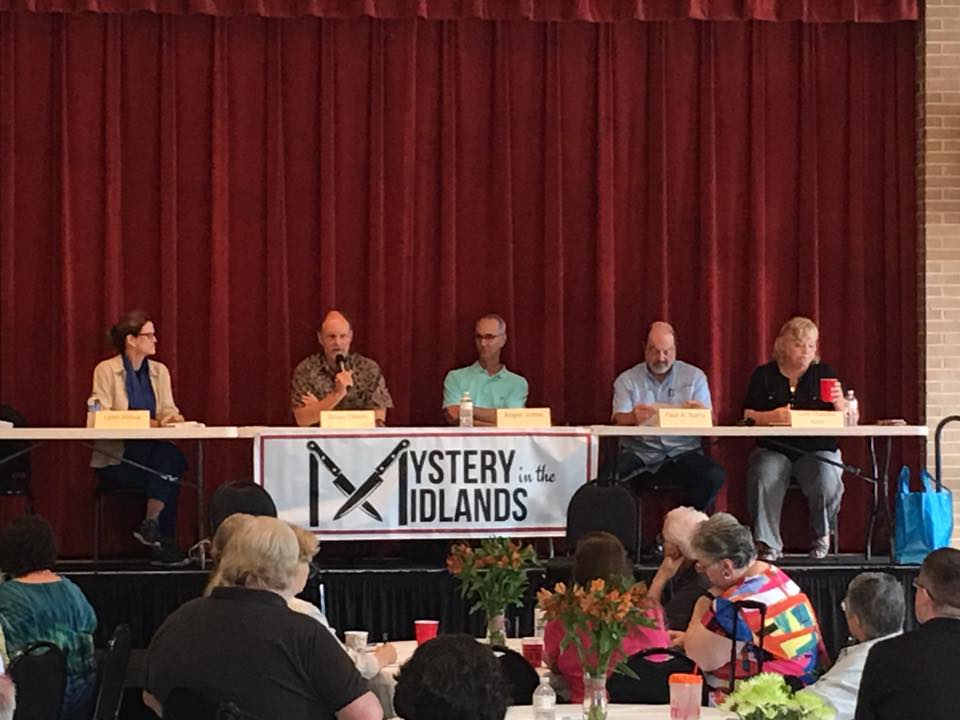
Mystery in the Midlands
by Paula Gail Benson
P
residents Riley Miller (Palmetto Chapter) and Maggie
Toussaint (SEMWA) headed our planning committee, which included Carla Damron,
Maxine Henry, Debra H. Goldstein, Lynn Chandler Willis, and myself as liaison
and event coordinator for each group. We sent out a call to SinC chapters and
SEMWA members in the region, asking who might want to participate in a day of
master classes and panels. We were delighted by the overwhelming response. In
addition to Elaine Viets, 20 authors served on 4 panels and 3 authors taught
master classes.
![]() |
| Jaden (Beth) Terrell |
![]() |
| Richard Helms |
![]() |
| Debra H. Goldstein |
We began the morning with Krispy Kremes and caffeine. (By the
end of the day, our excellent assistant Billy Itter, a talented cartoonist,
told me he now understood that authors were fueled by regular, not
decaffeinated, coffee.) The first presentations of the day were the three
master classes featuring Jaden (Beth) Terrell (“Don’t Sweat It. Get It Done!”),
Debra H. Goldstein (“Turning Up the Heat with Conflict”), and Richard Helms
(“The Brains Behind the Words”). All these classes were well attended and the
only complaint I heard was that folks wanted to be in all three at the same
time. Our gracious presenters have agreed that we may post their materials on
our website. YAY!
![]() |
| Lynn Hesse, Brian Thiem, Roger Johns, Paul A. Barra, Lynn Chandler Willis |
![]() |
| Elaine Viets and Cathy Pickens |
![]() |
| Riley Miller |
During a buffet lunch, Riley Miller presented a super “Hot
Leads” introduction of authors. Each table had a composite of author “mug
shots.” Riley told the audience an unknown fact about each author in the composite
group. The person who guessed the author won a center piece (each beautifully
designed by Donna Robison), then the author had a few minutes to tell the
audience about his or her work.
After lunch, we continued with “Hot Shorts: The Art of the
Short Story.” I was delighted to moderate for Robert Mangeot, Warren Moore,
Karen McCullough, Claire Count, and Elaine Viets. I’ll have to brag a little.
Robert Mangeot got an acceptance from an editor during our panel discussion!
Another YAY!
![]() |
| PGB, Elaine Viets, Robert Mangeot, Claire Count, Warren Moore, Karen McCullough |
The final panels were “Characters That Sizzle on the Page,” a
lively consideration with Riley Miller moderating Maggie Toussaint, Stacy
Allen, and Reagan Teller, and “Turning Up The Heat: Defining Genres,” a great
round up moderated by Sally Handley with Leslie Conner, JR Ripley aka Marie
Celine, Kathleen Delaney, and Sharon Marchisello.
![]() |
| Riley Miller, Maggie Toussaint, Reagan Teller, Stacy Allen |
![]() |
| Sally Handley, Kathleen Delaney, JR Ripley, Sharon Marchisello, Leslie Conner |
![]() |
| Kim McCathern, Books on Broad |
![]() |
| Elysabeth Eldering |
![]() |
| Robert Mangeot |
We also had a silent auction, to which many of our authors
contributed books. Elaine Viets graciously offered a 20 page critique. Special
kudos to Marie Waller, Susan Husman, and Michelle McGee for helping to create
and transport the baskets.
The proceeds from the auction (totaling $468) will benefit the
My First Books SC -- Midlands program, a statewide partnership led by the
Palmetto Project and affiliated with Dolly Parton’s Imagination Library. It
provides books for any registered child from birth to age five.
Seventy-eight people registered for Mystery in the Midlands
this year and almost all attended. We were delighted with the participation and
look forward to continuing the new
tradition!
tradition!
Won’t you come to Columbia for next year’s Mystery in the
Midlands?
Tuesday, August 15, 2017
A Visit from Jeffrey Deaver
by
Paula Gail Benson
| SEMWA Board with Jeffrey Deaver (Photo by PGB) |
This
year, the Mystery Writers of America’s President Jeffrey Deaver has given a
great gift to the regional chapters. On his own dime, he is visiting each of
the chapters to provide a writing workshop for members and guests. The chapters
organize the event and may use it as a fundraiser and a means of bringing
awareness to the chapter’s activities. It’s a wonderful opportunity for writers
throughout the country to hear from a master of the craft without having to
travel to an expensive conference.
As
a board member for the South Eastern chapter (SEMWA), I was thrilled to hear
the news. I was even more delighted when the board decided the program should
take place in my home state. It’s been more than twenty years since SEMWA held
a “skills build,” the title usually applied to a craft workshop, in South
Carolina. I remember that long ago workshop because it was one of the first
writing seminars I attended, and I still use the concepts I learned there from
such distinguished folks as editor extraordinaire Chris Roerden and our own
blogging colleague Carla Damron.
Our
board’s first task to prepare for the visit was to explore various locations.
We finally determined to have it in Columbia. I was delighted that my church’s
assembly hall was available. We went through a process of evaluating caterers
and setting reasonable pricing to cover the costs. We felt fortunate to be able
to offer the event for $25 for members and $30 for non-members and to include
lunch and a reception as part of the package. We attracted participants from
South Carolina, North Carolina, Georgia, and Tennessee, four of our six state
area. Over fifty registered to attend. To say “thank you” to Deaver for donating
his time, we provided each participant with one of his books.
| Jeffrey Deaver Presenting Workshop (Photo by PGB) |
Deaver’s
presentation was generous and comprehensive. He addressed both craft and business
aspects of the profession. Some of the important information that he emphasized
included:
(1)
Understand
what you want from writing and what methods work best for you. He told us that
today’s writing world offers lots of options, including traditional, hybrid, and
independent. All are viable depending upon each writer’s goals. Be honest about
what you are seeking to achieve.
(2)
To
build confidence and an audience, produce a regular product and don’t miss
deadlines. He pointed out that both Shakespeare and Mozart worked on
commission. To build a reputation as a successful, readable author, you must
approach the work as a business.
(3)
A
writer’s mission is to produce an emotionally engaging story, or creating good
and bad characters who confront increasing levels of conflict that are resolved
in a largely positive manner. These principles are almost direct quotes.
(4)
Novels,
short stories, and plays all require different craft skills. Learning how to
write one won’t teach you how to write another. Write in the style that comes
most naturally for you and discover all you can about the marketplace for your
writing.
(5)
The
four basic elements of storytelling are plot, character, setting, and dialogue.
Propel your story by conflict and suspense. Always keep the readers on the
edge.
| Panel Discussion (Photo by PGB) |
Following
Deaver’s presentation, our board members joined him in a panel discussion of
how we had applied his recommendations. Hearing about the individual techniques
and applications allowed us to explore the many options open to writers and
helped emphasize that success can come in many forms.
The
opportunity to meet Deaver and hear about his personal writing habits (he is a
confirmed planner who does not write a novel until he has outlined it, then
completes it only after revising through approximately fifty drafts) made the
day truly informative. I was particularly impressed with his humble, structured
approach and his continuing curiosity. If you have the chance to hear his
presentation when he comes to a MWA chapter near you, please take advantage of
the experience. You won’t regret it.
![]() |
| Group Attending Deaver Event (Photo by Lynda Sasscer Hill) |
Also,
if you haven’t had a chance to consider MWA membership (chapter membership is
included when you join MWA), check out this link to the website.
Subscribe to:
Posts (Atom)