Showing posts with label mysteries. Show all posts

Friday, August 14, 2026


What Grover Taught Me about Writing Mysteries

By Heather Weidner


I am Gen X, first-generation Sesame Street and first-generation MTV. One of my favorite children’s books of all time was the classic, The Monster at the End of This Book. I still have my copy. Mystery, fantasy, suspense, monsters. This book had it all.


As I look back on some of my childhood favorites, I realize I’ve been reading mysteries for a long time. Here’s what this Little Golden Book and the blue fuzzy monster from Sesame Street taught me about writing mysteries. 

  • You need to build suspense in your stories to keep your readers engaged.
  • Your readers need to like or empathize with your protagonist.
  • Everyone is afraid of something, and writers need to tap into fears to build tension.
  • Write strong (and fun) dialog. Make it sound like real speech, slang and all.
  • Use pacing correctly. Slow down the action to build suspense, and speed it up to amp up the excitement.
  • Your protagonist needs a challenge or a problem to solve.
  • Your character should not be perfect. Little (or big) flaws make your character relatable and interesting.
  • Make sure your character is not flat. He or she needs to be a real person (or monster) with all the things that life throws in the way. Your protagonist has to stumble and make mistakes.
  • When you think your character has had enough and is close to breaking, pile it on. Add more tension.
  • Don’t load up your work with a lot of narrative and back story. Readers want to stay in the action.
  • And most importantly, never forget that reading is fun.

Do you have a favorite children’s book that taught you some life lessons?


Heather Weidner writes cozy crime fiction for readers who want justice with a sprinkle of fun and a southern accent.

Through the years, Heather Weidner has been a cop’s kid, technical writer, editor, college professor, software tester, and IT manager. She writes the Pearly Girls Mysteries, the Delanie Fitzgerald Mysteries, The Jules Keene Glamping Mysteries, and The Mermaid Bay Christmas Shoppe Mysteries. 

Originally from Virginia Beach, Heather has been a mystery fan since Scooby-Doo and Nancy Drew. She lives in Central Virginia with her husband and a crazy Mini Aussie Shepherd. 


Monday, August 10, 2026

When Your Setting Starts Killing People, You Know You’re Doing Something Right

A Guest Post by Mindy Quigley


You may have heard writers describe moments when their characters take over the story. This has certainly happened to me. I’ll think I know which way a scene needs to go, only to have the folks on the page inform me they have other plans.

Something that gets less attention is what happens when a book’s setting starts taking over the plot. 

I certainly didn’t expect Geneva Bay, the charming Wisconsin lakeside resort where my books take place, to start murdering people. But—surprise!—it did just that. 

When I first pitched the Deep Dish Mysteries, I had no intention of setting the books in small-town Wisconsin. The books feature deep-dish pizza and a detective descended from Al Capone, so obviously they belonged in Chicago. I envisioned my fictional pizzeria in Hyde Park, where I could draw on the neighborhood’s fascinating history and the city’s unseemly connection with organized crime.

My publisher had other ideas. They loved the concept, but wanted it set in a small, tightly knit community—a place where readers could take a mental vacation. 

I tried to argue that Chicago is, in fact, a great place for a vacation, but finally relented, moving the whole shebang to “Geneva Bay,” a lightly-fictionalized version of Lake Geneva.

As it turned out, Lake Geneva had everything I needed. It’s a short drive from Chicago, and its history is deeply intertwined with the city. Wealthy Chicagoans flock there in the summer, and during Prohibition, the area served as a convenient booze-smuggling pitstop. Gangsters, including Al Capone, also reportedly used the area as a place to lie low when things got too hot in Chicago.

I soon realized that my publisher had done me a huge favor. The town wasn’t just a backdrop: as I got to know it, it became a murder-mystery-generating machine.

The early books’ plots were driven primarily by the characters. Take the first book. Main character Delilah O’Leary discovers her elderly aunt holding a literal smoking gun over the corpse of her seemingly beloved caregiver, upping the stakes. In the sequel, Delilah herself becomes a prime suspect after a murder takes place in a juice bar owned by her ex-fiancĂ©’s new girlfriend. 

By the fourth book, though, Geneva Bay had started suggesting plot twists of its own.

Sleep in Heavenly Pizza takes place during the U.S. Snow Sculpting Invitational, a real event Lake Geneva hosts each winter. Huge mounds of snow are transformed into oversized artwork over the course of a few days. Watching the sculptors work, I began to wonder: What would happen if they carved back the snow only to unearth a corpse? 

I hadn’t simply found a fun place to hide a corpse (though it is fun!). The entire mystery grew out of the setting: the town’s winter attractions, its wealthy seasonal residents, its unpredictable weather. The murder couldn’t be uprooted and plunked down in another place. It became a wheredunnit. Only Geneva Bay could’ve pulled it off. 

By the time I started writing At Death’s Dough, the fifth Deep Dish Mystery, the setting was again at the top of my mind.

In this book, Delilah’s great-aunt, an enthusiastic ice fisher, takes her out onto the frozen lake, where—well, you can probably guess what happens next.

The gruesome discovery plunges Delilah into a mystery involving a real-life, century-old crime, the Capone family, and a trail of clues that may lead to a priceless treasure. All of those elements are unique to Lake Geneva/Geneva Bay.  

At Death’s Dough won the 2026 Agatha Award for Best Contemporary Novel, which was a particularly satisfying development for a book that began with the question, “How might this cute-as-a-button place kill someone (again) and why?”

At long last, the audiobook of At Death’s Dough is now available, narrated by the super talented Holly Adams. 

So if you’re fed up with the summer heat and looking for a book to transport you, I invite you to visit the frosty shores of a scenic Wisconsin lake. 

Just watch your step. Geneva Bay is a dangerous town.


Agatha Award-winning author Mindy Quigley writes twisty, character-driven crime fiction with a sharp, snappy sense of humor. Her Deep Dish Mysteries were a Woman’s World book club pick and have been featured in Parade and the Seattle Times.

Before turning to full-time fiction writing, Mindy spent more than a decade managing veterinary clinical research studies. That followed an unusual career path that took her from the U.S. to the U.K., where she studied British colonial history, worked as the personal assistant to the scientist who cloned Dolly the sheep, and project managed a neurology research clinic founded by J.K. Rowling.

She now lives in small-town Virginia with her Civil War historian husband and their children. For a lifelong dog owner, she spends an awful lot of time thinking about cats.


Friday, May 10, 2024


Where Did Your Love of Mysteries Begin? – by Heather Weidner

When I’m asked about where did my love of mysteries start, I always say that Scooby-Doo and Nancy Drew were my gateways to the mystery world. But as I look back on my favorite children’s books, I realized that the first mystery that really hooked me was actually a picture book, Jon Stone’s The Monster at the End of the Book. Grover, the blue fuzzy protagonist, spends the entire book fretting over the monster who is supposed to make an appearance on the last page of the story. In hindsight, this is where I was discovered a passion for suspense, mystery, plot twists, clues, and irony.

Saturday morning cartoons were also the beginning of my mystery-watching addiction that has blossomed to include true crime shows, podcasts, and a host of murder documentaries. There were so many cartoons in the seventies with crime fighters and puzzle solvers like Scooby-Doo Where Are You, Josie and the Pussycats, The Funky Phantom, Captain Caveman, Jabber Jaw, Goober and the Ghost Chasers, Speed Buggy, Lassie’s Rescue Rangers, The CB Bears, Deputy Dawg, Mumbly, and Devlin, and I watched them all.


Cartoons and my picture books started a love that grew to include a whole host of books as soon as I discovered the library. In fourth grade, my friend and I raced to finish the yellow-covered Nancy Drews, and then we moved on to the Hardy Boys and the Three Investigators. (And it didn’t hurt that Shaun Cassidy and Parker Stevens starred in The Hardy Boys and Nancy Drew Mysteries every week on TV.)

Nancy Drew and the Hardy Boys, like the Mystery Inc. gang in the Scooby-Doo series, were ordinary kids who were able to solve mysteries that the adults couldn’t. They had freedom to explore, cool transportation, and friends to help them solve the crime and bring justice. I devoured these books and moved on to Two-Minute Mysteries, Agatha Christie, Edgar Allan Poe, and Arthur Conan Doyle.

Mystery and crime fiction followed me to college where I took the best course offered in our English department, Dr. Magnuson’s “Mystery and Detective Fiction.” He introduced us to the history of the genre, key tropes, subgenres, and the “rules” for writing crime fiction, but the best part was that I was required to read an entire syllabus of new-to-me authors.

My love of mysteries started early with cartoons and books. It also didn’t hurt that I was a C. K. (cop’s kid), and murder and true crime were regular topics at our dinner table.

Where did your love of mystery and suspense start?


Monday, August 30, 2021

MY TBR LIST by Nancy L. Eady

 I truly love being a member of Writers Who Kill and having my name associated with the other talented writers who blog here. One of the proudest days in my writing life was the day I was asked to join this group as a blogger.

But in the midst of the many positive benefits of being a Writers Who Kill blogger, there is one drawback—the length of my “to be read” (“TBR”) list keeps growing exponentially. For example, Elaine Douts did an interview with the author of the Haunting Danielle series, so I gave the first book in the series a try. Within the next three weeks, I had purchased and read the remaining 22 books in the series, and now I wait impatiently for each additional book in the series.

I don’t remember which blog post it was that encouraged me to try Elizabeth George’s Inspector Lynley series, but I am grateful. It is the rare book that can present me with new vocabulary words, but Elizabeth George throws out at least two or three per book while keeping me enthralled with the pacing, suspense, and characters in the mystery. Since I just discovered this series, I have only reached book four, but the rest of the books are on my list.

I eagerly await each new release in Debra H. Goldstein’s Sarah Blair mystery series and Allison Brooks’ (aka Marilyn Levinson’s) Haunted Library series. And many of the books on my TBR list were written by my fellow bloggers here.

I am a little OCD with series, which does not help shorten my list. Each time a new book comes out in one of “my” series, I start with the beginning book and read through the newest book. For example, in one of the few series on my list that didn’t show up through Writers Who Kill, the Meg Langslow mystery series by Donna Andrews, the 30th book came out a couple of weeks ago. I am on Book 14 in my mandatory re-read, so it will take me through the middle of September before I get to book 30. If I’m lucky, I’ll take just long enough that I won’t need to re-read books 1-30 when the 31st book, a seasonal Christmas mystery, is released.

When I need to decide what I want to write about, when my turn for blogging rolls around, I flip back through the blogs we’ve posted in the last couple of weeks. In doing so for this blog, another nine books (from Alyssa Maxwell’s The Gilded Newport mystery series) popped onto my list. Doesn’t the idea of a mystery set in the world of Newport society during the Gilded Age sound fascinating? 

Whether you are visiting Writers Who Kill for the first time, or have been a regular visitor for years, please take a minute to click on each name in the yellow box towards the top of the page and look at each individual author’s writing repertoire. I guarantee you will find more than one book you need to add to your list.

Thursday, January 7, 2021

Novels to Novellas: The Long and Short of It by Susan Van Kirk


Several years ago, after writing my first novel about the small town of Endurance, I did something very uncharacteristic. I wrote a novella and published it only as an e-book. I called it The Locket: From the Casebook of TJ Sweeney. At first, I wasn’t sure how I’d like writing something much shorter than a novel, but later I decided I enjoyed the experience immensely. It was certainly a change from writing novels. It fit between my first and second Endurance books.


The Locket
afforded me three advantages compared to the Endurance novels I’d written. First, I was able to expand the character of my detective, TJ Sweeney, by writing her story instead of Grace Kimball’s. Grace, the protagonist in my novels, put in a brief appearance as a minor character. Second, I mixed up the tone from cozy mystery novel to a slightly darker police procedural. Finally, I made it more compact, an 82-page mystery for readers who preferred a shorter reading experience.

I made several changes in my thinking and decision-making when I switched from writing novels to writing a novella.

Length was the most obvious consideration. My cozy mysteries ran anywhere from 71,000 to 82,000 words. My research dictated a novella should be 20,000 to 40,000 words. The Locket ended at 25,000 words, which translated into 82 pages of content. It was readable in one or two sittings, the perfect length of an afternoon reading break or a commute to or from work on a train. This, of course, affected other decisions.

A novella couldn’t have numerous subplots. In fact, I wrote TJ’s story with one main plot. Period. But it had to allow for quite a few complications. I chose a cold case from the 1940s which emerged when human bones and a skull were found during a building foundation dig. Once Detective Sweeney determined this was a murder, she had to figure out the identity of the victim and what happened to her. How could she identify this murder victim who died long before DNA databases existed? Or missing-person databases? Who was the killer? Why? The twists, turns, and dead ends pushed the plot more quickly compared to that of a novel. The time difference alone—1940 to today—created many possibilities for quick plot twists based on the changes in investigative technology.
Choices about character and viewpoint were also differences I had to navigate. No longer did I have the luxury of several major characters and a supporting cast of minor characters. A novella generally had one or two main characters, and the supporting cast members had to be few and have a darn good reason to be in an 82-page plot. I discovered that rarely did novellas have more than one viewpoint while a novel might have several. Again, it was condense, condense, condense.

The conflict in a novella had to be recognizable early and then continue as the focus of the plot. I didn’t have the luxury of side problems or minor conflicts. The pace of the conflict had to be fast, so complications occurred very quickly. The number of complications determined how long the novella would be. In The Locket, the investigation of the cold case was primary, but TJ Sweeney’s strong identification with the victim provided a roller coaster to complicate the plot and further develop my detective’s character and backstory.

Revision was another consideration when changing from novels to novellas. Unlike the luxurious, rambling pace of a novel, a novella had to be streamlined. I had to be merciless when it came to cutting unnecessary words and too much description. And I was.

What resulted was The Locket: From the Casebook of TJ Sweeney. It was a delightful ride after plodding through an 80,000-word novel. This is the short summary.

The Big Band Era—Dancing on the Rooftop—Romance in the Air—And Murder in the Shadows. After solving a double homicide in the hot Midwest summer, TJ Sweeney isn’t given long to rest. A construction crew has found human bones while digging a building foundation on the outskirts of Endurance. Sweeney’s investigation soon concludes this was a murder victim, but from many decades earlier. Trying to identify the remains and put a name to the killer takes the detective through a maze of dead ends and openings, twists and turns. And then it becomes personal…


Saturday, November 14, 2020

Innovating With Short Stories by Jennifer J. Chow


I feel like there are authors who excel at short stories. I’ve enjoyed various such authors over the years, from O. Henry to John Updike to Sarah M. Chen. I’ve written a few myself, but it takes a different sort of skill to craft a novel than a short punch of a tale.


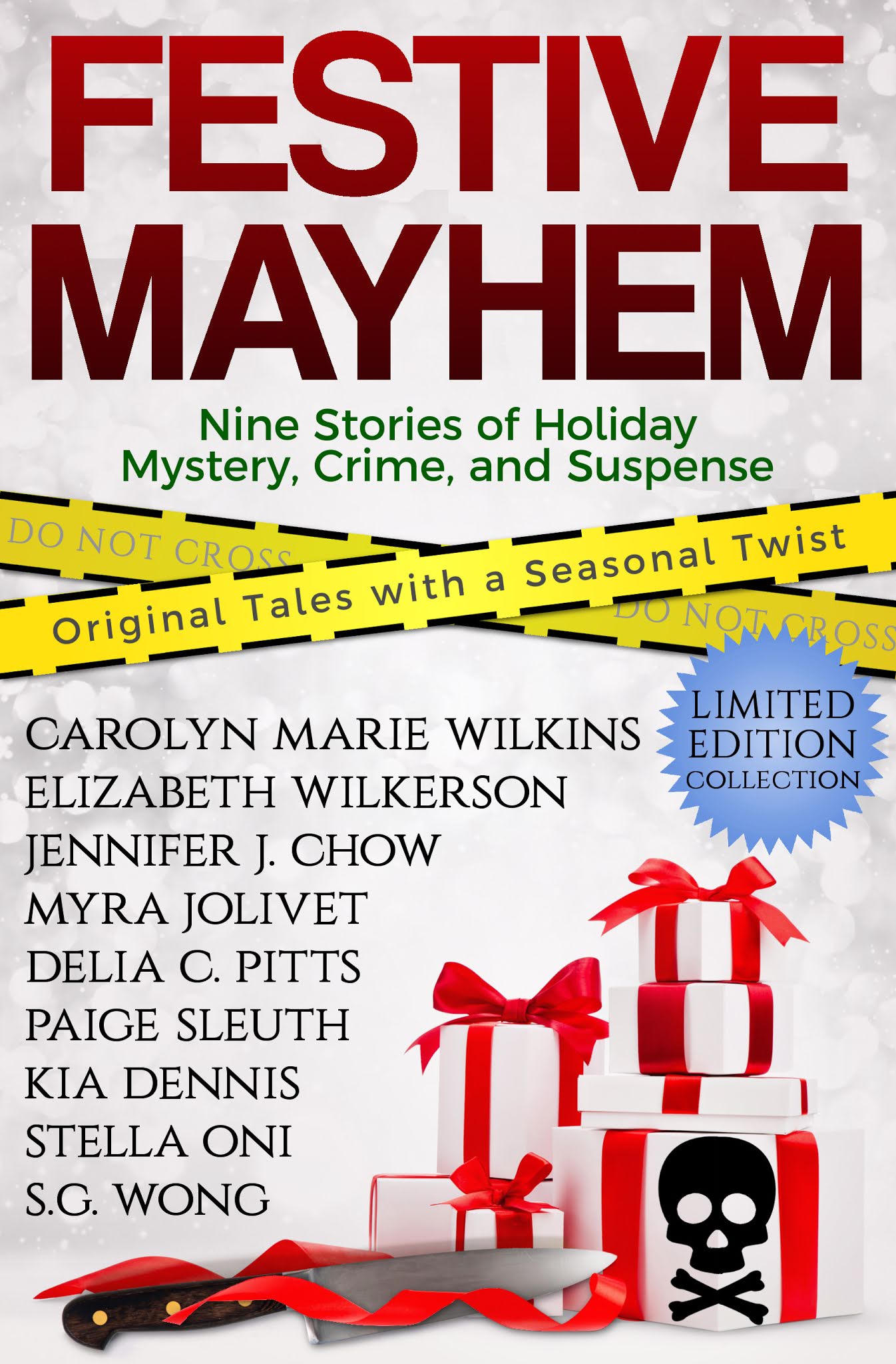
Last year, I decided to challenge myself by writing to a theme and submitting my work. I’m happy to announce that my short stories were accepted by two anthologies. The first, Festive Mayhem, is a collection of holiday-themed tales of suspense and mystery. The stories range in flavor from warm and cozy to downright cold. Here’s a rundown of the works you’ll find in the collection:


• "The New Year's Hex" by Carolyn Marie Wilkins. Carrie McFarland finds her New Year's plans derailed when a psychic vision pulls the 1920s African American amateur sleuth into someone's evil scheme.
• "Pipe Dreams" by S.G. Wong. In this hard-boiled Crescent City short story, infatuation and passion drive Minnie Chen straight into danger as she tries to best the City's most glamorous private detective in a reimagined 1930s-era Chinese Los Angeles.
• "A Christmas Tip" by Elizabeth Wilkerson. A surprise Christmas bonus becomes too tempting for Philadelphia nursing assistant Brianna Byers to resist—even if accepting requires some skillful skirting of the law.
• "The Stranger in the House" by Stella Oni. This London House Mystery prequel stars Elizabeth Ojo, a Nigerian housekeeper at a posh guest house, who finds her Christmas intersecting with that of a mysterious resident in trouble.
• "What Lies Inside" by Kia Dennis. A tormented university professor falls deeper and deeper into a destructive obsession in this harrowing tale of love and longing.
• "A Deadly First" by Delia C. Pitts. Thanksgiving takes a fatal turn when New York private eye SJ Rook finds himself thrust into his first murder case in this darkly atmospheric tale of noir.
• "The Holiday Murder MĂ©lange" by Myra Jolivet. This Sarah Doucette Jean-Louis short story follows the Creole P.I. around the San Francisco Bay Area on her quest to figure out who killed a man outside of her office.
• "Those Holiday Blues" by Jennifer J. Chow. Jasmine, aka "Jazz," can't escape the tragic past when an old boyfriend asks to meet on the anniversary of his mother's death.
• "Holiday Holdup" by Paige Sleuth. In this Cozy Cat Caper Mystery Short, Imogene Little gets tangled up in a Christmas Eve bank robbery orchestrated by none other than Santa Claus himself.


The second anthology releases in fall of 2021. Spearheaded by our very own Abby L. Vandiver, it’ll be published by Crooked Lane Books. The collection will feature original mystery and crime stories from nineteen authors of color. 


(Photo credit: Abby Vandiver)

Although my mystery writing specialty is cozy series, I’ve veered off course for these anthologies. The stories in them are more chilling than my usual fare. I think I needed a break from the same type of writing, and I also wanted to stretch my creative wings. Sometimes I doubt myself and wonder if I should have strayed from my typical writing style. Share your thoughts below.


Do you prefer stories similar to an author’s previous works? Why or why not?

Sunday, January 19, 2020

What Came Before?


 by Kaye George

This article was drawn to my attention by fellow mystery writer, Molly MacRae;

by darnok

The author talks about how her profession in mathematics feeds her writing. Her discussion also concerns logic. It’s easy to see how that is useful in putting together a plot!

by GeoffS
The article got me to thinking. What do our previous lives bring to our writing? For me, how have my many jobs/professions/careers helped my mystery writing? Honestly, how could they not? I have contended before, that what comes out of a writer’s mind is a mishmash of everything that’s ever gone in, gotten stirred up, combined, recombined, and emerged as what sometimes looks like an original idea. 


I’m lucky in that I’ve had a whole lot of prior occupations. I started babysitting at 15, waitressing a couple of years later. On school breaks and in the summer, more waitressing, cooking, even dishwashing once (never again), nurse’s aide, factory janitor, nanny. Then, after marriage, I worked civilian for the Army for a year before following Hubby around the country working at secretarial and bookkeeping jobs. 
by Erean


My college major, in case you’re wondering, was Russian Studies, which in no way prepared me for any job I ever had. (But helps reading Greek just a bit.) In college, I envisioned being an interpreter, but Viet Nam and marriage turned out not to be the path to that career. 
by Ferval


Along the way, I always played violin in local groups: community orchestras and string quartets. And we had three kids, so child-raising is part of my rĂ©sumĂ© too. And puppy training, kitten training, goldfish care, fish care, newt care, and probably some I’ve forgotten about. (And, now, grand-mothering.)

I finally settled down and worked at computer programming for about 15 years before retiring from that to write mysteries. 
IBM mainframe  By Ing. Richard Hilber - Self-photographed, Public Domain, https://commons.wikimedia.org/w/index.php?curid=8724964


Right after being a mom and grandma, this is the best job I ever had. I’m so glad I made it to this stage!

What former positions have influenced my writing? All of them, of course.

A few of the more obvious ones for me~~
From the food industry: recipes for my cozies
From music: a series with a composer/conductor as sleuth
From moving all over the country: locations galore that I can use for novels and short stories
From office jobs: work relationships
From family: family relationships

Relationships are a big part of my writing. What we are today is a result of every relationship we ever had, every job we ever had, every book we ever read, every movie we ever saw, every piece of music we ever listened to, every place we ever lived and visited.

It has just occurred to me that this is another way to answer the perennial question: Where do you get your ideas? I’ll have to remember this!

Sunday, October 6, 2019

Left High and Dry


by Kaye George

What to do when you’re left high and dry? That is, when your nice little small press goes away, the one that published the series that starts with the first serious mystery novel you deemed worthy. The mystery novel you worked on for ten years. The mystery novel that tells of an alternate life you might have led, had things gone differently.

Me playing an outdoor wedding in Dallas; daughter was my page turner
I’m a life-long classical violinist, from the age of ten anyway. So when I started out to write in this genre, I created a character who was also a classical musician, but a keyboardist, just so she wouldn’t be exactly like me. And I had her become a composer and conductor, two things I’ve dabbled at, but never did for a living. I guess you could say Cressa Carraway is my alter-ego. 


During the ten years I took to get the first novel in shape (never mind the two I wrote before that—they’re hopeless), I took classes, learned about critique groups, joined writers’ organizations locally and, eventually, online. In other words, it took me about ten years to learn how to write a mystery.

Then I started querying agents. I learned that classical music is not considered by them to be a popular hook. I ignored those who said that and kept querying. For a long time. I ran out of agents and started on small presses. Lo and behold, Barking Rain Press decided to take it. I was thrilled! (It wasn’t my first novel accepted—I wrote a few more during that ten years and had two others accepted by other small presses, but it’s my first baby.) It even became a Silver Falchion Finalist at Killer Nashville.


I wrote a sequel and Barking Rain published that one, too. The series even acquired some fans. Things were going well!


Then I got sidetracked on other projects, always meaning to get that third one written. Soon, soon. But, before that happened, things started getting out of kilter at BRP. Royalty statements were late. Payments were late. Communication was extremely poor. I had asked for my rights back from another small press where I had disastrous experiences and ended up self-publishing that series. So I decided to get my rights back for this series, too.

Just about the time the second book reverted to me, BRP announced they were going to shut down! Good timing on my part, for once. So, what to do next? 
morguefile.com by lauramusikanski


CreateSpace, the self-publishing tool I used, wasn’t there anymore. Oh brother! What a bother. I actually DID come up with an excellent solution, but I have to leave you with a teaser—can’t tell you yet what will happen. Tune in two Sundays from now!

Sunday, July 14, 2019

With a Little Help from My Friends


More help than I even planned, for this—my first blog here!


Here’s what I planned to say…

There’s no other kind of writer I’d rather be than a mystery writer. Yeah, journalism would be sexy and exciting, getting sent to areas of conflict, doing undercover work, revealing corruption. Oh, you say you don’t start out that way? It’s mall openings and Elk meetings for quite a few years?

Romance writing sounds intriguing. Think of the research, right? Then there’s literary writing. Those are the books that make it to the top of the best-seller lists.

But mystery writing is the best. You know why? Because of mystery writers. They are the best. Even people who are not mystery writers notice it. We don’t backstab. We support each other. We’re genuinely happy when a colleague breaks into print, gets a fantastic review, wins an award.

Our conferences are the best. Many of us write in solitary seclusion much of the time, isolated from one another—our fellow humans and even our fellow mystery writers. But a conference is chance to get together with our own kind. We’re delighted to tour a forensic anthropology lab. 


We love talking about poisons and weapons. We even overcome our fear of public speaking to be on panels before incredibly friendly, supportive, and interested audiences.


Take for instance, this blog. Here we are, a bunch of mystery writers supporting each other.

Here’s the unplanned part:
My fellow blog mates support even me, who is late posting on my very first day!
I am so grateful to have been asked to participate here. This is an awesome bunch!
Thanks!! (And feel free to edit out the exclamation points, if needed.)

Thursday, June 7, 2018

Once Upon a Time


Once upon a time long, long ago, someone told a story while sitting around a fire. Of course, we have no idea exactly when story telling began or who that first story teller was. It doesn’t matter who the storyteller was, or who all the forgotten storytellers who followed were. It was an attempt to make sense of the world.


The beginning stories; myths, folktales and fairy tales, usually had elements of magic like dragons, wizards, witches, talking animals or magic objects like magic mirrors, a magic ring and even beans as in Jack in the Beanstalk. The number three was often important in those stories, too, like in The Three Little Pigs, Goldilocks and the Three Bears, The Three Wishes, and The Three Billy Goats Gruff to name a few. The number three carries on with three main characters; victim, villain and the hero who goes on a quest to save the victim or thwart the bad guy and often has to fulfill three challenges to reach his goal. The only heroine I can think of offhand in those early tales was Gretel in Hansel and Gretel, who killed the evil witch and saved Hansel.


Over the years the stories have been altered and changed, but many sill followed the same motif of good conquering evil with a happy ending as in The Chronicles of Narnia and The Harry Potter series. This is not true with more modern literary works, but it still holds true with most mysteries, albeit with an absence of magic except in some paranormal mysteries.

I have always enjoyed reading folktales and took a class in college about folktales. It was one of my favorite classes. Folk tales have been told all over the world. Much of the fairy tales originated in folk tales like Cinderella which comes from France as does Puss in Boots and  Beauty and the Beast and others. The Fisherman and his Wife, Little Red Riding Hood, and many, many others came from Germany. In North America there was People Who Could Fly, The Wonderful Tar Baby Story (Uncle Remus) and Paul Bunyan’s Cornstalk, and many more told by American Indians.


Some authors have picked up on the fairytale or folklore theme and altered them like Gregory Maguire, the author of Wicked Confessions of an Ugly Stepsister, and others written from the point of view of one of the characters from a fairytale. The same was done even earlier with children’s books like The True story of the 3 Little Pigs! By A. Wolf as told to Jon Scieszka. One of my favorite children’s picture books was An Undone Fairy Tale by Ian Lendler in which the princess locked in the tower by her wicked step-father in the end rescues Sir Wilber, who comes to rescue her. It’s a delightfully funny tale immensely enjoyed by all the classes I’ve read it to both in my own classes and in the many classes I substituted for later.


Because we live in a world often filled with violence, dishonesty, and unfairness, we still hope for the happy ever after ending portrayed in many fairy tales even though deep in our minds, we know it can’t always be that way. Of course, some fairy tales are cautionary tales like The Fisherman and His Wife or The Emperor’s New Clothes, but most mysteries, other than noir, and especially in cozies, do follow the fairy tale motif ending of: “and they lived happily ever after,” unless it’s part of a series where we’re only given hints that if we keep reading the series it eventually will be with a happy ever after ending.
Of course it’s rarely the same joyful tripping down the path of happiness we envisioned when Cinderella was romanced by the handsome Prince Charming, and they went off to live in his castle where her life then became perfect; no quarrels, no problems, no dirty diapers, no sickness, and all was love and laughter, Sigh.


No, mysteries are more realistic than that. However, we do have the same motif; victim, villain, and hero/heroine. The heroes or heroines may be flawed. In fact, that makes them more interesting if they are. The reader may not know who the villain of the story is in advance, but will follow with the hero/heroine’s quest to bring the villain to justice, trying to figure it out as they read along, either who the villain is or how the villain will be uncloaked. Usually the hero or heroine has a friend or sidekick, although not seven dwarfs like Cinderella had, but someone to bounce ideas off of and help them when necessary. There may not be a Cinderella ending, but it almost always brings satisfaction to the reader because justice, at least in mysteries is served. And that’s what makes mysteries so popular. It brings a sense of justice to the reader. At least it does until they pick up a newspaper or turn on the TV.


Do you like happy endings in your mysteries?
Do you like folk tales or Fairy Tales?

Thursday, February 9, 2017

The Amish Books of Linda Castillo


Last July Amanda Flower, a writer of multiple cozy series at least one or more dealing with the Amish, and Hudson, Ohio Librarian, and member of our NeoSinc chapter, asked us  to come to hear an author named Linda Castillo who would be speaking so there would be a good turn-out. I hadn’t heard of her before, but to support Amanda, I went to hear this author and was fascinated by her talk about how she came to writing the books she writes and her path to writing, especially the Amish thrillers she writes.
Sugar Loaf Nursery the first one my sisters and I visit each spring.

Because I’ve lived within easy driving distance of the Amish for years, and shopped at their stores, garden centers, and had other contact with them, I’m interested in the Amish and like any books dealing with them. Also many Amish families have been moving into the township where I live. I’ve had Amish put a roof on my barn and my sun room, and one who takes care of my ponies’ hooves. I’ve had them bring hay to my barn and store it for me. He had to use a guy with a truck who wasn’t Amish, of course.

Linda originally came from the area where her Kate Burkholder series is set in Holmes County, and now lives in Texas with her husband, but she has retained her knowledge of the Amish in the county. She told us she returns every so often to the area to visit people she knows, and to refresh her memories of the Amish. I bought the first three books in her series, and was totally hooked and ended up ordering all the other ones, too, and can’t wait for her next one to come out this summer.


Castillo’s Kate Burkholder is a break-away Amish woman, who is now sheriff of the small fictional town of Painters Mill, in Holmes County. She deals with the English-Amish divide since she was banned because of walking away from her religion in her late teens. What helps her is that she still is able to speak Pennsylvania Dutch, and understands their reticence about reporting any crimes to the English. So even though they don’t want to tell her things that would help her solve murders and other crimes against the Amish, she can still sometimes get them to co-operate because of her background with them. I found it interesting that when Castillo writes dialogue using their language; it’s in italics with the English translation following in normal print. Also, there was one book where Kate and John traveled to a county in N.E. Ohio and drove on roads and through towns I know well.


Kate Burkholder is an interesting character with something in her background she keeps a secret.  Enter John Tomasetti, a BCI agent from Columbus, who has a dark background, too. He was sent to help Kate solve the crime in Painters Mill. There’s friction between them, but also an attraction, which builds in each of her following books. I like the officers who work under her, and the descriptions of an Amish area I can picture so well. Even though it takes place in a small town in a rural area, there is nothing cozy about Castillo’s books. They’re suspense/thrillers hard to put down. I lost a lot of sleep reading them.
Her latest book in the series until this summer

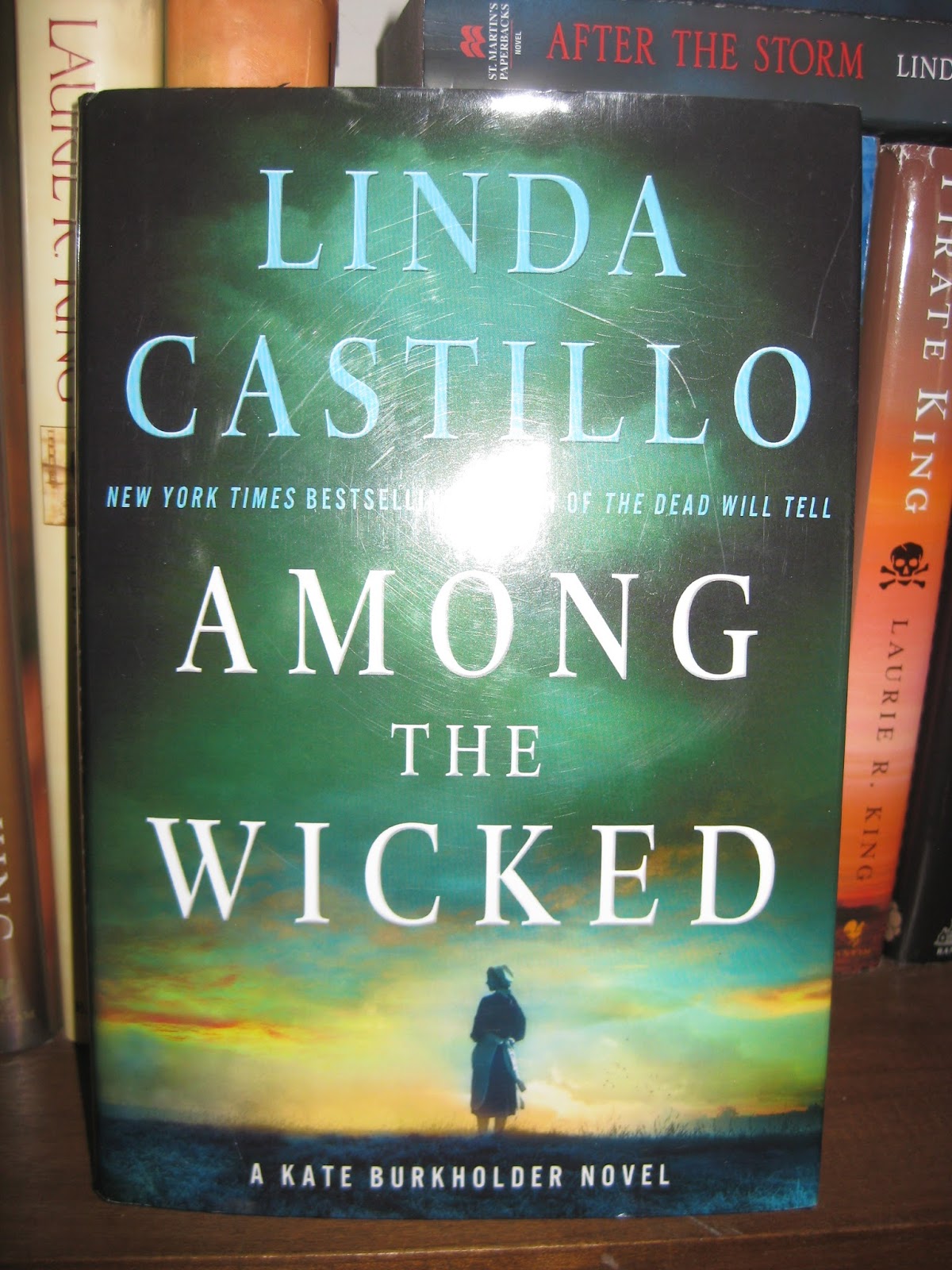
Linda Castillo’s first book in the series, is Sworn to Silence which won numerous awards and was on the Times Best Seller list for four weeks. Her following books in order are Pray for Silence, Breaking Silence, Gone Missing, Her Last Breath, The Dead Will Tell, After the Storm, and Among the Wicked. Her next one is supposed to come out this coming summer, and I can’t wait to read it.

Linda Castillo has written other books, too. According to her website, she’s written thirty books for three New York Publishing houses, and has won numerous awards for her books. The two I’ve read that are not Amish, take place in Texas the state she lives in now. I liked those, too, but they weren’t a series, and I really like mysteries with characters I’ve grown familiar with coming back.

Sworn to Silence was made into a two hour movie re-titled An Amish Murder. I’m not sure how to get it, but I might be able to find it on Amazon.


How familiar with the Amish culture are you?

Have you read any Amish mysteries?

Monday, November 9, 2015

Mystery Solved!

by Shari Randall

Life presents us with big mysteries and small mysteries. The big mysteries (Why are we here? Who built the giant heads on Easter Island? Where do all those missing socks in the dryer go?) are the ones we have to live with. In time, a brilliant archeologist or philosopher may give us the answers to these big questions, but we can live with these mysteries because they don’t impact our every day life. Well, sometimes the missing socks mystery does, but we just buy more socks. Some mysteries can be managed just fine without a definite solution.

The smaller mysteries are the ones that we can sometimes clear up ourselves. My friend Donna heard a strange rapping sound behind the wall in her bedroom. Upon investigation, it turned out a woodpecker had gotten in through a hole in the siding (and thank goodness her handyman was able to get the woodpecker out again!)

When I moved into my home on the New England shore, I couldn’t figure out why the head of the bed in the master bedroom was pushed up against the large picture window in the front of the room.  

Sure, the window overlooks the water, but the view is hard to admire when sleeping with my head against the windowsill. And when I say head of the bed, I mean the mattress. This beach house bedroom is pretty barebones; the bed is a mattress and box spring – no headboard or footboard.

We decided to leave the bed where it was; we had plenty of other household tasks to worry about. Besides, the sound of the waves that played softly outside the window was restful.

A few nights later, light peeking around the edges of the blinds woke me up. I rolled onto my stomach and pulled the blinds aside.

Photo taken with cell phone.
The moon had risen and had spilled a shimmering silver path directly across the water to our front door. At least it looked that way. I’ve lived near a city for so long that seeing the sky without light pollution was a revelation. Without ambient city light, the sky and the sea were a perfect black velvet backdrop to the moon, bigger and clearer than I’ve ever seen at home in the suburbs of northern Virginia.

A few nights later my husband and I settled into bed, lying on our stomachs, heads propped on our pillows, looking out at the stars. The constellation Orion, belt glittering, filled our window. Then just before dawn a few days later, my husband woke me to see the planets Venus and Jupiter, larger and brighter than either of us had ever seen them before, shining as deep pink and gold sunlight streaked the horizon. The sight was so wonderful that I didn't even mind the early wake up call.

Finally, the placement of the bed by the window made sense. Mystery solved! Our east facing window was a perfect spot for stargazing.

Seeing the stars that are usually obscured by the light pollution of my home in the suburbs also cleared up a literary mystery. Wendell Berry wrote a poem, “The Peace of Wild Things” about the solace he found in the natural world. Now that I had observed the beauty hidden by the light, his lines suddenly made sense:

“And I feel above me the day-blind stars
waiting with their light.”

Have you solved any mysteries – small or big - at your house?