Showing posts with label Mystery in the Midlands. Show all posts

Tuesday, October 21, 2025

Mystery in the Midlands: Writing Short Mystery Fiction 2025

by Paula Gail Benson


For the second year in a row, author and editor Michael Bracken joined with the Palmetto Chapter of Sisters in Crime and the Southeastern Chapter of the Mystery Writers of America to present a virtual program on writing short mystery fiction. We were delighted to have 189 registrants. Between 65 and 75 attended the sessions live on Saturday and dozens have asked for access to the recording.

The lineup of speakers and panelists was phenomenal. After resolving a few technical difficulties, we began with John M. Floyd, author of more than 500 stories that have appeared in Alfred Hitchcock’s Mystery Magazine, Ellery Queen’s Mystery Magazine, Strand Magazine, Best American Mystery Stories, Best Mystery Stories of the Year, and many other publications. He gave us a primer on plotting, saying that he began with a plot first, then populated it with interesting characters.

John recommended Ronald B. Tobias’ Twenty Master Plots and How to Build Them, which defined a story as a series of related events. For example, the king died, then the queen died was a story. However, the king died, then the queen spit on his grave became a plot, or a series of related events that introduced suspense and made the story readable and interesting.

He emphasized the importance of remaining observant because ideas might come from everywhere. When he was working for IBM, he traveled a great deal. He mentioned two instances when he encountered information he stored away for possible plots: (1) not being able to scuba dive within 24 hours before flying, and (2) losing or gaining a day when crossing the International Date Line.

Following John Floyd, Michael Bracken moderated a panel of New Voices in Short Mystery Fiction, consisting of N.M. Cedeño, whose short stories have appeared in science fiction and mystery publications; LaToya Jovena who writes about the D.C. suburbs and whose work has appeared in Ellery Queen’s Mystery Magazine and The Best American Mystery and Suspense; and Tom Milani, who since 2022 has published ten short stories, a novella, and a novel and whose work has been short-listed for a Derringer Award. N.M. spoke about being runner up for several of AHMM’s Mysterious Photo contests. She then wrote a full story which EQMM rejected but was accepted by Analog when her brother-in-law suggested she submit it there. Latoya emphasized perseverance—never giving up in spite of the obstacles. Tom mentioned how helpful his writing critique group had been, particularly for hearing when something did not seem to work for many readers.

In the last segment, I moderated a discussion with three wonderful editors: Barb Goffman, who has won the Agatha, Anthony, Derringer, Macavity, Ellery Queen Readers Award, and the Short Mystery Fiction Society’s lifetime achievement award as well as edited or co-edited 15 anthologies; Sandra Murphy, whose stores have appeared in Alfred Hitchcock’s Mystery Magazine, Ellery Queen’s Mystery Magazine, and other publications and who has edited 4 anthologies; and Josh Pachter, author, editor, and translator, who joined us from Morocco. They all emphasized the importance of following instructions but also being creative in developing a story to meet the theme. In addition, they gave viewers a lot of good information about currently pending anthologies and how to find submission calls.

If you would like to view the recording, connect to the link below by pressing CTRL (control) and clicking on the link:

https://us02web.zoom.us/rec/share/iZh6oa8BgBpUUzPDxu1nDwpbbfmq8sWcKe7KT4XdknrONPNVGTaNvsG6X-m3k3HS.OG0O8fzM1XHqDPtt?startTime=1760799152000

When prompted, enter the Passcode below.

Passcode: 7Zb@%i5f

Do you write short stories? Why do you enjoy that format? 

Tuesday, October 15, 2024

Free Program about Writing Mystery Short Stories

by Paula Gail Benson

More and more authors are considering writing short stories, to tell parts of their characters’ adventures between novels or to experiment with different types of storytelling. Fortunately, we are experiencing a time when magazines and anthologies give excellent opportunities for entering the short story field.

In May, Michael Bracken, author of almost 1,300 short stories and an Edgar Award nominee, Shamus Award nominee, Derringer Award winner, and the Edward D. Hoch Memorial Golden Derringer Award for lifetime achievement in short mystery fiction, launched ShortCon, the Premier Conference for Writers of Short Crime Fiction. An in-person gathering in Alexandria, Virginia, ShortCon will take place again this year on Saturday, June 7. Please check it out at this link.

Meanwhile, if you would like to attend a virtual conference dedicated to short story writing and FREE, please consider this year’s Mystery in the Midlands: Writing the Short Story. The Palmetto Chapter of Sisters in Crime and the Southeastern Chapter of Mystery Writers of America have collaborated with Michael Bracken to bring you some of crime fiction’s phenomenal practitioners.

WE HOPE YOU CAN ATTEND!

 Here’s the information to register for the program, to be held this Saturday, October 19, 2024:

FREE—JUST REGISTER

MYSTERY IN THE MIDLANDS: WRITING THE SHORT STORY

VIRTUAL CONFERENCE—SATURDAY, OCTOBER 19, 2024

11:15 AM TO 2:45 PM EASTERN TIME

10:15 AM TO 1:45 PM CENTRAL TIME

9:15 AM TO 12:45 PM MOUNTAIN TIME

8:15 AM TO 11:45 AM PACIFIC TIME

Do you write mystery short stories? Would you like to learn how?

The Palmetto Chapter of Sisters in Crime and the Southeastern Chapter of Mystery Writers of America are proud to present this FREE conference featuring some of today’s most expert mystery authors to unlock the craft and business of writing the short story.

 Register in advance for this meeting at the following link:

https://us02web.zoom.us/meeting/register/tZIsdu2spj8rHdQA5w1n6kKl9rC1dY6Ack6m

After registering, you will receive a confirmation email containing information about joining the meeting.

PROGRAM

11:15 AM/10:15 AM/9:15 AM/8:15 AM                 WELCOME


11:30 AM/10:30 AM/9:30 AM/8:30 AM                 Crafting the Short Story—Art Taylor


12:30 PM/11:30 PM/10:30 AM/9:30 AM                New Voices in Short Mystery Fiction—Ashley-Ruth M. Bernier, James A. Hearn, and Stacy Woodson (moderated by Paula Gail Benson)


1:30 PM/12:30 PM/11:30 AM/10:30 AM                The Business of Short Story Writing—Michael Bracken


2:30 PM/1:30 PM/12:30 PM/11:30 PM                   CONCLUSION


FACULTY:

Art Taylor (www.arttaylorwriter.com) is the Edgar Award-winning author of two short story collections—The Adventure of the Castle Thief and Other Expeditions and Indiscretions and The Boy Detective & The Summer of ’74 and Other Tales of Suspense—and of the novel in stories On the Road with Del & Louise, winner of the Agatha Award for Best First NovelHe won the 2019 Edgar Award for Best Short Story for “English 398: Fiction Workshop,” originally published in Ellery Queen’s Mystery Magazine, and he has won three additional Agatha Awards, an Anthony Award, four Macavity Awards, and four Derringer Awards for his short fiction. He edited Murder Under the Oaks: Bouchercon Anthology 2015, winner of the Anthony Award for Best Anthology or Collection, and California Schemin’: Bouchercon Anthology 2020. He is an associate professor of English at George Mason University, and he has contributed frequently to the Washington Post, the Washington Independent Review of Books, and Mystery Scene Magazine.

Ashley-Ruth M. Bernier (www.ashleyruthbernier.com)’s work has appeared in Ellery Queen Mystery MagazineBlack Cat WeeklyStone’s Throw, Smoking Pen Press, Malice Domestic's Mystery Most Devious, The Best American Mystery and Suspense 2023, and other anthologies. Originally from St. Thomas, U.S. Virgin Islands, Ashley-Ruth writes mysteries highlighting the vibrant culture of her home. She currently lives with her family and teaches first grade in North Carolina. 

James A. Hearn (www.jamesahearn.com), an Edgar Award nominee for Best Short Story, writes in a variety of genres, including mystery, crime, science fiction, fantasy, and horror.  His work has appeared in Alfred Hitchcock’s Mystery Magazine, numerous anthologies, and has been selected for inclusion in Best American Mystery and Suspense.

Stacy Woodson (www.stacywoodson.com) made her crime fiction debut in Ellery Queen’s Mystery Magazine’s Department of First Stories and won the 2018 Readers Award. Since her debut, she’s had almost forty stories accepted for publication, one adapted for animation. She’s a two-time Derringer award winner, a Macavity Award and Thriller Award nominee, and has a story included in Best Mysteries of the Year 2024. When she’s not writing, she co-edits anthologies with Michael Bracken.

Paula Gail Benson (www.paulagailbenson.com), a legislative attorney, has thirty plus stories that have appeared online and in anthologies including Mystery Times Ten 2013; A Tall Ship, a Star, and Plunder; A Shaker of Margaritas: That Mysterious Woman; Fish or Cut Bait: a Guppy Anthology; Killer Nashville Noir: Cold Blooded; Love in the Lowcountry; Heartbreaks and Half-truths; Malice Domestic’s Mystery Most Diabolical; Dark of the Day; and Smoking Guns.

Michael Bracken (www.CrimeFictionWriter.com) is an Edgar Award and Shamus Award nominee whose crime fiction has appeared in The Best American Mystery Stories, The Best Mystery Stories of the Year, and many other publications. Additionally, Bracken is the editor of Black Cat Mystery Magazine and several anthologies, including the Anthony Award-nominated The Eyes of Texas. In 2024, he was inducted into the Texas Institute of Letters for his contributions to Texas literature. 

Tuesday, July 19, 2022

Sharing the Writing Experience

by Paula Gail Benson


Earlier this year, I wrote about two Sisters in Crime Chapters (Capitol Crimes and Palmetto) planning and executing a virtual program. Last month, I mentioned a cooperative effort between the Palmetto Chapter of Sisters in Crime and the Southeast Chapter of Mystery Writers of America (SEMWA), Mystery in the Midlands, which began as an in-person event, then has been virtual the last three years because of Covid. Needless to say, I’ve spent a lot of this year working with authors I did not know, as well as  trying to figure out the most meaningful and economical ways of sharing information that both writers and readers could appreciate.

Planning these events takes a lot of work. It really helps to have dedicated, supportive folks pulling together.

Both times, we had that. I’ve been particularly grateful to get to know the members in the Capitol Crimes Chapter (which is across the country from me) and to learn more about the SEMWA board members who don’t live near me. While our energies were directed toward the projects, we still had time to talk with each other about our own writing. It always amazes me to hear the types of work and methods of approach that other authors have. Not only does it give me ideas about how to improve my craft, it also gives me a larger “to be read” list!

Clockwise from top left: Shawn, Dana, Joseph, and Alan

During this past weekend, that happened with the third virtual Mystery in the Midlands. We had three panels and a keynote interview. Our ten participating authors were all superstars. Dana Kaye, our moderator and facilitator, made  her work look effortless and took care of all the technical concerns as well as asking wonderful questions.

The first panel featured short story authors and editors. Alan Orloff, whose Young Adult novel I Play One on TV, won this year’s Agatha and is nominated for the Anthony, spoke about the need to leave gaps so that readers can make leaps. Shawn Reilly Simmons, an Agatha and Anthony winner and editor at Level Best Books, gave an example of finding a name for a character from a wine bottle. Amazingly, Shawn writes her own stories while editing other authors’. Joseph S. Walker, who has written more than fifty stories while working full-time as a college professor, emphasized the importance of  well-chosen details for developing a sense of place in a short story. All three recommended reading stories written by Edgar, Derringer, Agatha, and Anthony award winning author Art Taylor.

Hank and David
For the keynote, marvelous David Heska Wanbli Weiden, whose debut novel Winter Counts was a multiple award winner, was interviewed by the incredible Hank Phillippi Ryan. This segment exemplified what happens when two fabulous authors speak craft and career. David revealed that his protagonist in Winter Counts originally died in a short story, but David could not let him go, so he returned in the novel. At first, David thought he was writing about tribal justice, but after eighteen revisions, he realized the theme of the work was identity. He was very pleased that the novel had been read by Congressional aides who have contacted him about possible revisions in federal law.

Raquel, Daryl, and Abby

The cozies panel was delightful with authors Daryl Wood Gerber (Agatha winning author of three series), Raquel V. Reyes (Lefty winning author whose debut novel has just been optioned for the screen), and Abby L. Vandiver (who writes under three names and who as an anthology editor has been nominated for an Anthony). Abby said in her writing and in advice to students she suggested to always have characters eat, spend money, and pee (the three connectors in the human condition). She mentioned that food and pets were definitely relatable. Raquel mentioned that while some people made the recipes in the books, many just liked to read how dishes were put together. Daryl said while ingredients may be the same, the differences in recipe descriptions made them unique and added to the elements in the story.

Hallie, Hank, and John

In the final panel, Hallie Ephron (New York Times bestseller, Edgar Award finalist, and five-time finalist for the Mary Higgins Clark Award), Hank Phillippi Ryan (USA Today bestselling author and five-time Agatha Award-winning author of 13 thrillers and winner of 37 Emmys for investigative reporting in Boston), and John Hart (author of six New York Times bestsellers and the only author in history to win the best novel Edgar Award for consecutive novels) spoke eloquently about setting and suspense. Hank mentioned that setting could be weather or clothing and different in perspective if an adult or child. She showed a sticky note she kept on her computer with the words “Be There.” John said if the writer wasn’t there, the reader wouldn’t be. He encouraged engaging the senses, especially smell, and talked about creating the internal, emotional landscape. Hallie’s novels often take place within a house. She takes into consideration family, relationships, and how a character feels stepping into a place. She emphasized developing an intersection between character and setting.

Dana, Hank holding Winter Counts, and David

Thank you to all those participating in the program, those viewing it, and those who put it all together. Saturday was a great day for learning and sharing.


What meetings and conferences (virtual or in-person) have you found helpful this year?  

Tuesday, June 21, 2022

MYSTERY IN THE MIDLANDS: A Virtual Program with 10 Authors for $8

 by Paula Gail Benson

           Question: Where do you have the opportunity to spend 4 and ½ hours with award- winning mystery and suspense novelists all for the cost of a single e-book or paperback?

            Answer: Mystery in the Midlands (hosted by Palmetto Chapter of Sisters in Crime and Southeastern Chapter of Mystery Writers of America), which began as a mid-summer conference in “Famously Hot” Columbia, S.C. For the third year, this is a virtual event through Crowdcast.

            Date: Saturday, July 16, 2022

            Cost: $8 (to defray event costs)

            Link to register: https://www.crowdcast.io/e/mystery-in-the-midlands-3/register

           Books will be available through our virtual bookstore, Fiction Addiction, based in Greenville, S.C. (bookseller: Jill Hendrix).

            If you are not able to attend virtually on the day of the event, by registering, you can access the recorded panels at your leisure.


Here’s the schedule and a little about the participants:

Raise the Temperatures with a Warm Welcome

10:30-10:45 am ET/9:30-9:45 am CT/8:30-8:45 pm MT/7:30-7:45 pm PT

Dana Kaye, Lynn C. Willis President of SEMWA, and Carla Damron President of Palmetto Chapter SinC


Shorts that Pack Heat

11:00-11:45 am ET/10:00-10:45 am CT/9:00-9:45 am MT/8:00-8:45 am PT

Alan Orloff, Shawn Reilly Simmons, and Joseph S. Walker


Alan Orloff has written more than 35 short stories and his YA novel I Play One on TV won this year’s Agatha and is nominated for an Anthony.


Shawn Reilly Simmons is Managing Editor at Level Best Books and has won the Agatha for her short stories and the Anthony for an anthology she edited.


Joseph S. Walker is the winner of the Bill Crider Award, given at the Dallas Bouchercon, and has published more than 50 short mystery stories.


Sizzling Keynote

12:00-12:45 pm ET/11:00-11:45 am CT/10:00-10:45 am MT/9:00-9:45 am PT

David Heska Wanbli Weiden interviewed by Hank Phillippi Ryan


Our keynote is David Heska Wanbli Weiden, an enrolled citizen of the Sicangu Lakota Nation, and the author of Winter Counts, which was nominated for an Edgar Award, and won the Anthony, Thriller, Lefty, Barry, Macavity, Spur, High Plains, Electa Quinney, Tillie Olsen, CrimeFest (UK) and Crime Fiction Lover (UK) Awards. He will be interviewed by the wonderful Hank Phillippi RyanUSA Today bestselling and five-time Agatha Award-winning author of 13 thrillers, and winner of 37 Emmys for investigative reporting in Boston.


Served Piping Hot: Cozies with Recipes

1:00-1:45 pm ET/12:00-12:45 pm CT/11:00-11:45 am MT/10:00-10:45 am PT

Daryl Wood Gerber, Raquel V. Reyes, and Abby L. Vandiver


Daryl Wood Gerber is the Agatha Award-winning, nationally bestselling author of The Fairy Garden Mysteries, The French Bistro Mysteries, and The Cookbook Nook Mysteries. As Avery Aames, she writes the Agatha Award-winning, nationally bestselling Cheese Shop Mysteries.

Raquel V. Reyes writes Latina protagonists. Her Cuban-American heritage, Miami, and Spanglish feature prominently in her work. Mango, Mambo, and Murder, the first in the Caribbean Kitchen Mystery series, won a Lefty for Best Humorous Mystery and was nominated for an Agatha award.

Abby L. Vandiver, also writing as Abby Collette and Cade Bentley, is a hybrid author who has penned more than thirty books and short stories. She has hit both the Wall Street Journal and USA Today bestseller lists.


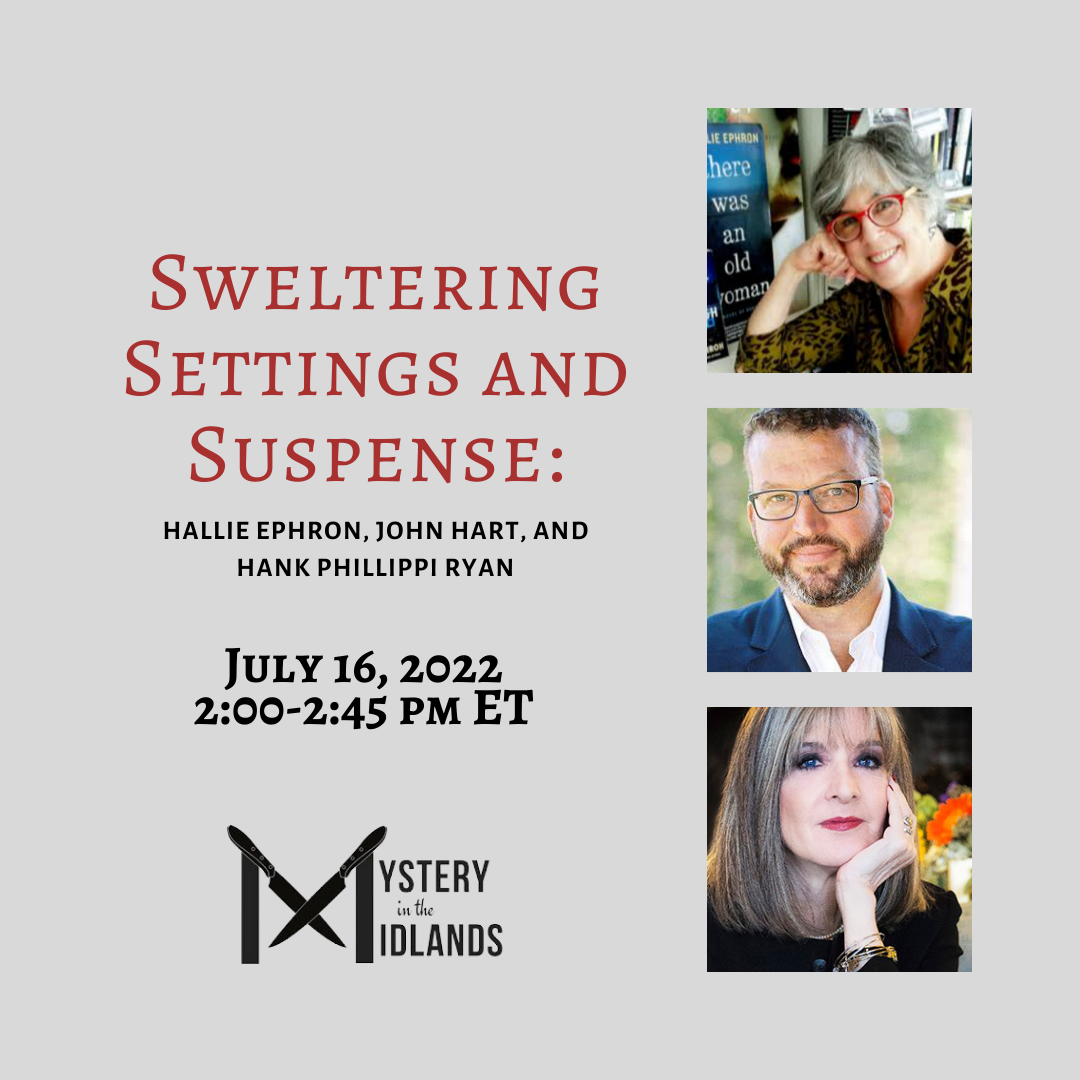
Sweltering Settings and Suspense

2:00-2:45 pm ET/1:00-1:45 pm CT/12:00-12:45 pm MT/11:00-11:45 am PT

Hallie Ephron, John Hart, and Hank Phillippi Ryan


New York Times bestselling author Hallie Ephron has been an Edgar Award finalist and five-time finalist for the Mary Higgins Clark Award.


John Hart is the author of six New York Times bestsellers and the only author in history to win the best novel Edgar Award for consecutive novels.


Hank Phillippi Ryan is the USA Today bestselling and five-time Agatha Award-winning author of 13 thrillers, and winner of 37 Emmys for investigative reporting in Boston.


Final Comments Before Cooling Off in the Pool

3:00-3:15 pm ET/2:00-2:15 pm CT/1:00-1:15 pm MT/12:00-12:15 pm PT

Dana Kaye, Lynn C. Willis President of SEMWA, and Carla Damron President of Palmetto Chapter SinC


So, what are you doing on Saturday, July 16, 2022? Why not join us at Mystery in the Midlands?

Tuesday, May 18, 2021

Join the Tradition: Attend Mystery in the Midlands (Virtually), Part Two


by Paula Gail Benson

Yesterday, in my post for The Stiletto Gang, I encouraged readers and writers to attend the fourth annual Mystery in the Midlands, jointly sponsored by the Palmetto Chapter of Sisters in Crime and the Southeast Chapter of Mystery Writers of America. Today, I’ll provide more information about our keynote speaker and panelists. The event will be held virtually on Saturday, June 26, 2021, from 10:00 am to 2:45 pm ET, and we very much hope for a great attendance.


Our guest of honor is Dr. Kathy Reichs, who will be interviewed by Debra Goldstein. Reichs wrote the Temperance Brennan series, upon which the television show Bones is based. Dr. Reichs has used her experience teaching FBI agents and working in a Montreal lab to bring her forensic thrillers to life. She is one of only 100 forensic anthropologists to ever be certified by the American Board of Forensic Anthropology.


The short story panel will feature Frankie Y. Bailey, Michael Bracken, and Barb Goffman. A PhD and tenured full professor, Frankie teaches “crime” at the University at Albany (SUNY) as well as writing nonfiction and fiction (two series, one with crime historian Lizzie Stuart and the other with police detective Hannah McCabe). Michael has written over 1,300 short stories, edited nine crime fiction anthologies, and won multiple awards for copywriting, two Derringer Awards for short fiction, and the Edward D. Hoch Memorial Golden Derringer Award for lifetime achievement in short mystery fiction. Barb’s short stories have been finalists for national crime-writing awards thirty-two times and she has won the Agatha, Macavity, and the Silver Falchion. Her “Dear Emily Etiquette” has been nominated as Best Short Story for an Agatha and an Anthony and won the Ellery Queen Mystery Magazine Readers Award.


Our panel to discuss how American authors write British historical mysteries will be Laurie R. King, Lori Rader-Day, and Caroline Todd. Laurie has written extensively, both fiction and nonfiction, including the Mary Russell and Sherlock Holmes series, the historical Stuyvesant and Grey series, and police procedurals featuring San Francisco homicide detective  Kate Martinelli. Lori, winner of the Anthony and Mary Higgins Clark awards, is well-known for her contemporary suspense novels and looking forward to the release of Death at Greenway, a historical novel based at Agatha Christie’s home. Caroline, with her son Charles, write the Ian Rutledge and Bess Crawford mysteries. Their over thirty novels have received the Mary Higgins Clark, Agatha, and Barry awards.


The final panel, on writing great suspense, will feature Yasmin Angoe, Robert Dugoni, and Alex Segura. Last year. Yasmin received Sisters in Crime’s Eleanor Taylor Bland Award, and this November, her debut novel, Her Name is Knight, will be published. Robert, critically acclaimed by the New York Times, Wall Street Journal and Washington Post, and #1 Amazon bestselling author of the Tracy Crosswhite series, has sold more than 6 million books worldwide, including his Charles Jenkins espionage novels and David Sloane legal thrillers. Alex, the award-winning author of novels, comic books, short stories, and podcasts, has two pending Anthony nominations, one for Star Wars Poe Dameron: Free Fall (Best Juvenile/Young Adult Novel) and another for “90 Miles” (Best Short Story).

You can register to attend or listen to the recordings from Mystery in the Midlands by clicking the following link:

https://www.crowdcast.io/e/mystery-in-the-midlands-2

The cost is $5 (to help defray our costs). Isn’t that a bargain for this stellar line-up?

I asked these authors some questions and they were kind to share their intriguing answers.

What place would you love to write about that you haven’t already written about?

Yasmin Angoe:

I would love to write about Italy and Greece. There are many places because I’ve only written about a few so far.

Frankie Y. Bailey:

Paris and Ireland. In the seventh book in my Lizzie Stuart series (currently being reissued), I want to send Lizzie and Quinn to Paris on their honeymoon and then on to Ireland (home of Quinn’s ancestors on his father’s side). I’m working on the sixth book now. I’ve been to Paris a couple of times, but never to Ireland. Of course, writing a book set in Tuscany would also be lovely. But Quinn promised to take Lizzie to Paris on their honeymoon and Ireland is an unexpected detour.

Laurie R. King:

Istanbul. I SO want to set a Russell & Holmes story in 1925 Istanbul, if ever I get the chance to travel (Research: it’s work, not pleasure!)  Gorgeous architecture, political complexity, a melting pot of cultures. And hey, I even have a Turkish publisher!

Alex Segura:

I’d love to write a world-spanning spy novel.

Caroline Todd and a bi-plane

Caroline Todd:

What place would you love to write about that you haven’t already written about? Africa! There are so many stories to tell there. But there are already too many great authors who beat us to it.

Have you ever used a real or wished-for pet as a character?

Yasmin Angoe:

Nope, but that’s an idea!

Frankie Y. Bailey:

Yes. I have a Maine Coon in The Red Queen Dies. He has a walk-on scene when the detectives visit the mansion where he lives. But he is crucial to the plot. I did some research on Maine Coons, and I was so fascinated by the size and personality of the cats that I later adopted Harry, a rescue, who was a terrific cat. We had six wonderful years together. After he died, I received a notification about Penelope, a Maine Coon female.  I drove to Danbury, CT to bring her home. We are getting to know each other, but she is a long, lean girl and very sweet. 

In that same book, my Albany police detective protagonist, Hannah McCabe, brings home a Great Dane/Labrador/who knows? puppy. The (real) University at Albany mascot is a Great Dane, and since McCabe is a UAlbany alum, I thought it would be fun to have her adopt a puppywho finally gets a name at the end of the second book, What the Fly Saw.

In my Lizzie Stuart series, her romantic partner, former homicide detective John Quinn, has a dog named George, a Labrador mix that he found on the highway and didn’t intend to keep. I love Labs. My family had one when I was a teenager. But I have a seven-month-old Cavalier King Charles Spaniel who is better suited to my small house. Fergus is still puppy crazy, but he isas multiple strangers have told him as he dragged me over to greet them“adorable”. He and Penelope are getting along well.

Michael Bracken

Michael Bracken:

I have often used my pets as inspiration for animals in my stories, though more often in stories written in genres other than crime fiction.

Robert Dugoni:

I put my animals in my novels all the time, especially if they have passed on. It’s a way for me to keep them alive in my heart.

Barb Goffman:

In my story “Alex’s Choice,” the dog, Maxwell, was named after author Ellery Adams’s childhood dog, but he was modeled in part after my dog Scout. I wrote the story a month after Scout died, and doing so really helped with my grief. For anyone who would like to read it, the story appears in the time-travel/mystery anthology Crime Travel

Laurie R. King:

There’s a dog in one of the Kate Martinelli stories that I adopted from a friend. Or rather, there’s a real fictional dog, that one of the characters in the Martinelli story adopted from my friend Val McDermid’s character, when she—the character—had to move back to England from San Francisco.  Neither Val nor I wanted the poor (fictional) dog to face the lengthy British quarantine, so the dog stepped from Val’s Booked for Murder to my Night Work. Which all goes to answer the question, When is a dog an Easter egg?

Lori Rader-Day and Clementine

Lori Rader-Day:

No, because if you put animals into stories, terrible things often befall them. I couldn’t write a book where I was protecting the dog the entire time.

Alex Segura:

I haven’tthough I did kill my PI, Pete Fernandez’s cat, Costello (named after Elvis Costello) in the second novel in the series, Down the Darkest Street. He was a version of my own, now gone, cat David Byrne. I’ve never gotten angrier fan mail!

Caroline Todd:

After a fan won a pet’s name to be in a Rutledge book, we had to find a story where an adorable dog called Muffin could fit in with murder. Took two books to do that, but when we did, it worked a treat!

We do hope that you’ll be able to join us on Saturday, June 26, from 10:00 am to 2:45 pm ET. Again, here’s the link to register:

https://www.crowdcast.io/e/mystery-in-the-midlands-2 

Won't you consider putting this event on your schedule?

Tuesday, March 16, 2021

Starting with Plot

by Paula Gail Benson

I write short stories. Even if I’m writing for a themed anthology, I start with character. I need to know the people whose story I’m telling.

Last year, during the short story panel for Mystery in the Midlands, John M. Floyd said he always began with plot. His words made me think about my method.

John M. Floyd
For those of you not familiar with John's work, he has been described by Douglas Preston as the “master of the art of the short story.” He is the author of more than 300 short stories, with his work regularly appearing in The Strand, Alfred Hitchcock's Mystery Magazine, Ellery Queen's Mystery Magazine, The Saturday Evening Post, and Womans World. He’s a regular blogger on Sleuthsayers, and has won four Derringer awards and been nominated for an Edgar and the Pushcart Prize. Not only is he prolific, but also he’s generous in encouraging writers in their work.

This year, I’ve been trying to increase my writing output. I decided to try John’s recommendation and begin with plot rather than character.

I have to admit, my experience became a combination of both. I started out hearing the voice of a child pleading with his mother not to return to a place they had lived. Why? I decided his father had been convicted of a crime there.

After hearing the child’s plea, I heard the mother’s reply. There was no other choice, no other place to go. Why? The mother had been offered work in the town and needed it to support them.

Okay, so what goes wrong? After returning to the town, the mother is jailed for killing the person who gave her the job. The child, with the help of a caretaker, must find the real murderer.

I reached this point without knowing the names of the characters (except the child). I had determined the time period, the location, and the mother’s job. How to proceed?

Where did the crime take place? In the house where the victim lived. How was the crime committed? I wanted something unique. The victim’s head was crushed by a heavy sculpture in the victim’s study.

Why would the mother be suspected? She was found with the body and had a motive. The victim was the judge who sentenced her husband to prison.

Okay, why didn’t the mother do it? She truly was grateful for the opportunity to provide for herself and her son.

So, who did it and why was the mother set up? Here, I began to develop the cast of characters involved in the story. I realized the child would be playing a Watson role in describing his caretaker’s sleuthing efforts. But, even before I reached that point, I had to create the crime, to know who was in the house when the murder occurred and to figure out step-by-step how it happened.

I felt empowered. I knew the villain and had some ideas about how that identity would be revealed.

Then, I had to start the story in earnest from the sleuth’s viewpoint. How did she discover each aspect of the crime being committed and who had a reason to want the victim dead?

I mapped these things out on two pages of my journal. At the bottom of the second page, I listed the characters in the story, by description—only the child had a name.

During a Zoom meeting, I saw a participant’s interesting surname and gave it to my sleuth. After that, the names of the other characters came together easily.

I’ve now finished a first draft. I’ve been amazed at the backstory that has come out as my sleuth and her Watson progressed through their investigation. Focusing on plot caused my story to begin with a bang and meant that the characters’ backgrounds were revealed more naturally and less in info dumps. Working from plot, I felt more assured in the story’s pace. Also, I became aware of the need to have a slow scene followed by a rapidly moving one.

Thank you, John Floyd. I’m not sure my method matches yours, but I truly appreciate your suggestion to try it. By using it, I’ve learned more about writing.

How do you start, with characters or plot? Does your method change for short stories versus novels? 

Thursday, July 30, 2020

A Virtual Mystery in the Midlands

by Paula Gail Benson


For the past two years, the Palmetto Chapter of Sisters in Crime and the Southeast Chapter of Mystery Writers of America (SEMWA) have successfully partnered to present Mystery in the Midlands, a mid-summer conference for crime fiction readers and writers held in Columbia, South Carolina. We’ve been able to secure Elaine Viets and Nancy Pickard as previous guests of honor as well as master classes and panels featuring regional authors. In addition, we’ve had a silent auction to benefit the Palmetto Project’s My First Books, an affiliate of Dolly Parton’s Imagination Library that provides free books for children from birth to age five.

This year, we were really looking forward to our third program because Charlaine Harris had agreed to be our guest of honor. We’d scouted out a new, larger venue that had promised to advertise the event on its marquee and we’d planned to add a ghost tour to the schedule.
  
Then, in March, we were confronted with the Covid 19 shutdown. What were our options?
 
Preparing for Mystery in the Midlands
Photo by MA Monnin
After seeing the success of Murder and Mayhem being converted from an in person to an online event and with excellent counsel from Debra Goldstein, President of SEMWA, and agreement from our program committee, we began learning about how to go virtual. We contacted Charlaine Harris to ask if she would be willing to be our online guest of honor and she answered “yes” within minutes. We were on our way!

The key became how to structure the program. We decided to follow Charlaine’s own achievements in short stories, paranormal, and transferring story from page to screen. Following our tradition of naming the panels for Columbia’s reputation as “Famously Hot,” we called them: Slip into Some Shorts (short stories), Spectres Rather than Heat Mirages (paranormals), and Pages Burning Their Way to the Screen.

By going to a virtual conference on Saturday, July 25, 2020, we were fortunate to be able to ask authors to participate who might have found it difficult to attend in Columbia. They came to us from New England, Virginia, North Carolina, Mississippi, Texas, and Oregon. 
Clockwise from upper right: Dana Kaye, John Floyd, Tara Laskowski, and Art Taylor
Photo by Kathryn Kathryn Prater Bomey, shared by Tara Laskowski
Our short story panel, all nominees and/or recipients of the Agatha, Anthony, Edgar, Macavity, and Thriller, were distinguished both as authors and editors and their advice was invaluable. John Floyd suggested that submitted stories might have an advantage for selection if they were shorter in length, contained humor, and had dialogue. Tara Laskowski said she began a story when she heard a character speaking because “if I hear the voice, I can get that person in trouble.” (John indicated that he always began with plot.) Art Taylor found short stories great vehicles for experimenting with different structures. All three authors gave a template (preferred terminology over “rules”) for approaching a short story: (1) start with a change in circumstances (John); (2) only hint at backstory (Art) or reveal it through dialogue (John); and (3) leave more open at the end (Tara).

Dana Kaye and Charlaine Harris
Photo by Tara Laskowski
Charlaine Harris gave the keynote, which she called Mystery Writers are Always Hot! “Because they are,” she told the listeners. Her most remembered line was “your responsibility is the written word.” She gave some really important advice: (1) dare yourself to do what you find uncomfortable; (2) the real detective work of writing is finding the kink in the hose and fixing it; (3) take the challenge of writing the book in your heart rather than the one you’ve read before; and (4) writers are peers so don’t get caught up in competition. She graciously took questions. By the end of the session, the comments in the chat line indicated that the audience wanted to package Charlaine’s infectious laughter and enthusiastic inspiration for future encouragement.


The talented paranormal panel featured Alexia Gordon (who writes about a musician confronting an Irish ghost), Toni L.P. Kelner (whose protagonist, Sid, is a skeleton), and Gigi Pandian (whose alchemist Zoe is aided by a living gargoyle). Toni pointed out both actual and paranormal writing centered on world-building. She found herself fascinated by motive and tried to use it in different ways with each work. Alexia advocated finding a writing method that worked and sticking with it. She created rules for how the paranormal elements operated and always made sure that the detective had to solve the crime instead of the ghost mysteriously providing the answer. Gigi spoke about how looking at story structure through the screenwriting or cinematic process had been helpful to her, but admitted despite planning before writing, she was wrong about the bad guy every time.


 In the third panel, Dana Cameron, Jeffrey Deaver, and Charlaine Harris discussed their experiences in seeing their novels converted to the screen. They each had interesting anecdotes about contractual situations and experiences on the set. They agreed that series or movies based on novels became great advertising for the authors’ writing. Jeffrey said he had been influenced as much by movies as books so his work was cinematic in structure. Charlaine found her life had been enriched by televised versions of her books, which placed her in unique situations she otherwise would not have known.
Dana described her first day on the set, being unsure if it might be an elaborate joke played by her friends Charlaine and Toni, until she saw the Maine flag had been raised over a Canadian police station where the filming took place. That change in flags convinced Dana it was real.

Dana Kaye expertly moderated the panels, dealing effortlessly with technical glitches. At one point when Charlaine could not hear her questions, Dana wrote them out on a large white board, which Charlaine could see, but not the audience. The only reason I know is that Dana showed the board to Debra Goldstein and me during a break.

BTW, if you ever need a partner in crime (or crime fiction programing) seek out Debra Goldstein. She is truly an asset and fount of wisdom.

We’re particularly delighted that, with support from our sponsoring organizations, our chapters could offer Mystery in the Midlands free of charge. We’re over the moon that we’ve had more than 900 register to view the program or see its replays.

Thank you so much to all our wonderful speakers and viewers!

If you would like to see the virtual Mystery in the Midlands, here’s a link to access the program:


Have you enjoyed a virtual writing conference this year?