Showing posts with label author debut. Show all posts

Saturday, November 23, 2024

An Interview with Jennifer K. Morita

This has been a busy week for Jennifer K. Morita. Her debut mystery novel, GHOSTS OF WAIKĪKĪ, released on Tuesday, November 19. Jennifer’s protagonist Maya Wong, an out-of-work journalist, has returned to Hawaii to ghostwrite Parker Hamilton’s, a controversial land developer’s, biography. When Hamilton dies under suspicious circumstances, Maya finds herself investigating with her ex, Detective Koa Yamada, the very person she was determined to avoid.

Welcome, Jennifer, and thanks for joining us at WRITERS WHO KILL!

                                                                                                                Paula Gail Benson


Jennifer K. Morita

Does your protagonist share any of your characteristics?

I drew bits and pieces of my own life to create Maya - my experience working in the newspaper industry and what I remember from the years my family lived in Hawaiʻi. A lot of her inner thoughts are similar to my own, which is why I chose the first-person POV. Maya has a perspective and opinions as an Asian American woman that she wouldn’t necessarily say out loud.

But she’s also more daring, more independent and less old-fashioned than I am. And she’s a runner, and I don’t run.

Have you ever been a ghostwriter? How is Maya drawn into that world?

Back when I first thought up the Maya character, I was a rookie reporter working for a weekly newspaper in Northern California. I was reading Naomi Hirahara’s Mas Arai series about a Japanese gardener in Los Angeles and Jan Burke’s Irene Kelly books featuring a city reporter in a fictionalized Long Beach. I really wanted to read a mystery series with an Asian American journalist, much like the real Naomi Hirahara herself.

By the time I sat down to plot my book, newspapers were dying off. I remember watching drone footage of an empty newsroom before the building was demolished. It was no longer viable to have a working journalist as a main character, particularly one who would come back to her home in Hawaiʻi.

Years ago, I wrote a profile story about an elderly man, who liked the article so much he wanted to hire me to ghostwrite a biography of his life that he would self publish. He wasn’t a rich developer trying to leave behind an Ozymandian legacy, but rather a man who wanted his children and grandchildren to know his story and their family’s history.

Maya takes the ghostwriting gig from Parker Hamilton out of desperation. It’s her last chance to salvage her writing career before taking a state desk job.


Tell us about some of Maya’s family and friends. Are they connected to the death? What advice are they giving Maya?

Maya has lost touch with her old childhood friends Lani and Willa over the years, but reconnects with them when she returns to Hawaiʻi. Lani — who was really fun to write because she doesn’t suffer fools and never shies from expressing her opinion — is struggling to keep her clothing boutique afloat amidst pressures from developers and big chain stores. She has a tangential connection to the case and helps update Maya on the current state of affairs in their home which has implications in the investigation. She also disapproves of Maya’s latest career choice, and frequently lets her know.


Prior to your novel, you had a short story published in the Capitol Crimes chapter of Sisters in Crimes 2021 anthology CEMETERY PLOTS OF NORTHERN CALIFORNIA. What is “Cranes in the Cemetery” about? What are some of the differences you found in writing a short story and writing a novel?

I wrote “Cranes in the Cemetery” while I was querying GHOSTS OF WAIKĪKĪ in the spring of 2021. I had just joined Capitol Crimes, which is the Sacramento chapter of the national Sisters in Crime organization (as well as one of the largest and most active SinC groups.) I wanted to beef up my bio because: (a) I didn’t have any published fiction to my name, and (b) I wasn’t expecting any success with the first round of queries.

As soon as I heard about the anthology’s theme - Northern California cemeteries - I knew exactly which cemetery I was going to use in my story. I believe it’s the oldest cemetery still existing in Sacramento, dating back to the Victorian age, and it’s kitty-corner from the Sacramento Buddhist Church.

“Cranes in the Cemetery” introduces readers to Maya Wong, who is visiting her baachan, or grandmother, in Sacramento. It’s the eve of the annual Bazaar, and Maya has been recruited to help make futomaki when a woman from the church is found dead in the old historic cemetery. The only clue is a trail of folded paper cranes.

I wrote the story after the Bazaar had been canceled because of the pandemic. It was inspired by one of my fellow Girl Scout leaders whose troop organized an origami paper crane “fold in” as part of Tsuru for Solidarity’s protest to end U.S. immigration detention camps.

“Cranes” is the only short story I’ve published, and I found it incredibly challenging to write a fully developed mystery in 5,000 words. I’m hoping to hone my short story writing skills and maybe publish more.

What are you writing now?

I’m currently about halfway through Book No. 2 in what I hope will be my Maya Wong series. Not gonna lie - it’s hard writing the second book. It was the pandemic when I wrote the early draft of GHOSTS OF WAIKĪKĪ, and so I had more time at home. But it was also easier psychologically because in the back of my mind I thought, “It’s not like anyone’s ever gonna read this.”

I also have ideas for other books, including a culinary mystery about a woman who runs a mochi shop with her grandmother in Sacramento’s declining Japantown, and a standalone about a San Francisco bartender in Chinatown whose customer reveals a terrible secret and ends up dead in Portsmouth Square the next day.

Many thanks, Jennifer, and best wishes to you!

BRIEF BIO:

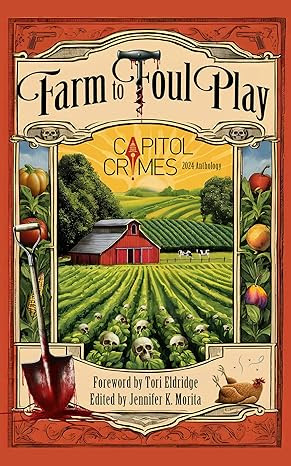
Jennifer K. Morita is a former newspaper reporter, who juggled freelance jobs with being a stay-at-home mom for several years before becoming a writer for the communications department at a local university. She spent the first six months of the pandemic purging and baking with the rest of the world before giving her lifelong pipedream of being a mystery author a chance. She is a past president of her local Sisters in Crime chapter who continues to serve on the board and recently edited the 2024 Capitol Crimes anthology FARM TO FOUL PLAY. She lives in California with her husband and two daughters. Her website is Jennifer K. Morita, Author – mystery author.


Wednesday, July 5, 2023

An Interview with Grace Topping by E. B. Davis

(For those of you who missed reading Grace Topping's Laura Bishop's mystery series, here's my interview with her on the first book in the series, which was nominated for an Agatha Award in 2020.)

Sister Madeleine paused at the door leading to the school library. “He also
recognized people sometimes become boxed in and kill out of sheer desperation.
Look for the person around Victoria Denton who became desperate.
Grace Topping, Staging Is Murder, Kindle Loc. 889

Laura Bishop just nabbed her first decorating commission—staging for sale a 19th-century mansion that hasn’t been updated for decades. But when a body falls from a laundry chute and lands at Laura’s feet, replacing flowered wallpaper becomes the least of her duties.

To clear her young assistant of the murder and save her fledgling business, Laura’s determined to find the killer. Turns out it’s not as easy as renovating a manor home, especially with two handsome men complicating her mission: the police detective assigned to the case and the real estate agent trying to save the manse from foreclosure.

Worse still, the meddling of a horoscope-guided friend, a determined grandmother, and the local funeral director could get them all killed before Laura props the first pillow.


Grace Topping’s first book in her Laura Bishop mystery series, Staging Is Murder, will be released by Henery Press on April 30. Grace has created a memorable cast of characters with the natural premise of staging homes for sale, putting main character, Laura Bishop, on the spot when murder occurs.

Laura has obtained her first commission. But the job she’s taken on is huge, a pre-Civil War mansion, and hindered by the homeowner’s uncooperative attitude. Laura has a good assistant, Tyrone Webster, a young, black man who has experience staging theater sets. Unfortunately, we don’t get to see much of Tyrone because for most of the book he is arrested and locked in jail. I hope there’s more for Tyrone to do in the next book because he’s playful and smart.

Nita Martino, her best friend, comes from a large Italian family, which has helped and healed Laura from the dearth of support in her own family. But Nita is superstitious, reading horoscopes daily, a fault that Laura treats with humor.

Please congratulate my interview partner Grace Topping on her debut!                                                       E. B. Davis  

What’s the difference between interior decorating and staging? Can either job be done by the same designer? Are there educational requirements?

An interior decorator or designer adds personality to a home to reflect the homeowner. A home stager takes the personality out to make the home appeal to a wider audience. But it goes beyond that. A home stager works with the homeowner to identify what needs to be done to make a home look up to date and attractive—to ensure that it sells faster and for more money.

I gather Louiston, Pennsylvania is in the western part of the state. Is it real or based on a real town
where you have lived?

Louiston is a fictional town based loosely on my hometown in the Allegheny Mountains, more in central Pennsylvania. A lovely area and a place I miss more the longer I live away from it. Fortunately, I have family there, so I get to visit often.

Laura and her late mother weren’t close. Why? Has Laura made changes in her life since her mother’s death?

Laura’s mother was a cold and remote individual, who never showed Laura affection. She was definitely a glass half empty kind of person who always saw the negative side of life, unlike Laura’s father, who had been friendly and outgoing and made everyone feel special, whether it was a friend or someone hired to paint the house. Sadly, when her parents divorced, Laura was left with her mother. It was one of her teachers who saw the lack of love and emotion in her life and helped nurture her friendship with another student from a large and loving family.

Laura recognized how her mother’s negative attitude poisoned her life and sets out to make sure that that she has a positive outlook. But she has to work at it, especially given her failed marriage. Fortunately, she has her best friend, Nita Martino, and her large and loving family’s influence in her life. They brought laughter into her life and showed her how good life can be.

Victoria Denton, the homeowner and murder victim, was not a pleasant person. How does she obstruct Laura’s work?   

Victoria came from a less affluent part of town and thought when she married into the wealthiest family in Louiston that she would have the status and social life she had always yearned for. However, it didn’t work out that way and over the years, she became dissatisfied and developed a reputation for being one of the most disagreeable people in town. When she and her ex-husband are forced to sell their 19th century mansion, she isn’t willing to do much to help Laura make it more attractive for other people to buy it. She only agrees to have the home staged after being convinced to do so by her ex-husband and her real estate agent so they can sell it fast, before the bank can initiates foreclosure. With the age and condition of the house, it wouldn’t have sold fast or for a very good price.

Victoria felt there was nothing wrong with the way the house looked. She was unhappy having to sell it, and no matter what Laura and Tyrone did to help improve the home’s appearance, she wasn’t pleased with it. They didn’t have carte blanche to change the home and needed to have her buy in to their suggestions. When she didn’t, their hands were rather tied.

Why doesn’t Laura like attractive men?

Every time someone made Laura unhappy, took credit for her work, or just generally embarrassed her, a handsome man was involved. Her mother warned her that handsome men were trouble, believing that if Laura’s father hadn’t been so handsome, he wouldn’t have been unfaithful and left them. Unfortunately, Laura didn’t listen to her and married Derrick—as handsome as they come. Big mistake. She should have listened to her mother. When he and his female companion (long story) were killed in an automobile accident, Laura swore off handsome men forever.

Tyrone is a candidate for the Quincy Scholarship at the college where he is studying design. After he breaks a valuable vase, Victoria, who is on the scholarship committee, tells him she will recommend against him getting the award. After Tyrone pleads with her, he leaves. A short time later, Laura finds her dead body. Tyrone has motive, but what about means and opportunity?

After the incident with the vase, Tyrone leaves for the day. When he arrives home, he goes for a run to work off his frustrations and decides to return to the Denton house to talk to Victoria—to apologize again and convince her not to interfere with his scholarship possibilities. But after getting close to the house, he changes his mind and returns home—but not before someone spots him running away from the area about the time Victoria is murdered. The police believe his being in the area at the time of the murder and the fact he had a key to the Denton house gave him means and opportunity.

With Victoria’s death, Laura’s contract to stage the house is null and void. But ex-husband Skip Denton rehires her to finish the job. Nita hires a local psychic to “clear” the house of negativity or Victoria’s spirit, but Laura still feels uneasy in the house. Do you believe in spirits or ghosts?

No, not really. But I think there are things that just can’t be explained, and sometimes a place just has negative vibes, especially a house that is nearly 200 years old, like the Denton house. Laura doesn’t want to go back into the house because it was the scene of a murder. Sometimes that’s enough. It’s Nita who thinks Victoria’s spirit is still there and sets out to make sure she leaves.

Guido, Nita’ husband, is wonderfully supportive. What does he do?
 
Guido is a great guy, isn’t he? With his mild manner and patience, he is the perfect mate for Nita. He has a background in construction but now works for the Romano family as general office manager and accountant.

At the beginning of each chapter, you provide home staging advice. Did you study home staging?

Actually, my knowledge of home staging came primarily from watching far too many HGTV home staging and home flipping programs. I discovered that I have a knack for it, probably from watching all those shows, and I began helping friends stage their homes. When I decided to write a cozy mystery, which usually has a main character with a business or interest that is a key part of the story, it was a natural choice to make my main character a home stager. It also helped that a home staging main character hasn’t been done much in the cozy mystery world. I also read a number of books and guides about home staging.

After I completed and polished my manuscript, I contacted some home staging training and certifying companies to make sure I hadn’t misrepresented the home staging business. Debbie Boggs, one of the founders of Staging Studios in San Antonio, Texas, kindly read my manuscript, gave me some pointers, and endorsed it. It was a great relief knowing I had gotten it right. I have continued to learn a lot about home staging by watching webinars Staging Studios makes available. At this point, I probably could start my own staging business. If I weren’t busy writing mysteries, I almost would try it. From what I’ve learned, home staging is a rapidly growing field and an excellent prospect for people who want to start their own business.

Why do people call Vocaro’s, the local coffee shop, their third place?

A third place can be defined as that place where people feel welcome, comfortable, and connected. Connected being the key word. It was a term coined by sociologist Ray Oldenburg and refers to places where people spend time between their home (their first place) and work, (their second place). If you remember the TV show, Cheers—that place where everyone knows your name—Vocaro’s is like that.

As a writer, Vocaro’s coffee shop is a place I can have characters cross paths with other characters and witness things they wouldn’t ordinarily see. It’s also a good place to pick up gossip about what’s happening in the community.


After Tyrone is arrested, his grandmother, Mrs. Mariah Webster, visits Laura and charges her to find Victoria’s killer so Tyrone will be exonerated. Would you describe Mrs. Webster for our readers?

Readers have told me they love Mrs. Webster. I do too. Mrs. Mariah Webster is an African-American elderly grandmother (think Cecily Tyson) who single-handedly raised her orphaned grandson from the time he was five years old. She is a retired home-care nurse, who has seen a lot of life and doesn’t take guff from anyone. She could best be described as someone with lots of moxie. She is courageous and probably could have conducted her own investigation without any trouble.

Was Sister Madeleine a substitute sister, mother, or something else to Laura?

I think of Sister Madeleine as more a fairy godmother. As a young nun, she was Laura’s second grade teacher and saw how emotionally neglected she was. She encourages her friendship with Nita Ramona (now Martino), who comes from a large Italian-American family, knowing that the family would take Laura to their hearts, which they did. She keeps an eye on Laura over the years, and encourages her love of reading—introducing her to mysteries, which Laura takes to with great relish. When faced with trying to solve a murder, Laura turns to mystery-loving Sister Madeleine first for advice.

Laura likes chocolate. She understands why early church leaders thought anything so good must be sinful and banned it. Is that true?

Absolutely. In the 1600’s, religious leaders banned monks and nuns from eating chocolate, believing it was a powerful aphrodisiac that would inflame their lustful passions. All it does for me is add weight. I eat it for its antioxidant properties. At least that’s what I tell myself.

Throughout the book, Laura, who has no illusions of being a sleuth, asks herself what her favorite literary sleuths would do? What characters does she rely on and do they help her?

Laura draws on the wisdom of such wonderful characters as Anne Perry’s Hester Latterly and Sara Paretsky’s V. I. Warshawski, and on the humor of characters such as M. C. Beaton’s Agatha Raisin. Growing up in such a cold and lonely environment, characters from books were her friends and guiding lights. So she often thinks about them and wonders how they would handle various situations.  

At one point, Laura wonders if she’s gullible and her ability to judge people. Will solving the crime change her?

Laura wants to believe the best of everyone and hates to think one of the people around her could be guilty of murder. So she is readily willing to believe their alibis and explanations. Later she wonders whether she was too willing to believe them because what they told her made sense, or because she likes them and doesn’t want to believe them guilty. She learns that while most of them aren’t guilty of murder, they all have secrets they don’t want revealed. Protecting their secrets makes them appear guilty of more serious things. Laura has to learn to sift through the secrets she uncovers to get to the more serious crime of murder. One can only hope she’ll learn from her detecting not to be so gullible.

What’s next for Laura?

In the second book of the series, Laura discovers that someone is trying to sabotage her fledgling business, and she is introduced to the world of artists and art festivals. When a body shows up at Hendricks Funeral Home with a knife in its back, Laura finds herself drawn into another murder investigation—again quite reluctantly. Look for it this time next year.   


Wednesday, August 14, 2019

An Interview with Heather Day Gilbert by E. B. Davis


“You know they’re just going to waste it on alcohol or drugs, BB,” she’d say,
using my initials as a pet name to soften me.
I didn’t really care how the homeless spent it. All I knew was that I had a
little money and they didn’t, and I couldn’t walk on by and do nothing.
I felt the same way about Margo’s death. I’d found her, so it seemed I should
go one step further and search for the one who’d viciously strangled her.
Heather Day Gilbert, Belinda Blake and the Snake in the Grass, Kindle Loc. 587

Pet-sitter Belinda Blake doesn’t rattle easily, but move-in day has been eventful, to say the least. The python in her care tried to slither to freedom—just as she met Stone Carrington V, her landlords’ disarmingly handsome son. With the constrictor back in its cage, she heads out to the garden, only to discover a designer shoe poking out of the boxwood hedge—attached to a woman’s dead body.

The victim, Margo Fenton, was a Carrington family friend, and no one in their circle seems above suspicion. Between client trips to Manhattan and visits to her family in upstate New York, Belinda begins to put the pieces together. But though she’s falling for Stone’s numerous charms, Belinda wonders if she’s cozying up to a killer. And soon, daily contact with a deadly reptile might be the least dangerous part of her life . . .

Heather Day Gilbert’s Belinda Blake and the Snake in the Grass, her first Exotic Pet-Sitter mystery, is also her first traditionally published mystery. She’s self-published many novels and has written a nonfiction book on self-publishing. She’s also garnished a few nominations and awards in faith-based fiction. To me, that’s an interesting way to get traditionally published.

Belinda Blake, Heather’s main character, pet-sits for exotic animals. When she moves from NYC to tony Greenwich, Connecticut, her rental is a carriage house on the Carrington family’s estate. Behind the carriage house is a garden, which seems to grow corpses. In life, those bodies were friends of the estate owners’ son, Stone Carrington V. He has lots of issues. Whether or not he is guilty of murder is Belinda’s problem. Her family, in upstate NY, is wary for her.

Please welcome Heather Day Gilbert to WWK.
E. B. Davis

How and why did Belinda start her pet-sitting business?

Belinda is the kind of person who doesn't relish a desk job. She likes adventure and is easily bored, so she kind of stumbled into sitting exotic pets when she was sitting more "normal" pets in Manhattan. She's comfortable with many kinds of pets because her father, who lives in upstate New York, is a veterinarian and she grew up working in his office and going on house calls with him.

What is Belinda’s sideline business?

She's a video game reviewer. As the series progresses, this aspect of her life starts to take on a bigger role, as her blogposts/articles become extremely popular in gamer circles. I grew up with video games and I still enjoy playing in my free time, so the gamer side job was quite natural for me to write about.

Although Belinda doesn’t seem fearful of Rasputin, a ball python, she also doesn’t seem very knowledgeable about snakes other than what the owner has told her. Is lack of fear the best attribute of an exotic pet-sitter? Does she have experience?

She does have some experience with unusual pets—after all, her dad was a vet in an area where farms are par for the course, so she's been around cows, chickens, and more. But in this book, we see this is her first encounter snake-sitting. She does her research ahead of time and she consults her vet dad before accepting jobs, and in this case, the doting snake's owner gave her a bullet-point list of expectations for his snake's care. :) She basically goes into it ready to follow the owner's wishes, because that's why he's paying her the big bucks!

Belinda knows Rasputin is a constrictor. Why would she allow the snake to rope itself around her neck? Is she suicidal?

I think she likely watched the same kind of YouTube videos I did, where you'll see ball python owners handling their snakes and allowing them to slither around on them (or even watch TV with them!). She was also following the owner's careful instructions about "walking" his pet so it could get fresh air. And Belinda's personality is not one given to fear. She's done some riskier things in her life, so this is just another on her list. She tends to dive into things before realizing she might be in over her head.

Why do ball pythons need humidity? How often do they shed? Eat?

From what I can tell in my research, answers vary with each snake. Some advise bathing the snake (as Belinda does in this book), and some don't. Some advise feeding rats, some mice. The pythons need humidity as they gear up to shed, which can be once a month, with younger snakes shedding more often and older snakes shedding less often. Feeding can vary, as well, but can be every ten days, give or take.

When Belinda finds Margo Fenton’s body in her garden, why doesn’t she just dial 911?

Hm. I'd have to reread it, but she might not have had her phone, and there are people milling around nearby at the manor house where the owner lives, so she runs for help first. Greenwich is a very exclusive town and I suspect she wanted to make sure the homeowners knew there was a dead body in their yard and see how they wanted to proceed, especially since she'd just moved into their carriage house and the Carringtons have a private security team. But the bottom line is that she was probably in shock, despite keeping a relatively cool head when she discovered the body.

Do formidable people usually have something to hide?

I wouldn't say that—I've known many formidable older people who are quite transparent. On the other hand, I'd say many people are hiding at least one thing.

Stone Carrington V is about Belinda’s age. Why does he start to investigate Margo’s murder?

He was a close family friend of Margo, and he regularly played pool ("billiards") with her. He wants to know why she died on his family's estate.

How is Katrina, Belinda’s older sister, who is an Albany psychologist, the direct opposite of Belinda?

Katrina is quite practical and has a "mama bear" personality—she's always advising Belinda to be careful. Belinda, of course, rarely listens. Katrina instinctively distrusts people, and Belinda tends to trust a little too easily. Katrina has always been an over-achiever, and Belinda is a fly-by-night personality who really doesn't plan ahead. And in looks, Katrina has dark, curly hair and porcelain skin, whereas Belinda has curly naturally blonde hair and freckles/light tan. You'll see how their personalities work together as the series goes on—Katrina often helps her sister by giving her take on the possible psyches of the murderers.

Why didn’t Belinda go to college?

Actually, she did, but then she went directly into the Peace Corps in China. Predictable jobs don't interest her much.

When Stone asks Belinda to help him interview mutual friends of his and the victim’s, Belinda thinks of the outing as a date. Why?

That would be because Stone set it up that way, at a very posh restaurant, etc. He also seems to be hitting on Belinda from the start of the book, which tends to confuse things for her. After all, he is incredibly rich and handsome, but he's also approachable, even though he's the "lord of the manor," so to speak. She's impressed he's so rich and yet so friendly to her. She instinctively likes him...but sometimes Belinda's instincts are wrong. ;) Still, she's not the type to sit around second-guessing herself when she likes someone.

Tell readers about Red, my favorite character, if you would?

I like Red too. Let's see...you'll get to know more about Red in the second and third books, so I'm not sure how much to tell! Let's just say he's a chauffeur, but he seems to carry out some bodyguard duties along the way. He used to be in the Army before he took the chauffeur job with the Carrington family.

Even though Belinda finds out Stone has kept secrets from her, she defends him to her mother, sister, and an old friend from back home, Jonas Hawthorne. Why does she have faith in Stone?

Again, Belinda kind of acts on her instinct about people, and she tends to look for the good in people (unlike her sister). She likes that Stone isn't stuck-up and that he seems to genuinely enjoy her company, even though she's not a Greenwich socialite.

Why does Belinda need alone-time?

She's a bookish introvert, so give her a rainy day, a book, and a cup of coffee, and she's happy. She doesn't love big groups, but she's great one-on-one with people. Sometimes I think she doesn't realize how winsome she is, because she spends a lot of time feeling she's messed things up. Like most introverts, she needs time alone to decompress and process the events of the day.

What’s next for Belinda?
 
She's about to accept a rather dangerous job at a wolf preserve. I had an absolute blast researching for book two, Belinda Blake and the Wolf in Sheep's Clothing, which is available for preorder here and will release this October. And she'll have another adventure—book 3 releases in February of 2020. I'm hoping this series will do well and I can write even more books about Belinda, because she's so fun!

AUTHOR BIO:
Heather Day Gilbert, an ECPA Christy award finalist and Grace award winner, writes contemporary mysteries and Viking historicals. Her novels feature small towns, family relationships, and women who aren’t afraid to protect those they love. Like Belinda Blake, Heather plays video games, although so far she hasn't done any exotic pet-sitting or hunted any murderers. Find out more on HeatherDayGilbert.com.


 Heather Day Gilbert and Liesel, her Shiloh Shepherd

Wednesday, July 4, 2018

An Interview with Christopher Huang by E. B. Davis


The year is 1924. The streets of St. James ring with jazz as Britain races forward into an age of peace and prosperity. London's back alleys, however, are filled with broken soldiers and still shadowed by the lingering horrors of the Great War.

Only a few years removed from the trenches of Flanders himself, Lieutenant Eric Peterkin has just been granted membership in the most prestigious soldiers-only club in London: The Britannia. But when a gentleman's wager ends with a member stabbed to death, the victim's last words echo in the Lieutenant’s head: that he would "soon right a great wrong from the past."

Eric is certain that one of his fellow members is the murderer: but who? Captain Mortimer Wolf, the soldier’s soldier thrice escaped from German custody? Second Lieutenant Oliver Saxon, the brilliant codebreaker? Or Captain Edward Aldershott, the steely club president whose Savile Row suits hide a frightening collision of mustard gas scars?

Eric's investigation will draw him far from the marbled halls of the Britannia, to the shadowy remains of a dilapidated war hospital and the heroin dens of Limehouse. And as the facade of gentlemenhood cracks, Eric faces a Matryoshka doll of murder, vice, and secrets pointing not only to the officers of his own club but the very investigator assigned by Scotland Yard.

I was sent a copy of A Gentleman’s Murder by a publicist from Inkshares, a publisher I’d never heard of, and due to an endorsement blurb written by Rhys Bowen, I gave it a try. Written by Christopher Huang, the story of Eric Peterkin appealed to me because of the character’s vulnerability and the setting of London during the post WWI era.

Please welcome Christopher Huang to WWK.           E. B. Davis

Christopher—even after going to the Inkshares website, I don’t really understand the publisher’s process. Could you describe it to me? The company claims to be reader-driven. How do they get books out to readers? Do readers vote, and if your book is popular, it then gets published? What’s it all about?

It’s about getting off to a running start, and it’s about evaluating the market for a book. The process is this: you set up a page on the Inkshares website with your book title, a synopsis, and perhaps a couple of sample chapters. You don’t actually need a completed novel at this point, though it helps.

Then you begin what they call a “campaign,” in which you try to sell pre-orders of the book to people, based on whatever material you’ve got on that webpage. The idea is that each pre-order sale represents a vote of confidence, someone who’s willing to put money down on the projected success of your book. After all, anyone can say that a book is wonderful if you asked them to, but talk is cheap and once you put a price on a vote, suddenly people get a lot more skittish.

The general rule is that you need 750 pre-orders within your campaign period to qualify for publication, but things like contests could lower the requirement.

The book starts with a conversation between Eric Peterkin and his friend Avery Ferrett. Eric and Avery seem like two very different men. Eric dresses in a tight military style, whereas Avery wears deconstructed clothing without creases. Eric spent a year in the trenches in France as a lieutenant. Avery, for his health, spent the war in Buenos Aires. How do they know each other? Why are they friends?

Eric and Avery met on a London train platform in 1919: Eric had just been demobbed from the Army, and Avery had just returned from Buenos Aires. Each of them was the first person the other met on arrival in London that day, and for a while they were each other’s only friend in the city. Also, there was a murder involving an impertinent lift boy and a bag of gobstoppers, but that story’s going to need a lot more work if I’m ever to release it into the wild.

You are a Canadian. Was there a reason you decided to set your book during the 1920s and in London?

It’s just a milieu I’m very fond of, thanks to Agatha Christie and all the detective fiction writers of that era. The Anglophilia has to be fed! And the advantage of the period is that you don’t have to worry about all the advances of forensic science putting the investigation beyond the grasp of your amateur sleuth. The 1920s, I think, are just similar enough to the modern day to be familiar while still being different enough to be a fascinating foreign land.

“Detective fiction wasn’t just literature; it was interactive entertainment.”
Kindle Loc. 5964

Would you explain to our readers what you mean by that statement?

Certainly! I mean that, generally speaking, when you read a book, you experience the world as the hero experiences it; but with detective fiction, you’re engaged in a different way. You’re encouraged to think one step ahead of the protagonists. It becomes a game, trying to spot the clues as they come up and guess at the hidden secret at the heart of the story. And in that sense, it’s interactive. You don’t just read a mystery: you play it.

The requirements for membership in The Britannia Club, Eric’s club, are experience on the battlefield and members must be gentlemen. What qualifies a man for gentlemen status?

That’s a title whose meaning has evolved, especially over the course of the 1800s. It once indicated a sort of minimum aristocracy, but it gradually came to mean a degree of refinement, education, and respectability—characteristics expected of the lower aristocracy but attainable by anyone else. What it means in the present day is actually something of some interest to me. With all the current news of men behaving badly (an understatement), I rather wish that the gentlemanly ideals—honourable behaviour, respect for women, the use of one’s privilege in the service of the underprivileged – would come back into fashion, and that “being a gentleman” were something more men aspired to.

Even though Eric’s ancestors were founding fathers of The Britannia Club, his status is unpopular because he is half Chinese. Yet on the battlefield, Eric found war to be the great equalizer. He was respected as a commander. Why would military men be prejudiced?

I think that if you’ve spent years fighting a certain enemy—if your primary experience of a certain people is that they’re trying to kill you—then you’re likely to form a prejudice against them. Then again, joining the Army was, until recently, one of the best ways of seeing foreign cultures, and thus gaining a more nuanced view of the outside world. A lot would depend on the nature of one’s Army experience.

A publisher pays Eric to read mysteries and evaluate them. How did he get his job? What are his qualifications?

The publisher was a friend of Avery’s family, and Avery helped convince him to hire Eric—another reason why Eric remains friends with Avery. It never got around to a question of qualifications, though Eric does have a degree in Classics. But I doubt if he’ll hold that job for very long: he’s not very good at it.

How did the Far East mysteries with their menacing Mandarin villains get popular?

I blame Fu Manchu. Everyone loves to read about exotic cultures, real or imagined, and Fu Manchu was exotic. That’s all it comes down to, I think: exoticism. The Mandarin character provided a romantic idea of what the other side of the world might be like, and his villainous typecasting provided a way of saying, “But we are better, and our values are better.”

I was surprised that the victim, Albert Benson, a conscientious objector, would have been admitted to the club, but he was. Why?

Aha, there’s a bit of a plot point there. But the stated reason, the one that we open with, is that he did spend time in the thick of the fighting as a stretcher-bearer. It was a dangerous job, going out to the battlefield to retrieve the dead and the wounded, and many conscientious objectors volunteered to do it. If they didn’t fight, it was out of principle, not cowardice.

What were the Chinese Labour Corps?

They were a noncombat unit in the First World War, performing support services such as filling sandbags, building depots, moving cargo, and so on. They were not expected to fight, but that didn’t mean they were out of danger or that they suffered no casualties. There are WWl graveyards in France with Chinese headstones for those who died there.

What was the White Feather brigade?

That’s an unofficial name that I cooked up to describe them. Officially, they were the Order of the White Feather: people (almost always women) who distributed white feathers as an award for cowardice to men whom they thought were shirking their duty to their country. Though some men were shamed into enlisting by this accusation of cowardice, the Order was not very popular with the armed forces. It was very easy to mistake soldiers on leave or essential state employees—or, in one case, an actual war hero on his way to receive his Victoria Cross—for so-called “cowards.”

The Britannia Club has safe deposit boxes that members may use, and Benson uses one. After another member bets that he can get into the box and take an item out by the next morning, Eric is enlisted as a third party to vouch as to what was placed in the box by Benson to ensure no cheating occurs. After Benson’s murder, Eric is the only one who knows what was in the box. Those items become the basis, clues, of his investigation. Why does Eric investigate Benson’s murder?

Eric’s family has been associated with the club since its founding, and Eric feels a sense of responsibility to the club. But beneath that is also a strong sense of justice and honour. He’s certain that the murder is not being properly investigated. It also appears that the others are anxious to sweep the matter under the carpet, and he finds this unacceptable.

Shell shock and war neurosis were two early terms for what is now known as PTSD. How were those disorders treated then, if at all?

There were a range of treatments, some more brutal than others. Electroshock therapy, for instance, or solitary confinement. Remember, nobody really knew anything yet, and the study of psychology was still very new. I think Seale Hayne Military Hospital achieved one of the best success rates for treatment, employing gentler techniques like occupational therapy in peaceful, agrarian surroundings.

Eric suffers a flashback to the war where the here and now recede. What precipitated this episode?

The sudden threat of danger. It catches him by surprise, and his mind leaps to a similar moment in the War.

I always thought WWI was responsible for black market cocaine, but morphine addiction was a more common plight and dates back to the American Civil War, “a soldier’s disease,” as you stated in your afterword. Was society tolerant of morphine addiction?

I think people were tolerant of it the same way they were tolerant of alcoholism. Few people really thought of morphine as an “illegal” drug, so there wasn’t much sense of addicts being criminals. They thought, rather, that addiction was a sign of moral weakness, and they were more concerned with whether the addict caused trouble in the community. I don’t know if that means they were more tolerant, but the views seem somewhat different.

Eric solves the murder, but he also learns a lot and gains maturity. What is the result for his men? For his club?

Ah, a potential spoiler minefield! For Eric’s men, the ones he had charge of in the War, it’s a matter of getting in touch. There is a lot to be said, I think, for the support of social networks, and in a world before social media, it takes a little bit more effort. For the club, let’s just say that the good is restored and the bad is washed away ... as they should be.

What is Bovril and how is it used in England?

A liquefied cow! It’s a very thick, black liquid, or maybe you’d call it a viscous paste, and it tastes of salted beef. You can spread it on bread, or you can dilute it with hot water to make beef tea, or you could make it into gravy. There are probably other applications, but these are the ones I remember that don’t involve Chinese congee. It’s a delicious piece of my childhood, and I rather miss it.

This isn’t your only book. What else have you written?

“The Hero Unmasked!” is interactive fiction in a more traditional sense—odd though it is to refer to something computerised as “more traditional” than a printed book. You are the protagonist, and the narrative changes with the choices you make. And it’s a very different sort of story from A Gentleman’s Murder, too, being a superhero fantasy set in the contemporary world. I am, as you can see, very fond of my interactive fiction.