Showing posts with label Authors. Show all posts

Sunday, July 12, 2026

AUTHOR BRANDING: WAS MINE A MISTAKE?

by Korina Moss 

Branding. It’s a word that I’m sure writers have heard after they’ve signed their first publishing contract or are writing their first novel. As an author, you want to stand out from the crowded field, which means you have to do more than market your book, you have to market yourself. This is where branding comes in. Branding helps readers identify you, helps them to feel a connection with you and your books, and lets them know what they might expect from your writing. 

Consistency is the key to branding. Ideally, you want to be easily identified. You should attempt to maintain a consistent look on all your social media, your website, and in your newsletter. You can do this by choosing a color palette (ideally similar to your books), color tone, fonts, and even creating your own logo. 

The background of my website has 
a huge cheeseboard

For instance, if you use bright jewel tones as your signature colors, readers will know to stop and look for you when those colors show up on their timeline. They’re more likely not to miss an event you’re attending or when you have a preorder sale. 

Is there’s something from your genre that readers can associate with you? If you write British cozy mysteries, perhaps you could make a quick “good morning” reel every Monday morning while drinking a cup of tea. If a dog or cat is featured in your mysteries, you’ll want to feature your own dog or cat on your platforms.

Is there something featured in your series that will make you stand out? Lucy Burdette (the pen name for Roberta Isleib) has a long-running Key West Food Critic Mystery series. She also happens to spend most of the year in Key West, so much of her social media features her life in Key West. We get to see the places she mentions in her books, and we get a little peek into her life too. It’s definitely a plus to set your series in the area where you live, even if it’s a fictional town. 

Lucy Burdette's IG post with a photo of the
Key West restaurant from a snippet from her book. 

When I was deciding how to brand myself before my Cheese Shop Mystery series came out, I had to consider what I wanted my identity to be. I’d hoped I would have a long and varied career, so although cheese was the obvious branding choice, going all in with it might not be a smart move in the long run. Ultimately, I decided to heed a variation of the advice editors give to new writers when starting a series: Don’t save anything for later. I was writing a Cheese Shop Mystery series, and I wanted to stand out and be noticed. I decided not to worry about later and go all in on cheese.

Wearing my cheese earrings
my publicist gave me

I named my newsletter subscribers Team Cheese and used the hashtag #teamcheese in most of my social media posts until eventually, most reviewers and bloggers who mentioned me on social media also used the hashtag. My first year at the Malice Domestic fan convention after my book had released the month before (and I’d already been branding myself for many months), I was regularly called “the cheese lady” by readers when they’d forgotten my name. It was ok—they knew my book! I've received wonderful cheese-related gifts from readers. I can’t tell you how many cheese memes, funny cheese reels, and cheese board posts I still get tagged in and messaged to me. And the message always says, “I saw this and thought of you.” It was exactly what I wanted—when cozy mystery readers see cheese, they think of me.


My St. Martin's editor and me in my cheese shirt
at Malice Domestic

I was shocked when my first book and I were well known enough in the mystery community to be nominated for an Agatha Award for Best First Novel, and two more books were nominated for Best Contemporary Novel the following two years. I’ve had a lot of great opportunities and decent sales. 


However, now that my Cheese Shop Mystery series has ended, do I still want to be known as the cheese lady? Probably not. Oops. I still go to events and sell my books, and I don’t have another series coming out imminently, so I’m backing away slowly from the cheese. I still post on National Cheese Day (and all the variations of it), but I’ve changed my newsletter sign-off from “Cheers to Cheese” to “Keep it Cozy.” I’ve left the Mystery Lovers’ Kitchen blogging group where recipes and cheese played a big role and focused on my author role in the Facebook group Cozy Mystery Crew. Every three weeks, I spend a day with our members, where we chat about what’s going on in my life and theirs. Cheese isn’t totally off the table (pun intended), but it takes a backseat now when I speak about my life and my books. 

In a way, I’m back to step one in deciding how to brand myself. It’s not exactly where I want to be, but on the other hand, I can’t deny that my strategy worked in the moment. 

You get to decide what’s right for you, but you can’t go wrong with these simple steps for starting your branding journey:

1. Take time to decide how you want to define yourself. Try to identify your point of difference, the thing that sets you apart from other authors in your genre. What kind of vibe do you want to give off?

2. Build your presence – Start with two platforms and decide how many you can handle. (They take more time than you think.) Create a website. Join online groups and organizations in your genre to interact with readers and writers in a personal way, not as a salesperson. Get to know your target audience, which will help you make decisions about your branding. 

3. Be consistent – Use the same profile photo across all author platforms. On social media, your website, and your newsletter, consider using the same color palette, fonts, type of music, illustration elements, and perhaps even a logo. Consistency will lead to recognition.


Readers: Think of your favorite author. What elements make up their brand? How does it match up with their book(s)?

KORINA MOSS is the author of the Cheese Shop Mystery series, which includes the winner of the Agatha Award for Best First Novel, as well as two novels short-listed for Best Contemporary Novel. Listed as one of USA Today’s “Best Cozy Mystery Series,” her books have also been featured in PARADE Magazine, Woman’s World, and Writer’s Digest. Korina is also a freelance developmental editor specializing in cozy mysteries. To learn more or subscribe to her free seasonal newsletter, visit her website korinamossauthor.com.


Wednesday, November 19, 2025

Killer Questions: Our Favorite Thanksgiving Foods


Killer Questions: Our Favorite Thanksgiving Foods

Sarah E. Burr: I love candied yams or any type of sugary yam casserole dish!

Paula G. Benson: I love having real cranberries on Thanksgiving. As a relish or just cooked cranberries, they are my favorite. Often in the South, we have sweet potato pie instead of pumpkin pie. That’s another great food for the holiday.

Marilyn Levinson: Stuffing with sautéed mushrooms and onions.

Heather Weidner: Turkey and gravy.

Shari Randall: Years ago, my family decided that we'd rather have lasagna than turkey. Although there's still a turkey and cranberry sauce (my second favorite)  most of the family are chowing down on a luscious dish of pasta layered with mozzarella, ricotta, and homemade sausage and beef marinara. Buon appetito! 

Judy Murray: My husband's homemade apple pie, a recipe handed down from his mother. It took years for him to perfect without tossing pie crust dough across the kitchen in disgust.

K.M. Rockwood: My favorite Thanksgiving food was actually a drink. Apple cider. It does need a bit of background explanation. My family never served water at meals. Except for the youngest tots, we got one glass of milk each. Years later, I learned I have a swallowing problem. I also have some health issues that tend to leave me dehydrated. On Thanksgiving, someone always brought a couple of gallons of apple cider. While we weren't permitted unlimited amounts, I discovered I could down the first glassful get a quick refill. Possibly several refills. I didn't have problems downing the rest of the food if I had the cider. It was the best meal of the year.

Lori Roberts Herbst: Thanksgiving food: pumpkin pie, with tons of whipped cream.

Kait Carson: My parents came from the generation where holiday food was a never-varying tradition. Despite being a self-taught gourmet cook, my mother served turkey, ham, mashed potatoes (yes, marshmallows were involved), broccoli cheese casserole (howdy, Campbell's) and corn pudding (another nod to the soup people). Dessert was pumpkin pie and three-layer coconut cake. The first thing I did when I broke away on my own was to toss any recipe that contained canned soup. When Mom passed away, my dad moved in with me for a while. That first Thanksgiving, he stood in the middle of my kitchen, took in the prep work an looked at the recipes with a sad expression on his face. I thought he was missing Mom, but I asked if anything was wrong. Where, he wanted to know, were the broccoli casserole and the corn pudding? The question stopped me cold. That's when I realized that my favorite Thanksgiving foods weren't foods. They were the tradition they represented. Hubs can't have broccoli, but corn pudding - howdy Campbell's - is still on the menu.

Korina Moss: The stuffing (with gravy)! 

Grace Topping: I absolutely love turkey. My husband, who hails from England, not so much. There, they had turkey once a year on Christmas, and he feels that's enough. So, I slip turkey into recipes whenever I can, hoping he'll think it's chicken. My favorite is turkey thighs, which aren't readily available except around the holidays. I find myself scouring grocery stores in search of them--most times without luck. Recently, when I asked an employee working near the meat section where I could find turkey thighs, he looked really puzzled—as if to say that it isn't Thanksgiving yet, and pointed me to the chicken section. This Thanksgiving season, when I hope to find packages of turkey thighs, I plan to stock my freezer with them. Even if it means taking every package that's on the shelf.

Debra H. Goldstein: Unfortunately, I don’t care much for Thanksgiving food, but there usually is a corn pudding or squash casserole that makes me happy. My mother also was big on the Jell-O mold with nuts, cream cheese, and red Jell-O. I don’t make it, but it brings back pleasant memories when I see it at someone’s house.

James M. Jackson: Homemade cranberry sauce.


Sunday, July 14, 2024

WHAT DOES A PUBLISHING HOUSE EDITOR DO?

 By Korina Moss


Before I became a published author of the Cheese Shop Mystery series, I had only a vague idea of what a publishing house editor does. I’m sure I still don’t know all their roles, but I do know what my relationship with my editor is regarding my series. Take into account when reading this that not all editors are the same and not all publishing houses are the same. In this post, when I refer to an editor, I’m basing it on what I know about the role of editors in my larger publishing house (Macmillan Publishing). This may be very different than what editors do in smaller independent houses. It’s also different than a freelance editor you might hire to help you with your manuscript before you send it out for querying or self-publishing. I’m also aware that I’m simplifying the roles of a publishing house editor and likely leaving out many other important duties their job entails.

One of the roles of an editor is to read and evaluate manuscripts sent to them by agents. If an editor loves your manuscript and thinks it’s marketable and will fit their house, they will bring it to the acquisitions team to discuss whether to make an offer. In larger houses such as the one I'm with (Macmillan Publishing), it is never the decision of just one person.

Once you sign a contract with the publisher, your editor is the project manager for that book or series. It’s their job to shepherd that book to completion. They are in charge of making a lot of decisions about the book, such as the direction of the marketing team, the cover art, possibly the title, and keeping track of the production schedule. I've heard from my author friends that their editors have given them varying degrees of involvement with these parts of the book process. In my case, my editor has asked my input on the cover art, and we’ve bounced around cheese pun titles. All the book jackets in a series should be cohesive, so the designers are also involved in the titles and cover art decisions. People often judge a book by its cover, so I’m happy to leave it up to the professionals. However, with each book, my editor asks for a short summary from me about things that might be germane to the cover, such as plot points, locations, season, etc., so they can align the cover design with my story.    

Once I hand in my manuscript, my editor will go over it and do what's called a developmental edit. This is different than line editing, which is fixing grammar, word choice, punctuation, etc., which is taken care of by a separate editor, the copy editor. A developmental edit means she makes suggestions for changes to the content, such as the pacing, characterization, inconsistencies, etc. A misnomer is that an editor makes changes to your manuscript or demands the author make changes. In my experience, that has never been the case. What an editor will do is point out where she thinks the trouble spots are, and then leaves you to decide if you agree and make the appropriate changes or not. Because I write a series, she also keeps tabs on past books. For example, in my third book, Curds of Prey, she thought my original ending was too similar to one I'd just done in Gone For Gouda. I hadn’t been happy with the ending either, for other reasons, but I had to get it in by the deadline. Since several weeks had passed since then and knowing my editor thought the ending was lackluster as well, I was able to read the manuscript with fresh eyes and come up with a much better ending. Among all the other things my editor does, she’s made me a better writer. 

Last but certainly not least, an editor champions their authors’ books, presenting them to the publishing team, who determines things like promotion and, if applicable, the lifespan of the series. 

To sum up, a publishing house editor is a manager, a teacher, and your biggest cheerleader. 

For you yet-to-be published or self-published writers, is what an editor does different than what you thought? For traditionally published writers, is this different than your experience with your editor?  


KORINA MOSS is the author of the Cheese Shop Mystery series set in the Sonoma Valley, including the Agatha Award winner for Best First Novel, Cheddar Off Dead and the Agatha Award finalist for Best Contemporary Novel, Case of the Bleus. Her books have been featured in USA Today, PARADE Magazine, Woman’s World, AARP, and Fresh Fiction. Book 5 in the series, Fondue or Die, arrives on October 22nd. To learn more or sign up for her free monthly newsletter, visit her website at korinamossauthor.com.  

You can preorder Korina's next book, Fondue or Die, for 25% off online at Barnes & Noble with code PREORDER25 now through July 17th with a free or premium B&N membership. 

Monday, May 13, 2024

The Ups and Downs of #AuthorLife

by Shari Randall

Authors find many events to celebrate on the writing journey. Just a few days ago fellow Writer Who Kills Lisa Malice wrote about being a debut author. Debuts are definitely worth celebrating as well as publication days AKA “book birthdays,” signing a contract, and publishing a new story in a fun anthology. If we’re lucky, also we celebrate nominations and awards and being named to "best of" lists. 

We don’t mention it as much but I think we should celebrate a book or story simply being written. So many people have told me that their dream is to write a book. Writing a book or story isn’t easy – it’s hard to find the time, hard to make the time, hard to start, hard to keep going, hard to finish, hard to edit. Hard – goodness knows – to rewrite it!


So I try to keep that in mind and celebrate each step. With every publishing milestone, I stop and think to myself “#authorlife.” Coffee with an editor. Yes, #author life! Typing THE END on a manuscript - #authorlife! It’s my way of stopping to savor, to smell the roses, of this crazy turn my life has taken.


That brings me to the less sunny milestones of #authorlife. Series cancellations. Short stories that turned out to be novels and vice versa. Losing beloved editors. Rejections.  


I recently passed one of those less-than-sunny milestones - having a series drop out of print.


Giving author talks at libraries is one of my favorite parts of #authorlife, and they often include the opportunity to sell books. I needed some copies of my first book, CURSES, BOILED AGAIN, so I ordered some from an online bookseller.


The next day I received an email from the bookseller. “Sorry, it’s OOP.”

I wrote back, “OOP?”

“Out Of Print.”

Oh.

That sound you heard was my heart dropping off a cliff. My beloved first novel – out of print. It felt like all my characters had been swept off a beach in a tsunami, without a chance for me to say a proper farewell.


Gone.


Well, I was naïve, and honestly, not paying attention. The book was released in 2018. Books that don’t sell a certain threshold go out of print, especially books that were published six years ago, an eon in the publishing business.


What to do? Simply wish my characters RIP? Or…..another adventure in #authorlife?


I decided to get my rights back, revive the series, and publish it myself. I'm working with a wonderful artist on designs for new covers. A fresh look. I couldn’t let my characters go, and I hope the new covers will entice new readers.


I’ll be self-publishing them, so that's another stop on the road called #authorlife. Wish me luck.


How do you cope with the ups and downs of writer’s life?


Shari Randall is the author of the soon to be revived Lobster Shack Mystery series. As Meri Allen, she writes the Ice Cream Shop Mystery series, which is still in print and available wherever books are sold  (thank goodness!)


Saturday, April 17, 2021

Lunch with a Non-Living Author

By WWK Authors

I asked my Writers Who Kill compatriots, “If you could have lunch with any author who is no longer alive, who would you pick and why?” Two or three sentences, we agreed. I should have remembered my friends write well, but some are more challenged with mathematical concepts like two and three. And some don’t eat lunch, preferring tea, or dinner and drinks. (Submitted by James M Jackson)

In alphabetical order by author’s first name, we start with Agatha Christie.

Marilyn Levinson: I’d love to chat with Dame Agatha over tea and scones and discuss poisons and plotting mysteries.

Shari Randall: Like my friend, Marilyn Levinson, I'd love to do high tea with Agatha Christie, the Queen of Crime. Perhaps in the library of her wonderful home, Greenway? Or Brown's Hotel, the inspiration for Bertram's Hotel? Wherever we go, I'd love to pick her brain about poisons and plotting, all the while being very careful to keep watch over my teacup. She looks like such a mild-mannered lady, but we all know and admire the devious mind that brought us The Murder of Roger Ackroyd and Murder on the Orient Express.

Then after tea, I'd meet M. C. Beaton for drinks down at the pub.

Marilyn: I’ll go along with Shari to have drinks with M. C. Beaton :) She’s a favorite of mine as well. Love all her series.

Susan Van Kirk: I would love to share a meal with the poet Anne Bradstreet [1612-1672] who was the wife and daughter of two governors of Plymouth Colony. She braved the ocean at age 18 to come to the New World. [Seriously, I would never have climbed aboard that tiny ship.] I'd love to hear about her religious beliefs, her life in the colony of Massachusetts, and how she managed to write while raising eight children with a husband often absent on colony business. Also, I'd like to tell her that she shouldn't have felt guilty about writing. When my first son married, I gave the new couple a framed calligraphy done by an artist friend that intertwined Anne Bradstreet's "To My Dear and Loving Husband" and John Ciardi's "Men Marry What They Need." Anne Bradstreet was such an amazing woman, and one evening with her would be the perfect conversation.

EB Davis: If I could have lunch with a dead author I'd choose Anne George because of her humorous Southern Sisters Mystery series, comprising eight novels, set in Birmingham, AL, which won an Agatha Award. What people don’t know about Anne George? She was nominated for a Pulitzer Prize in 1993 for her poetry collection, Some of it is True. Her humor was delightful, a gift from a very talented author. I’d like to think we’d have a Southern tea party with all the bells and whistles—white tablecloths flapping in a gentle breeze, hydrangea centerpiece, set on an antebellum mansion porch surrounded by old Magnolia trees. 

James M. Jackson: Benjamin Franklin is my preferred lunch companion. He is unique as the author of his autobiography, Poor Richard’s Almanack, and contributor to four of the major United States’ Founding documents (the Declaration of Independence, the Treaty of Alliance with France, the Treaty of Paris establishing peace with Great Britain, and the U.S. Constitution). He’d probably control the conversation, but I’d love to quiz him on the concept of original intent.

Molly MacRae: I’d love to have a meal with Charlotte MacLeod. There are so many dead people with whom I’d love to have meals, but the humor in Charlotte’s books is a balm in these uncertain times. Having breakfast, lunch, tea, or supper with her would surely be a delight. Or brunch. Then maybe, if I were well-enough behaved, she would let me come over to her house just to sit and watch her write. I’d be very quiet.

Tammy Euliano: I would love to lunch with C. S. Lewis (1898-1963) most famous for the Narnia series in which he painted a remarkable world with amazing and perfectly flawed characters. He skillfully incorporated themes of Christianity without, in my opinion, beating the reader over the head. The stories are enjoyable even if one ignores the well-crafted allusions. His progression from Christian to atheist and back fascinates me, and mirrors my own, the latter portion very much triggered by a reading of his Mere Christianity. The Screwtape Letters is masterful and truly enjoyable (and hilarious).

Grace Topping: When the question of who I would like to have dinner with comes up, I always immediately think of Eleanor Roosevelt, someone I admired immensely.  For this project, I thought of her and then immediately dismissed that idea since we were looking for non-living authors to share a meal with. Then I discovered that Mrs. Roosevelt wrote not only an autobiography but also a book about her twenty years serving as an advice columnist for the Ladies Home Journal. So Eleanor Roosevelt it would be. With her experience as First Lady during WWII and serving at the United Nations, she would make the perfect dinner companion. 

Debra H. Goldstein: If I could have lunch with a dead author, it would be Elmore Leonard, Jr., in order to inhale his wisdom and ability to write spare character and dialogue driven long and short crime fiction and westerns. He was a master at including all the details and intonations while leaving out the parts readers tend to skip.

Kait Carson: I would love to have lunch with Margaret Maron. Her Deborah Knott series, Bootlegger’s Daughter series spanned twenty books. It was always fresh and engaging and her characters consistently surprised the reader. It’s difficult for a series to remain fresh, to keep both author and reader interested. Maron’s character is the only daughter in a huge family, yet each character is unique and vital. The voice never interchangeable. I’d love to learn her process, and swap stories of farm life.

Annette Dashofy: My choice would be Mary Higgins Clark. I was fortunate enough to meet her several years ago, although briefly. We writers know about the “elevator pitch” where agents are concerned. I literally rode down on the elevator with her at our hotel when she was guest of honor at Bouchercon. I managed to stutter out how much her writing influenced my choice of genre, but there is so much more I’d love to talk to her about.

Martha Reed: If I could have lunch with a dead author, I’d choose Mary Roberts Rinehart, the American “Agatha Christie,” although technically MRR’s successful crime fiction career developed first. Born in 1876 in Allegheny City, Pennsylvania near downtown Pittsburgh, prolific and dedicated to her art, MRR wrote The Circular Staircase in 1908. The book sold over a million copies and propelled her to international fame. The story was adapted into a long-running Broadway play, The Bat, which is credited with influencing the comic-book superhero Batman. During WWI, she served as the first woman war correspondent to the Belgian front. In 1929, she helped her sons found the publishing house Farrar & Rinehart and served as its director. She developed series characters Letitia (Tish) Carberry and Nurse-Detective Hilda Adams (AKA Miss Pinkerton) in hundreds of short stories. She is also credited with inventing the phrase “The Butler Did It” from her novel The Door in 1930. In 1947, her personal chef tried to shoot her at point blank range over a menu dispute, but the gun misfired. He then chased her through the house brandishing carving knives. MWA awarded her a Special Edgar in 1954. MRR died in 1958 and was buried in Arlington National Cemetery. My first question to her would be: “Where do I begin?”

Margaret S. Hamilton: I would like to have lunch with P.D. James and discuss her use of place, particularly as it performs the role of a major character. I’m curious which comes first, the setting or the characters (I suspect it’s the former). My favorite Adam Dalgleish novel is Devices and Desires, set on a fictional isolated headland near a nuclear power station on the Norfolk coast. Cordelia Gray, her young private investigator, investigates a Cambridge student’s suicide in An Unsuitable Job for a Woman.

Jennifer J. Chow: If I could have lunch with a dead author I'd choose Wilkie Collins because he set the scene for detective and multi-narration novels. Also, I'm impressed in general by authors who wrote serials and could insert dramatic suspense. Finally, I appreciate that he populated his books with women and explored domestic issues.

Your turn: In the comments tell us who you’d choose and why.

Monday, October 14, 2019

Pseudonyms 101

By Shari Randall

I was thrilled when my publisher asked me to write another series but a bit baffled when I was told to write under a pseudonym. My agent said this is done to differentiate the two series. So when my new Ice Cream Shop mysteries come out they’ll be written by Meri Allen. (A mix of my hometown, Meriden, and my dad’s first name, Allen).

The writing has gone well. I’m falling in love with my new characters, especially Grace Rhodes, a librarian with a secret past. When her friend asks her to help run an ice cream shop in Connecticut’s Quiet Corner, Grace jumps at the chance and of course, lands smack in the middle of murder. (Don't worry - if you’re missing the Lobster Shack series, there will be a Lobster Shack holiday story, “The Queen of Christmas," which will be up for preorders in November.)

 Julie Anne Lindsay
Julie Anne Lindsey
I had some questions about writing two series and using a pseudonym, so I called on some friends for advice: Julie Anne Lindsey and Edith Maxwell, two talented writers who have successfully juggled series and pseudonyms for years. Between the two of them they publish under seven names: Edith Maxwell (Maddie Day, Tace Baker) and Julie Anne Lindsey (Julie Chase, Jacqueline Frost, Bree Baker).

I had questions, they had answers and reassuring insights. I hope this short Q and A helps every author who is switching gears not just with a pseudonym, but also with a new series and characters.

Do you feel like Sybil, with multiple personalities?

Julie:  I think you'll find it's easy to switch between author names because they're kind of irrelevant. Like nicknames, not other personalities.

Edith: Writing under different names presents both joys and concerns.

How do you shift gears when writing a different series and different characters?

Julie: As for changing between worlds and writing one series then another, I don't struggle with that because everything is so different in each series. The places and characters are real enough to me that I easily know what they'd do or say in each situation like I would with my friends in real life. So, I just tell their stories. 

Tell us a bit about your evolution:

Edith: When my editor of the Local Foods Mysteries (my first Edith Maxwell series)
Edith Maxwell
at Kensington Publishing accepted my proposal for the Country Store Mysteries, he said he wanted me to use a pseudonym. I agreed and settled on Maddie Day, but I wasn't clear why. My agent said it was probably to make me look like a new author to readers and booksellers. That series has done so well, I have a second Maddie Day series, the Cozy Capers Book Group Mysteries. I guess it worked!
As it turns out, I wasn't very smart choosing Maddie Day as a pen name. There are other Maddie Days out there, so my URL and all my social media accounts have to be MaddieDayAuthor. Next time I'll find a unique name if it kills me. A caution to writers considering a pseudonym - do your research first. Once you're locked into a name, you can't go back
My historical Quaker Midwife Mysteries are published as Edith. And my short stories are all written by Edith. I also had two early books written as Tace Baker - Speaking of Murder and Bluffing is Murder. The publisher has gone out of business, so Beyond the Page Publishing (who puts out the Quaker Midwife books) is going to reissue the pair with new covers (and a fresh edit update) as Edith Maxwell books. I love the name Tace, an archaic Quaker name I dug up, and maybe she'll come back with another series one day. 

How to deal with conference nametags?
Julie: At Bouchercon, the mystery conference, I think Bree Baker will be in parentheses beneath Julie Ann Lindsey on my name tag. I was torn about the name tag situation because my latest Bree Baker book just released 9/24 but my first Cider Shop as me releases during Bouchercon so... I figured since one was my actual name, it would be reasonable to make that my nametag name and the other a subtitle. It can be tricky.

Edith: My editor never said I couldn't link the names, so link I do. I often sign emails and blog posts "Edith/Maddie." Having two names on a convention nametag means both are smaller, which is a bit of a drawback. So far I've appeared at mystery conferences under both personas, so it doesn't make sense to use one without the other.


What about social media? Tips or tricks? 
Julie: I don't know that I have any tips or tricks. I'm muddling along like everyone. I think just being ourselves and engaging readers is all we can do. Cross-promote when you can. Support yourself LOL. And maybe think of the pen name as a subtitle of the series- just there to help readers looking for that slightly different thing to find it. I often cross-promote between Julie Anne Lindsey and Julie Chase on Facebook, but on Twitter and Insta, it's just me.
Edith: I've opted to use a single web site for all my names and series. I have a MaddieDayAuthor.com site, but it's only a landing page to send readers over to EdithMaxwell.com. I also use a single bookmark, which I change up every year (or more frequently) with the three most current covers.
I have Instagram and Twitter accounts for both names, and two separate Facebook author pages, too. Managing all that is a handful, I can tell you. 
I have unifying artwork for my author brand, which I was lucky enough to receive as a gift from my best friend for a milestone birthday seven years ago. The painting, titled "Edith's World," goes on my bookmarks, web site, business cards, and Facebook author pages.

Many thanks for your insights, Julie and Edith!

Writers, you ever used a pseudonym?

Thursday, May 3, 2018

MALICE DOMESTIC 30


Paula, Debra, Gloria, Shari, Grace


Gloria Alden:  This past weekend I went to my twelfth Malice Domestic Conference. My friend Irma Baker was going to take me there and we were going to room together, however, her cat got very sick and she had to take him to the vet the day before we were to leave and the day we were to leave, so she contacted four members of our Sinc chapter who she knew were going and one of them volunteered to pick me up and take me. Tricia Spayer is a rather new member and since I often don’t go especially in the winter because we meet at least 30 miles from where I live, I didn’t know her nor did she me, but she came down from near Cleveland to pick me up and we got acquainted on our trip there. She was very helpful helping me get my stuff in her car and taking them out later when we got there and then going home.


My panel and the moderator  

This year I was on a panel “Out in the Country” The last two years I was a moderator which I enjoyed, but it was kind of nice to talk about my books this year. There weren’t a lot of people who came to this panel, but the few other panels I went to didn’t have a lot of people either unless there were more popular authors on them.
In addition to the bag of free books we always get at Malice when we sign in, this year outside of the signing room there were at least five or more long tables with free books being handed out by publishers with most of the authors of the books there to sign the books. I came home with 37 free books counting the ones in the Malice bags, and seven books I bought.


Tony and Me

I was a co-host at a table at the Malice Banquet this year with Tony Porona an author I’d never heard of before who writes books with his daughter. Two of the books I bought were his and his daughter’s. My favors were small bags with pretty flowers in them, my book marks and candy. I have to say the food was better this year than the past five years. The room was packed with hundreds and hundreds of people. Catriona McPherson was the toastmaster. Louise Penny was the Guest of Honor, and Nancy Pickard was the Lifetime Achievement Honoree and there were some other honorees.


Although none of my books sold this year, which many people thought was due to all the free books being given away. Word was that the dealers suffered this year because of that, too, I still enjoyed myself very much while there meeting new people and people I’ve met before from the other Malice Conventions I’ve gone, too.


Catriona McPherson was the toastmaster speaking here. The Guest of Honor was Louise Penny, Nancy Pickard got the Lifetime Achievement Award, Brenda Blethyn won the Poirot Award, and there were some other awards, too.


Shari's new book I'm going to read.

Shari Randall: Malice was one big blur of happy reunions, some with longtime friends, and some with folks I’ve only met on Facebook. But this year Malice was also a working weekend for two reasons. First, I’ve joined the Sisters in Crime board as Library Liaison, so there were several meetings and I had to speak at the Sisters in Crime Breakfast at 7:30 a.m. 

Normally I’m up at the crack of 8:00, so this was a challenge, but I managed to get my shirt on straight and not fall off the stage, so I’m counting it as a success.
Second, this was my first Malice as a published novelist, and I had a panel. New England Mysteries. It was so much fun to talk with everyone in the audience and get to know my fellow panelists Sherry Harris, Julie Henrikus, Leslie Maier and our moderator Rick Ollerman. Then a signing with my fellow Chesapeake Chapter writers for our new anthology, Fur, Feathers, and Felonies. Then the debut author’s breakfast – again, early – but again, I managed to chat with Cindy Silberblatt and not fall off the hot seat, so all good. It’s hard to go back to real life after so much fun, but it’s time to get to work on Book Three of the Lobster Shack Mysteries. Duty calls!

A friend and Debra


Debra Goldstein:  What a ride! Every moment of the weekend was jam packed for me. Between attending the Malice Go Round, the new Author’s Breakfast, the Guppy Get together Breakfast, the SinC Breakfast, Opening Ceremonies, the Banquet, meeting my agent, getting together with friends, taping a podcast for Alfred Hitchcock Mystery Magazine, dropping in at dinners and cocktail activities, wandering the halls of the hotel, and participating in the Make it Snappy Short Story panel (the nominees for the Agatha Award for Short Story), I was one tired but very happy attendee. Hats off to the volunteers who pulled Malice 30 together.


Grace

Grace Topping: Warning: Attendance at Malice Domestic Can Change Your Life. I have always been a mystery fan, so years ago it didn’t take much for a friend to convince me to go along with her to a Malice Domestic conference. I was thrilled to be among authors whose books I had read and to hear what they were working on. I wandered into panels where authors talked about how they had gotten started and what they were working on. This was a real eye-opener. The panel members were like me – balancing a job and family, but in their case, they had worked in time to write books. The seed of actually becoming a writer myself was planted and started to grow. I could now imagine myself becoming one of them.

During the intervening years I continued to attend Malice, slipped in an online class on how to write a mystery, devoured every book in the library on writing fiction, and best of all met writers who encouraged and helped me find my way. I was caught up in the world of mystery writing. Years went by and at the most recent Malice, I got to meet the literary agent who is going to market my manuscript.

I highly recommend going to Malice Domestic, but do so at your own risk.

Have you ever gone to Malice before?

If you haven’t would you like to go?

Thursday, March 24, 2016

The Death March

The crowd was larger than it shows here.
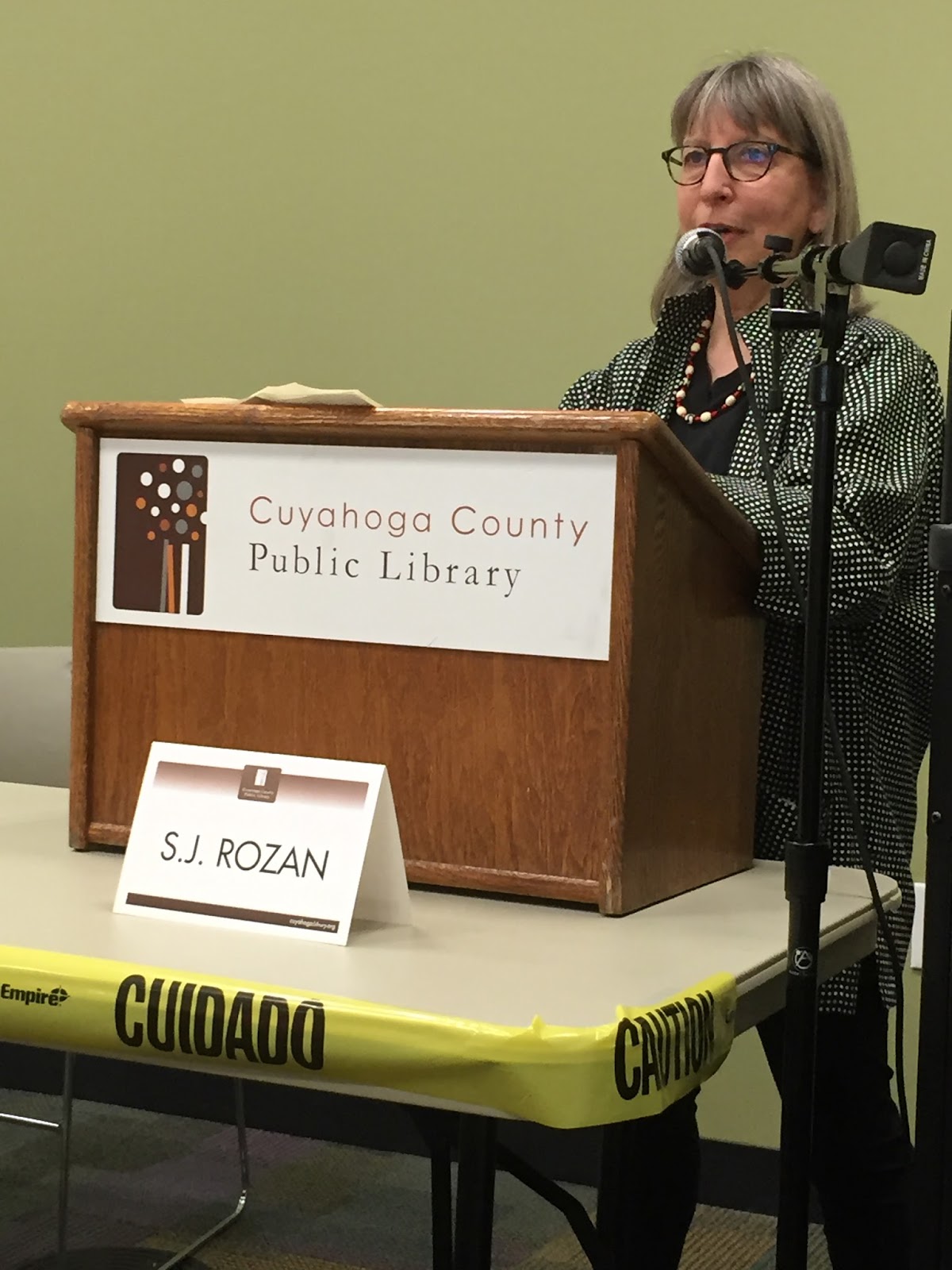
On Saturday, March 12th, my local chapter of Sisters in Crime – NeoSinc, with Laurie Kincer of the South Euclid-Lyndhurst Branch of Cuyahoga County Public Library, put on Death March, a mystery readers and writers’ conference. It was a fun and informative day with many people attending.

Our keynote speaker was S.J. Rozan

Before the event began, there was coffee, tea, hot chocolate or bottles of water along with lots and lots of fresh donuts. Throughout the day baskets of candy bars and other treats were available, too. Our chapter and the Friends of the South Euclid-Lyndhurst Branch Library furnished all the food and drinks that day.

Laurie Kincer and our president Irma Baker welcomed us and suggested that those writers who weren’t already members might want to join our chapter and pointed out who to see to sign up. They also told us what to expect including that they would be drawing names between each program for gifts members of our chapter had donated.
Amanda Flowers the furthest left and SJ Rozan a little right.

Dr. Katherine Clark, a mystery expert, and a member who has been with us since we first started meeting, long before we formed our chapter was our emcee. She got her doctorate researching mystery authors and their books and taking extensive polls of both writers and readers. I remember when she came to visit me and gave me her thesis to go over before she submitted it.

With her unique sense of humor, she called published authors to the front and lined them up on a continuum from scariest and/or goriest mysteries down the gentlest of the cozy books. It brought lots of laughter as the authors tried to figure out if one was cozier than another, or one had more violence in their books than another. I might be missing a few authors names here, but I remember Shelley Costa, Mary Ellis, Amanda Flower, D.M. Pulley, Victoria Selvaggio, Sam Thomas, Ann Turzillo, and either Scott Lax or Andrew Welsh-Huggins. One of those last two came later. I’m pretty sure Amanda Flower was at the very end of the cozy line. In fact, the joke was she should go out the door into the hall because of the sweetness of her mysteries. She is the daughter of a retired and now deceased Presbyterian minister, a special woman I was privileged to meet several times at Malice.


Next S.J. Rozan discussed “Categorization and its Discontents.” She’s an excellent speaker and held everyone’s interest and answered a lot of questions at the end. I for one enjoyed her talk, and I know others did, too. One of the reasons she was happy to come, was that she had gone to Oberlin College and was familiar with the area and liked it.


D.M. Pulley, Mary Ellis, Sam Tomas and Jane Turzillo

Jane Turzillo, a writer who writes true crime historical stories of murderers in Ohio moderated the next panel: Getting (and Staying) Published. Panelists were D.M. Pullen, Mary Ellis and Sam Thomas. This panel elicited lots of questions from those who were unpublished writers after the speakers answered the questions Jane had asked them.

And then it was lunch time. Some ate box lunches ordered in advance, some brought their lunch, and others left to go to a nearby restaurant. There was more than enough time to eat and visit with different people. I sat by Nancy Layan after I went back to the conference room, and before it started we had time to get acquainted and ended up exchanging copies of our first books before we left. She recently joined Sisters in Crime, but wasn’t sure about joining our chapter yet since she doesn’t live close to where we meet.

After lunch, Dr. Katherine Clark led a lively interview of S.J. Rozan. I know everyone enjoyed it as much as I did.

Scott Lax, S.J. Rozan, Andrew Welsh-Huggins & Sherrely Costa

Kim Hammond, another of our original members, moderated the panel “Bring on the Sizzle: Writing to Keep Readers Reading. Members of the panel were Shelley Costa, Scott Lax, S.J. Rozan and Andrew Welsh-Huggins. It was another interesting panel, but I have to admit I was starting to wilt. I had gotten up early and driven an hour to get there. Still others were interested, and I admit I found it interesting, too, but most of it was what I already knew.


The last panel was “Do You Really Need an Agent?” moderated by T.K. Star with panelists Amanda Flower, Victoria Selvaggio, an author and an Associate Agent with The Jennifer De Chiara Literary Agency, and Jane Ann Turzillo.  I have to admit that now I was more than ready to go home as was Nancy. It had not only been a long day, but I’m long past looking for an agent. But there were beginning writers, or writers who have a book and still looking for an agent, who were quite interested and asked a lot of questions.

There were book signings afterwards. I didn’t sell any books, but I bought two. I don’t think very many books were sold because I didn’t see anyone signing books, but maybe it was during lunch or something. I know the gal from Macs Back Books who brought a lot of books was packing up boxes and boxes of books to take back to the shop.

All in all, it was a good day. I learned a few new things, met fellow writers – those I knew, and those I met for the first time that day. I didn’t get lost getting there, and I made it home still awake, although barely. One thing still brings a smile to my face. There was a young man whose name tag said, Justin Thyme. I asked him if that was his real name or a pen name. He smiled and said, “Pen Name.” I said “I wondered if you had a mother with a quirky sense of humor.” Now I’m wondering if I could possibly create a character with that name. Think it would work?

What writing events have you gone to that you enjoyed?