Showing posts with label Writing conferences. Show all posts

Sunday, April 12, 2026

MY FULL CIRCLE JOURNEY

 by Korina Moss

Some of our WWK members at Malice Domestic

‘Tis the season for Malice Domestic, an annual mystery fan convention that takes place in Bethesda, MD the last weekend in April. 

My Agatha Award for Cheddar Off Dead

This conference has a special place in my heart because it’s where I get to meet readers who love mysteries as much as I do, hang out with my writing friends, and get to know some of my author idols. It’s also where I won an Agatha Award for Best First Novel for Cheddar Off Dead and was nominated the following two years for Best Contemporary Novel for Case of the Bleus and Fondue or Die. Being among the writers I admire in those categories and being recognized by the mystery community was an honor.

Selling and signing at the Little Falls Cheese Festival

As every published writer knows, behind the fun stuff like accolades and meeting readers, lies the hard work of writing and marketing your books. I keenly felt the pressure of having my first series published by an imprint of Macmillan, a big-5 publisher, along with then having to launch a new book every six months. By book six, I was pretty burnt out. 

Event poster and my books on display at Barnes & Noble 

When the series ended, I couldn’t imagine jumping into another book or series right away. However, I wanted to remain in the mystery writing community while my muse decided when to resurface. So about 16 months ago, I shifted my focus from cozy mystery author to freelance developmental editor specializing in cozy mysteries. I enjoy the work, and I get to revel in my clients’ successes: finding agent representation, receiving publishing contracts, and independently publishing their mysteries. And at this year’s Malice Domestic, I get to cheer on one of my clients whose book has been nominated for an Agatha Award for Best First Novel. (In February, it won the Lefty Award for Best Debut Mystery from Left Coast Crime.) 

Adrian Andover's lauded debut mystery

Expanding my role in the mystery community has been a balm for my burnout. Witnessing the determination and excitement of new writers has reminded me of my writing roots. It’s taught me to set aside the business aspects of being a published author to get back to what really matters—creating a story I want to tell.


Readers & Writers: If you’ve been to a mystery writers conference or convention, what has it done for you? If you haven’t, what would you hope to get out of it?

If you’re attending Malice Domestic, please find me on Saturday, April 25th at 2:00 PM on the panel titled Served with a Side of Murder: Food-Related Mysteries, with fellow authors Mary Lee Ashford, Jennifer J. Chow, Raquel V. Reyes, and moderator Debra Klein. I’ll be featuring my sixth book, Bait and Swiss. At 4:00 PM, you can find me in the book seller’s room signing my Cheese Shop Mysteries.


KORINA MOSS is the author of the Cheese Shop Mystery series, which includes the winner of the Agatha Award for Best First Novel, as well as two novels short-listed for Best Contemporary Novel. Listed as one of USA Today’s “Best Cozy Mystery Series,” her books have also been featured in PARADE Magazine, Woman’s World, and Writer’s Digest. Korina is also a freelance developmental editor specializing in cozy mysteries. To learn more or subscribe to her free monthly newsletter, visit her website korinamossauthor.com.


Thursday, March 24, 2016

The Death March

The crowd was larger than it shows here.
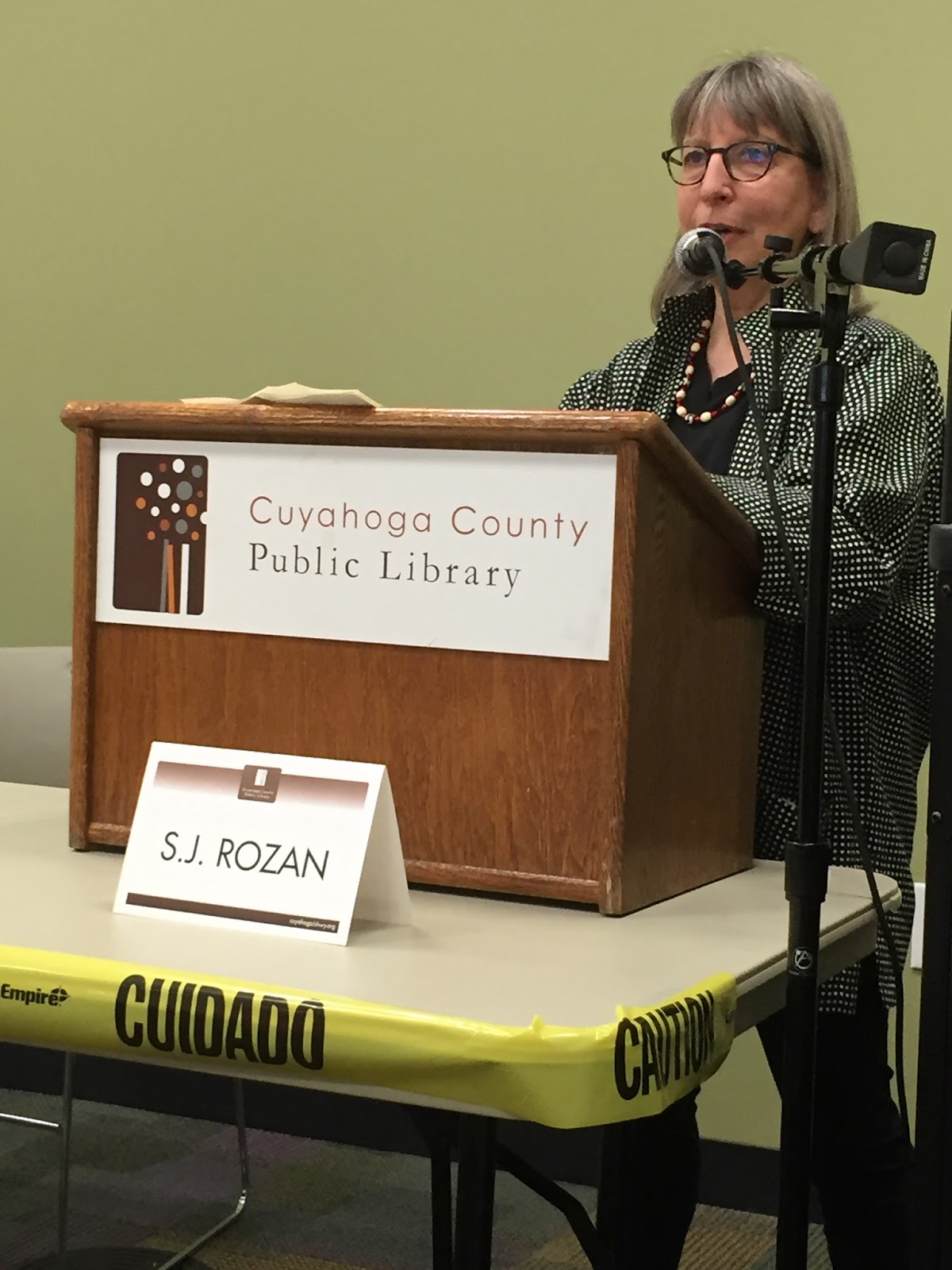
On Saturday, March 12th, my local chapter of Sisters in Crime – NeoSinc, with Laurie Kincer of the South Euclid-Lyndhurst Branch of Cuyahoga County Public Library, put on Death March, a mystery readers and writers’ conference. It was a fun and informative day with many people attending.

Our keynote speaker was S.J. Rozan

Before the event began, there was coffee, tea, hot chocolate or bottles of water along with lots and lots of fresh donuts. Throughout the day baskets of candy bars and other treats were available, too. Our chapter and the Friends of the South Euclid-Lyndhurst Branch Library furnished all the food and drinks that day.

Laurie Kincer and our president Irma Baker welcomed us and suggested that those writers who weren’t already members might want to join our chapter and pointed out who to see to sign up. They also told us what to expect including that they would be drawing names between each program for gifts members of our chapter had donated.
Amanda Flowers the furthest left and SJ Rozan a little right.

Dr. Katherine Clark, a mystery expert, and a member who has been with us since we first started meeting, long before we formed our chapter was our emcee. She got her doctorate researching mystery authors and their books and taking extensive polls of both writers and readers. I remember when she came to visit me and gave me her thesis to go over before she submitted it.

With her unique sense of humor, she called published authors to the front and lined them up on a continuum from scariest and/or goriest mysteries down the gentlest of the cozy books. It brought lots of laughter as the authors tried to figure out if one was cozier than another, or one had more violence in their books than another. I might be missing a few authors names here, but I remember Shelley Costa, Mary Ellis, Amanda Flower, D.M. Pulley, Victoria Selvaggio, Sam Thomas, Ann Turzillo, and either Scott Lax or Andrew Welsh-Huggins. One of those last two came later. I’m pretty sure Amanda Flower was at the very end of the cozy line. In fact, the joke was she should go out the door into the hall because of the sweetness of her mysteries. She is the daughter of a retired and now deceased Presbyterian minister, a special woman I was privileged to meet several times at Malice.


Next S.J. Rozan discussed “Categorization and its Discontents.” She’s an excellent speaker and held everyone’s interest and answered a lot of questions at the end. I for one enjoyed her talk, and I know others did, too. One of the reasons she was happy to come, was that she had gone to Oberlin College and was familiar with the area and liked it.


D.M. Pulley, Mary Ellis, Sam Tomas and Jane Turzillo

Jane Turzillo, a writer who writes true crime historical stories of murderers in Ohio moderated the next panel: Getting (and Staying) Published. Panelists were D.M. Pullen, Mary Ellis and Sam Thomas. This panel elicited lots of questions from those who were unpublished writers after the speakers answered the questions Jane had asked them.

And then it was lunch time. Some ate box lunches ordered in advance, some brought their lunch, and others left to go to a nearby restaurant. There was more than enough time to eat and visit with different people. I sat by Nancy Layan after I went back to the conference room, and before it started we had time to get acquainted and ended up exchanging copies of our first books before we left. She recently joined Sisters in Crime, but wasn’t sure about joining our chapter yet since she doesn’t live close to where we meet.

After lunch, Dr. Katherine Clark led a lively interview of S.J. Rozan. I know everyone enjoyed it as much as I did.

Scott Lax, S.J. Rozan, Andrew Welsh-Huggins & Sherrely Costa

Kim Hammond, another of our original members, moderated the panel “Bring on the Sizzle: Writing to Keep Readers Reading. Members of the panel were Shelley Costa, Scott Lax, S.J. Rozan and Andrew Welsh-Huggins. It was another interesting panel, but I have to admit I was starting to wilt. I had gotten up early and driven an hour to get there. Still others were interested, and I admit I found it interesting, too, but most of it was what I already knew.


The last panel was “Do You Really Need an Agent?” moderated by T.K. Star with panelists Amanda Flower, Victoria Selvaggio, an author and an Associate Agent with The Jennifer De Chiara Literary Agency, and Jane Ann Turzillo.  I have to admit that now I was more than ready to go home as was Nancy. It had not only been a long day, but I’m long past looking for an agent. But there were beginning writers, or writers who have a book and still looking for an agent, who were quite interested and asked a lot of questions.

There were book signings afterwards. I didn’t sell any books, but I bought two. I don’t think very many books were sold because I didn’t see anyone signing books, but maybe it was during lunch or something. I know the gal from Macs Back Books who brought a lot of books was packing up boxes and boxes of books to take back to the shop.

All in all, it was a good day. I learned a few new things, met fellow writers – those I knew, and those I met for the first time that day. I didn’t get lost getting there, and I made it home still awake, although barely. One thing still brings a smile to my face. There was a young man whose name tag said, Justin Thyme. I asked him if that was his real name or a pen name. He smiled and said, “Pen Name.” I said “I wondered if you had a mother with a quirky sense of humor.” Now I’m wondering if I could possibly create a character with that name. Think it would work?

What writing events have you gone to that you enjoyed?


Tuesday, June 16, 2015

A Writer's Holiday

Border for LRWA Summer Event
With summer, students can look forward to a break from classes and different opportunities to learn through library reading programs, camps, special activities, and vacations. For writers, summer is a time of conferences, book festivals, and research trips.

Of course, any time writers gather it provides not just an opportunity for exchanging information and networking, but for finding new creative outlets through interaction with your peers. It’s great to keep in contact by email, but face-to-face can give writers a boost through encouragement and shared experience. It’s like the difference between calling your relatives on the phone and seeing them at a family reunion. In person, the information exchanged is of a different quality.

Anna DeStefano
This weekend, my friend Susan F. Craft and I enjoyed attending the Lowcountry Romance Writers’ Summer Event, which took place on the Isle of Palms, near Charleston, SC. Twenty two writers convened to hear from Anna DeStefano, a romance writer born in Charleston who now lives in Atlanta. She met with us Friday evening for dinner and a brainstorming session, then presented a day long program Saturday evaluating how we write and offering suggestions and methodologies for structuring, drafting, and revising a novel. I really commend President Christina Sinisi (who writes as Lexie O’Neill) and the members who organized the event for a cost of $40, which included handouts, some supplies, refreshments, and a goody bag. For those of us traveling, a special rate was available at the hotel.

But, what if you don’t have the resources to travel to meetings or explore possible new settings for your work? Are you stuck at home, surfing the internet? And, if you are, can you have fun doing it?

Definitely. Many of the same organizations that offer events also provide online courses at reasonable costs. The Lowcountry Romance Writers has a monthly slate of online offerings. Every month has at least two featured courses. In July, the two four-week programs being offered are about improving punctuation and writing short stories for an anthology call. In August, the selections are Beginning WordPress and Writing from a Male POV. The cost for each is $20.

If you are a member of the Guppy Chapter of Sisters in Crime, you have access to the subsidized workshops coordinated by our own blogging partner E.B. Davis. She has arranged for well-known teachers like Ramona DeFelice Long and Kris Neri, who just completed a class on writing comedy. Cybercrimes was the subject of a recent well-received course and a short stories class is now being offered.

Thanks to Jim Jackson’s teaching a writing revision course in January, I learned about the online workshops sponsored by the RWA Kiss of Death Chapter’s College of Felony and Intrigue (COFFIN). Two tracks are featured. Murder One has experts in various forensic and other specialties as instructors while Killer Instincts focuses on writing craft. The cost is $15 for members and $30 for non-members. 

Hank Phillippi Ryan
Through the Murder One track, I’m currently taking a class with Hank Phillippi Ryan about how newsrooms and investigative reporters operate and how writers can use journalistic skills to improve fiction writing. Thanks to Hank’s wonderfully generous, interactive style, the information is terrific and student participation is high. In July, for Murder One, Chef Fran Gleason will provide an orientation to working in a kitchen and how you can commit murder there. For July’s Killer Instincts, Pam McCutchen has a course about writing convincing dialogue and other tips.

Writer’s Digest University has numerous online courses covering every possible writing topic at a variety of costs. If you’re interested in writing thrillers, take a look at WD’s thriller conference that takes place next weekend and features instructors like Hallie Ephron, D.P. Lyle, and James Scott Bell. In addition, it offers an opportunity to submit a query for agent evaluation.

Consider the opportunities that may be available in your community through libraries and bookstores. Authors on tour may be stopping by for signings. Check out the meeting schedules for your local RWA, MWA, or Sisters in Crime chapters. In South Carolina, our local chapters all feature monthly speakers. Most chapters allow interested persons to attend several meetings before asking that they become members.

Seek an experience that enhances your creativity. Go to a museum or ask to interview an expert at a law enforcement agency or university. Most people enjoy talking with interested persons about their specialties.

Taking a break from the routine tasks can bring you back to writing with renewed enthusiasm. So what do you have planned for a writer’s holiday?

Sunday, May 3, 2015

A bunch of writers walk into a room…


By the time this blog goes live, I will be headed back from the Oklahoma Writers’ Federation Inc. Conference in Oklahoma City. I’m on the faculty for the conference and speaking in three sessions—on self-editing, dialogue and creating atmosphere (they had way cooler titles than this, just sayin’).

Obviously, as I write this, I have no idea how it went—if my PowerPoint worked, if I ended up with an impossible question, if I passed out in front of a room full of people.

You know, the usual.

Like most writers, I prefer to hide behind the printed word, not actually say anything out loud. 

Especially to a bunch of my peers. But, I’m getting better. And mostly, I want to brave my nerves just for the fact that if any of the information I have to share helps another writer, it will be worth it.

What’s the most useful piece of information you’ve picked up at a conference, workshop or writers’ meeting?

Sunday, April 12, 2015

Drawing the Reader In

Think of a book you really loved. I mean really loved. Was it because of its perfect plot? A twist ending so surprising it astounded you? Because every word was exactly the right word?

I will go out on a limb and suggest that while those elements may have been present, you loved the book because you became deeply invested in at least one character. You cared about what happened to that individual, in how they would fare in the world they inhabited, which may be very different from any world you will experience.

Writers are beaten about the head and shoulders with the mantra to “show, not tell.” As I write this blog, I am participating in a weeklong Donald Maass workshop. We spent a good portion of day three discussing how to tell, not show.

What?

Yep!

Here is a diamond of understanding I picked up. Writers, you might try it out and see whether it deepens a story you are working on. Readers, see if you can catch a favorite author sucking you into their make-believe world with this technique.

Have your character tell (yes, tell) about an emotion they are feeling. Incorporate the following elements in the description. [My parenthetical example happens to use first person, but it works as well in third.] Include this in an action scene (not as a reflection or reaction scene) to make it immediate. Make it short so it does not feel to the reader as though the action has stopped.

Step 1. Use an analogy to describe the emotion. This objectifies the emotion and makes it safe for the reader. [My anger glowed as hot and fragile as a freshly blown glass figurine. One false move and everything would shatter.]

Step 2. Have the character make a moral judgement about their emotion. [No matter how much justified, surely God despised this much anger.]

Step 3. Include inner conflict regarding what the character is feeling. [And yet, within that fire, that blinding white rage, I felt a corner of my mind evaluating my posture, the tightness around my eyes, noting sagely that I was showing none of what I felt. The fury, should I let it slip its leash, would come as a complete surprise to the other wedding guests.]

Step 4. Add a touch of self-reflection. [There, I said it: should I let it slip its leash. It would be conscious if I did, and even if others called me insane, I would know it for a conscious effort. It was my beast to wrestle, to control.]

Had you read this on the first or second page would you be interested in reading more about this character? If you read it later in the story, would it deepen your understanding of this character? If this telling occurred while the individual stood as best man, watching the bride-to-be walking down the aisle on her father’s arm, would it have stopped the action, or indeed would it have been part of the action, even though it was all exposition?

Remember, I just learned this and so am practicing, but I do think it works. What about you?

~ Jim

Sunday, March 29, 2015

On the Road Again

Publication date for this blog is day three on a forty-seven-day road trip wandering from our place in Savannah to our home in Michigan’s Upper Peninsula. Before we arrive home, we will have traveled in at least twenty states (probably twenty-two) and one Canadian province. The car’s odometer will have recorded an additional 6,500-7,000 miles. We’ll have driven well over 100 hours; some of the hours will be bogeying on interstates, more will be wandering what William Least-Heat Moon has forever labeled for me as “blue highways.”

We designed our route from Georgia to Oregon to visit as many National Wildlife Refuges as we have time for. I’ll check off a bucket list item when we catch the sandhill crane (Grus canadensis) migration as it hourglasses at the Platte River.

As many as a quarter-million cranes pour into the Platte region as they move up from the bottom of the hourglass encompassing the Gulf of Mexico through Arizona, pinch at the Platte and spread across northern North America. (There are other sandhill crane flyways in North America, but this is by far the largest.) We’ll be there at the end of the migration, so we’ll see how many cranes are still around given the early warm Spring in that part of Nebraska.

In Oregon I’ll spend six days improving my writing skills at the Donald Maass workshop while Jan tours the area around Mt. Hood and visits friends in Portland. On the second portion of the trip we’ll catch family in St. Paul, Minnesota; I’ll participate in a bridge tournament at Lake Geneva, Wisconsin while Jan visits family in Highland Park, Illinois; we’ll visit more family in Rochester, New York and some of Jan’s childhood friends in Lansing, Michigan.

Given the early warm weather, we expect mud season will be over by the time we reach home. If not, we’ll add an extension onto our trip until we can drive in the last fourteen miles of logging roads to our place!

I plan to take a photograph every fifty miles, no matter where we are. The process will provide a visual record of the topography and vegetation changes as we move up from twelve feet above sea level across the Appalachians, back down into the Mississippi drainage, up into the plains, over the Rockies, and back down toward sea level as we reach the West Coast areas. The only gaps in our photographic recording will be when we drive at night.

If you want to follow the trip, I’ll be posting on my personal Facebook page, and I expect to add more pictures using my personal blog My Two Cents (Before Inflation).

So come along with us on the trip, if you wish. I’ve discovered our friends fall into two camps: those who think this is a marvelous idea and those who think we are bloomin’ crazy. Which group do you fall into?

~ Jim

Sunday, May 25, 2014

RT Convention 2014 Roundup


Mission accomplished.
As you can see from the pic above, my time at the Romantic Times Convention in New Orleans last week went pretty darn well. Not only did I get to meet Lee Child, perhaps my biggest goal of the conference, I got to take a hilarious picture with him (he’s about 6-foot-5 and I’m barely 5-1, just in case you’re wondering).
So, dream meeting aside, what’s it like to be at a “romance” convention as a crime writer? In a word: fun.
Despite RT’s name, the focus really is on books in general, not just romance books.
Actually, let me rephrase that: It’s about books by women. Probably 98 percent of those in attendance and those who made appearances and appeared on panels were women. Most of the book fans were women. Most of the agents and editors in attendance were women. Most of the authors were women.
And all of these women write very different books. Sure, there were plenty of steamy covers to go along with the male cover models parading around the venue, but those few men (and Lee) stuck out much more than I did for being a crime fiction author.
Everyone there wanted to talk about books, writing and the industry. It didn’t seem to matter much what type of words you put on the page.
And that was extremely clear during the “roast” of Lee Child and Jack Reacher that I attended moments after that very silly picture at the top of the blog was taken. Lee has his nineteenth Reacher book coming out this fall, and they aren’t the most romantic books, as his readers know. Yet, there were tons of writers, readers and industry people in attendance for the roast, and we all giggled along together as a Reacher impersonator (flown in from Australia) emceed the event as the famed character himself.


Yes, there were a few Tom Cruise short jokes thrown in there. But mostly, it was clear that the writers roasting Lee—including Alafair Burke and Tess Gerritsen—cherished the friendship and camaraderie they have with Lee as writers, all the while skewering him for our entertainment.
In fact, friendship really was the theme of the entire conference. I’d mentioned in my previous blog that though I was really excited to meet Lee, the biggest thing for me was to get to hang out with friends I’ve known online for years. We had long meals served with long conversations, we went to the former home of Anne Rice in the Garden District, we ate beignets and drank coffee, tripped over cobblestones during a ghost tour, lined up for panels and parties, and squirreled away an hour or two of revision time. It was fabulous, and many selfies followed.

I won’t bore you with every picture I took or adventure I had, but I will finish with one last little thing I did. I spent several hours at an old-timey bar called Arnaud’s 75 with my Irene Goodman Literary Agency sisters.

The IGLA agent in attendance, the lovely Miriam Kriss (in the striped shirt and glasses), organized the outing. And it was a fantastic time, hanging out, and getting to know one another. It was truly one of the most fun evenings I think I might have ever had. And even if I’d just flown to New Orleans for that small swatch of time, it would’ve been completely worth it.
So, yeah, mission definitely accomplished.

Sunday, May 11, 2014

The Mysterious World of a Romance Conference


I’ve decided to go to my first major writers’ conference. Yippee!
However, rather than picking Malice Domestic or Bouchercon or ThrillerFest or any of the other perfectly good mystery-related conferences out there, I’m going to a place most purveyors of this blog will think is a little strange. You ready?
Next week, I’m headed to the Romance Times Convention, aka RT, in New Orleans.
And before you start wondering if I’ve jumped the mystery ship for more lovey-dovey waters, I haven’t.
Sure, my books have some romance in them, though that’s never the actual aim of the story. Which makes me like 90 percent of the writers I know who are attending RT.
That’s right: of the people I know in real life or on Twitter or just in the writing community in general, I’d say three of them are actual romance writers. The rest are just like me: we do a nice romantic subplot. Kind of like the famous writer who I’m the most excited to see there: Lee Child.
Yes, Jack Reacher’s maker himself will be there, doing a few different events, and I’m super excited.
That said, I’m not attending RT to see Lee Child. In fact, I didn’t even know he was officially going until after I signed up. Rather, though I’m sure I’ll be excited for the conference proper and all the things to see and do and learn there, my main reason for going to RT is this: To meet some of the amazing people in the writing community I’ve gotten to “know” over the past few years.
There are several writers (20? 30? Maybe more?), I know, either in real life or online, who I’ll get to hang out with for a few days for a reason I love. I just can’t wait to meet these ladies, talk shop, and attend sessions together.
Sure, celebrities and parties with cover models sound cool and all, but to me, really, I’m in New Orleans to be in the same place as some of my very favorite writerly people. I’m sure many of you who have gone to Malice Domestic or Bouchercon or ThrillerFest have done the same for very similar reasons.
Have you gone to a writers’ conference? What was your favorite part?

P.S. I’d like to give a happy Mother’s Day shout out to my very awesome mom, who always demands to read what I’m working on, even though books with murder aren’t exactly her thing.

Sunday, November 3, 2013

Seven Characteristics of a Great Panel Moderator

Last weekend Jan and I attended Magna cum Murder in Indianapolis. I found most of the panels well run and the panelists thoughtful and interesting. Two panels stuck out from the rest. One was extremely well moderated; the other, not so much.

Here are six things the exemplary moderator did well:

1.       Before the panel started, the moderator had clearly done his homework. He was familiar with each of the panelist’s writing. Before the conference he provided the panelists a list of areas he planned for them to discuss.
2.       He began the discussion with a description of the panel and a very brief introduction of himself.
3.       He provided a short introduction to each of the four panelists (the conference provided longer bios in the conference book).
4.       He varied which panelist discussed each question first. His introduction of the topic often included specific reference to the panelist’s work (the advantage of homework).
5.       He asked other panelists to comment on interesting observations one of them had made, often choosing a panelist with a different perspective (another advantage of doing his homework).
6.       He never interjected himself into the conversations, except to provide transitions between panelists or to introduce a new topic for discussion.
7.       He never provided his opinions, disagreed with the panelists, or offered elaboration on their answers.

The exemplary moderator acted as a lubricant for the discussion. He did his job so well, one of the panelists commented on it and audience gave the moderator an ovation. In contrast, the less-than-satisfactory moderator failed on a number of accounts.

1.       The moderator surprised the panelists by asking them to introduce themselves, when the previously announced game plan had been for the moderator to make all the introductions.
2.       The moderator’s introduction of himself lasted longer than the introduction of the panelists.
3.       For each topic discussed, the moderator provided his own answer after the four panelists had talked, and used each answer to self-promote.
4.       The moderator read each of ten items on a handout he had already provided the audience.
5.       When it came time for questions from the floor, the moderator answered questions directly.

A moderator’s objective should be to make the panel run smoothly and help make the panelists look good. Solely based on their performance as moderators, I’ll be buying the first person’s newest mystery, and never buy the other moderator’s books, no matter how good they might be, based on their hijack of the panel. I suspect most of the audience feels the same way.


~ Jim

Monday, August 19, 2013

Conferences and Festivals—Why I Go


This week, I’m going to Killer Nashville, a great conference for mystery writers and readers. I am looking forward to it after having finished my third Skeet Bannion novel and turned it in on my deadline. It will be a time to celebrate books, readers, writers, and the mystery field. And did I mention it’s in Nashville? I am ready for Music City, USA.

I’ll be on a panel called “Fiction on the Fringes: Writing about Other Cultures, Closed Societies and Countercultures.” Appearing with me will be Rabbi Ilene Schneider, Ed.D., Bharti Kirchner, Jill Yesko, and moderator Stacy Allen. We’ll be discussing writing about universities, the Cherokee, Jewish and (East) Indian communities, and the worlds of hackers and street people. I think it should be a fascinating panel.


My husband and I are carpooling to Nashville with Julie Tollefson, a friend from  Border Crimes, our local Sisters in Crime chapter. We’re not staying at the conference hotel but with Lorraine Lopez, a dear friend and wonderful literary fiction writer. And while we’re at Killer Nashville, we intend to run around with other great writer friends like Hilary Davidson, Chris and Katrina Niidas Holm, and Debra Goldstein. These are people I’m so fond of and, with the exception of Julie, seldom get to see.

 That’s one of the things that sends me to writers conferences—friends in the business who live far away and are as busy as I am, so we seldom see each other. The AWP (Association of Writers and Writers Programs) national conference held in late winter at various large cities around the country is a big one I almost never miss. Over 1,200 writers and publishers gather each year, and I can’t walk from one spot to another without constantly being pulled over by someone I know. Some of my favorite people in the world I only see at AWP anymore.


Then there are book festivals. Tucson holds a legendary book festival that numerous friends want me to attend, and I hope to do that soon. Los Angeles also puts on a famed book festival that friends and my poetry publisher in California would like me to attend, so I will try to make that happen in the next year or two. This fall, I’ve been invited to read at the Brooklyn Book Festival in New York City and at the Hudson Valley Writers Center in Sleepy Hollow, NY, just outside of the city, so September 20-23 will see me in New York. Again, many friends in the writing world will be there, and it will be a great opportunity to see them, as well as my agent and editor.


However, the main reason to go to these conferences and festivals, at least for me, is the readers who flock to them. It’s a wonderful way to make contact with readers from different parts of the country and a grand way for readers to meet and hear their favorite authors and learn about and find new favorite authors. At a conference or festival, a writer can connect with readers in a way s/he seldom has a chance to connect at other times. So, let’s hear it for all the wonderful conferences and festivals around and all the great people, usually volunteers, who work so hard to make them happen successfully!

What conferences and festivals do you like to attend? Why or why not?