Showing posts with label Writing Life. Show all posts

Saturday, September 19, 2026

Writing Life Advice from Writers Who Kill by Judy L. Murray

If you’re a writer or a reader fascinated with the writing process https://writerswhokill.blogspot.com is a wealth of information and inspiration. We invite you to discover the world of the accomplished Writers Who Kill.

Each blog post can improve your own writing skills or introduce you to the writing world from a different perspective with years of ideas, writing struggles, and new resources. All the articles are listed within months of the year. Scroll along and discover a new view of the writing and reading world!

On Writing Inspiration:
Tips to Help Writers Stay Motivated by Heather Weidner September 11, 2026
Thoughts on Writing by Nancy L. Eady August 31, 2026
Where Do We Get Our Ideas? It’s Complicated by Maureen Milliken August 29, 2026
My Writing Journey: From Cerebral Reader to Thriller Writer by Lisa Malice Nov 9, 2024
Travel with Benefits by Paula Gail Benson August 20, 2024
An Interview with a Writer Rosalie Spielman by Grace Topping November 13, 2024

On Writing Skills and Career Building:
Five Sure-Fire Ways to Kill Your Writing Career by Connie Berry August 27, 2026
There’s More to Writing Than Just Writing by Annette Dashofy August 23, 2026
Surviving the Editing Process by Judy L. Murray September 21, 2024
500 Words a Day by Martha Reed June 25, 2024
Website Rehab by Sarah E. Burr September 15, 2024
Insert Title Here by Mary Dutta November 2, 2024
How Do I Kill Thee? Let me count the ways by Teresa Inge June 3, 2024
Character Lessons by Lori Roberts Herbst October 4, 2024
Three Recommendations to Improve Your Stories by James M. Jackson October 1, 2024
Writing More Than One Series at a Time by Marilyn Levinson June 20, 2024
Getting Out of Your Safe Space by Susan Van Kirk February 5, 2026
Slowing Down Has Its Benefits by Debra H. Goldstein July 20, 2026
Don’t Create Your Own Roadblocks by Shari Randall June 10, 2024
Let’s Talk by K.M. Rockwood August 11, 2026

On Reading Enjoyment:
Prime Reading Cozy Months Ahead by Korina Moss September 13, 2026
A Bit of Fun About Reading and Writing Books by Molly MacRae August 2, 2026
What We’re Reading by Kait Carson July 30, 2026
Julia Spencer-Fleming’s At Midnight Comes the Cry (Review) by Margaret S. Hamilton October 9, 2025

As you enjoy these articles feel free to add your comments. We writers love to hear from you.

All the best, Judy L. Murray
Author, The Chesapeake Bay Mystery Series

https//:JUDYLMURRAYMYSTERIES.com
PenCraft First Place Awards
IPPY Gold and Silver Medalist
Silver Falchion Int'l Award
Agatha Award Nominee


Tuesday, July 7, 2026

All in the family?

 By James M. Jackson

Later this year, I will publish Niki Unbound (Niki Undercover Thriller #3). It will be my eleventh novel. In addition, I have written one non-fiction book and two novellas—a reasonable output for someone whose first book wasn’t published until his sixties.

However, that oeuvre does not make me the most prolific author in my family. And I am far from the most notable. Here’s the scoop:

Dr. James C. Jackson
My great-great-great-grandfather James Caleb Jackson is the most notable. He was a well-known abolitionist speaker in the 1840s; in the 1850s his attention turned to health, and he founded a “health resort” focused on good water, exercise, and a vegetarian diet. He invented the first “ready-to-eat cereal,” Granula. (You know granola because the Jacksons sued the Kelloggs for patent infringement and won, and Kellogg had to change the name of his product.)

In addition to his work as editor and owner of various anti-slavery newspapers, he published 11 books (per Wikipedia), all nonfiction, including titles such as How to Treat the Sick Without Medicine, and Dancing: Its Evils and its Benefits. Some of those books, like Dancing are quite short.

In the Jackson line, we skip four generations to the next published author, my father. His textbook, A User’s Guide to Principal Components, published by Wiley in 2003, is still used for graduate-statistics courses. He also published a variety of historical pamphlets and the book, The Castles on the Hill, which detailed the history of the Jackson Health Resort and its subsequent lives.

Dr. Albert Tracy Leffingwell
Looking at my family writ large, I have prolific cousins as well. Dr. Albert Tracy Leffingwell was James Caleb Jackson’s nephew; therefore, my first cousin four times removed. He founded the American Society for the Regulation of Vivisection and served as president of the American Humane Society. Pertinent to this article, Wikipedia attributes twelve publications to him. I have Rambles Through Japan Without a Guide, but none of his other books (which include Vivisection in America, Does Science Need Secrecy, and American Meat).

The grand prize for number of publications goes to Albert Tracy’s son, Albert Fear Leffingwell—my second cousin three times removed. He published a book of poetry while still a Harvard student. After graduation, he became a New York advertising executive. He wrote three early nonfiction works, and then, starting in 1939, he published thirteen noir crime novels under his name and the pen names Dana Chambers and Giles Jackson.

That’s seventeen published works. He died at age fifty-one. I didn’t have my first book published until I was sixty-one! Such a sluggard, I am. In fairness to me, his novels are less than half as long as mine, so I might have the family record for the number of published words!

His novels are being republished by Stark House Press. Last month, Curtis Evans, who wrote the introduction to the republication of the first two novels, contacted me. Curt is a retired history professor, specializing in the antebellum US and post-Civil War era. He found the link between the Leffingwells and the Jacksons, ran across a blog I had written about James Caleb Jackson, and discovered I wrote crime fiction.

Long story (somewhat) short: he’s invited me to write an introduction to one of the future republications. Details remain to be worked out, but that’s one way to keep it all in the family.

Writers: do you have a history of authors in your family? Readers: is this kind of information interesting, or TMI?

* * *

James M. Jackson writes justice-driven thrillers with brains and bite, including the Niki Undercover Thriller series and the Seamus McCree series. To learn more information about Jim and his books, check out his website, https://jamesmjackson.com. You can sign up for his newsletter (and get to read Low Tide at Tybee, a novella featuring Seamus, his darts-throwing mother, and six-year-old granddaughter, Megan).

Saturday, April 25, 2026

How Writing is Like Running

By Kait Carson

Many of you know I’m a runner. More when I lived in Florida than now. Maine has these things called hills. Something I never trained on and tend to avoid. Still, come spring and early summer, I’m out there running the circumference of our mowed field. On the hill. I should know better.

My running days began in the 1970s. I belonged to The Book of the Month Club, and I bought Jim Fixx’s book, The Complete Book of Running. I ran daily until Son of Sam appeared and murdered women in Kissena Park, six houses from mine and home to my running trail. Screech. Slide to a stop. After Sam’s capture, I took up the sport again, and then we lost Jim Fixx. Running might not be all it was cracked up to be, and I stopped.

Then I started working for lawyers. I’m sorry. I know several of my blogmates are Bar members, but truly, lawyers were the proximate cause of my rededication to the sport. Legal work is stressful. Running provided an outlet, and all the law firms I worked for fielded teams for the Miami Corporate Run. I never was much for racing. Not that I’m not competitive. Boy howdy, I am. It’s just that I’m SSSSSLLLLLOOOOWWWW, but preparing for and running is a great team-building exercise and it’s fun. Group suffering is the best.

What in the Sam Hill (who was Sam Hill? Anyone know?) does any of this have to do with writing? Oh, more than you think.

The hardest part of running isn’t ticking off miles. It’s lacing up the shoes. The hardest part of writing isn’t accumulating the word count. It’s butt in chair, fingers on keyboard. Once you get past the prelims, clear sailing. Not.

As with running, writing, at least my writing, proceeds in fits and starts. New ideas bring endless hours of plotting, pounding out chapters, working up characters, red herrings, clues, and research. Then, here comes the hill. Life gets in the way, or something doesn’t flow, or, and this happened to me twice, a key bit of story changes or disappears and it’s back to the drawing board. The setbacks may be temporary or permanent, but either way, they slow you down, or, in the case of losing a publisher (or agent) put your writing life on hold.

Then there are the days, weeks, and months when the ideas flow and you wish for a second set of hands to pound the keyboard. In running, this is called the runner’s high. It’s a real thing, and it is directly analogous to a writer’s high. When it’s good, it’s good, and the author knows it. Those are moments to crave and cherish. True confessions—I’m in one of those periods now, and I wish I could bottle it.

As an aside, lawyers figured in my writing life as well, and they are the reason I use a pen name. You see, in my first book, I killed off a lawyer. The book was a work of fiction, but after twenty years in the legal field, people knew me, and the firms I worked for, and I wanted to avoid the ever-popular game of pin the crime on the attorney!

How about you? Where are you in your writing life? Smooth sailing, on hold, or laboring up the hill?

Kait Carson writes the Hayden Kent Mysteries, set in the Fabulous Florida Keys, and is at work on a new mystery series set in her adopted state of Maine. Her short fiction has been nationally published in the True Confessions magazines and in Woman’s World. Kait’s short story, “Gutted, Filleted, and Fried”, appeared in the Silver Falchion Award nominated Guppy Anthology Hook, Line, and Sinker. Her nonfiction essay was included in the Agatha Award-winning book Writing the Cozy Mystery. She is a former President of the Guppy Chapter of Sisters in Crime, a member of Sisters in Crime, and Guppies.


Saturday, October 25, 2025

The Birth of a Writer

by Kait Carson

For a dreamer lives forever. And a toiler dies in a day. John Boyle O Reilly

My mother used to say this to me. I think she considered it her motto. But I never knew what she dreamed of. I wish I had asked. Like many of her generation, she was schooled in poetry. To her dying day, she quoted entire poems, The “Charge of the Light Brigade” being a favorite, most anything by Elizabeth Barrett Browning, and Carl Sandburg. We lived on a river, and at certain times of the year, fog formed a wall between the banks. I never look at fog that I don’t see a gray cat, tail curled around its feet, floating in the mist. Her quotes were cryptic comments, but they’ve become clearer as they followed me through life.

Looking back on the dreamer quote, I think it was my mother’s way of encouraging me. I was a late child, born nine years after my only sibling. My parents were well into middle age at the time and unsure of what they needed to do about this tiny bundle of energy born when they thought their lives would be slowing and settling. The kids in my neighborhood were older and male. As the lone girl child, I needed some serious coping skills to keep up. I became an over-achieving daredevil of a kid. Nothing was too hard or too dangerous. To fail meant being left behind.

Add an overactive imagination, and learning to read at the tender age of two into the mix, and this girl-child had a setup for adventure. We built snow forts, igloos, and practiced skiing down snow-packed stairs. Yes. Stairs. We’d heard of the Tenth Mountain Division, and although we had little knowledge of the men who served with them, we invented battles and stories for our snowy play forts.

Then came Mark Twain. What better books for children growing up along a river? We lashed fallen branches together and built rafts, all of which met watery deaths. None of us did, though. I had the honor of being rescued by the tugboat captain once. I’m sure we were the bane of the bridge tenders' existence. Given we played in the Passaic River, I’m surprised we don’t glow in the dark! We paid homage to Tarzan by building platforms in trees and swinging out over the river on ropes. My parents took much of this in stride. They drew the line when I jumped out of the second-story window. I landed unbroken and unfazed, rescued the wagon train from Billy the Kid and had heck to pay when I knocked on the front door to be let back into my house. Ended up spending two weeks in my room. That would have been acceptable, but they took my books away.

I met Jo March about the same time most of my older friends were entering middle school. The difference in our ages became an insurmountable chasm. My endless imagination turned inward and emerged as words on the page. School always came easily. I excelled at the work. Math, science, and English all flowed effortlessly. My teachers were thrilled, but they all had one negative comment. She’s a dreamer, they would write on my report card. My parents attended more than one conference where teachers expressed frustration. Once I understood something, I lost interest in the rest of the class and scribbled stories. Stories I was forced to read aloud as punishment. One or two paragraph flights of fancy that often drew applause from my classmates.

My parents would come home from these meetings at a loss how to discipline me. My mother would say, “She’s a dreamer, Bill, and a dreamer lives forever, a toiler but a day.” I’m still a dreamer. Now my dreams take the form of books and short stories. Some of them sell, some do not, but they are all a part of me. Some, like this post, are deeply rooted in the heart of the child.

How about you? Are you a dreamer? Do you still follow your dreams?

Kait Carson writes the Hayden Kent Mysteries, set in the Fabulous Florida Keys, and is at work on a new mystery series set in her adopted state of Maine. Her short fiction has been nationally published in the True Confessions magazines and in Woman’s World. Kait’s short story, “Gutted, Filleted, and Fried”, appeared in the Silver Falchion Award nominated Guppy Anthology Hook, Line, and Sinker. Her nonfiction essay was included in the Agatha Award-winning book Writing the Cozy Mystery. She is a former President of the Guppy Chapter of Sisters in Crime, a member of Sisters in Crime, and Guppies.

Tuesday, June 3, 2025

Changing My Tagline

For many years, I have used the tagline "Thrillers with a twist of financial crimes" to describe my fiction.

It’s part of my email signature. The jamesmjackson.com website includes it in the header that appears at the top of most webpages. It encapsulates most of my writing. Sure, there’s the short story here or there that doesn’t involve a financial crime or isn’t a thriller, but for 95% of my writing, it is dead on target.

Until the near future, when 100% of my current writing does not fit that description. I am working on the Niki Undercover Thrillers, which I envision having at least three novels. The first, Niki Undercover, is in its final stages before actual production; the second, Niki Unleashed, is with beta readers; this week I started a first draft for the third, Niki Unbound (I think). The thrillers part of my tag line still applies, but the twist of financial crimes portion becomes less meaningful the further into the series we go.

What one line will intrigue readers, differentiate my stories from everyone else’s, and be honest? After posing that daunting question, I considered adding a financial crime to Niki Unleashed and being done with the concern.

Instead, I reflected on common themes in my novels. Both Seamus McCree and Niki seek justice. Seamus fights for the powerless against powerful people and institutions. Niki focuses more on bringing to justice those internal forces who attack the United States, but she also tries to right institutional wrongs the system can’t or won’t address. Conflicted family relationships play a role in most of the stories. My novels are complex, weaving multiple storylines. My characters use brains more often than brawn. They are intelligent, deeply human characters, not superheros.

Starting with a blank sheet can be daunting. Here is a great use of AI. I posed the problem to ChatGPT, and it spit out many alternatives, giving reasons each might apply. But they spurred me to my first try:

Justice-seeking thrillers with a heart.

ChatGPT told me why it liked it but then offered alternatives with a similar bent. One of which was:

Smart, driven thrillers for readers who care.

I didn’t care for it (the “for readers who care”) was off-putting, but inclusion of the word smart triggered another alternative:

Smart, justice-driven thrillers.

ChatGPT riffed off that idea and among others came up with

Smart, justice-driven thrillers with a bite

Justice-driven thrillers with brains and bite.

Thrillers powered by justice and smarts.

Smart thrillers. Justice at their core.

Intelligent thrillers with a moral compass.

Now comes the fun part. I have my favorite two, but I may be too close to be the best judge. Which one(s) do you think work best?

I look forward to your comments.

* * *

James M. Jackson authors the Seamus McCree series. Full of mystery and suspense, these thrillers explore financial crimes, family relationships, and what happens when they mix. To learn more information about Jim and his books, check out his website, https://jamesmjackson.com. You can sign up for his newsletter (and get to read a free Seamus McCree short story).

Tuesday, March 4, 2025

Speaking Truth to Power

By James M. Jackson

After deciding to become a published author, I made a conscious decision to avoid politics in my blogs and online commentary. Because I have an interest in finance, many of my early blogs related to financial topics with an emphasis on personal finance. Those blogs were fact-based, and although they expressed my opinions, they avoided espousal of any political views.

As my writing turned more toward fiction, so did my blogging and online commentary. Again, I avoided politics, instead concentrating on the craft and business of writing.

I continued to use my financial knowledge, especially regarding Social Security, Medicare, and pension plans, to address factual errors I saw in others’ blogs and social media posts. It didn’t matter to me whether I agreed with the other person’s position; what I tried to do was point out factual misunderstandings. Similarly, I used my MBA and general business knowledge to shed light on the financial concerns of writers.

I was born a numbers guy. My mother taught high school math. My father was a statistician, and from him I learned at a young age the difference between correlation and causation. In a college course Dad taught, he had a slide that showed the correlation between the number of stork nests in some European city (Rotterdam?) and the number of births in the city. Turned out that the more stork nests there were, the more babies were born. The correlation was huge and continued for years!

Did storks deliver babies in that city? (The purported causality.) No. Rotterdam babies came into the world in the normal way. The connection between these two sets of highly correlated statistics occurs because the city constructed houses with flat roofs—perfect conditions for storks to build nests. As the population of the city grew, the number of human births grew, the number of flat-roofed houses grew, and the number of stork nests grew.

Mark Twain attributed to British Prime Minister Disraeli the quote that there are “lies, damned lies, and statistics.” To that I would like to add an amendment: There are lies, damned lies, statistics, and politics using statistics. By politics, I include politicians and those who frame political arguments, be they think-tanks, “news” media, or so-called influencers.

In 1955, The American Friends Service Committee issued a publication Speak Truth to Power: A Quaker Search for an Alternative to Violence[i]. It addressed peacemaking in a world of violence. The phrase, speaking truth to power, has been picked up and used/misused by many organizations and movements since then. The introduction to the 1955 publication indicates the idea of speaking truth to power is taken from the charge given to 18th century Friends to make the effort to speak from the deepest insight of the Quaker faith.

In the publication, the Friends claimed to speak to power in three senses:

  • To those who hold high places in our national life and bear the terrible responsibility of making decisions for war or peace.
  • To the American people who are the final reservoir of power in this country and whose values and expectations set the limits for those who exercise authority.
  • To the idea of Power itself, and its impact on Twentieth Century life.

While I do not share the Quaker faith, I have come to realize I do feel strongly about speaking truth. There should and must be free discussion about what policies our governments—local, state, and federal—should implement. As a fiscal conservative and social liberal, I may or may not agree with those policies. That is of little importance, because, through our representative election process over time, the body politic at large decides policies. What is critically important to me is that when discussing actual or proposed policies, those in power, politicians and media, use facts to argue the merits of the policies. Facts about our current situation. Facts about the effect of the proposed policy.

I feel called to speak to power when politics uses statistics and lies to obfuscate the truth behind the policies.

If this decision adversely affects my writing business, so be it.

Does this mean my future Writers Who Kill blogs will be political, speaking truth to power? No. They will be about my writing world, just as this blog is about my writing world. And yet, that, too, is part of speaking to power.

I look forward to your comments.


[i] Speak Truth to Power: A Quaker Search for an Alternative to Violence https://quaker.org/legacy/sttp.html?form=MG0AV3

* * * * *

James M. Jackson authors the Seamus McCree series. Full of mystery and suspense, these thrillers explore financial crimes, family relationships, and what happens when they mix. To learn more information about Jim and his books, check out his website, https://jamesmjackson.com. You can sign up for his newsletter (and get to read a free Seamus McCree short story).


Saturday, February 22, 2025

Rinse. Repeat. How Writing Imitates Life by Kait Carson


Snow Scallops

They say that when a Mainer doesn’t know what to say, they talk about the weather. That may be so. I’m not a Mainer, I just live here. That said, I had absolutely no topic for my monthly blog until this morning. That’s when I realized that writing and life have much in common.

It’s been a snowless year up here in the Crown of Maine. November, December, and January all passed and left behind a meager five inches of snow. Then came February. Oh, my. We had over a foot of snow fall between February 13th and Valentine’s Day. My husband and I have an agreement. I operate the shovel for detail work; he operates the snowblower for the paved areas. Fair deal. On Valentine’s Day morning, I picked up my shovel from next to the house and proceeded to shovel the steps, the side dooryard, and a dog run. Then I moved to the front of the house and shoveled the porch, a path to the bird feeder, and around the trash bins in the side yard. Then the plowman came, and I got to dig through five-foot drifts to reopen the dog run, clean up the stairs, and dig out the garbage bins. Rinse. Repeat.

Dog run dug though a five foot drift
Fast forward to the next morning. Did I mention we’d had winds in the neighborhood of 25-40 miles per hour? All those nice paths I’d carefully cleared were blown over. Rinse. Repeat. 

The snow started again on Sunday. By Monday morning we had over a foot of new snow. Rinse. Repeat.

I was working my way up the hill clearing the dog run when I realized shoveling snow is just like writing. You write the first draft—aptly called the vomit draft—and when you’re done, you’re not finished. You may take a quick break, but then it’s time to edit. Rinse. Repeat. Write draft two and more edits. Rinse Repeat. Then off to betas and…Rinse Repeat. You get the picture. 

Birds gotta eat, too
At some point in time, spring arrives, and the snow falls cease. Same with writing. There comes a time when you’ve done all you can and the book is ready to bloom. It’s a great feeling, but if you’re a writer, or a Mainer, you know what’s coming. Rinse. Repeat.


Kait Carson writes the Hayden Kent Mysteries set in the Fabulous Florida Keys and is at work on a new mystery set in her adopted state of Maine. Her short fiction has been nationally published in True Romance, True Confessions, True Story, True Experience, and Woman’s World magazines. Her short story, Gutted, Filleted, and Fried, appeared in the Falchion Finalist nominated Seventh Guppy Anthology Hook, Line, and Sinker. She is a former President of the Guppy Chapter of Sisters in Crime, a member of Sisters in Crime, and Guppies. Visit her website at www.kaitcarson.com. While you’re there, sign up for her newsletter and receive a yummy, authentic, key lime pie recipe. 


Friday, January 10, 2025


Some Unintended, But Wonderful Surprises

By Heather Weidner

At the beginning of a new year, I tend to get nostalgic, reflect on the past, and think about where I’m going with my writing life. Over the holidays, I was remembering some things that really made a difference along the journey. Sometimes routine conversations or things you try on a whim turn into happy surprises.

The best thing I did was to find my crew early on in the process. I saw an article in a local paper about a mystery writers’ group forming in my area, and I knew I needed to check it out. It was time to stop procrastinating, finish my manuscript, and find some direction on this whole publishing process. I joined Sisters in Crime to learn what to do next, but I ended up with so much more. The other authors, who were in different stages of their careers, were so generous with their time and advice about publishers, agents, conferences, marketing ideas, and a whole host of things I didn’t know that I didn’t know.

I am grateful to Sisters in Crime for my first traditional publishing credit for a short story that appeared in a chapter anthology. I cannot even explain the joy and excitement of opening that box of books and seeing my name on the cover. The group of authors were incredible. The anthology also turned into a series, and we did hundreds of events and programs to promote the three books. We went to some amazing places and festivals, and I will always remember my first book launch at the Library of Virginia.

When there was an opening, I volunteered to be the programming chair for our chapter (which turned into the first of many stints). I enjoyed planning events and inviting interesting speakers to talk to our group. I made so many valuable library, bookseller, and law enforcement connections. I now have two bail bondsmen, a toxicologist, a forensic artist, and an arson investigator in my contact list. Who knows when you might need one?

Through my writing groups, I found some wonderful critique partners who helped me hone my craft. We started out as colleagues but grew to be friends. Writing is a lonely (and crazy) business. You need to find the people who will lift you up and help you celebrate.

My writing connections also led me to the amazing Writers Who Kill authors, and when there was an opening for a blogger, I was honored to join. Being part of a group blog helps authors share audiences, network, and publicize each other’s work.

One year early on in my journey, I had a table at a mystery conference next to an agent. We chatted throughout the day, and I learned a lot from our conversations about what she represented and how she worked with publishers. At that time, I had a manuscript that needed a lot of rework. I wanted to seek representation, but the timing wasn’t right. Eventually when I had a polished manuscript for a cozy series, I reached out to her, and she became my first agent.

Sometimes, seemingly simple moments can be the beginning of something big. I hope you have a joyous and healthy 2025, full of happy surprises.


Through the years, Heather Weidner has been a cop’s kid, technical writer, editor, college professor, software tester, and IT manager. She writes the Pearly Girls Mysteries, the Delanie Fitzgerald Mysteries, The Jules Keene Glamping Mysteries, and The Mermaid Bay Christmas Shoppe Mysteries.

Originally from Virginia Beach, Heather has been a mystery fan since Scooby-Doo and Nancy Drew. She lives in Central Virginia with her husband and a pair of Jack Russell terriers. 


Tuesday, January 7, 2025

When (2 + 2) is less than 4

 by James M. Jackson

I am starting the writing year facing two tasks I thoroughly enjoy and two I absolutely despise.

What I am looking forward to


I have been working on and off (actually, more off than on) creating a new series featuring Ashley Pendergast Prescott, who is initially an FBI undercover agent. My plan is to develop a three-book series (and if those do well, then more). In researching this blog, I was shocked to discover I had begun writing the first book, currently titled Niki Undercover, in early 2019. Just before Christmas this year, Jan finished her read through of that WIP, found a few typos and misplaced commas and pronounced it the best novel I have yet written. My next task is to listen to Niki Undercover one last time because when I listen, I always catch a problem or two that my eyes and Jan’s never found. It’s a fun task. I get to lie on the couch and listen to an AI voice tell me a story and giggle at its mispronunciations. Plus, when I am done, I can call the story complete. Well, almost—see below for the tasks I am not looking forward to.

I wrote the first draft of the second book in the Niki Undercover series (tentatively titled Niki Unleashed) in the spring of 2021 and completed the second draft in January 2022. Jan read it then, made some suggestions. The manuscript sat just shy of three years before I picked it up this past December and gave it a read through. It needs work, but between Jan’s comments and my recent notes, I am cranked to write the third draft—my second enjoyable task. Yes, it will be a formidable task, ripping away the parts that don’t work and creating a tighter, edgier plot. But I know what I want that story to do, and that is exciting.

What I am not looking forward to

After Jan’s read through of Niki Undercover, she said, “You really should try to get an agent for this. It’s the best thing I’ve read recently.” I tend to think whatever book I just finished is my best (even though during its creation, I was sure it sucked, and I should abandon it). Jan has never made a statement like that about anything I’ve written.

I had planned to self-publish the new series. I figured I would wait until later this year when I had the second novel in decent shape and a draft of the third novel complete. That way, I could start pre-orders for the second book at the same time I published the first.

And then Jan damned me with that great praise. As a result, the first dismal task I need to complete is to craft a synopsis for Niki Undercover. Even though I have created synopses that won publishing contracts, I claim zero expertise and one-hundred-percent dread. I’ll get it done; I know I will. But until I do, it’s like rolling Sisyphus’ rock up the hill while the Sword of Damocles dangles by that single thread over my head.

And then, when I get that sucker done as well as I can, I must accomplish my second dread-laden task: researching literary agents to find ones who might be interested in my novels. Sending out the actual emails (or filling in online forms) is drudgery, but I have no fear of rejection. If they all say no, I am back to my original plan of self-publishing. If one signs me on, I know I have another round or two of revisions ahead of me.

To keep sane, each day I will work on both enjoyable and apprehensible tasks. I’ll start with the stuff I abhor and then reward myself with work I want to do.

I hear there is an open betting line in Vegas about whether I can pull this off. What odds do you give me?

* * * * *

James M. Jackson authors the Seamus McCree series. Full of mystery and suspense, these thrillers explore financial crimes, family relationships, and what happens when they mix. To learn more information about Jim and his books, check out his website, https://jamesmjackson.com. You can sign up for his newsletter (and get to read a free Seamus McCree short story).

Saturday, October 26, 2024

Letting Go

By Kait Carson

 When I lost my day job during the Covid pandemic, I decided to follow my dream and become a full-time writer. I envisioned myself like Jo in Louisa May Alcott’s Little Women. I’d retire to my writing lair and pound out the words. Problem was, it had been a long time since I wrote any new words. Writing is like a muscle. It needs constant exercise. A little light lifting seemed in order. Rather than dive into a new story, I figured it was best to edit and re-release my previously published books. My rights to the Hayden Kent series had reverted and, to be frank, there wasn’t much revision needed to get them ready for prime time. They’d been through two rounds of professional edits before publication, and they were also technologically contemporary. Once they were in hand, I polished and independently published the third offering in the series, Death Dive.

Then came the hard part. I had a sparse catalogue of published novels– two prior self-published books, and an ambitious ‘works in waiting’ catalogue. What are those? Stories I’d completed, edited, and then, oh look, something shiny appeared and I shelved them. The Southernmost Secrets stories are traditional mysteries with a cozy edge set in the Florida Keys. They need updating. Not for plot or style, but for setting. That’s a problem with writing stories set in the Keys. Hurricanes come through and the landscape changes. Sometimes significantly.

Rather than tackle the Florida Keys re-writes, I returned to my roots, the first novel I’d self-published in the early 2010s. I was proud of the Catherine Swope stories. At the time I wrote them, I was working an insane number of hours at a full-time job. I knew my marketing time would be limited. I felt lucky to have time to write. For those reasons, I opted to indie publish and not solicit an agent or submit the work to a small press. The thought of deadlines gave me hives.

When I returned to the Swope books, I expected extensive revisions to the text and updating to modernize the dated technology. I’d grown since those days, and learned a lot as a writer. I was prepared to apply that knowledge to the revisions. Turned out, I wasn’t prepared for what I discovered as I reread the first of novel.

While the book held up in terms of story and plot, it contained references to a real-life incident of a Me Too nature that I had witnessed, reported, and was essentially told, “boys will be boys”. The event galled me enough to include it as an inciting incident in the victim’s death. Me Too hadn’t existed in 2010. To bring the plot into the 2020s required a new storyline, one I’m not ready to write, and maybe never will be. Rather than attempt a rewrite, I decided to shelve it. As a result, I’ve removed the Catherine Swope mysteries from my catalogue. The decision wasn’t easy, but it was the right one, for now.


I’m deep in edits for No Return, the first of a new series set in Maine, and I’ve outlined the next book of the Hayden Kent series. Perhaps when I finish those, I’ll return to the Swope series. Ya never can tell.

Writers, have you ever abandoned a work and removed it from your catalogue? Readers, have you ever read a novel and thought the author should remove it?

 Kait Carson writes the Hayden Kent Mysteries set in the Fabulous Florida Keys and is at work on a new mystery set in her adopted state of Maine. Her short fiction has been nationally published in True Romance, True Confessions, True Story, True Experience, and Woman’s World magazines, and in the Falchion Finalist Seventh Guppy Anthology Hook, Line, and Sinker. She is a former President of the Guppy Chapter of Sisters in Crime, a member of Sisters in Crime, Guppies, and of Sisters in Crime New England. Visit her website at www.kaitcarson.com. While you’re there, sign up for her newsletter and receive a yummy, authentic, key lime pie recipe.

Tuesday, June 4, 2024

Launch Party Success


Poster for Book Launch

By James M. Jackson

I had a blast on May 25th at Hijacked Legacy’s (Seamus McCree #8) coming out party. The Crystal Falls (MI) District Community Library had invited me to make a presentation and thought the Saturday of Memorial Day weekend would be a good time. I have to admit, I wasn’t sure about the date. Crystal Falls is in Iron County of Michigan’s Upper Peninsula, the county in which most of the book’s action takes place. The librarian figured lots of vacationers would be around and we might attract some. I was a bit worried that, being a holiday weekend, people would have family things to do.

I shouldn’t have been concerned. The space is cozy, which caused an overflow crowd. (Although there was one free seat in the front row, but those left standing preferred not to take it.)

The audience included the woman who won a silent auction to name a character in the story. At the time of the auction, she did not know if the character I picked would be good or bad, minor or major, live or die. The auction had supported the Friends of the Crystal Falls library, which supplied the event snacks. After the librarian introduced me, I called the winner forward to express my thanks on behalf of the library and the Friends. Knowing she had read the book, I asked whether she was pleased with her character. (That was not as brave or stupid as it seems. We had talked earlier, and I knew she was thrilled, so other than putting her on the spot, it was a low-risk situation.)

Audience at Book Launch
I prepare for author events the same way I write the first draft of a novel. I know how my presentation starts; after that, I trust my instincts and experience to guide me through to the end. Other than making sure I comb my hair and wear clean clothes, I try to be my normal self and share what I love with the audience.

Most author events I have attended start with the author telling a little about themselves and how they came to write. They know readers like to learn about authors as people (and if they like you, they are more likely to buy your book).

Some authors focus more on the book, describing its premise, or tantalizing readers with its hook, or discussing why they created this particular book. Done well, the premise and/or the hook can convince readers on the cusp of buying to plunk down their money. An author discussing why they chose to write this story at this time often works well. It combines insight into the author with an interesting reason readers would want to read the novel.


Hijacked Legacy
is the eighth novel in a series that also includes two novellas. Believing most of the audience had read at least one book in the series, I took a different approach than those I had seen. I described the dilemma an author faces after publishing many books in the series: how to introduce continuing characters to new readers without boring old readers. How much character description should you provide? Hijacked Legacy is the fourth Seamus McCree novel in which much of the action centers on his camp on Shank Lake. How much, and what kind of location description is the right balance? Also, what backstory do you provide regarding where series readers last left the protagonist?

Having set up the questions an author must answer, I then read the Hijacked Legacy scene that introduces readers to the current “ordinary world” of Seamus McCree. I write all scenes in Seamus’s point of view using first person, which makes for easy reading. The chosen passage was longer than usual, lasting eight or nine minutes. Unplanned, I interrupted myself about halfway through the passage after reading this line:

Life, I thought, does not get much better than this.

My parenthetical comment, “If a character thinks something like this early in a story, you know bad things are about to happen,” elicited a warm chuckle. Of course, the reading ended on a hook. The last two lines follow Seamus detailing some of the rare wildlife he had just spotted that day.

And, blessedly, not a single human.

That luck did not hold.

After that, I opened the conversation to questions and answers. (Or, as I told them, non-answers if one would involve spoilers. If I didn’t know, I promised not to make stuff up like Google’s AI, which had suggested one way to keep cheese from sliding off a pizza shell was to use a little glue!) That kicked off the discussion, and fifteen minutes past the scheduled end, I had to stop the fun.

SM Book Series

The questions were excellent and, many times, allowed us to engage in broader discussions. The audience bought a bunch of books, always a bonus. Most important for me, I had a great time and believe the audience did as well.

What makes author events enjoyable for you?

* * * * *

James M. Jackson authors the Seamus McCree series. Full of mystery and suspense, these thrillers explore financial crimes, family relationships, and what happens when they mix. To learn more information about Jim and his books, check out his website, https://jamesmjackson.com. You can sign up for his newsletter (and get to read a free Seamus McCree short story).

Saturday, April 27, 2024

The Ups and Downs of Writing Full-Time by Kait Carson


Part-time writer dreaming of full-time
Today I’m riffing on Heather Weidner’s recent blog, Getting Your Writing back on Track. In 2020, the pandemic brought me a massive surprise. After what felt like a zillion years of working sixty-to-eighty-hour weeks for a law firm in Miami, Florida, and carving out time to write, I found myself laid off and ultimately, unemployed.

The writer in me shouted “Yea!” I had visions of cranking out books by the score – well, that’s a slight exaggeration, but you get my drift. For the first time in forty years, my time was my own. Real time. Not time carved out from vacation, or turn the phone off and huddle in for a long weekend time. This was nobody is watching and you have only yourself to report to time. Bliss, luxury, nirvana. Reality check! 


Full-time writer office ready to rock
It's been almost four years. What did I do with all that delicious time? Not nearly as much as I planned. In fact, last night while I was procrastinating, I mean writing, I discovered my writing calendar from 2013. It was eye-opening. I was far more productive while working a full-time job. How was that even remotely possible? Let’s circle back to that ‘my time is my own’ statement above. It is, and then again, it isn’t.


I was far more protective of my time when someone else was paying me for my hours. Come to think of it, so was my husband. Well, there was that one time he interrupted a Zoom hearing because he couldn’t find his cell phone, but hey, that happens. And he learned to knock. Now he breezes in and out of my office on a regular basis. And I let him. So, where’s the problem? It looks at me from the mirror every morning. The situation hasn’t changed. I’ve changed. I allow myself to be distracted and interrupted, and seriously, oftentimes I’m my own worst enemy. While I was writing this blog, I took time off to do dinner prep. Take gun, roll cylinder, shoot self in foot.


Piper wondering when the magic begins
Finding that ancient calendar was quite the revelation—and a lesson. The luxury of “all that time to write” still exists. The onus is on me to use it properly. Since I opted to self-publish, my day cannot be entirely writing. There’s marketing, social media (for fun and hopefully profit), and volunteer work that keeps me connected to the writing world. All of that takes time, but it’s also writing related. Clearly, I’m one of those writers who needs structure. And possibly a deadline. It’s time to re-think this luxury, make a plan, and stick with it. It also wouldn’t hurt to set a deadline or two and make those happen. It worked before.


I’m taking several of Heather’s suggestions and rededicating myself to the writing life. How about you?


Saturday, September 23, 2023

Write What You Love by Kait Carson

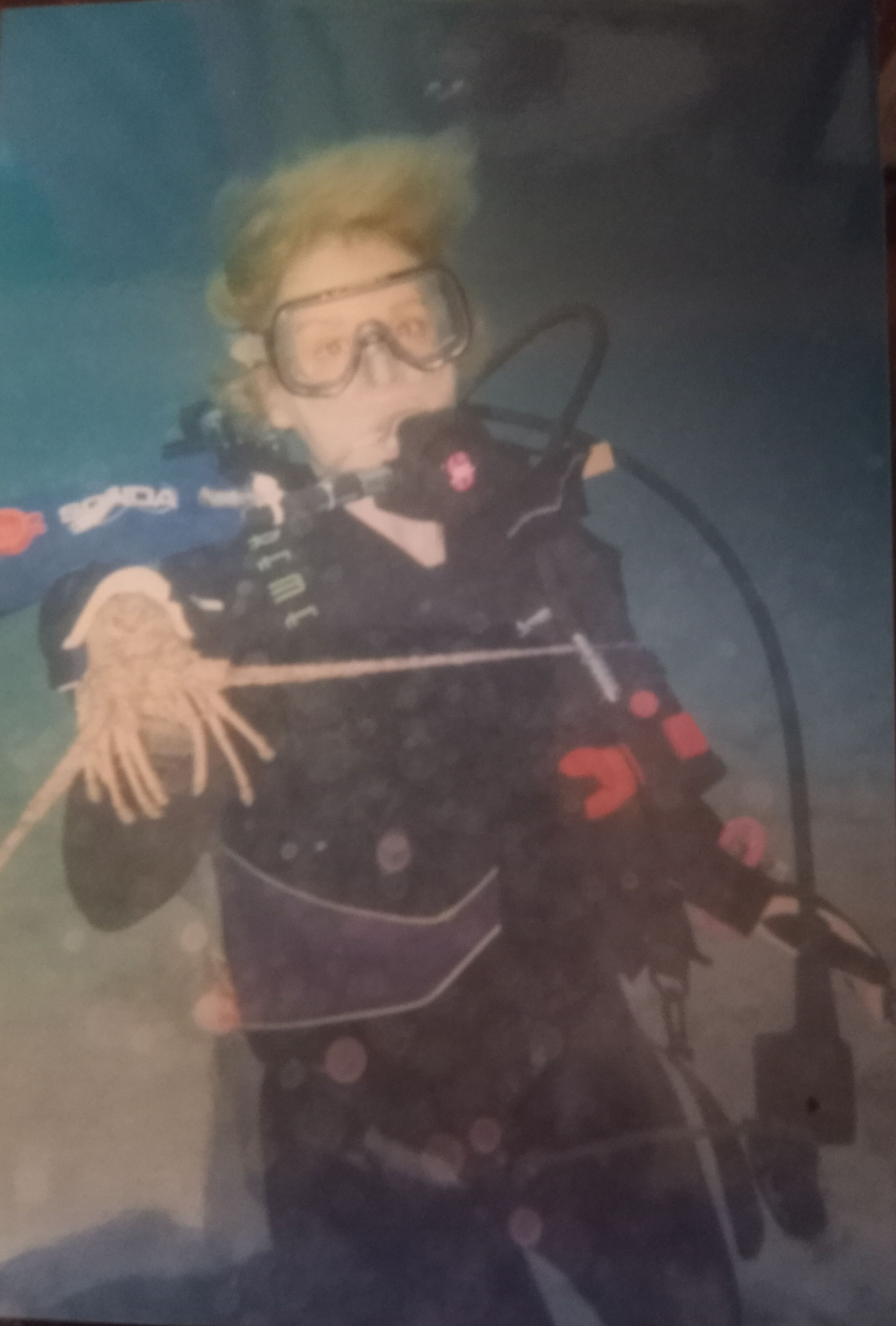
 When E.B. Davis helped me celebrate the release of Death Dive with an interview on Writers Who Kill, several of the questions were about dive gear. And that got me thinking. Things sure have changed!

My First Dive Book
I learned to dive in 1971. In fact, my certification dive was January 14th, 1971. In a sinkhole at Orange Springs, Florida, with manatees. My boyfriend was my dive instructor. I never got the certification card because, well, I was in college. The card cost $15. My monthly allowance was $15! That came back to bite me in later years. But I digress.

 Back in those early days, we used double hose regulators (think Mike Nelson), round masks, fins we called flippers, tanks—not much changed about those—and if we were wearing wet suits, they were rubber. Mine was robin’s egg blue with big yellow daisies. You’d never lose me underwater! That was it. Done. The coursework comprised lots of math. There were gas pressures to consider. Charles’s Law and Boyle’s Law loomed large (they have to do with gas/temperature and pressure). Recreational divers like me did not have pressure gauges, or depth gauges. You figured that out on your own. Nor did we have dive vests, a/k/a BDCs, or buoyancy compensation devices. We did have horse collars that could be inflated, but we laughed at people who dove with life preservers. Go figure. We were young and immortal.


Fast forward ten years. I stopped diving when I graduated from college, married someone other than my instructor, and moved north. When I returned to Florida, a friend and I were sitting over drinks and talking about recreation. The chat turned to diving. She was also a diver, and she asked me what kind of BDC I had. Since I had never heard of one, I didn’t own one. She also told me about dive computers, air integrated pressure gauges, dive skins and other various foreign to my ears and experience items. I wanted to dive again, but what were all these clothes about! To compensate, I took a scuba refresher course. Turned out, since I never got the certification card, I had to take a full dive course.

 It was an eyeopener. They deemed many of the skills we had to learn in 1971 too difficult and dangerous for students. Diving had become a credit card intensive sport. No more science. No more math. No more figuring your own dive tables. You had gadgets and gizmos for that. Yes, I bought them all, and learned to dive in a life preserver. By this time, they had become required gear, and they’d turned into vests. Whew. I nearly flunked the final. I never learned to breathe through a snorkel! It freaked me out. Still does. I carry a folding one in my BCD pocket.

I dove every weekend from the time I recertified (this time I got the card) to when I met my husband. He also dives, but he introduced me to aviation. We were flying around most weekends and flying and diving don’t mix. When we moved to Maine in 2005, my dive days were done. And I missed them.

Corals

While reading through my dive logs, they reminded me of a dive in Marathon on the Thunderbolt. A plastic bag wafted out of the wheelhouse of the wreck. Freaked me out. I thought it was a hand. All of that was in my dive log. So was the time I was on the sand at one hundred and twenty feet below the surface. My first stage blew, and my dive buddy was exploring the other side of the wreck. The first stage is the part of a regulator that attaches to the air tank. If it’s defective, the air simply flows out until you turn off the flow or run out of air. Fortunately, when I first learned to dive, one of the skills was called ‘breathing off the bottle.’ That’s what I did, all one hundred and twenty feet to the surface. Hayden Kent experiences both events in Death by Blue Water.


 I loved scuba diving, and especially wreck diving. It’s a beautiful world under the sea. When it came time to write. I wrote what I loved. I gave my protagonist mad dive skills and shared some of the old-time skills with her. Together we’ve made multiple dives in Marathon, Florida, Grand Cayman Islands, and Belize. I hope my readers learned to share my love of the undersea world, and maybe learned to dive because of Hayden and her friends.

 Writers, do you share any hobbies with your protagonists? Readers, have you ever taken up a hobby because of a book?

Saturday, August 26, 2023

Things Writing Taught Me by Kait Carson


Writing is more than a profession. It’s an adventure. If the National Security Agency ever comes looking at my Google history, I’m in deep trouble. Most writers will say the same. Recent searches: Insulin overdose speed and effects; non-user Fentanyl toxicity vectors; how to make a noose; how to hang a person; pipe bomb construction; how to distill and disguise oleander poison. You get my drift—it’s not stuff you’d want your mother to see. In fact, lately, I open an incognito page to search for ways for my characters to commit fictional mayhem. It seems safer, but I think it might be a fool’s paradise.

What happens to all of that hard won knowledge? Some of it ends up in my books. Mostly it makes me good at Jeopardy and other trivia games. Twice in the past months, it made me a lifesaver. Not a bad return for those hours down the rabbit hole, and if the NSA shows up, I can point to my successes.

Those who follow this blog know I’m a cat mom. I have four: two live upstairs and two downstairs in my office. One of the downstairs cats has serious allergies and often requires eye drops. He also has a lousy personality, but that’s another blog. The eyedrops sit on my desk out of the way behind a lamp. They’ve been in this location since we moved into the house. Last month, I reported to work and found a small puddle oozing from the neck of the eyedrops bottle. The little buggers had gotten the cap off and used the bottle as a chew toy.

Eyedrops are poisonous. I dove into triage mode and called my vet, who had no idea that eyedrops were toxic. Fortunately, I had a file of information on my computer ready to send—I’d used eyedrops in one of my books. We were on the way when my vet called to tell us she’d cleared the decks for an emergency admission. The cat survived after aggressive treatment that did nothing for his personality. Ingrate. Research made a difference.

Last weekend, I was cleaning the kitchen when I heard a pop. At first, I thought we’d had a power outage, but the electronics all shone bright. I shrugged it off. We live in a rural area, and birds occasionally hit the windows, squirrels drop nuts, and then there are those four cats making odd noises. A few hours later, my husband came in and asked me if I had taken the gauge from the propane tank that powers our gas stove. Trust me on this, folks. I love gas cooking. Dealing with the propane tank is outside of my wheelhouse. I asked him when he last saw his mind, since clearly, he’d lost it. Then I remembered the pop.

When I attended the Writer’s Police Academy, I’d signed on for the bullet trajectory class. Professional trajectory calculations use implements like surveyor’s tools. My problem was simpler. I knew my starting point. I needed to figure out where the gauge landed. Sure enough, using basic geometry and enough trajectory knowledge to be dangerous, I deduced the gauge landed beneath our deck. I crawled under, discovered the gauge, and retrieved it. We’d been concerned that the tank would leak without the device. Turns out we were in no danger. The dial is magnetic—who knew? Now to research my way into discovering why the thing blew off and flew for eight feet.

Readers and writers, have you used research, or something you’ve read in a novel, to solve real-life problems? How did it turn out?