Showing posts with label inspiration. Show all posts

Tuesday, September 29, 2026

Finding Mystery Novel Ideas in Everyday Life:

 A Guest Post by Kim Harrington

One of the questions writers hear most often is, “Where do you get your ideas?” People are often surprised when I tell them that many of mine came from my real life. Which, admittedly, sounds a little alarming, since I write mysteries.

But the moments that have inspired my books weren’t dramatic crimes or terrifying experiences. They were small, everyday occurrences that most people would forget by the end of the day. But if you keep your writer hat on, you can spin everyday happenings into a compelling mystery.

My YA novel FORGET ME (written as K.A. Harrington, Putnam, 2014) grew out of a glitch on a social media site. One day, I uploaded a photo, and the site’s facial recognition feature tagged someone else. The two people happened to look a lot alike. Without wearing my writer hat, I would have just laughed it off, fixed the tag, and moved on. Instead, my writer brain went to work imagining all the ways this could have gone incredibly wrong. Then I played a writer’s favorite game: what if. What if you were uploading the photo of someone who had passed away? And what if the website tagged him with someone else’s name? Someone who looked exactly like him but was very much alive. Suddenly, a harmless technical error became the seed of an entire thriller.

Another YA novel THE DEAD AND BURIED (Scholastic, 2013) started with a newspaper article. I’d always wanted to try my hand at a haunted house novel, but I wanted a fresh spin. One day I read an article in the real estate section about “stigmatized properties” (murder houses) and how they can be great bargains for families looking to trade up to a nicer town or a bigger house. So I thought, instead of a crumbling Victorian home, what if my haunted house was an ordinary suburban McMansion that a family purchased to get into a more upscale town? And what if the ghost wasn’t centuries old, but the victim of a recent murder? And the ghost would haunt my main character until she figured out who amongst her friends at school was the killer? One newspaper article became the seed of my idea that blended a modern ghost story with a murder mystery.

Some ideas don’t become books right away. When my son was small, we used a baby monitor during naps. One day, I heard an adult’s voice coming through it. I raced upstairs, but no one was in his room. I eventually realized our neighbors had brought their new baby home and were using the same type of baby monitor, which was causing cross-talk. First, I got rid of that baby monitor! Then, I wrote in my idea notebook, “Rear Window meets a baby monitor.” I had no idea where I’d use it. Years later, while brainstorming the second book in my middle grade SLEUTH OR DARE series (Scholastic, 2012), I searched through the notebook and found the entry. Within minutes, I had a plot about kids babysitting who overhear something suspicious on a baby monitor. The idea had simply been waiting for the right story.

Most recently, my debut adult mystery, A KILLER FOR CHRISTMAS (Crooked Lane Books, 9/22/26) was inspired by a conversation with my husband. One night, I told him I was heading upstairs to watch TV in bed. He asked, “What is it tonight? A Hallmark Christmas movie or a murder show? Because it’s always one or the other.” I laughed and said, “If only there were a cozy Christmas town, a romance…and a serial killer.” We both laughed, and then my writer brain lit up. And I knew exactly what I wanted to work on next.

Notice that none of these stories began with earth-shattering events. They started with a social media glitch, a newspaper article, a faulty baby monitor, and an offhand conversation.

That's the wonderful thing about writing mysteries: ideas are everywhere. The trick isn't waiting for something extraordinary to happen. It's paying attention to the ordinary. Keep your writer hat on. Stay curious. Ask "What if?" every chance you get.

You never know which seemingly insignificant moment will become your next novel.

Have you ever had a small, everyday moment spark a story idea?

 Kim Harrington is the author of A Killer for Christmas, her debut adult mystery from Crooked Lane Books. She is also known for her teen novels Clarity, Perception, The Dead and Buried, and Forget Me, as well as books for younger readers including Revenge of the Red Club, the Sleuth or Dare series, and Gamer Squad series. Her books have been published in ten countries. She lives in Massachusetts with her family and never leaves the house without a book. She has an MBA but would rather plot twists than business plans. When not writing, she's most likely reading or dreaming about her next vacation. Visit her on the web at https://kimharringtonbooks.com/ or on Instagram at https://www.instagram.com/kimharringtonauthor/


Saturday, July 25, 2026

A Life on Vacation

By Kait Carson

I was casting around for a last-minute blog topic this morning so I could finalize my Newsletter this afternoon and coming up empty. What a surprise, I thought. My brain is on vacation. That’s when the light bulb lit and pulsed. Vacations. Past. Present. Future. How perfect.

My Dad worked for the Otis Elevator Company. Like most 1950s kids, I’m clueless about how much annual vacation my father received, but I knew that somewhere in the two-week period that surrounded my July birthday, we’d be packing the car for a road trip.

Road trips were the quintessential defining events of the era. We drove from our New Jersey home to Miami, Cuba (the auto ferry assisted with the watery parts), Washington D.C., Northern Virginia, Upstate New York, Montreal, the 10,000 Islands, Boston, Philadelphia, and of course, the Jersey Shore (pronounced goin’ dinna shore). Many of these trips were pre-interstate highway systems. Traveling back roads was a joy for a kid, and Dad turned off at any place the AAA TripTik suggested a historical or scientific location. Sometimes he even found them! I didn’t appreciate the magic of those trips until I became an adult and air travel replaced the open road.

By the time my generation was self-supporting, recessions, sky-rocketing oil prices, and economic downturns plagued the world. So, let me begin by saying unless you consider retirement a vacation, I may hold the record for taking a grand total of one during my working life. Quite the accomplishment when you consider my work life began in 1974. But don’t hang out the hankies for me. My lack of vacations didn’t equal a lack of travel. Between 1980 and 1989, I had a part-time job running a friend’s company in Europe and the Caribbean. Every weekend and most holidays found me in St. Thomas, Sint Maarten, Saba, Stasia, Milan, Florence, Paris, and London. Cue the hankies. It was exhausting.

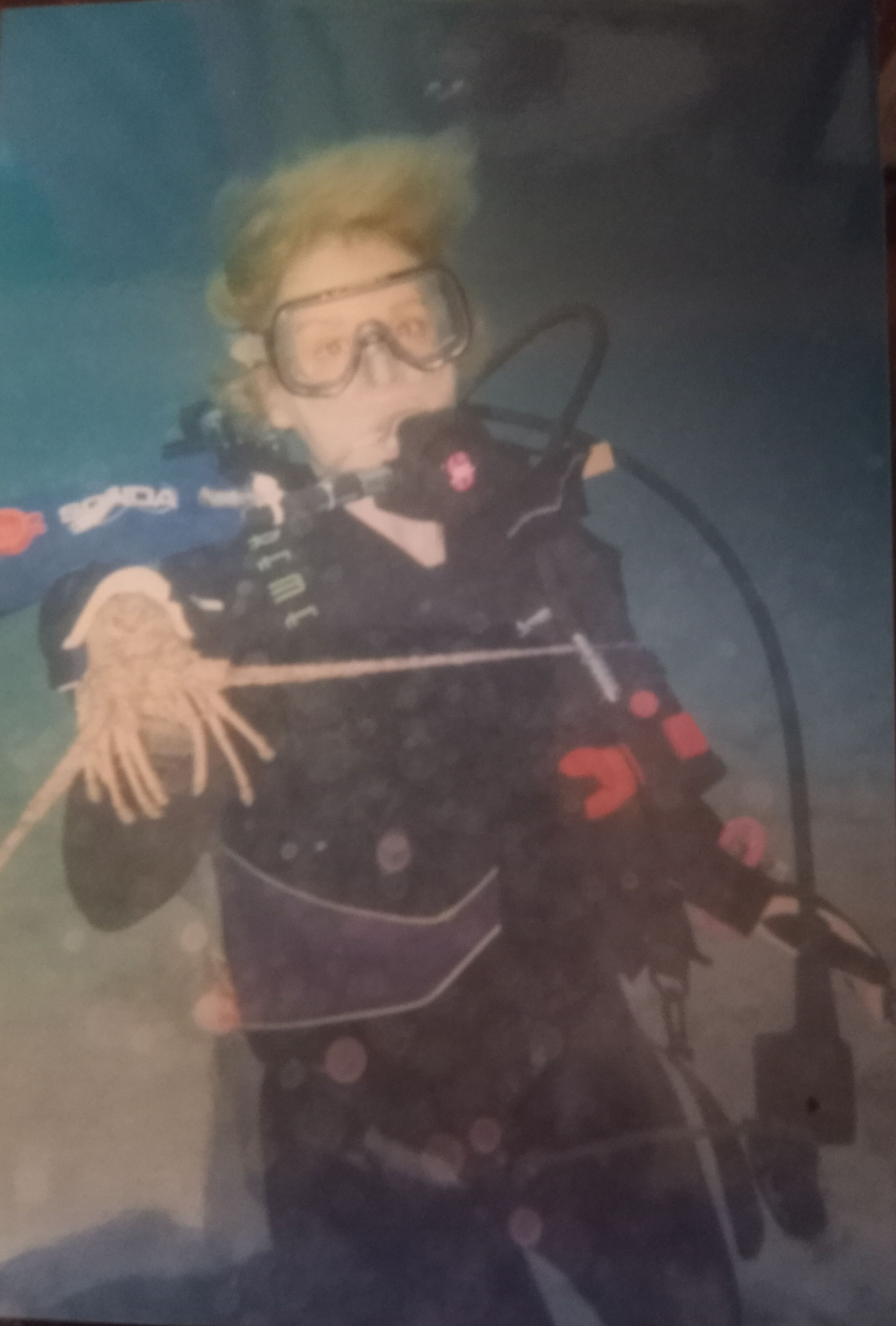
During the 1990s, I became a rabid scuba diver and spent most weekends in the Florida Keys. This hobby led to my only real vacation. A live-aboard dive trip to Belize in 2004. Maine beckoned soon after, followed by a return to Florida. The pandemic brought me full-circle with a return to Maine. In many ways, life turned into a vacation. Talk about good fortune.

These days, I’m retired, living in Maine and grateful for the journals I kept of my travels. When you’re a writer, no experience goes unrewarded, or unplundered. I’m in the vicarious vacation stage of my life. Giving the odd nuggets of past events to my characters and watching them grow into scenes and plots.

Writers: Do you plunder your past in the service of your art? Readers: Do you enjoy ripped from real-life events in fiction?

Kait Carson writes the Hayden Kent Mysteries, set in the Fabulous Florida Keys, and is at work on a new mystery series set in her adopted state of Maine. Her short fiction has been nationally published in the True Confessions magazines and in Woman’s World. Kait’s short story, “Gutted, Filleted, and Fried”, appeared in the Silver Falchion Award-nominated Guppy Anthology Hook, Line, and Sinker. Her nonfiction essay was included in the Agatha Award-winning book Writing the Cozy Mystery. She is a former President of the Guppy Chapter of Sisters in Crime, and a current member of Sisters in Crime and Guppies.

Thursday, July 31, 2025

Real Crimes to Inspire Your Next Mystery

By Jen Dodrill

 As a fellow mystery writer, I know the pain of staring at a blank page, wondering where to begin. After watching so many real-life crime stories, I’ve wondered, “What if?” What if I used an actual crime to inspire me? How could chilling, bizarre, and unsolved mysteries be turned into a piece of fiction?

 This idea is nothing new for writers. The Lindbergh kidnapping inspired Murder on the Orient Express. Psycho came out of Ed Gein’s horrific crimes. And one of my personal favorites, Jaws, was inspired by shark attacks that happened in 1916 off the New Jersey coast. I know, it’s not a mystery, but what if …?

 Typically, I write cozy mysteries, which have mild to no gore and sex. Some of these stranger-than-fiction crimes are twisted and not something that would work for a cozy. Or maybe they could. A little adaptation, some creative license, and ta-da!

 If you decide to turn a true crime into a mystery – gritty noir, cozies, or thrillers – think about these things:


·       Research the real crime and look for ways to change it for fiction

·       Consider what location/setting you want to use

·       Decide your characters’ backgrounds

·       Modify your characters' ages

·       Delve into your characters’ secrets

·       Explore the what-ifs, the twists and turns life can take

Here are five real-life cases that you can use as a springboard:

1. The Isdal Woman (Norway, 1970)

In 1970, a partially burned body of a woman was found in a remote valley in Bergen, Norway. No one knew who she was, and the items that were discovered had their labels removed. Questions: Was she a spy? A criminal? A victim of something darker? Consider setting your mystery in a small town with similar circumstances to the real crime. Maybe your protagonist is a local journalist who realizes the murdered woman wasn’t the first … or the last.

2. The Murder of Julia Wallace (Liverpool, 1931)

William Wallace received a message to meet a potential client at a fake address. When he returned home, he found his wife brutally murdered. Wallace was arrested, convicted, and then acquitted. Questions: The perfect alibi? Or, a perfect frame job? Consider incorporating modern technology into the story, such as a spoofed phone call, GPS tampering, or a deepfake alibi. Or, flip the POV—tell it from the perspective of the real killer who thinks they got away with it.

 3. The Circleville Letters (Ohio, 1970s–90s)

Residents of Circleville began receiving threatening, anonymous letters detailing their secrets. One woman’s husband died in a suspicious crash involving tampered brakes. A suspect was arrested, but the letters continued to be sent while he was in prison. Questions: Who was the letter writer? One person, or many? Secrets are often used to blackmail people—layer in modern touches, such as anonymous emails, burner phones, or deep web message boards.

 4. The Tamám Shud Case (Australia, 1948)

A man was found dead on Somerton Beach. A scrap of paper reading “Tamám Shud” (“it is ended” in Persian) was discovered in his pocket and was traced to a rare book in a stranger’s car. A phone number and a sequence of letters were found in the back of the book. Questions: Was the man a spy? Who did the phone number belong to? Think about weaving this cryptic message into your story. Your protagonist might be a cryptologist studying conspiracies.

 5. The Boy in the Box (Philadelphia, 1957)

The body of a young boy was found in a box in the woods. No one came forward to claim him. Despite facial reconstructions, national press, and decades of investigation, the case went cold until DNA matched him to a family in 2022. Still, how he died remains murky. Questions: Why was this child abandoned, and who covered it up? Consider using genealogy to identify the victim. The detective must unravel what happened and determine why an entire neighborhood kept it quiet for decades.

These ideas are narrative seeds: the strange timing, the anonymous threats, the eerie symbolism. As writers, we can ask, “What if?”

• What if the wrong person went to prison?

• What if the murder was never meant to be solved?

• What if the killer is still alive—and watching?

 In real life, crimes aren’t always solved. Closure doesn’t always happen. However, in fiction, the writer gets to decide who lives, who dies, and who pays for their actions.

 Happy plotting—and remember, truth really is stranger than fiction.


Bio:

Jen Dodrill is living out her dreams on the pages of her books, bringing readers compelling stories of inspiration and hope for both good and bad times. 

Her first book, Birds Alive! An Empty-nesters Cozy Mystery was released in 2024. Book #2 in the series, Where’s the Quetzal, came out in February 2025. Book #3, No Egrets, will be published in 2026. Jen has co-authored a novella collection, Trinity Sands Beach Club, with Deborah Sprinkle and Sharon H. Carpenter, which was released June 17, 2025.

For more information about Jen and her books, check out her blog: https://jendodrillwrites.com/.


Saturday, September 23, 2023

Write What You Love by Kait Carson

 When E.B. Davis helped me celebrate the release of Death Dive with an interview on Writers Who Kill, several of the questions were about dive gear. And that got me thinking. Things sure have changed!

My First Dive Book
I learned to dive in 1971. In fact, my certification dive was January 14th, 1971. In a sinkhole at Orange Springs, Florida, with manatees. My boyfriend was my dive instructor. I never got the certification card because, well, I was in college. The card cost $15. My monthly allowance was $15! That came back to bite me in later years. But I digress.

 Back in those early days, we used double hose regulators (think Mike Nelson), round masks, fins we called flippers, tanks—not much changed about those—and if we were wearing wet suits, they were rubber. Mine was robin’s egg blue with big yellow daisies. You’d never lose me underwater! That was it. Done. The coursework comprised lots of math. There were gas pressures to consider. Charles’s Law and Boyle’s Law loomed large (they have to do with gas/temperature and pressure). Recreational divers like me did not have pressure gauges, or depth gauges. You figured that out on your own. Nor did we have dive vests, a/k/a BDCs, or buoyancy compensation devices. We did have horse collars that could be inflated, but we laughed at people who dove with life preservers. Go figure. We were young and immortal.


Fast forward ten years. I stopped diving when I graduated from college, married someone other than my instructor, and moved north. When I returned to Florida, a friend and I were sitting over drinks and talking about recreation. The chat turned to diving. She was also a diver, and she asked me what kind of BDC I had. Since I had never heard of one, I didn’t own one. She also told me about dive computers, air integrated pressure gauges, dive skins and other various foreign to my ears and experience items. I wanted to dive again, but what were all these clothes about! To compensate, I took a scuba refresher course. Turned out, since I never got the certification card, I had to take a full dive course.

 It was an eyeopener. They deemed many of the skills we had to learn in 1971 too difficult and dangerous for students. Diving had become a credit card intensive sport. No more science. No more math. No more figuring your own dive tables. You had gadgets and gizmos for that. Yes, I bought them all, and learned to dive in a life preserver. By this time, they had become required gear, and they’d turned into vests. Whew. I nearly flunked the final. I never learned to breathe through a snorkel! It freaked me out. Still does. I carry a folding one in my BCD pocket.

I dove every weekend from the time I recertified (this time I got the card) to when I met my husband. He also dives, but he introduced me to aviation. We were flying around most weekends and flying and diving don’t mix. When we moved to Maine in 2005, my dive days were done. And I missed them.

Corals

While reading through my dive logs, they reminded me of a dive in Marathon on the Thunderbolt. A plastic bag wafted out of the wheelhouse of the wreck. Freaked me out. I thought it was a hand. All of that was in my dive log. So was the time I was on the sand at one hundred and twenty feet below the surface. My first stage blew, and my dive buddy was exploring the other side of the wreck. The first stage is the part of a regulator that attaches to the air tank. If it’s defective, the air simply flows out until you turn off the flow or run out of air. Fortunately, when I first learned to dive, one of the skills was called ‘breathing off the bottle.’ That’s what I did, all one hundred and twenty feet to the surface. Hayden Kent experiences both events in Death by Blue Water.


 I loved scuba diving, and especially wreck diving. It’s a beautiful world under the sea. When it came time to write. I wrote what I loved. I gave my protagonist mad dive skills and shared some of the old-time skills with her. Together we’ve made multiple dives in Marathon, Florida, Grand Cayman Islands, and Belize. I hope my readers learned to share my love of the undersea world, and maybe learned to dive because of Hayden and her friends.

 Writers, do you share any hobbies with your protagonists? Readers, have you ever taken up a hobby because of a book?

Sunday, April 2, 2023

Inspiration – Everything and the Bathroom Sink by Molly MacRae

I’m at the beginning of a new adventure—writing a new mystery series for Kensington Publishing. The first book comes out in July of 2024. That seems ages away, but Kensington’s art department is already working on the cover and that makes the whole thing more real. Scary, too, because the manuscript is due in mid-June.

The Haunted Shell Shop mysteries are about widowed storyteller, Maureen Nash, who goes to Ocracoke Island, off the coast of North Carolina, to find out why the owner of a notable shell shop has been writing cryptic letters to her late husband. She arrives on the tail end of a hurricane, the shop owner ends up dead, and Maureen is the prime suspect in his murder. She works to clear her name helped by a new . . . friend? This questionable friend is Emrys Lloyd, the ghost of a pirate who died in 1750. Although, as he insists, he was an accidental pirate and only that one time. The first book is called Come Shell or High Water.

Where did my inspiration for this setup come from? From some of the same places we all get our ideas—familiarity with the place (and a yen to spend more time there for real and in my head), from items I’ve read in the paper, snippets of overheard conversation, daydreams, details and memories of other places, other times, bits of history. Anything and everything can provide inspiration. Even, as it turns out, our bathroom sink.

Here's how that unlikely thing happened. I was brushing my teeth one morning, years ago, when a shape appeared in the bathroom sink. Think of it like looking for pictures in fluffy white clouds on a beautiful summer day, except this shape showed up in the somewhat unattractive beige faux marble. And instead of finding a bunny, or a camel, or a whale, I found a face. Not just any face, either. The face of a pirate. And not just a pirate, but the pirate’s hollow-eyed ghost with white brocade trim on his hat. Imagine my surprise. And my delight. Who wouldn’t want a haunted sink? As soon as I set eyes on him, Emrys sprang to life. In my head, thank goodness, and not our in our tiny bathroom; that would have been alarming. In Come Shell or High Water, Maureen is as startled to meet Emrys, the ghost pirate, as I was.

And so the fun begins.

Writers, what’s the most surprising tidbit that’s given you inspiration for a story?


The Boston Globe says Molly MacRae writes “murder with a dose of drollery.” She’s the author of the award-winning, national bestselling Haunted Yarn Shop Mysteries and the Highland Bookshop Mysteries. As Margaret Welch, she writes books for Annie’s Fiction. Her short stories have appeared in Alfred Hitchcock Mystery Magazine and she’s a winner of the Sherwood Anderson Award for Short Fiction. Visit Molly on Facebook and Pinterest and connect with her on Twitter  or Instagram. 

Sunday, January 2, 2022

Finding Inspiration in Disaster—A Tale of Two Scottish Poets by Molly MacRae

On January 25th, people all around the world will celebrate Burns Night in honor of the birthday of Robert Burns (1759-1796). Burns, despite living only 37 years, is widely regarded as the national poet of Scotland. If you have a chance to attend a Burns Night Supper, take it. The festivities start with the Selkirk Grace:

Some hae meat and canna eat,
And some wad eat that want it;
But we hae meat and we can eat,
And sae the Lord be thanket.

Cullen skink follows the grace. Then comes the piping in of the haggis, a recitation of Burns’ “Address to a Haggis,” whisky, neeps and tatties, whisky, clootie dumpling or cranachan and, if you like, whisky. A Burns Supper is a splendid feast that shouldn’t be missed. (menu glossary below)

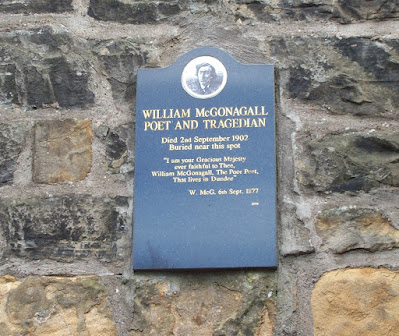
But have you heard of William Topaz McGonagall? McGonagall (1825-1902) was another Scottish poet, one “so giftedly bad,” according to Stephen Pile in The Book of Heroic Failures, “he backed unwittingly into genius.”

Plaque near McGonagall's burial site in Greyfriars Kirkyard, Edinburgh, Scotland (photo by author)


McGonagall, born in Edinburgh, was the son of Irish handloom weavers. His parents moved to Dundee when he was three, and he lived most of his life there. He joined the family trade but was also an amateur Shakespearean actor. The story goes (there are a number of stories about McGonagall) that when he played the lead in Macbeth, he took umbrage at being upstaged by Macduff and refused to die at the end of the play.

At 52, he apparently had an epiphany and dedicated the rest of his life to writing poetry—poetry so bad he’s widely regarded as not just the worst-ever Scottish poet, but the worst-ever British poet. Some would go so far as to say he’s the worst poet in the English language. And yet, he delighted audiences with his recitations. True, some audience members pelted him with fruit and eggs, but that didn’t stop him. It also didn’t make him rich. He and his wife depended on the charity and kindness of friends.

The characters in my Highland Bookshop Mysteries of course love Robert Burns. But some of them are also besotted with McGonagall. Below is a passage from Argyles and Arsenic, coming out March 1st. 

During his lifetime, nineteenth-century Scottish poet William Topaz McGonagall delighted and appalled audiences with his labored rhymes, awkward scansion, melodramatic subject matter, and general butchery of the art form. Christine adored him. Tallie found him fascinating in the way videos of avoidable disasters fascinated others.

Janet agreed with both of them. Shortly after she and Curtis the rat had bought the house in Inversgail, she’d embroidered the last two lines of McGonagall’s “The Tay Bridge Disaster” onto an antique linen tea towel. The words, “For the stronger we our houses do build; The less chance we have of being killed,” suited the sturdy, granite house, and she’d hung the framed needlework above their front door. She still loved the embroidery, but was sad her marriage hadn’t been stronger.

McGonagall found inspiration in disasters for many of his poems, “The Tay Bridge Disaster” being his most famous. Though ridiculed during his life and after, McGonagall would be delighted to know that collections of his poetry are still available today.

Crime writers take inspiration from disasters, too. Most often their inspiration comes from the disastrous choices people make. We do try, though, for a better reaction to our work than poor McGonagall received.

In the new year, may your writing go well. May your writing be notable and avoid the notoriety of William Topaz McGonagall.

Menu glossary:

  • Cullen skink: thick soup made of smoked haddock, onions, and potatoes.
  • Haggis: dish made from the minced heart, livers, and lungs of sheep, mixed with oatmeal, suet, seasonings, salt, and broth and boiled in a bag made from the sheep's stomach.
  • Neeps and tatties: mashed turnips and mashed potatoes.
  • Clootie dumpling: Scottish pudding, made with dried fruit, spices, oatmeal or breadcrumbs, flour, and beef suet, steamed in a cloot (a cloth), and served with a dram of whisky.
  • Whisky: Uisge beatha in Scottish Gaelic, which translates as water of life.
  • Cranachan: Scottish dessert made of whipped cream, raspberries, heather honey, whisky, and oatmeal.


Cranachan in author's kitchen (photo by author)


Molly MacRae writes the award-winning, national bestselling Haunted Yarn Shop Mysteries and the Highland Bookshop Mysteries. Visit Molly on Facebook and Pinterest and connect with her on Twitter  or Instagram.


Sunday, March 18, 2018

A Long Overdue Thank-You Note

by Julie Tollefson

A couple of weeks ago, I shared the stage at an Authors and Appetizers fund raiser with author Pam Eglinski, who writes suspense, historical fiction, and time travel novels. In one of life’s crazy coincidences, Pam’s late husband holds a special place in my memories as someone who changed my thinking and taught me to be a better writer.

Dr. Edmund Eglinski taught art history at the University of Kansas. His class introduced me to great artists and their work, but I remember him as the only professor in my four and a half years of undergraduate education to really teach me how to write a research paper. He reviewed my first attempt and gave thoughtful, comprehensive, direct feedback that showed me the right way to research and write an academic paper.

I never thanked him, in part because at the time, I didn’t realize what a rare and meaningful gift it was to receive such personalized, detailed attention.

Reminiscing about Dr. Eglinski and his influence on my writing brought to mind another individual who made a brief appearance in my life forty years ago. (Oh, my, where did the decades go?) She was a student teacher in my eighth-grade English class, and if memory serves, she only worked with us for a few weeks. But what a lasting impact!

In the most memorable assignment of that period, she asked us to write an essay describing a basketball. I thought the assignment was stupid, and I “forgot” to do it until I panicked about 15 minutes before class. (I’ve always been a rule follower. Skipping class, missing assignments, getting any grade lower than an “A” gave me massive anxiety.) I scribbled something along the lines of “round, orange, with black lines” and turned it in. I knew it wasn’t my best work, but really, the assignment was ridiculous.

Our student teacher, though, as yet too new to the profession to give up on uncooperative, difficult, know-it-all teenagers, pulled me aside for a one-on-one chat about my work. She knew what I was capable of as a writer, she said, and the basketball essay didn’t even come close. She gave me a second chance and guilted me into taking it.

So I sat, with a basketball in my hands and ran my fingers over its uneven surface, its original bumps worn smooth in patches by thousands of bounces on the concrete driveway. I smelled it, dusty and musty and maybe a hint of dog poop from when it bounced astray? I really looked at its color, which wasn’t uniformly orange after all.

Then I wrote a detailed, almost poetic, description about that basketball, and I learned a few things about writing:

1. Don’t settle for easy. My best writing is never easy.

2. Look beyond the obvious and superficial. Sure, a basketball is orange and round, but it might also be a symbol of love between father and daughter who bond over March Madness or a symbol of loss, deflated and abandoned in the weeds beyond the edge of the court at a neighborhood park.

3. Question perception. To me, the assignment was a waste of time, but our student teacher (I wish I could remember her name!) turned it into a lifelong lesson.

4. Writing is rewriting.

All writers have long lists of people to thank for helping them along the publishing path. These two—Dr. Eglinski with his commitment to showing the right way to approach academic papers and a student teacher who refused to accept shoddy writing—gave more than they had to and inspired me to be better as a result.

Who are the people who influenced your life? Have you thanked them?


Tuesday, November 7, 2017

The Rock


by Paula Gail Benson


Growing up, I remember hearing the story of the Pilgrims coming to Plymouth Rock during this time of year. I would help my mother pin paper figures of early settlers, Native Americans, turkeys, and autumn leaves on her first grade classroom bulletin boards. The effect was very much like the images we would see on Thanksgiving morning when we turned on the Macy’s parade and watched the giant bird and Pilgrim head floats wheeling down 34th Street.


This year, I’ve had my eyes opened about a few “traditional” Thanksgiving ideas.


While in a doctor’s waiting room this summer, I picked up the November 2014 issue of Highlights for Children and read a short story about a contemporary young girl trying to convince her parents to prepare a Thanksgiving dinner like the first feast. The family quickly realized the idea was impractical in that several favorite dishes (like pie, cranberries, and potatoes) would be missing and that others would be difficult, if not impossible, to obtain (lobster, eel, partridge, and–horrors!–eagle).


Also during the summer, I went to Boston on a business trip and spent a few extra days touring the surrounding area. One of my trips took me to Plymouth, a seaside village that boasts a replica of the Mayflower (the Mayflower II) and the remaining rock itself.


Unfortunately, our group did not have the chance to see the Mayflower II because the reproduction had been taken to Mystic Seaport where it was being restored for viewing by Queen Elizabeth II and many others during the 400 anniversary of the original’s sailing in 1620 (to take place in 2020). We did have lunch and the opportunity to explore a charming village filled with delightful tourist attractions. I enjoyed clam chowder and ice cream at Ziggy’s, which had been operating in the same spot at 120 Water Street since the 1960’s. While sitting at a corner table, I heard customers comment that they came back to Ziggy’s every summer.


Further down the street, a stone portico sheltered “Plymouth Rock.”


In my imagination, a massive boulder represented the place where the Pilgrims first walked. Surely, it must look like Henry A. Bacon’s painting, The Landing of the Pilgrims.


Well, perhaps it did once. But, in 1774, the townspeople of Plymouth decided to move the rock, which resulted in it being split into two portions. The top part moved to various locations around Plymouth and eventually had the date 1620 inscribed in it. You can read about its journeys in Wikipedia (https://en.wikipedia.org/wiki/Plymouth_Rock) and Trip Savvy (https://www.tripsavvy.com/visit-the-plymouth-rock-1599133).


Our bus driver had warned us not to expect too much when we went to view the rock. The canopy seemed a bit grand when we stared at the portion of granite that had been preserved. Yet, as I listened to the officer quietly tell the story and gazed down at a small, yet inspirational part of the American heritage, I could sense a connection with the band of travelers seeking religious freedom on a distant shore.


There was one other connection that made me seek out the rock. The first short story I ever completed was written in a spiral notebook my aunt had given me. I wrote it on a Thanksgiving Day during my childhood. That story was about a young Pilgrim girl, probably about my age, who had survived the devastating winter with her father, but had lost her beloved brother. As she helped to prepare the feast, she wondered whether the struggle had been worth the cost. Finally, she happened to hear her father in prayer, expressing thanks to still have her and pride in all that she had accomplished. Her father’s words renewed her resolve to continue to face the challenges in the new world.


So, when I had the opportunity to gaze upon that small chunk of remaining Plymouth Rock, I remembered the child I had been who wrote her first story and believed that she would write others. In the same way Plymouth Rock makes us grateful for those who came before us, I’m very thankful that its legacy helped me to become a writer.


As we approach Thanksgiving, what makes you grateful as a writer?

Plymouth Panorama from Wikipedia