
On January 25th, people all around the world will celebrate Burns Night in honor of the birthday of Robert Burns (1759-1796). Burns, despite living only 37 years, is widely regarded as the national poet of Scotland. If you have a chance to attend a Burns Night Supper, take it. The festivities start with the Selkirk Grace:
Some hae meat and canna eat,
And some wad eat that want it;
But we hae meat and we can eat,
And sae the Lord be thanket.
Cullen skink follows the grace. Then comes the piping in of the haggis, a recitation of Burns’ “Address to a Haggis,” whisky, neeps and tatties, whisky, clootie dumpling or cranachan and, if you like, whisky. A Burns Supper is a splendid feast that shouldn’t be missed. (menu glossary below)
But have you heard of William Topaz McGonagall? McGonagall (1825-1902) was another Scottish poet, one “so giftedly bad,” according to Stephen Pile in The Book of Heroic Failures, “he backed unwittingly into genius.”
 |
| Plaque near McGonagall's burial site in Greyfriars Kirkyard, Edinburgh, Scotland (photo by author) |
At 52, he apparently had an epiphany and dedicated the rest of his life to writing poetry—poetry so bad he’s widely regarded as not just the worst-ever Scottish poet, but the worst-ever British poet. Some would go so far as to say he’s the worst poet in the English language. And yet, he delighted audiences with his recitations. True, some audience members pelted him with fruit and eggs, but that didn’t stop him. It also didn’t make him rich. He and his wife depended on the charity and kindness of friends.
The characters in my Highland Bookshop Mysteries of course love Robert Burns. But some of them are also besotted with McGonagall. Below is a passage from Argyles and Arsenic, coming out March 1st.
During
his lifetime, nineteenth-century Scottish poet William Topaz McGonagall
delighted and appalled audiences with his labored rhymes, awkward scansion,
melodramatic subject matter, and general butchery of the art form. Christine
adored him. Tallie found him fascinating in the way videos of avoidable
disasters fascinated others.
Janet
agreed with both of them. Shortly after she and Curtis the rat had bought the
house in Inversgail, she’d embroidered the last two lines of McGonagall’s “The
Tay Bridge Disaster” onto an antique linen tea towel. The words, “For the
stronger we our houses do build; The less chance we have of being killed,”
suited the sturdy, granite house, and she’d hung the framed needlework above
their front door. She still loved the embroidery, but was sad her marriage
hadn’t been stronger.
McGonagall found inspiration in disasters for many of his
poems, “The Tay Bridge Disaster” being his most famous. Though ridiculed
during his life and after, McGonagall would be delighted to know that collections
of his poetry are still available today.
Crime writers take inspiration from disasters, too. Most often their inspiration comes from the disastrous choices people make. We do try, though, for a better reaction to our work than poor McGonagall received.
In the new year, may your writing go well. May your writing be notable and avoid the notoriety of William Topaz McGonagall.
Menu glossary:
- Cullen skink: thick soup made of smoked haddock, onions, and potatoes.
- Haggis: dish made from the minced heart, livers, and lungs of sheep, mixed with oatmeal, suet, seasonings, salt, and broth and boiled in a bag made from the sheep's stomach.
- Neeps and tatties: mashed turnips and mashed potatoes.
- Clootie dumpling: Scottish pudding, made with dried fruit, spices, oatmeal or breadcrumbs, flour, and beef suet, steamed in a cloot (a cloth), and served with a dram of whisky.
- Whisky: Uisge beatha in Scottish Gaelic, which translates as water of life.
- Cranachan: Scottish dessert made of whipped cream, raspberries, heather honey, whisky, and oatmeal.
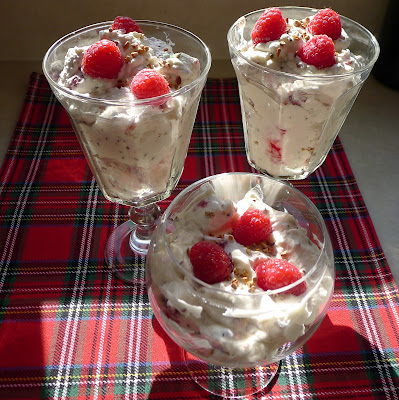 |
| Cranachan in author's kitchen (photo by author) |
Molly MacRae writes the award-winning, national bestselling Haunted Yarn
Shop Mysteries and the Highland Bookshop Mysteries. Visit Molly on Facebook and Pinterest and connect with her on Twitter or Instagram.
