Showing posts with label New Zealand. Show all posts

Wednesday, June 4, 2025

A Book Review by E. B. Davis: The Retired Assassin's Guide To Country Gardening by Naomi Kuttner


Dante has come to the small coastal town of Te Kohe, New Zealand, for a fresh start in life. But he doesn't want to open a BnB, or save a charming bookshop, or start a romance with a single mother in need of rescuing.

He just wants to forget about his past career (which involved a lot of dead bodies) and have everyone leave him the heck alone. Unfortunately for Dante, life has other plans...

Amazon.com


Naomi Kuttner is a new, young author from New Zealand. Previously, she wrote a three-book urban-fantasy series. The Retired Assassin’s Guide To Country Gardening is her first cozy mystery.


I admit to debating if I wanted to read it, but due to it being on Kindle Unlimited and I found the title intriguing, I downloaded it. When I started reading, I did not understand that it had a paranormal element, which I now realize was due to my downloading the book on my iPhone rather than from my computer on the Amazon website. I guess the narrow format forced a reduction of description. As that is the case, the author needs to put a few more sentences into her jacket copy revealing that Te Kohe, the town in New Zealand where the action takes place, is haunted by past residents’ ghosts. I see paranormal as a plus, but I recognize others may not.


We soon learn that the main character, appropriately named Dante, has retired from being an assassin, and he is only in his early forties. This information doesn’t endear Dante to readers, but we do find that he is trying to reform. He is a member of an online group of AA (Assassins Anonymous), is a man of few words, and through his associations, is trying to lose the assassin’s mindset or at least redirect it in a positive way. The house he bought belonged to an old woman (now deceased) that has a greenhouse containing rare plants. When a young gardener, Charlie, knocks on his door, Dante learns that there is no avoiding the gardener or the town’s Garden Society because his greenhouse contains the rare Corpse Plant. The symbolism isn’t lost on Dante.


Enter a local hotel owner, who threatens to out Dante to the townspeople unless he serves as a bodyguard at an event. Dante agrees but only because he goes by the adage of “know thy enemy.” But it soon becomes apparent that Dante and Charlie are in the frame for a woman’s murder at the event, and Charlie is the only one who has motive. A townswoman in the know and about town in all the lady’s societies approaches Dante enlisting him to help her find the real murderer because she knows Charlie couldn’t have done such a deed. Having grown fond of Charlie and knowing he was set up to be in the frame, Dante agrees. But he observes that the woman, Eleanor, often pretends to be a frivolous airhead when she is anything but. It is she, their leader, who determines how they will get the truth to find the real murderer.


The rest of the plot is up to you to discover, but there is a lot of backstory affecting the plot and the outcome of the investigation. But I will say that about mid-way through the book, it is revealed that Dante was an assassin for (we assume) England, perhaps M16. That information helps the reader cope with Dante’s immorality since he didn’t kill to make a fortune, but he is more akin to a soldier. Knowing that  doesn’t sit well on Dante’s shoulders. He retired early for a reason. I included that tidbit to allay fears of those not wanting to champion an evil main character.


I recommend reading this book. It was unexpected and enjoyable. Ms. Kuttner provides a descriptive sentence summarizing each chapter heading tempting us to read further. I found them amusing and accurate.


A second in the series, The Assassin’s Guide To Orchid Hunting is due out in December of 2025.    

Friday, June 8, 2012

Kiwi Talk


Kiwi Talk

One of the joys of travels is learning new ways of expressing yourself. This is a blog I wrote while

living in New Zealand.


I’ve noted that the New Zealanders we’ve met tend to use descriptive language without the aphorisms

that we in the United States tend to favor. An aerosol can on a bathroom shelf of a Bread and

Breakfast we stayed at in Wanaka said it “ends toilet odors.” Isn’t that more what we really want? No

pussy footing around with “air freshener.”


Outside the train station Graymouth a building on one side of the street had a sign — “Eat and Drink.”

A building on the other side of the street had a sign — “Beds.” Any questions? Any confusion?

The traffic bumps to slow cars are known as judder bars. That’s descriptive.

A sign on the Canterbury University campus reads, “People prepared to make changes.” This too, I

believe is another example of straight talk. It is, after all, up to these people, whoever they are, whether

or not they actually make changes. Maybe they’ll decide things are just peachy the way they are and

keep everything just as it is.
                                                  

Since there is no tipping the cost of a meal or a taxi ride is what the tab says. No complicated math

required.

A weather person describing upcoming cold weather recommended wearing “puffy coats” and advised

listeners to “rug up.”

Grocery carts are known as trolleys or better yet, trundlers.

Responding to grumbling, “Build a bridge and get over it.”

If you get a sore throat you take “Throaties.”

The student centre is offering a seminar about, “flatting” for students who have not, “flatted” before i.e.

renting an apartment (a flat) with a roommate.

Praise: “Good on you.”

Across the Tasmin Sea: “Across the ditch.”

Farmer: “Cowspanker.”

A man from China said he came to New Zealand to learn English and has been so warmly received that

he now considers himself a "Chiwi."

For authors when a book is reprinted it is known as a “Revived Edition.” I really like that.

When your significant other is checking your “speedo” he or she is looking to see how fast you are

driving not checking out your body.


What have you heard on your travels? 

Friday, April 20, 2012

Discover Places for Booklovers in New Zealand


For anyone who loves books and reading who is lucky enough to live in or plans to visit New Zealand, I have two recommendations for you.


If you stay in Wellington try the Booklovers Bed and Breakfast, a delightful welcoming place, run by Jane Toleston. It is centrally located in a lovely house with the original plans dated 1894. The house is within walking distance of Te Papa National Museum and the downtown district. It is also located right at a bus stop so you don’t have to walk far if you don’t want to. There are some excellent restaurants nearby. The owner, Jane, is the author of five books and has won a New Zealand book award. Most of her work is historical, based on oral histories. The walls of the B&B are lined with every type of book imaginable. She’s an interesting person to talk to and I enjoyed talking to her other guests as much as to the hostess. She offers free Internet access, yummy breakfasts and many more amenities.


In you stay in Dunedin you can visit a frequent guest at Booklovers B&B , Mike Hamblyn who, with his wife Cheryl, runs Read On! located in Gardens Mall. The second hand bookshop has to be the tidiest bookstore I have ever been in. Mike offered my wife and me tea. We had a far-ranging conversation involving everyone in the store about writing, publishing, selling books and the state of independent bookstores.

Mike and Cheryl accept only nearly perfect books for resale. He uses eucalyptus oil to clean and sanitize the book covers. He changes his window display weekly to attract customer and the mall brings foot traffic past his store. Even so he said he does not think there is a future for independent bookstores because of online competition and changes in the publishing world. He said he makes very little money on the store but absolutely loves what he does. With the cost of new books in New Zealand being so high there is a need for redistribution of used books and many customers become friends.

If you visit either place please give them my regards. I remember both places fondly.

Friday, November 4, 2011

Island Boy


Island Boy

I’ve visited Islands before, but my visits were not for long periods of times. I’ve noticed some differences from mainland thinking in the United States and here in New Zealand.

Environmental awareness


For one thing there are three kinds of trash pick; rubbish for landfills, paper, plastic and glass for recycling and organic materials, for compost. People seem to have an awareness of the islands geographic limits. They work to sustain the land that sustains them . Recently on television there were shows about constructing a sustainable house from old tires, used glass bottles and dirt. It involved an amazing amount of hard labor and I’m not sure I would want to live in the result. But it left a minimal carbon footprint. On the news there an item talked about two families who used a stream flowing from the mountains to build a hydroelectric generator.

Heating


Most local houses don’t have central heat. People just close off room they do not use. We have a delightful pellet stove. The Pellets are from compressed pine wood residue from sawmills and wood products. We were somewhat surprised that people burn coal and wood to stay warm. We are told they have a large supply of both. They replant trees to keep supplies of wood available.

Finances

When Judy, my all-time favorite wife, applied for a work visa she had to show she had a job offer and a ticket home in order to get a visa. As her partner I had to prove I had independent means apparently so if she comes to her senses and dumps me here officials can be sure they will not be stuck with me either. I’ll have the money for a one-way ticket out of New Zealand.

Protection of agriculture

Customs has a strict policy of not allowing agricultural products into the country as do many other countries. The products might carry pests and diseases. A TV production showed a man form Korea who had suitcases full of food. He got angry and tried to eat it all when customs officials tried to impound it. The customs official complained to his tour guide that he was aggressive and impolite. He was so un-New Zealandish.

Christchurch

Plans for rebuilding Christchurch have been revealed. Cost is estimated at 1.6 billion based in part on more than 1,000 plans submitted by residents. There will be a memorial for the 181 people who died. Building will be limited to seven stories high and there will be lots of green areas along the Avon River. They plan a light rail to start from the University to the coast Citizens have a month to review the plan and react.

Weather


It started with snow in July. Snow in August. Over the last two days (15 and 16 of August )weather from the South Pole has come calling and the University of Canterbury plus most businesses on both Islands has been shut down. Auckland had the first snow since 1932. A visitor from Norway was on the news because he was taking pictures of people taking pictures of the snow. We have come into spring when beautiful warm days alternate with chilly wind and showers. I have half a zillion pictures of amazing flowers and the damaged central business district is showing signs of new life.

Earthquakes

When I lived in California I became accustomed to earthquakes, but I’ve never felt as many in a short period of time. I have felt more earthquakes here in three months than I had in California where I lived for ten years.

Equality

I find it refreshing that the people I have met in a variety of jobs have not been servile or resentful regardless of their position. People seem proud of their work. Maintenance workers have been wonderfully helpful as well as bus drivers wait staff. There seems to be real opportunity for people to improve their financial status. New Zealand seems to lack rigid class structure and extremes of wealth and poverty. I mentioned the no tipping above so people being helpful were not trying to get money out of me. They wanted to be helpful. On television arrogant people are criticized.

Community

In positive ways the country feels like a small town. When the star rugby player was injured television crews interviewed his dad and mum as well as the player. People all over the islands expressed concern when there was a oil spillage on one beach. Everywhere I’ve gone I’ve heard expressions of concern about the effects of the earthquakes on Christchurch. During the World Cup of Rugby, which New Zealand won, many people I talked to sounded like supporters of the local high school teams in small towns across the United States.

Friday, October 28, 2011

KIwisdom


Kiwisdom

Hello, from the nation that won the 2011 Rugby World Cup. All Blacks forever!

Some of the things I ‘ve seen and heard about here on the other side of the world make a lot of sense and I’d like to share some of them with you. I cannot be certain that someone somewhere else came up with the ideas, but I first encountered them here. No matter what an Aussie might tell you.

Toy libraries. Well maintained used toys can be checked out for a fee and returned if they are still in good shape when your child outgrows them. Brilliant. Pull-toys, tricycles, bikes etc. have a relatively brief period of usefulness with any particular child. Whey buy new toys each time?

Small two-wheeled bikes made of sturdy wood, which have no pedals. Children sit on them and push with their feet. Improves balance, takes a licking and keeps rolling along on replaceable sturdy tires. Helps children rely less on training wheels.

Larger and a greater number of women’s bathrooms than men’s bathrooms in concert halls, shopping malls etc. In the United States women’s bathrooms often have lines of people waiting when men’s bathrooms do not.

High mileage rental cars that come already dented and imperfect. As long as the upkeep is good, why not? Less to worry about when you rent a car. No need for a “white glove” inspection when getting or returning a car. I know some companies in the U.S. like “Rent a Wreck” have this business model. In New Zealand it is standard practice.

Three trash cans. One for compostable material, one for recyclable material and one for garbage. A simple idea for a greener planet.

Pellet stoves that burn recyclable fuel and give off a cheery glow.

There is no tipping expected in restaurants, taxis etc. Workers are paid a living wage. There is no incentive for a cab driver to take the longest route to your destination or for wait staff to hurry you out of a restaurant. In many restaurants you pay first so the owners, staff and patrons can all relax.

New Zealand has a one dollar and two dollar coin. Bills start at five dollar denominations. Coins last a very long time. Also the smallest coin has the value of ten cents. Making change is a breeze. I've read that in the United States a penny costs more than one cent to produce. Whose nation is smart in this world?

Friday, August 26, 2011

2011 Ngaio Marsh Award Winner Accepts Award


Paul Cleave

2011 Ngaio Marsh Award Winner Accepts the Award

Paddy Richardson, Neil Cross, Paul Cleave and Alix Bosco, all excellent writers whose styles differ widely, were nominated. Paul Cleave won for his novel Shotgun Men. And he showed up to accept the second annual award. Last year, in a plot twist Ngaio Marsh might have employed and enjoyed, Alix Bosco won for Cut & Run. But Alix Bosco is a pseudonym and the winning author did not appear.


Greg McGee

A week before the award ceremony on 21 August of this year, Greg McGee announced that he uses the pseudonym Alix Bosco and that he would appear to support the other authors and the awarding of the prize. In a series of interviews he explained that he wanted the character he created, a female investigator to be evaluated by readers and critics as the creation of an unknown writer. He described his reputation, based in part on his personal history — a rugby player who wrote a play about rugby, “ as a bloke who writes about blokes” He noted that prepublication readers who knew he was the author found the character not credible but, readers unaware of the author’s identity found the character engaging. McGee said he had to argue with his agent and publisher to publish the book without using his name. He noted that historically women authors have had to use male pen names to get published.

Best-selling and prolific author Tess Gerritsen and award-winning author John Hart began the ceremony by speaking and answering questions about their work. They were warm informative and funny.


Tess Gerritsen and John Hart

The nominees also spoke about their work and took questions from the audience. One topic that was repeatedly asked about was if the writers would use events from the latest major earthquake, the greatest natural disaster in New Zealand’s history, in their writing. Paul Cleave sets his novels in Christchurch, site of the disaster.

The authors as a group suggested the events were too recent and emotions were still very raw. Each author said they would not write about the earthquake any tme soon. With so many people as direct witnesses, any error in detail would be immediately noted. They also agreed about the importance of literature was a way for a nation to mourn and to process terrible events like wars and disasters.

I would be remiss if I did not praise the organizers of the event who were determined to have the awards in the sad, wounded city of Christchurch. I cannot imagine the hurdles and persistence it must have taken to find a place, coordinate scheduling, overcome the uncertainties, and actually hold the ceremony. Kudos for a truly outstanding event.


Friday, August 19, 2011

When my city fell down


“When my city fell down.”

Since we have arrived in New Zealand we have been struck by the never-give-up attitude of the people of Christchurch. Although the news coverage internationally have gone on to other things, including the worse national disasters of Japan, here in Christchurch the tremors continue and the cleanup will take at least a decade. People often talk about, “When my city fell down” and how much they miss the vibrant central business district.

The national and city government, fire and police departments acted immediately. Jokes were made that the prime minister, John Key, raffled off a free lunch with himself and was also the highest bidder The Red Cross, the Salvation Army and other first responders were quick to react. What I did not know initially was how many people in and outside the city responded on a volunteer basis.


University of Canterbury students self-organized into a volunteer army 10,000 strong. Using Facebook and GeoOP they turned out to shovel silt, dispatch needed assistance, help people connect with loved ones and provide many social services. They took photos and kept the authorities updated on their activities and problems they found.

Local businesses made donations, organized charity fund-raising events. They helped locate missing people and allowed their employees to donate time and service while being paid for work.

Farmers from around the island came to Christchurch and paraded down the streets with their tractors with excavators and earthmovers, which they then used to remove rubble and silt so that transportation could be restored. Many of them set up tents in city parks, supplying their own food and water so they did not put additional strain on limited resources while they worked, staying on through the aftershocks to help the beleaguered city.

Farmers also delivered more than 200, 000 liters of drinking water and tons of food to the needy population.

The Christchurch earthquake took place on February 21. The Japanese earthquake took place on March 11. New Zealand was the first foreign country to send rescue teams to Japan despite the problems here.

We went to dinner last night in a downtown restaurant that reopened three weeks ago. I noticed the chain link fence across the street from the reopened business had messages, ribbons and toys attached to it by patrons of a damaged restaurant blocked off by the fence, encouraging the people who own that restaurant to return

Friday, August 5, 2011

Report from Christchurch


Report from Christchurch

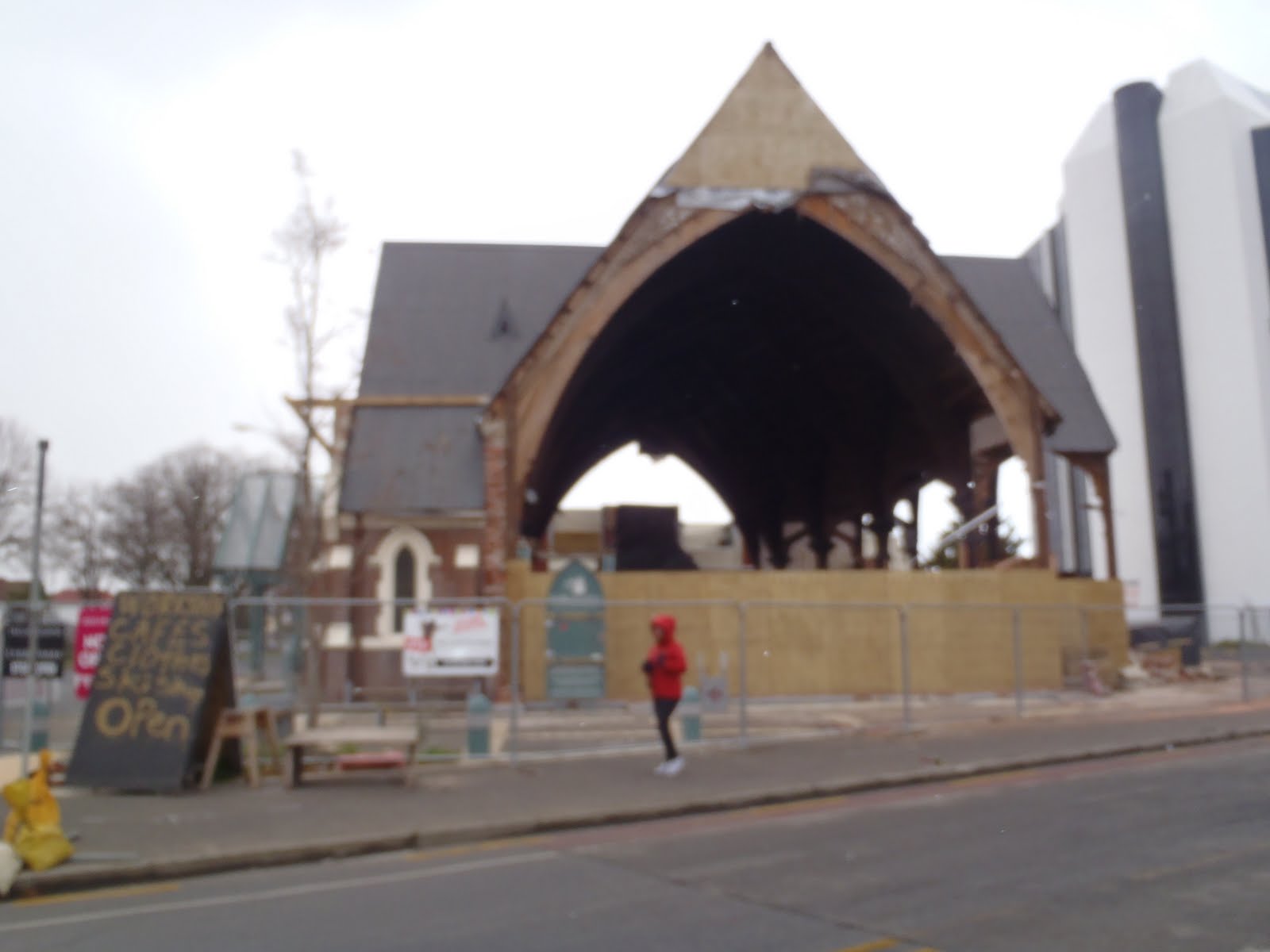
The earthquakes continue frequently. Most are too small to feel. I’ve seen the downtown where several areas are still blocked off. I know the destroyed building only from pictures. People who live here say they are heartbroken to see the magnificent cathedral and other classic buildings fallen, standing as structural skeletons or red-tagged for demolition. Many people are still in temporary structures without bathrooms or heating. Many temporary offices are in tent labeled AFT which stands for “Another Frigging Tent.”

Over the weekend we had the coldest temperatures and the most snow in 19 years. The University of Canterbury, schools and most businesses were closed. Police advised people to stay home. Many of those who did not heed the warning spun and slid on icy streets, driving too fast and recklessly for conditions Locals called this, “The icing on the earthquake.”

Workers told me, “It makes a change from shoveling silt to shoveling snow.” Although some people saw the snow as just one more burden, children seemed to enjoy it, making snowmen and having snowball fights. Other people said the snow renewed their sense of purpose.


Christchurch is in that long slow painful phase known as recovery. Much that was lost will never return, many tough decisions have to be made and additional losses are bound to occur. At the same time, small victories are occurring. Favorite restaurants and stores are reopening in safer areas. People enjoy rediscovering them. Bus lines are expanding fitfully into their former territory. People share their stories of loss and survival. They also talk about rebuilding and their hopes for the future.

The university has maps indicating which buildings are closed, where to assemble if/when another serious quake occurs and where to find security staff. A bank branch and a bus line terminal once on campus are closed. Some visiting professors cancelled their visits but others have come instead.

World cup rugby and city-wide art festivals are optimistically planned for later this year. Life goes on.

Friday, July 29, 2011

News from New Zealand

New Zealand News

Last week I wrote about news of the Midwest. This week I will tell you about the news in one paper that I borrowed after it was discarded by my seatmate on the flight from Auckland to Christchurch. I make no claim to describe all print journalism in the land of the long white cloud.

The lead story was about a woman who survived a head on collision with a drunk teenager who was driving in her lane. Good news and well worth covering. However the paper showed a picture of the woman, who was very attractive, in a bikini. Now, I do not know what she wears when she drives but it is midwinter here.

Another story was about a teenaged couple who killed one set of parents who disapproved of their relationship and then invited their friends over to have a party. I don’t remember where they lived. The parents might have had a point.

A third story was about an Italian woman who supported her husband’s political career but when he lost an election for mayor she dressed in a cat woman suit, and waited with a gun to kill him. According to the story she told police she had a change of heart when she had him in her sights and decided not to shoot.

Rupert Murdock’s wife reportedly assaulted a protestor after he threw a pie pan full of shaving cream in her husband’s face.

Were these four stories the most crucial information for the public to know? I could be wrong but I suspect not. I wondered if the paper was owned by Rupert Murdock.

I also noticed many want ads under the heading of Adult Entertainment. Some ads seemed to be jobs to be filled. Others seemed to be ads by entertainers searching for an audience. The three most common attributes described were blonde, thin and large bra cup size.

There was extensive news about rugby and full paragraphs where I knew each and every word individually but I could not understand what they meant together.

I don’t think I’ll subscribe.

Other tidbits: The water drains from the sink counterclockwise opposite from the direction in the United States. The stars visible in the sky at night are in different constellations. I have seen the Southern Cross. There was a 5.1 earthquake the first night we were here. We slept right thorough it but have been assured that we will have other chances to experience one.

Cheerio!