Showing posts with label FBI. Show all posts

Sunday, November 24, 2019

FBI Citizens Academy Field Trip: Flight 93 Memorial


September 11 is one of those dates. We all vividly recall the moment we first heard the news. Even years later, the emotions surface with little provocation, which may be why I’d never visited the crash site of Flight 93 despite it being less than two hours from my home. Every time I’ve passed the exit on the Pennsylvania Turnpike, I’ve said, “I need to go there someday.”

Someday was November 6.

As an alumnus of the FBI Citizens Academy, I was offered the opportunity to join a private tour of the National Park. With my good pal, Liz Milliron, along as a guest, I made my way to the site, which wasn’t as easy as one would think. No one simply stumbles across this park. Even my GPS took us to two different incorrect locations before we found our way there.

But the memorial was well worth the effort.

Symbolism is everywhere, beginning with the 40 passengers. Their individuality is celebrated. So is the way The Forty came together to become one. The numbers 40 and 93 are repeated throughout the park as are diagonal lines, symbolic of the hemlock trees that grow near the crash site.
 
Our FBI CAA tour opened with
a slide show and lecture.

First, a little background history, not all of which I knew.

Flight 93 took off at 8:42 a.m. after a roughly 25-minute delay. That delay was crucial to how everything turned out. By 9:28, when the terrorists on board took over, the first two planes had already struck the Twin Towers.

The first three hijacked planes each had five terrorists on board. Flight 93 only had four because their fifth man had been detained days earlier in Miami. Two of the Flight 93 terrorists took over the cockpit. The other two stood guard at the front of the plane after forcing the passengers and crew to the rear. While we can’t know for sure, it’s widely assumed the fifth man would have been assigned to keep an eye on the captives.

The terrorists told the passengers they’d be released once demands were met, just like every other hijacking of the time. However, since the terrorists were a man down and had no one to watch them, The Forty started making phone calls to loved ones. They learned in these phone calls that this was anything but a standard hijacking.

Had the flight taken off on time, they wouldn’t have known and likely wouldn’t have attempted to retake the plane. And the plane would have crashed into its target in Washington DC.

We know a lot more about what transpired aboard Flight 93 than about the other three flights. Both Flight 93’s cockpit recorder and flight data recorder were discovered intact, and data was retrieved from them. Such was not the case in any of the other crashes. So the voices of the hijackers and the sounds of the passengers trying to retake the plane can be clearly heard.

The visitors center displays the timeline of the day’s tragic events, the news reports, artifacts retrieved from the ashes, and offers recordings of three phone messages left by the passengers on their loved ones’ answering machines.


We walked the flight path, which is a striking memorial exhibit carved with the diagonal lines I mentioned earlier. The timelines of the crashes are also engraved in the walkway. The walls are designed to focus attention on the site of the crash rather than on the parking lot or the buildings in the park.


Once we reached the overlook at the end, the same walls block the backward view as well, keeping all attention on the flight path and crash site.


The plane hit soft, surface-mined ground in a manner similar to dropping a marble into a sandbox. The unused fuel hurdled into the stand of hemlocks, setting a semi-circle of them ablaze.

At the edge of what was the debris field, a memorial to The Forty has been erected. Continuing the symbolism, viewed from a distance, it appears to be one solid white marble wall. 

But as we got closer, we could see there were 40 individual marble slabs, each engraved with one of the passengers and flight crew’s names. Forty individuals. One heroic action.
 
That boulder marks the site of the impact. You
can still see where the hemlocks were burnt (the shady
area on the left half of the photo.)
One last exhibit remains incomplete. The Tower of Voices, designed with the diagonal lines representing the hemlock, is 93 feet tall and will contain 40 windchimes, all tuned to a different pitch, again representing forty individual voices creating one song. 

Unfortunately, there have been engineering issues, and at this writing, only eight windchimes have been installed.

I definitely intend to go back and spend more time at this haunting, somber, yet beautiful site. If you get a chance, go.

And bring tissues.

Here's a video clip I shot while standing at the edge of the debris field.


Sunday, July 7, 2019

FBI Citizens Academy: Graduation Night!


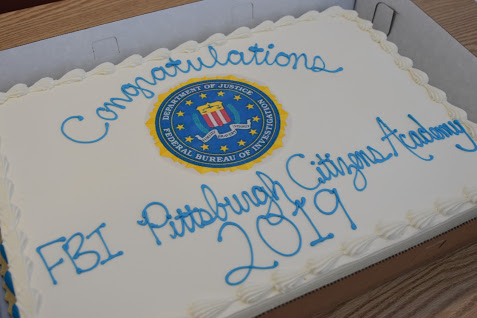
After seven weeks of mind-blowing, eye-opening lectures and demonstrations, we finally reached our eighth and final class. With friends and family in tow, the Pittsburgh FBI Citizens Academy Class of 2019 held our graduation ceremony.


It was an amazing evening with speeches, smiles, and more than a few tears. 
Special Agent-in-Charge Robert A. Jones
congratulates the FBICA Class of 2019

Fifty-two (mostly) strangers had become friends. We’d laughed together, been awestruck together, and showed off our shooting prowess (or lack thereof) together.
Looking back at our first night and first group photo

Looking back at Range Day
We came from vastly diverse backgrounds with different reasons for being there. But by graduation, we’d become one unified community, armed with information and respect.
 
And there was CAKE!
I’m now an official FBI Citizens Academy Alumni and look forward to participating with my fellow alum to continue my education while supporting the Bureau when and where I can.


In the end, was it worth the weekly drive to the city during rush hour, and the time away from my family? Absolutely. Would I do it again? In a heartbeat. Do I recommend the FBICA to anyone able to apply? YOU BET.


Sunday, June 23, 2019

FBI Citizens Academy: Week 7


While much of the FBICA consisted of lectures, the seventh class, like the field trip, was largely hands-on…and a ton of fun. The presentation on the Evidence Response Team (ERT) began with a talk. Here are a few of the highlights that interested me, as a mystery writer and fan:

·         We hear the term “latent print” but may not know what it means. A latent print is a print left behind on a surface, as opposed to an “inked print.”
·         The FBI doesn’t have a K9 unit but works with local partners who do.
·         The FBI lab is located in Quantico, Virginia.
·         All FBI divisions have at least one ERT, and all ERTs have the same skill sets so they can work together. The process used is the same across the board.
·         An ERT consists of 8 members. All 56 field offices have one to five teams.
·         The ERTs respond to over 1,000 callouts each year, both domestic and international.
·         The FBI ERT members all wear navy shirts and khaki pants to make identifying each other easier.

After the lecture, we broke into groups to rotate through four stations where we could get our hands dirty. In some cases, literally.

My first station demonstrated how blood evidence is located and collected.
I’ve watched the crime shows on TV and seen them swab a surface and apply a few drops of liquid to turn the swab pink if blood was present. The reality isn’t far off. Some notes: the swabs are kept sterile prior to use. After swabbing a questionable surface, two different types of drops are applied to the cotton tip. If blood is present, the two different chemicals react and turn the swab pink, but a paler shade than the hot pink used on TV.

If blood is detected, they will then collect the item. If the blood is on a wall, they’ll cut out a chunk of that wall. If it’s on a marble floor or counter, they’ll cut out the piece they need. (Keep that in mind the next time you cut your finger and bleed on your expensive kitchen counter!)

My second station involved ALS or Alternate Light Sources. We were shown a number of items with no real discernable staining. After we put on special goggles, the agents turned off the room lights and shined the ALS on the same items. As on TV, all sorts of stains (you don’t want to know what kind) became evident.

In the same station, we had the opportunity to play CSI and collect fiber evidence from each other.
Yes, that's me in the purple gloves.
I got to dress up like a real CSI (not quite as glamorous as on TV) and try to find dog hairs on a fellow student. (Either he used a really good sticky roller before coming to class, or I need new glasses because it wasn’t as easy as I’d expected.)

Next came fingerprint collection. While I’d watched it done before at Writers Police Academy and at other citizens academies, this time I was able to use the powder and brushes and try to lift my own prints from various surfaces.
FYI, those cards with clear tape used on TV shows are called “hinged lifters.”

The final station demonstrated making molds of tire tracks or shoe prints, which is one thing I’d not seen done in any of my previous research. As with much of the crime scene investigation, it wasn’t as easy as it looks on TV or in the movies. (I failed miserably!) Fun fact: they use plain old hair spray to stabilize tire or footprints in dirt.
Preserving tracks in snow is tricky because the material used to make the cast creates heat. The tracks must first be treated with a special spray (like the hair spray trick) to keep the snow from melting.

(Photos courtesy of the FBI)

Next time: Graduation


Sunday, June 9, 2019

FBI Citizens Academy: Week 6


After a month off to promote my new book, I’m back to share the final weeks of my FBI Citizens Academy experience with you.

The sixth installment covered a lot of ground including International Operations, Weapons of Mass Destruction, Public Corruption, Polygraph/Statement Analysis, and a Tour of the Mobile Cyber Forensics Lab.

Is it any wonder my head was ready to explode? Here are just a few of my takeaways.

International Operations – The FBI has worked abroad since 1940. Those agents are called legal attachés, “legat” for short. The FBI has primary US jurisdiction when a terrorist incident occurs overseas. Those investigations are coordinated with the Department of State and are conducted with local law and ground rules established by the host country.

Weapons of Mass Destruction – This is one of those topics that will keep you awake at night. The FBI works to educate those who work with chemicals or biologicals to get out in front of a threat. They have an early warning network in place with businesses such as Home Depot where someone could purchase large quantities of the materials used in bomb-making.

Public Corruption – The definition of Public Corruption is when a public official abuses his public office for private gain and is among the most sensitive of investigations.

I’m leaving that topic right there.

My favorite part of the evening was the presentation on Detection of Deception. This is the stuff any of us who write crime fiction that involves questioning a witness or suspect needs to know. Here are a few tidbits from my notes:

When interviewing a suspect, you want to build a rapport with them. Therapy techniques are used.

The subject makes reasonable justification for otherwise criminal acts. Example: “I didn’t steal money for drugs. I stole it to help my family.”

Repressed emotion comes to the surface in some sort of body movement.

What’s coming out of their mouths differs from what’s going on in their heads.

A lie is “cognitive tasking.” (Think about it. The truth requires no real brain power, but the creation of a lie, and remembering the lie that’s been created, requires a lot of mental activity.)

The interviewer watches for inadvertent body “leakage,” meaning movement, activity, and expressions that give away the “cognitive tasking” going on.

The subject may use “pacifiers” or soothing mechanisms such as grooming gestures or nose rubs (in men) or playing with the hair (in women and girls).

Yawning is an indicator the subject has checked out, and the interviewer needs to re-engage.

A subject, who intends to lie, goes through a thought process when asked a question: Hearing >>> memory recall >>> judgment >>> fear, anxiety >>> planning (the lie) >>> verbal response.

The best indicators of deception in response to an open-ended question is equivocation, meaning use of words like “probably,” “maybe,” “I assume,” “somewhat,” “I may have,” or “as best I can recall.” And negation, using phrases such as “I don’t know” or “I’m not sure.”

A subject who’s being deceptive will use “text bridges” such as “after that,” “the next thing I knew,” “later on,” or “afterwards.” In these cases, they’re covering up what they don’t want to talk about by skipping over it.

A final note, and something I’d never thought about, pertains to written statements. If a subject is willing, have him write out his statement first. They’re “uncontaminated” and will often contain tidbits the subject volunteers without realizing.

We wrapped up the very long evening with a tour of the Mobile Cyber Forensics Lab, a van with all the gadgets, gizmos, and toys you’d imagine!
 
Photo courtesy of the FBI photographer
That's me on the far right with the red shirttail hanging out
My big takeaways from this talk was you can never truly delete your information from old phones (do you donate or dispose of your old cell phones? BAD IDEA.) And do you have Bluetooth in your vehicle? Or do you connect your phone to your rental cars to use the GPS? The next person to own that car or anyone else who rents it, could potentially access everything (everything) from your phone as a result. Scary, huh?

Next time: CSI Night at the FBI Citizens Academy!


Sunday, April 28, 2019

FBI Citizens Academy: Week #5


For our fifth session, we met on a Saturday morning at the firing range. 
Range Day for my FBI Citizens Academy Class
We started the day listening to a fascinating lecture on Use of Force, which raised lots of questions from my classmates—most of which were answered in the segments that followed. A few takeaways—law enforcement is trained to shoot to stop the threat. Not to kill. Not to injure. While it looks cool on TV, no one can shoot a gun from a subject’s hand or place a shot in the knee to stop them. They’re trained to shoot for center mass and to continue firing until the threat is stopped.

The fun started with a demonstration by the bomb techs. These guys really enjoy their work! They set off a number of explosions of all types, from homemade to military. The scary part is how easily items we all have in our medicine cabinets, basements, and garages can be combined into a bomb. Equally scary is the ease of finding directions online. The comforting part is most of these directions aren’t exactly accurate, and someone trying to use them is more likely to blow off their hand than to successfully create an explosive device.

My big takeaway was learning that the explosions we see in the movies and TV are nothing like the real thing. The film industry shows you lots of fire. At the end of their demonstration, the bomb techs triggered a “Hollywood Wall of Flames” and only then did we realize none of the other explosions had involved such an inferno. There was smoke—different shades of smoke mean different ingredients—and smells and booms. Sometimes the booms were softer. Some shook the earth. And some sent out an honest-to-goodness shockwave that we could feel in our chests.

My thinking is Hollywood does the Wall of Flame to show a visual impact because the sound and shockwaves can’t be duplicated. In reality, the sounds, smells, and sensations had a much bigger impact on us than anything we see on film.

(Side note: I wish I had photos or video to show you. We were told we could photograph stuff for our own personal use, but we were not permitted to share it online.)
 
Glock 22 40
After the bomb demo, we were split into groups to go through three different stations. My first one was live fire. We were armed with a Glock 22 40 and an H&K MP5 10mm assault rifle and took turns with an instructor. 
 
My target--Not too shabby!
The next station was a SWAT training simulation—Shoot/Don’t Shoot scenario. We were walked through a “house” and in each room, there were posters showing the people one might encounter. Some of the “subjects” were armed, some were merely pointing a finger or holding a can of Pepsi, some were cops. We were armed with pellet guns and had to make split-second decisions. My partner “killed” a guy with a can of pop. I’m pleased to say I aced it! I killed the bad guys and did not kill any civilians or other law enforcement.

Unfortunately, the program ran over and I had to leave before completing the third station, which was a FATS (Fire Arms Training Simulator). I’d already done these a few other times (and if you’ve read the opening scene of my With a Vengeance, you know that Zoe has too!) FATS is a computerized exercise with a large screen where a scenario plays out. The participant is armed with a Glock that doesn’t fire projectiles but is read by the computer so you can see afterward where—and who—your shots hit.

The entire day gave us a new appreciation of what the FBI and all law enforcement face every day out in the field. 

Sunday, April 14, 2019

FBI Citizens Academy: Week #4


Another mind-blowing week at the FBI Citizens Academy.

“The most effective weapon against crime is cooperation.” ~~J. Edgar Hoover

The first program of our fourth class dealt with counterterrorism and the Joint Terrorism Task Force. This is the kind of stuff that will keep you up at night.

Various areas of current threats were discussed. Homegrown Violent Extremists (HVE). ISIS (Islamic State of Iraq and al Shan) also known as ISIL. And lone wolf actors. For more details, click here.

One of the scariest tidbits was learning how terrorists are drawn to the encrypted apps a lot of us and our kids use every day. Snap Chat. Skype. Whatsapp. Because of the encryption, the conversations can’t be traced. If you’re concerned about privacy, untraceable conversations sound great. Not so great when those conversations involve terrorist activities.

Kids are especially susceptible to radicalization by violent extremists. They might be feeling lonely or misunderstood and these people prey on that, befriend the youngsters, and then lure them into their beliefs. We need to be vigilant. If a child in your life is withdrawing from activities and contact with real people, if they’re being secretive and are hiding their online activities, we need to take action. Talk to them and be alert. IF YOU SEE SOMETHING, SAY SOMETHING.

The second program of the night focused on Foreign Counter Intelligence. This topic includes espionage: protecting the secrets of the US intelligence community from foreign spies; economic espionage: protecting the national and private industry’s critical assets; and counterproliferation: keeping WMD, advanced conventional weapons, and related technology from falling into the wrong hands.

China and Russia are our biggest adversaries in this area but not the only ones. Iran, India, Pakistan, South Korea, and others seek to gain access to our knowledge and technology. Even travelers to France have had their laptops compromised.

Russia is choosier about what their spies go after. China, however, will go after the best and brightest of everything! For example, in January 2016, Mo Hailong pled guilty to conspiracy to steal trade secrets in the form of corn seeds

Other less surprising targets include MRI technology, glass insulation, wind turbine technology, and hybrid auto technology. Their goal is to produce this stuff cheaper without having to bother with research and development, resulting in our companies being undersold and going out of business.

The FBI doesn’t always aim to make arrests in these cases. You won’t see these stories on the nightly news. The goal is to disrupt the spy networks.

Read more about it here.

The final portion of the evening was the Cyber Program. This is the kinds of things we all need to be aware of in our daily online lives.


If you have Gmail and receive an email stating you need to reset your password by clicking a bit.ly link, DO NOT CLICK IT. If you do, the Russians will have your password and total access to your computer.

Also, DO NOT USE HOTEL WI-FI overseas. Honestly, after hearing about the ways wi-fi can be hacked, I don’t even want to use it locally. But in other countries, there is no expectation of privacy. Whatever is on your laptop will be in foreign hands.

Finally, you know all those weird friend requests you receive on social media? In case you weren’t already aware, those are foreign trolls. They might not contact you immediately, but they’ll eventually strike up a conversation and at some point, will suggest you take the conversation off that particular platform to an email with a link to click. Same as above. Once you click, they’ve got you. 

You can read a lot more about this topic on the FBI website.

Next time: FBI Range Day, including live fire, shoot/don’t shoot scenarios, and blowing stuff up!


Sunday, March 31, 2019

FBI Citizen’s Academy: Week 3


I’m pretty sure my head is going to explode before this eight-week course is complete.

Week #3 opened with a session on combatting the opioid epidemic. The numbers of people affected are staggering. In my local county, roughly 28% of the population have suffered from it, either as a user or as the family or loved one of a user. And nearby West Virginia leads the nation in opioid deaths.

Those addicted will pay whatever the cost, driving demand. So where do they get their fix? Partly through health care fraud—drug diversion, pill mills, and forged script rings.

And then there’s the darknet. Basically, on this alternate internet, you can shop for fentanyl, oxy, crystal meth, and whatever other drugs or supplies an addict could want as easily as we shop for books on Amazon. In fact, the pages for these online distributors look amazingly like any legit vendor. Except the items being sold are illegal drugs.


On the darknet or Tor network, IP addresses can’t be tracked. Orders are paid for in cryptocurrencies, mostly bitcoins, although there are lots of others. This is a peer-to-peer network without any financial institution as an intermediary. Side note: bitcoins themselves are not illegal, however, criminals are quite fond of the anonymity they provide.

Equally amazing (to me) is these “vendors” ship through the US Postal Service, just like anything else ordered online. 

The special agent giving the talk showed surveillance photos of a guy dumping bags and bags of standard shipping envelopes into one of those blue USPS boxes at a strip mall. Repeatedly. Day after day.

For more information on the darknet and opioids, click here.

One last note I found fascinating is the new trend of drug users carrying their own Narcan. At least they’re prepared. 

(FWIW, listening to these special agents talk about their cases is a blast! They clearly love their work and have fun bringing down the bad guys.)

The final presentation of the evening dealt with the Intelligence Community. This is the part of the FBI (and other federal agencies) that collects and analyzes information to determine whether it’s something that needs further investigation. The analysts are as excited about their work as the special agents, and, while they’re more behind-the-scenes, they’re every bit as important. Possibly more so. Click here for a deeper look into the FBI Intelligence Program. My big takeaway (as an author) is the fact that all the agencies SHARE their intel, unlike what we often see on TV and in fiction. Having local, state, and interagency conflict because of each department being stingy about what they know might make for good fiction, but it’s not how things are done anymore. Since 9/11, the Intel Community’s default has been “SHARE.”


I, for one, am very glad. 

Sunday, March 17, 2019

FBI Citizen’s Academy: Weeks 1 & 2


Week #1 was all about introductions. After dining on pizza and salad, all 52 of us took turns standing and telling about ourselves and why we were there. The attendees were a diverse group of civic leaders, from government officials to bankers, teachers, religious leaders, and business owners. All had noble reasons to participate, hoping to take information back to their neighborhoods, schools, and synagogues to make their communities safer.

And then there was me. The mystery author. I felt totally outclassed. Thankfully, no one else contributed to my lack of self-value. In fact, I’ve had several people say to me, “Oh, you’re the writer!” Suffice it to say, I totally understand why it took three tries to get into this academy, and I appreciate the powers that be who squeezed me in this time.

We also met the special agents (no, there are no “just-plain” agents. They all carry the title SPECIAL agent) and intelligence analysts who will be our speakers and instructors for the next eight weeks. There were a lot of them.


While electronic devices are forbidden (no photos), we did get a three-ring binder filled with bios and history…and a list of acronyms, of which there are many. HOPE? Heroin Outreach Prevention and Education. JTTF? Joint Terrorism Task Force. Just to name two.

With a tease of what was to come, I couldn’t wait until…

Week #2

Dinner was salad, fried chicken, and pasta alfredo. And cookies. Yeah. They feed us well!

The program was jam-packed. Private Sector Coordination, Violent Crimes Against Children, Countering Violent Extremism (Hate Crimes/Civil Rights), and Health Care Fraud.

Needless to say, I can’t possibly share all of it, but here are a few of the things that stood out. And a few things that kept me awake the next night.

There really is no such thing as a coincidence.
You’re not paranoid if they’re actually coming after you.
Don’t carry your everyday laptop if you’re traveling overseas, especially to China. They will access every bit of data you have on your electronics. The special agent recommended businessmen rig a special laptop containing only the information needed for that business trip.

The part about crimes against children left me haunted and disturbed. I don’t have kids, but now I’m worried about every child in my family as well as every child out there. When asked what was the most dangerous thing a kid could do, the special agent stated plainly, “Be on the internet.” You may think you know what your kids are doing online, but they’ll open additional accounts you know nothing about. He suggested Googling your kids and then Google all and any nicknames they might use. Predators are out there, posing as friends, gathering seemingly innocuous information such as fights with parents, grades, all notable events. They use this, sometimes weeks later (“Hey, are things any better with your folks?”), to earn trust and to “groom” their potential victims. Since most of our kids’ online activity is done on phones, the bad guys are able to geotrack them.

Words of advice: Keep a dialogue going with your kids. Know what’s on their phones. If you don’t know what an app is, find out. Only allow your kids to friend people you know face-to-face. “Friends of friends are NOT friends.”

This isn’t solely about pedophiles, although they’re bad enough. Religious extremists groom kids the same way.

I’m serious. I did not sleep the next night.

The discussion of hate crimes was led by two intelligence analysts and was fascinating. As analysts, they don’t go out and make arrests. They collect puzzle pieces and try to fill intelligence gaps. And the public is often their best source of those pieces.

We all hear about extremists standing on the first amendment and free speech. And a lot of what we consider sick or disgusting does indeed fall under “free speech.” However, the first amendment does not protect threats. If you feel threatened, report it. The analysts use those reports as puzzle pieces. If they learn it’s just someone spouting off, they’ll determine whether to let it drop. But if further investigation leads them to discover links to radical groups online, then they can pass the information on to be delved into deeper.

“Hate crimes may not rise to the level of a federal crime, but they still have intelligence value AKA a piece to the puzzle.”

The speakers also reminded us that while hate mongers might be protected by the first amendment when holding a protest and shouting hateful rhetoric, we’re also protected by the first amendment in telling them “NOT HERE. NOT IN MY TOWN.”

Finally, if you overhear threats, feel threatened, or believe you have one of these puzzle pieces, report it to www.fbi.gov/tips.

Oh, and I got this cool hat.


Have you ever encountered rhetoric or threats that frightened you or made you feel threatened? If so, did you do anything about it? 

Sunday, March 3, 2019

FBI Citizens Academy: Fingerprint Prologue


Prior to the start of FBI Citizens Academy, I was required to have a background check and be fingerprinted at the Pittsburgh FBI Headquarters. I looked forward to the process for a couple of reasons. First, it gave me a chance to figure out how to get there before the first class, which was good since I made a couple wrong turns. Second, I’ve never been fingerprinted before and—you know—RESEARCH.


I pulled into one of only a few visitor’s parking spaces and was immediately met by a security guard who checked my ID and asked if I had any firearms or explosives. Uh. No. I was told to leave all electronics in my car. No cell phone. Not even my Fitbit. Sadly, this also means I’ll be taking no photos of the classes. I understand the need for security but clearly need to brush up on my sketching skills if I have any hope of remembering stuff. Next, he brought out what looked like a very large dental mirror and scanned the undercarriage of my car as I eagerly watched, pondering how I can use this in a future book.

From there I was directed into the authorized parking area. Entering the building meant going through another security checkpoint. Metal detector. X-ray for my purse. Another check of my ID.

Finally, I was whisked back to a room where I would have my fingerprints scanned into a computer. Sounds easy enough. Would only take a couple minutes, I was told. Except the computer kept flunking my fingers. I was told this wasn’t unusual. However, an hour, two fingerprint techs, and a second computer, which also failed me, later, I got the idea I was a real problem child. The poor techs apologized to me. I apologized to them on behalf of my wonky fingerprints. But we finally managed to get enough fingers passed on each hand for the computer to accept the report.

If there was a “fun” part, it was this: they let me fingerprint myself. After an hour, I’d think I was getting pretty good at it, except for all the big red FAILs on the screen. In fairness to me, the tech had no better luck than I.

What did I learn? They no longer ink fingers. And if they do, the computer isn’t any more likely to accept the prints. (I would have suffered messy fingers if they’d said it would be more successful). Also, dry skin doesn’t scan well. They have a certain type of hand lotion (Jergens) that (usually) works well. But then they had to wipe the smears off the glass scanning plate. There’s something called ridge raiser wipes, but they seemed to be out of those. I was told makeup powder sometimes helps, but I don’t carry it with me. Oops. My bad.

The academy begins in one week. Check back with me here in TWO weeks for my next update.

But no pictures. Darn.


Have you ever been fingerprinted? If so, did they use ink or do the electronic scan?

Sunday, February 17, 2019

Research Junkie


My name is Annette and I’m a researchaholic. Yes, I’m addicted to learning new stuff. And as a writer, I have the perfect excuse. I guess that makes me my own enabler.

“They” say you should write about what you know. I prefer saying you should write about what you want to know.

I’ve done both. In my Zoe Chambers series, Zoe’s a paramedic, a deputy coroner, and a horsewoman. I’ve been an EMT and owned horses for 25 years. I have not, however, been a deputy coroner. Nor have I ever been a cop. So for Zoe’s job in the coroner’s office and Pete’s job with the Vance Township Police Department, I have to research.

Back in 2008, I took the Pittsburgh Bureau of Police Citizen’s Academy, which was my first behind-the-scenes taste of law enforcement. What I learned and experienced shaped the world I wrote about in huge ways. I blogged week by week about it on Working Stiffs. (Once you click the link, click on the Citizen's Police Academy label at the bottom of the post for more stories).

A few years later, I grabbed the opportunity to participate in the Pennsylvania State Police Citizen’s Academy. 


I thought there’d be a lot of overlap, which was fine. Refreshing the memory or getting updated information is always good. However, there was very little duplication. I learned and experienced a LOT of new stuff. And once again, it went into my writing.

In 2014 and 2017, I attended Lee Lofland’s Writers’ Police Academy, which further enlightened me about cops, firefighters, and emergency medical personnel. 

I made a friend at Writers Police Academy!


Handcuffing techniques demonstration

Eye-opening demonstration on how dangerous
a knife attack can be

If you write about this world and have never attended one of these, you have no idea how much you don’t know.

Let me pause for a brief commercial announcement. Registration for this year’s Writers’ Police Academy, dubbed Murder Con, open soon. Unfortunately, I won’t be able to attend, but if you’re a writer and you have the chance, DO IT. If you’re a member of Sisters in Crime, check out the grants they offer for education.

End commercial announcement.

While I can’t make it to WPA this year, my desire for a research fix won’t go unabated. I’m excited to announce that after a pair of failed attempts, I was accepted for this spring’s FBI Citizen’s Academy! Picture me doing the Snoopy Dance. I’ve long wanted to write a story with an FBI agent as a lead character. Beginning next month, I’ll be taking part in an eight-week program that will take me behind the scenes of the Federal Bureau of Investigation, which should give me the perspective needed to create an authentic character.

I have no idea what stories will hatch during these eight weeks, but I’m eager and excited to find out. (It will also provide material for a number of my future posts here at Writers Who Kill.)


My question to you writers: What kind of research do you do for your novels? And to the readers out there: Does it upset you to find glaring errors in procedure in the books you read? Or are you willing to suspend belief in order to enjoy the story?