Showing posts with label Saralyn Richard. Show all posts

Thursday, October 21, 2021

Interview with Saralyn Richard by Marilyn Levinson

Saralyn Richard and I are both members of the Blackbird Writers. We've discovered we have many things in common, among them we were both teachers and we both write mysteries and books for kids. Her mysteries are well-written and have won several awards.

How did your earlier career in education influence your becoming a fiction writer?

It really didn’t. In fact, my career in education delayed my writing for several decades. The years I was a teacher, administrator, and school improvement consultant, I had to put writing on the back burner. I didn’t have the time or discipline necessary to tell stories. 

Those were not wasted years, however. I was fortunate enough to be surrounded by thousands of diverse, interesting people, whose lives offered insights about human nature. Getting to know people and helping them address their challenges is a fertile training ground for an author of fiction.

 I also believe that there is a strong similarity between the acts of teaching-learning and writing-reading. In both cases, you can’t have one without the other.

Inspector Parrott, the sleuth and protagonist of your mystery series, is a wonderful character. How did you go about creating him?

I’m so glad you enjoy Detective Parrott as much as I do. Parrott actually appeared to me, fully-formed, when I was writing Murder in the One Percent. He’s African-American, male, and just starting out in his career—all things that I am not. He is, however, well-organized, morally grounded, and serious about righting wrongs—all things that I like to think I am. Having worked in mainly urban high schools, I’ve known and nurtured many “Parrotts.” I understand his struggles and ambitions, and I enjoy exploring them in each of the books. Because I want him to be authentic, I sometimes rely on my former colleagues and students to help vet particular details. 

Now that I’m writing the third book in the Detective Parrott mystery series, I know his character as well as I know my own. He inhabits my dreams and whispers to me quite often. He always has a lot of fascinating things to say.

Why did you set that series in Pennsylvania?

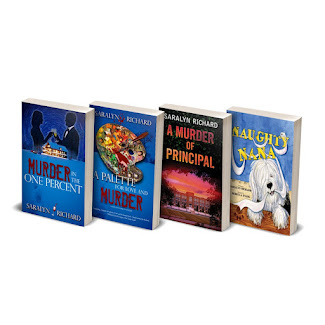
I mentioned earlier that I’ve been collecting ideas for novels for a long time. Some years ago, I attended an elegant birthday party at a country mansion in Brandywine Valley. The area impressed me as so lush, so peaceful—the last place you’d ever expect a murder to take place. The night of the party, after a nine-course meal with wine pairings, I turned to my fellow guest and said, “This would be the perfect setting for a murder mystery.” That was the seed for Murder in the One Percent and then A Palette for Love and Murder. 

One of the things I love about the series is that Detective Parrott is an outsider in this community that he serves. The ultra-wealthy people who inhabit that community, many of them horse enthusiasts or artists, have different ideas and different ways of behaving. Yet his outsider perspective is exactly what makes Parrott so successful in solving cases.

Your books include a variety of settings, topics and occupations. Bad Blood Sisters, the book I've just finished reading that's scheduled to come out in March, has a protagonist whose family owns a funeral home. How did you research for this profession?

Because I write murder mysteries, my books often have funeral scenes in them. Whenever I’ve had questions about funerals, I’ve gone to professionals for information. That’s how I met a Pennsylvania mortician, who has become a friend. I also know a local funeral home director in Texas who answers my questions whenever I have them. Through my conversations with them and others, I became intrigued by the question, “What if a woman working in death services were faced with having to prepare the body of her estranged best friend?” That was the seed for Bad Blood Sisters.

I find it interesting that you alternate each Parrott book with a stand-alone mystery. How did you come to write your books in this order?

I didn’t plan this pattern, and, in fact, the writing order was not exactly the same as the publication order. The alternating writing order just evolved. I must say, though, that I like returning to a new Parrott novel after I’ve been immersed in a different world with a standalone novel. I believe that writing a new setting and new characters ignites my imagination and allows me to grow as a writer. After a “vacation” from Parrott, I’m always looking forward to coming home.

Are you a plotter or a pantser?

I used to claim to be a pantser. I don’t outline, beyond having a general idea of beginning and ending and the main character’s arc. I like the spontaneity and freedom to let the story go where the characters take it. Over the years, though, after painting myself into more than a few corners, I’ve understood the value of having story anchors. So now I would say that I am a planter.

What do you think is the most effective way to reach your readers?

I teach creative writing to adults, and one of the most important things I encourage my students to do is to write from the heart. If an author tells her best story the best way she knows how, and she enjoys the writing experience, that passion and effort will flow through to the reader. For me, connecting with readers is the best part of being a writer.

Who are some of your favorite mystery authors that you love to read?

Some of my tried-and-true favorites are Agatha Christie, Michael Connelly, and William Kent Krueger, but I love finding new favorite mystery authors. I can highly recommend many of my fellow Blackbird Writers and members of The Stiletto Gang, including someone you know well, Allison Brook.

What advice do you have for someone first starting out as a new mystery writer?

Think of your book as an intellectual and emotional puzzle. The way you unveil the various pieces can make or break the experience for the reader. As in so many other artistic endeavors, timing is everything.

Your one children's book is about Nana, your real-life English Sheepdog. Do you think you'll be writing more children's books in the future?

Many of Nana’s fans have clamored for a series. They’ve suggested lots of interesting ideas:  Nana Goes to Hollywood, Nana Goes into Outer Space, Nana Finds a Best Friend. I’d love to pursue some of these, and I also want to write the story of a tame cheetah I once met. And then there are contemporary topics like day care, staying healthy, and dealing with violence. I’m full of ideas but short on time, and right now my adult novels are keeping me super-busy. 

What new books do you have coming out or are planning to write?

My most recent release, A Murder of Principal, goes behind the scenes of an urban high school when a new principal upsets the status quo. Next will be Bad Blood Sisters, in which a young woman’s past comes back to haunt her when her former BFF is killed, and what she’s buried puts her in extreme danger. 

Currently I’m writing the next Detective Parrott mystery, still untitled. This one will be released in August, 2022.

Buy link for Saralyn's books: http://books2read.com/u/4XnzxL


Saturday, April 3, 2021

Method Writing by Saralyn Richard

Much has been written about method acting, a compendium of rehearsal and training techniques for actors that promote emotionally expressive performances. Based on the system developed by the Russian actor and director, Konstantin Stanislavski, three teachers at the Group Theatre in New York set the standard of its success. Lee Strasberg emphasized the psychological aspects, Stella Adler the sociological aspects, and Sanford Meisner the behavioral aspects. In each of these techniques, the actor was taught how to submerge his own ego, experiences, and motivations and take on those of the character he played. 

Hundreds of America’s best actors were trained in this method, giving credence to its effectiveness in creating heightened performances of authentically-portrayed characters. Marlon Brando’s Stanley Kowalski in A Streetcar Named Desire is an example, but the list of method-trained actors includes distinguished names from Tom Hanks to Sally Field to Scarlett Johansson to Ryan Gosling.

What works for actors and directors of movies is also what works for me in the writing of novels. I’m often asked whether I’m an outliner or a pantser. The truth is, I’m neither. I’m somewhere on the spectrum of planners who approach their novels with the characters in mind. Once I have my primary characters firmly in mind—who they are, where they come from, where they are going, not just physically, but emotionally and spiritually—I’m ready to start writing. The characters compel me to submerge my own self and to slip into their skins. Once I can do that, the characters take over in my mind, and they are the ones who write the story.

As a method writer, I can (and do) write about characters who are super-rich or super-poor. I can write from the point of view of different genders, races, religions, sexual orientations, and occupations. I can take on the persona of a kick-boxing champion, a renowned artist, a nun, or a trophy wife, without ever having been any of these.

All that is required of me is solid research, a vivid imagination, and large doses of concentration and focus.

Method writing affects everything from word choice to style. If a character curses, espouses a controversial political belief, behaves impulsively, or even commits murder, I am not to blame (though this is a major stretch for me as a writer). Most of my characters have something of me in them, but usually, they are different from me in innumerable significant and insignificant ways. Yet, by the end of the manuscript I have lived inside of each of them long enough to understand exactly how they feel and why they do the things they do.

The intention is that this intimacy with the characters will transfer to the reader, leaving a memorable impression. Literature is at its best, for me, when that happens.

What literary characters can you think of that may have been created by method writing?


Award-winning author, Saralyn Richard was born with a pen in her hand and ink in her veins. A former educator, she loves connecting with readers. Her humor- and romance-tinged mysteries and children's book pull back the curtain on people in settings as diverse as elite country manor houses and disadvantaged urban high schools.

Visit Saralyn at 
http://saralynrichard.com, on her Amazon page at https://www.amazon.com/Saralyn-Richar..., or on Facebook at https://www.facebook.com/Palmcirclepres


Saturday, February 3, 2018

Getting the Details Right with Research By Saralyn Richard


Years ago, one of the most prolific crime fiction authors of the last decades, Stuart Kaminsky (1934-2009), spoke at a Young Writers’ Conference I attended. He debunked the idea that an author should write about what he knows. Half the fun of writing, he said, is learning about a subject one knows nothing about. For example, when writing about horseracing, he’d spent a lot of time researching the industry to build credibility and knowledge before writing. That way, he was always learning something new, visiting new milieus, meeting new people, and generating fresh ideas.
During most of Kaminsky’s time as a writer, research meant going places, interviewing people, or at the very least, poring over library materials. With the advent of the Internet, writers have worlds of information at their fingertips. Need a floor plan of a famous building? The menu of a restaurant? Or just a snazzy outfit for a character to wear? Finding the right specific details to add to a story can make or break the reader’s connection with the writing. 


Take, for example, this passage from my novel, Murder in the One Percent, which takes place on a gentleman’s horse farm in Pennsylvania and in the tony areas of New York:
                Caro stood beside the long dining table, fingertips grazing one of the menus.
                     Gold-embossed on sheer scalloped paper, they had been placed on all of the service
                  plates. When she had first shown it to John E., he told her it was a culinary pro-
                  gram fit for royalty.

Menu
Hors d’oeuvres
Champagne Krug, 2000
First Course
Bouillabaisse with Loupe
Chablis Grand Cru Les Clos, 1990
Second Course
Pate’ d’Foie Gras, Toast Points
Sauterne Chateau d’Yquem, 1990
Third Course
Fresh Halibut Cheeks
Corton Charlemagne Grand Cru, 2006
Fourth Course
Bibb Lettuce with Hearts of Palm, Vinaigrette
Fifth Course
Wood Roasted Squab, Boysenberry Sauce
Richebourg Leroy, 1991
Sixth Course
Rack of Lamb Persillade
Chateau Lafitte Rothschild, 1982
Seventh Course
Selection of Fine Cheeses
Graham’s Vintage Port, 1977
Eighth Course
Triple Chocolate Torte with Chocolate Ganache
Truffles a la Vicki
Hennessy Paradio Cognac and Other Cordials
           
What makes this fancy dinner party menu seem true-to-life are the many details that pepper the paragraphs with authenticity. The gold-embossed sheer paper of the menu, the service plates, the exotic dinner courses, the wine pairings—all of these converge to paint a picture of the characters, the setting, and the type of party attended by the ultra-wealthy.

Not being a regular attendee at parties like this one, the author had to research exotic food items, the wines that complement them, and the table service. Interviews with food and wine experts and a party consultant helped to serve up such a well-described menu. The desired effect is to take the reader to the party. And that is what good writers do.

Failing to get the details just right can spoil all the rest of the planning that goes into a story. Even if all the readers aren’t experts in the field of the book, some are, and there is no quicker way to lose a reader than to present him with an inaccuracy, an anachronism, or even an image that doesn’t ring true.

It’s not enough to write a book with an intriguing plot and compelling characters. The conscientious author needs research to get the details right.

“Someone comes to the party with murder in his heart and poison in his pocket.” Murder in the One Percent (©2018 Black Opal Books) pulls back the curtain on the rich and powerful. Available February 17 at Amazon.

Award-winning mystery and children’s book author, Saralyn Richard, is a writer who teaches on the side. Her children’s picture book, Naughty Nana, has reached thousands of children in five countries. Murder in the One Percent is her debut mystery novel. A member of International Thriller Writers and Mystery Writers of America, Saralyn is revising her second mystery. Her website is www.saralynrichard.com.