Showing posts with label Nancy Pickard. Show all posts

Sunday, April 16, 2017

A Favorite Book on the Big Screen


Monument Rocks in western Kansas.


By Julie Tollefson

Last weekend, I had the great pleasure of seeing one of my favorite novels, The Scent of Rain and Lightning by Nancy Pickard, come to life on the big screen. The movie—screenplay by Jeff Robison and Casey Twenter, directed by Blake Robbins—played to two sold-out crowds at the Kansas City Film Fest and won the festival's "Best Narrative Feature Film" award.


The film richly portrays the secrets and lies swirling in rural Oklahoma after a convicted murderer’s release from prison causes the daughter of his victims to question whether he actually committed the crime. It’s dusty and full of suspense and captures the cracks radiating through a community when tragedy strikes a close knit and influential family.

Q&A after first screening of the film at the Kansas City 
Film Fest (Nancy Pickard, third from left).
In a Q&A session after the first Kansas City screening, Pickard spoke about her inspirations for the book, including her desire to explore the idea that children of murderers and children of the murdered have much in common. It’s a thought-provoking insight and, in my opinion, it’s the basis of one of the most poignant relationships in the movie, that between Jody Linder (daughter of the murder victims) and Collin Croyle (son of the man convicted of the murder).

The cast is excellent and includes Maika Monroe, Brad Carter, Justin Chatwin, Maggie Grace, Bonnie Bedelia, and Will Patton.

Mid- to late-1970s teenaged me (left) with my parents at Monument Rocks.
The movie is terrific, though it strays from Pickard's original story in one very important (to me) aspect. The film may be set in Oklahoma, but Pickard’s novel takes place in a fictionalized version of my beloved western Kansas, specifically at Monument Rocks (called Testament Rocks in the book). Monument Rocks, if you’re not familiar, are unusual buttes that rise above the Kansas prairie. They’re the eroded remnants of chalk formed in a massive inland sea millions of years ago, and they’re full of fossilized marine creatures. I have many fond memories of long summer afternoons scrambling over the chalk monoliths with my cousins.

Pickard’s novel portrays that little-traveled part of the state with a deep affection for its people and their way of life. Her story embodies two of the recurring themes that crop up in my own fiction and in my posts for Writers Who Kill: small towns and Kansas landscapes.

“The Scent of Rain and Lightning” is playing the film festival circuit now. Keep an eye out for it!

Scent of Rain and Lightning on Facebook

Nancy Pickard’s website, with complete film festival screening information

What are your favorite movies based on books?

Sunday, April 2, 2017

Back to the beginning


by Julie Tollefson

I’ve been thinking a lot about the beginning of my work in progress the last few weeks. I like my characters. The situation I’ve put them in is fraught with suspense. The story is compelling.

At least, it’s all those things to me. But when I take a step back, I wonder: Does it move too fast? Are the characters really as three-dimensional as I imagine them to be? Is all the good stuff I see in my head really there on the page?

In an attempt to get perspective, I pulled three novels I love off my shelves and re-read the first twenty or thirty pages of each to see how the masters set the hook for readers like me.

Still Life, the first in Louise Penny’s Three Pines series, begins with a body, briefly introduces Inspector Gamache, then slips back in time and slows down without losing tension. Readers get to know Three Pines and its residents, victim included, in a gossipy way that reveals enough secrets and simmering feuds to keep readers captivated for 25 pages until Gamache appears again.

In just six pages of The Black Hour, Lori Rader-Day introduces a damaged protagonist (literally—she’s recovering after being shot before the story begins) and sketches a situation rife with drama. Questions draw the reader on: Who shot the main character? Why? How will she cope? What happens next? And, particularly interesting to me, do I even like this character?

Nancy Pickard’s The Virgin of Small Plains begins in the middle of action—a pickup truck’s almost slow-motion slide on icy roads and its driver’s equally slow-motion observation of her bathrobe-clad neighbor traipsing through a roadside graveyard in a blizzard. An odd situation, sure. But then, like Penny, Pickard takes the reader back in time to build a strong sense of place and relationships among characters.

Common to all three? In the beginning, the mystery isn’t so much about the dead body—that’s coming in each—but about the people through whose eyes we see the story unfold. In short, all three books have, as Donald Maass describes in Chapter 5 of his excellent Writing 21st Century Fiction, “standout characters.” (I’ve written about this book before, and I probably will again. I love it that much.)

“Look at those people in your own life about whom you care greatly,” Maass writes on page 76. “Often, they’re people who to the rest of the world appear ordinary.”

That’s it! The characters in all three novels appear ordinary, but their stories are not.

So, uh, how does that help me with my current manuscript?

First, I’m reminded that it’s not necessary to race straight into a murder investigation. The real story often happens on the fringes of the investigation, at a pace that allows the reader to breathe.

I’ll also take another look at my ordinary people—a detective content with his small-town beat, an ambitious college student—and find the extraordinary in them. Plot will keep the story moving, but characters will steal the show.

What qualities do you look for in the beginning of a novel? What keeps you reading?

Sunday, February 19, 2017

The Gift and the Dinner Invitation

by Julie Tollefson

Despite my best intentions, 2017 so far has fallen short of the roaring, productive writing year I envisioned at the end of 2016. Whatever the cause—post-holiday-hustle weariness, flu, mid-winter doldrums—my creative well has been in serious need of refilling.

In recent weeks, by chance, I found a bit of inspiration and renewed energy in a Christmas gift and a dinner invitation.

The gift: Born to Run, Bruce Springsteen’s new memoir. I came late to Springsteen fandom—1984, the “Born in the USA” tour—and I’ve had an on-again, off-again love affair with his music since.  The stories in his memoir about his life and rise to superstardom are interesting, but the pieces I find most fascinating are the descriptions of his creative process. This passage, for example, could apply to short stories or novels as easily as it does to songwriting:


The precision of the storytelling in these types of songs is very important. The correct detail can speak volumes about who your character is, while the wrong one can shred the credibility of your story. When you get the music and lyrics right, your voice disappears into the voices you’ve chosen to write about. (p. 401)

It’s inspiring to read the stories behind the songs, to get some insight into the creative process and struggles of an unquestionably successful and prolific artist.

The dinner invitation: An “authors and appetizers” fundraiser for the local chapter of Altrusa, an international service organization with a focus on literacy projects. A friend invited me to join her for this evening featuring Barbara Stuber, author of 2015 Kansas Notable Book Girl in Reverse, and Nancy Pickard, author of The Scent of Rain and Lightning (recently made into a motion picture and, fingers crossed, coming to nearby movie screens soon), and I’m so glad I did. Barbara and Nancy talked about their muses, research, and the roots of their stories. Their accounts struck just the right note and felt like the personal pep talk I needed to get past my recent bout of ennui.


The gift and the dinner invitation. Inspiration and encouragement. How do you re-energize your creativity when the well runs dry?

Thursday, September 24, 2015

Mystery Writers One-Day Getaway by Gloria Alden

Nancy Pickard, Our guest speaker
On Saturday, Sept. 12, our northeast Ohio Sisters in Crime chapter – NEOSinC put on a one day writers event at the Twinsburg Library a little south of Cleveland. At least fifty writers attended coming from other chapters as far away as Pittsburgh, Pa. and Columbus, Ohio which involved driving anywhere from over two hours to as much as three to four hours to attend.

SinC recently started a speaker’s bureau of well- known mystery writers, who were SinC members and willing to travel to events. It wasn’t supposed to start for another month or so, but Nancy Pickard was willing to be the first speaker early and came as our National Guest Author, and we were all thrilled to have her there.
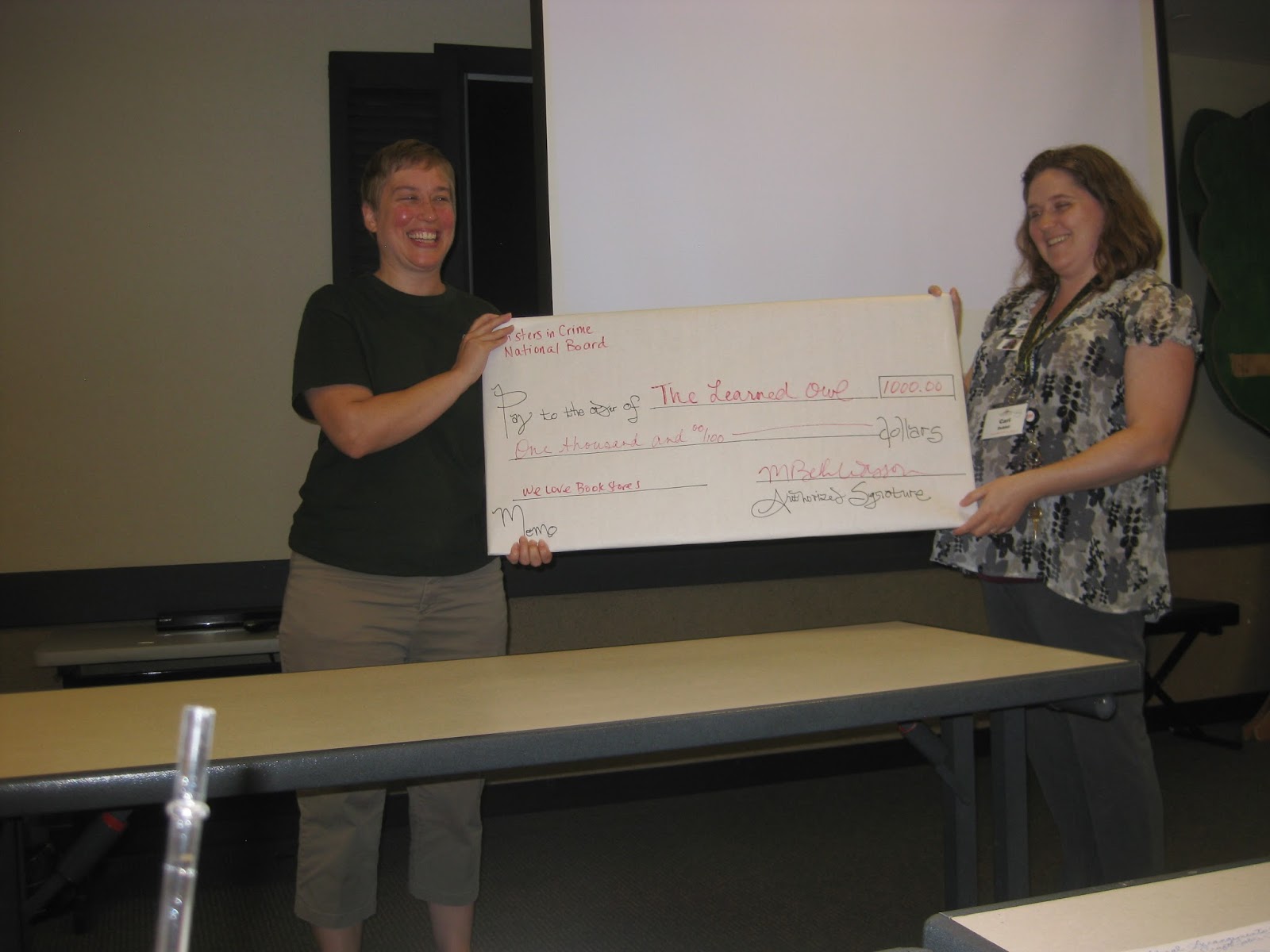
Owner of The Learned Owl winner of  a large check from SinC

Our event started at 10:00 with registration and a continental breakfast. We all got our name tags on a “Do not cross – Crime Scene” ribbon to hang around our necks made by our former president and now treasurer Kim Hammond. During brief breaks, there was a raffle with small bags of gift items our members had contributed. I got a cap with Cleveland on the front and FBI on the back donated I’m sure by our FBI member. There was also a break for lunch consisting of a make your own sandwich, various kinds of chips, fruit and some leftover donuts, etc. from breakfast, and in the middle of the afternoon a break for cookies, too, and always plenty of drinks all day – coffee, tea, pop and bottled water. At the breaks we could also purchase books of all the authors in attendance at The Learned Owl, a local independent bookseller who had a table set up there.
Victoria Selvaggio

Our president Irma Baker welcomed us all and then introduced our first speaker, Victoria Selvaggio, a literary agent with the Jennifer De Chiaira Literary Agency. Since I’m not sending query letters anymore, I didn’t take notes, but she was extremely informative for those who still are.


Amanda Flower/Isabella Alan
We also had three sessions called “Ask Me Anything” by three of our authors; Amanda Flower/Isabella Alan, Shelley Costa, and Casey Daniels/Kylie Logan who all answered questions about their publishing experience and with Amanda and Casey how they managed to write so many series and keep everything straight in their minds. They also answered questions as to whether they were plotters or pantsers or a little of both.


Nancy Pickard

Nancy Pickard also spoke in the morning about her background in writing and her road to publication. It was called “A Most Mysterious Occupation.” She also told us how her book The Scent of Rain and Lightning is being made into a movie. She is a very warm and interesting speaker – the kind of person you could invite into your home for a cup of coffee and not worry too much about a shaggy friendly dog or dust.  Later in the afternoon she taught a writing workshop on “First Sentence, First Paragraph, First Page.” I did take notes for that. She is a believer in the use of writers blogging to get over to the other side. She also wrote poetry, and recommended Annie Lamont’s book Bird by Bird for writers. She used the letters C for conflict, A for action, S for surprise, T for turn, and S for senses, all important elements in a good story. If a scene is flat, look for the main character in the scene. The character should show what he/she is feeling. People like surprises – both characters and the reader. She also said a writer should include the five senses and have as many as possible; smell, sight, taste, hearing and feeling or touch.  Pacing is also important – some scenes more relaxing.
Forensic Psychiatrist, Megan Testa

Our final presentation “Crime and the Mind” by Forensic Psychiatrist, Megan Testa was quite interesting. She works with those with mental problems, a lot of whom are women trying to get their children back. She discussed antisocial personality disorder, and I was writing so fast I might have some of the following mixed up. She talked of clusters.

A – Weird, tends to be a loner and maybe has a dog or some kind of pet, sometimes they’re schizophrenics, sometimes delusional.

B – Wild, won’t conform to societal norms, chaos in their life, and they can be highly narcissist with a sense of entitlement. They often have superficial charm, - think Ted Bundy. They lie and try to talk their way out of any problem. They are not faithful to any relationships. They’re impulsive and need lots of stimulation, and sometimes are violent. They are law breakers and don’t feel any remorse, and 80% of them have a mental illness and/or addiction. In brain scans when they’re shown violent pictures, their brain won’t fire up like the brain of normal people.

C – Wimpy, someone who has a dependent personality disorder and relies on others to meet their needs. They have trouble doing anything without having someone tell them what to do, and can’t make decisions on their own even in playing a game of cards.
Casey Daniels/Kylie Logan


We ended with this presentation and cleaned up and packed up. I packed my books that hadn’t sold, and left with Laura, my writer friend, who went with me. We headed for home stopping for supper on the way. It was an interesting and enjoyable day, but exhausting, too, as events like this always are. However, as Amanda Flower said in a recent posting to our list serve, it’s so good to be with fellow writers who understand us.


Shelley Costa
What writing events have you attended that you enjoyed?