Showing posts with label Lori Rader-Day. Show all posts

Sunday, January 7, 2018

Armchair Travels

by Julie Tollefson

I’ve been off work for the past two weeks, and it has been glorious. As temperatures dropped below zero (cold is sooo not my thing), I parked myself beside the fireplace and let the words of talented storytellers take me away from the bleak Midwestern winter. Between holiday gatherings and family game nights, I finished four books that have been on my to-read list for months.

The Hate U Give by Angie Thomas was a young adult sensation in 2017, spending many weeks at the top of the New York Times bestseller list. It’s told through the eyes of 16-year-old Starr Carter after she witnesses the police shooting death of a childhood friend. The story is emotional and current and deserving of every award and honor it’s received so far.

Hollywood Homicide by Kellye Garrett is the first in a new series featuring out-of-work actress Dayna Anderson. Day sets out to solve a murder, inspired by a $15,000 reward, and finds trouble and danger along the way. Day and her friends Sienna and Emme are a ton of fun to spend time with.

I’ve had The Day I Died by Lori Rader-Day on my to-read bookshelf since March, when I met Lori at the first Murder and Mayhem in Chicago. I’ve read and loved her previous books, and it about killed me that I couldn’t find time to dig into her most recent until the very last week of 2017. Totally worth it, though. The psychological thriller features handwriting analyst Anna Winger, whose life unravels as she consults on a case of a missing child.

Anatomy of Innocence: Testimonies of the Wrongfully Convicted, edited by Laura Caldwell and Leslie S. Klinger, pairs best-selling authors with fifteen individuals who describe every aspect of their ordeals from arrest to imprisonment to eventual release. The stories are heart wrenching and touch on the fear, pain, disbelief, and eventual exoneration of those who were wrongfully convicted of crimes. Honestly, this is the stuff of nightmares.

Where have books taken you recently?


Sunday, April 2, 2017

Back to the beginning


by Julie Tollefson

I’ve been thinking a lot about the beginning of my work in progress the last few weeks. I like my characters. The situation I’ve put them in is fraught with suspense. The story is compelling.

At least, it’s all those things to me. But when I take a step back, I wonder: Does it move too fast? Are the characters really as three-dimensional as I imagine them to be? Is all the good stuff I see in my head really there on the page?

In an attempt to get perspective, I pulled three novels I love off my shelves and re-read the first twenty or thirty pages of each to see how the masters set the hook for readers like me.

Still Life, the first in Louise Penny’s Three Pines series, begins with a body, briefly introduces Inspector Gamache, then slips back in time and slows down without losing tension. Readers get to know Three Pines and its residents, victim included, in a gossipy way that reveals enough secrets and simmering feuds to keep readers captivated for 25 pages until Gamache appears again.

In just six pages of The Black Hour, Lori Rader-Day introduces a damaged protagonist (literally—she’s recovering after being shot before the story begins) and sketches a situation rife with drama. Questions draw the reader on: Who shot the main character? Why? How will she cope? What happens next? And, particularly interesting to me, do I even like this character?

Nancy Pickard’s The Virgin of Small Plains begins in the middle of action—a pickup truck’s almost slow-motion slide on icy roads and its driver’s equally slow-motion observation of her bathrobe-clad neighbor traipsing through a roadside graveyard in a blizzard. An odd situation, sure. But then, like Penny, Pickard takes the reader back in time to build a strong sense of place and relationships among characters.

Common to all three? In the beginning, the mystery isn’t so much about the dead body—that’s coming in each—but about the people through whose eyes we see the story unfold. In short, all three books have, as Donald Maass describes in Chapter 5 of his excellent Writing 21st Century Fiction, “standout characters.” (I’ve written about this book before, and I probably will again. I love it that much.)

“Look at those people in your own life about whom you care greatly,” Maass writes on page 76. “Often, they’re people who to the rest of the world appear ordinary.”

That’s it! The characters in all three novels appear ordinary, but their stories are not.

So, uh, how does that help me with my current manuscript?

First, I’m reminded that it’s not necessary to race straight into a murder investigation. The real story often happens on the fringes of the investigation, at a pace that allows the reader to breathe.

I’ll also take another look at my ordinary people—a detective content with his small-town beat, an ambitious college student—and find the extraordinary in them. Plot will keep the story moving, but characters will steal the show.

What qualities do you look for in the beginning of a novel? What keeps you reading?

Tuesday, March 21, 2017

Why I read kid books By Lori Rader-Day


Here’s a story for you. Back when the first Harry Potter book came out, a friend of mine tried to convince me to read it. I refused. “That’s a kid’s book, isn’t it?” I sneered. (I can literally feel the face I must have made.)

Fast forward a couple of years, and that same friend brought me back from England a paperback of the first book as a souvenir. If it’s a present, I have to read it. Also, it was short—who doesn’t love a quick read? Fast forward several more years and, long story short, I’m standing in line at midnight at my local bookstore for the last in the series.

Harry Potter tricked me.

Since then, I’ve made room on my shelves and in my reading list for books that are meant for much younger readers. Much younger. I have read a few young adult books, but that’s not what I mean. My sweet spot is 8 years to 12, kids. The middle-grade book.

If that book is a mystery, well, even better. In April, I’m leading a discussion with some of the Edgar Award-nominated (search category for “juvenile”) mysteries for young people at the Edgar Symposium in New York. That’s a job I volunteered for; I’ve been happily reading the nominees in preparation.

So why does a 40-something who once scoffed at reading under her age group now find joy in finding a smart kid-lit mystery?

A few reasons...

I’m tired.
So are you. Modern life is exhausting. You know what you don’t want? War and Peace, just this minute. Sure, classics are great. Dense reads are fantastic. But it’s OK to read something sweet, too. And it’s certainly fine to read something fun, even if it’s meant for the tween set. Besides, many of these books will take you to a different place just as handily as a book written for an adult. Have you read Philip Pullman’s His Dark Materials trilogy? Start here and then talk to me about how reading books for young people isn’t proper use of your time.

I’m keeping track.
I read about 50 books a year—about 30 less than I used to, before I started writing a book a year—which is a good haul. I keep track of what I read on Goodreads and in a notebook I keep at home. There’s no prize for that. I just do it, because if I didn’t, I would come on here and tell you I read 10 books last year. But since I’m keeping track, what’s wrong with a few short reads? A few palate-cleansing page-turners you can get done in one sitting is a good way to get your reading goal for the year met. I don’t count picture books. I’m not a monster.

I want to be distracted.
When I’m drafting my mystery novels, I don’t tend to read anything too closely aligned. Sheila Lowe’s mystery series on forensic handwriting, for instance, even though my new book, THE DAY I DIED, features a handwriting analyst. Why not? Because I didn’t want Lowe’s books to leak into mine. I read nonfiction, non-mysteries, and mysteries that are so unlike my style that I can be sure I’m not borrowing. This is where a strategically placed pile of kid lit can help me out.

I want to support mystery books for kids. Actual kids.
I’m a mystery fan from way back because of what I read when I was 8. To support the publishing of mysteries for young people, I buy mysteries for all the young readers in my life. The kid gets a present, and one I like giving. Suggestion: I WANT MY HAT BACK by Jon Klassen is a mystery picture book, and it’s subversively funny. Check out the Edgar series from Jennifer Adams. He nevermore wants to go to bed! Selfishly, we also want these kids loving mystery now, so that they’ll be reading mysteries when they’re older.

I want to remember the joy of reading I got when I was a kid.
Most of us got our start as writers by being voracious readers. Do you remember? Walking into a library and knowing that you could take home any book in the place? Do you remember finding a book that took you somewhere you’d never been, somewhere you didn’t know existed, someplace that maybe doesn’t really exist? There’s magic in the words shared between writer and reader. Most of the time I’m on the job doling them out, but it’s nice to remember what it felt like to be on the receiving end, to be told a good, ripping story, just like when I was a kid and writing a book seemed like something only other people were allowed to do.

The good news is that those Edgar Award nominees I’m reading have been very good. When you go looking for a book that will turn you back into a gleeful kid, you won’t have to look that hard.

Lori Rader-Day, author of The Day I Died, The Black Hour, and Little Pretty Things, is the recipient of the 2016 Mary Higgins Clark Award and the 2015 Anthony Award for Best First Novel. Lori’s short fiction has appeared in Ellery Queen Mystery Magazine, Time Out Chicago, Good Housekeeping, and others. She lives in Chicago, where she teaches mystery writing at StoryStudio Chicago and is the president of the Mystery Writers of America Midwest Chapter.


Sunday, March 19, 2017

Murder and Mayhem, Chicago Style


by Julie Tollefson

Great swag.
Last weekend, I had the great joy of attending the inaugural Murder and Mayhem in Chicago (MMC) conference. I had two big professional goals for the day: (1) Learn something from the terrific lineup of writers and presenters that I could apply to my own writing and (2) meet some people in real life who I’ve only known online.

I’m happy to say MMC exceeded my expectations on both counts. The organizers (with Lori Rader-Day—one of my previous online-only acquaintances, now a real-life friend—and Dana Kaye at the helm) put together panels of authors, publishers, publicists, agents, librarians, and booksellers to talk about a well-thought-out mix of crime fiction and publishing topics.

The first panel of the day, Violence in Crime Fiction, played beautifully into my first goal. Panelists Lucy Kerr, Elizabeth Buzzelli, Nic Joseph, and Michael Harvey, moderated by Lynne Raimondo, unanimously agreed that violence is not the most compelling component of crime fiction, an opinion I hold as well. The aftermath of crime, the human reactions to violence are what make crime stories gripping and relevant.
New publications from conference
organizers Dana Kaye and
Lori Rader-Day.

As I listened to the panelists, I thought about my current work in progress, in which a young woman is murdered before page one. The story follows the tendrils of consequences and devastation her death causes in her small college town, especially how her murder affects her roommate, the cops who investigate her death, and her family.

One of the panelists mentioned the classic Raymond Chandler essay, The Simple Art of Murder. I’m a bit ashamed to admit I hadn’t read it in full before, but when I rectified that oversight, I recognized this famous passage:

But down these mean streets a man must go who is not himself mean, who is neither tarnished nor afraid. The detective in this kind of story must be such a man. He is the hero, he is everything…He has a range of awareness that startles you, but it belongs to him by right, because it belongs to the world he lives in. If there were enough like him, I think the world would be a very safe place to live in, and yet not too dull to be worth living in.

Of course I indulged in
Chicago-style pizza, too.

These words and the panelists’ comments have been in my thoughts this week as I work on revisions to my manuscript. Crime and punishment as presented in news stories often appear to be black and white, but the best crime fiction explores the gray areas, too. And that excellence is what I hope to achieve in my stories.

The folks who put together this first MMC are already planning the second and beyond. If you’re looking for an outstanding experience filled with fun people, I give MMC my highest recommendation.

Do you attend writer/fan conferences? If so, what’s your favorite conference, favorite brush with greatness, or favorite story?

Chicago started celebrating St. Patrick's Day early. Shout out to this terrific Irish band at The Gage, a lovely, lively venue.

Tuesday, July 19, 2016

My Summer at Yale


 by Paula Gail Benson
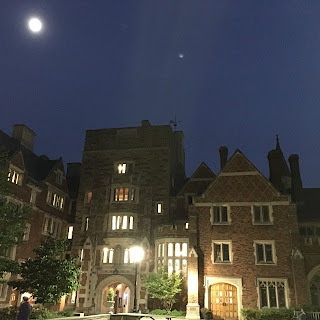

Calhoun Residence Hall
When I visited with friends at Thanksgiving last year, I had the opportunity to tour the Yale University campus. For many years, I had read about its famed drama school and hoped I might someday have the chance to study there.

A Calhoun Hall Gate
A few months later, I noticed a message author Lori Rader-Day posted on Facebook. She announced she would be teaching in Yale’s summer writing program and encouraged people to attend. I looked up the information on the website. Yale offered the program to anyone over the age of eighteen and gave it in two consecutive week-long sessions during the month of June. The first session was a general overview of writing craft, and the second was a genre-specific study course. You had the option of signing up for one or both weekly sessions. For the second session, you had to choose a single concentration in one of the following areas: fiction, nonfiction, biography, memoir, children and young adult fiction, historical fiction, science fiction, romance, mystery, poetry, playwriting, or screenwriting. While the second session offered some lectures for all participants, each genre course consisted of twelve hours of instruction and was limited in the number of students. The faculty was impressive. In addition to Lori Rader-Day, it included Sybil Baker, Louis Bayard, Lary Bloom, Elizabeth Hand, Stephanie Hart, Jonathan Levi, Sarah Darer Littman, and Julia Quinn.

My Dorm Room
I submitted an application for the second session and was thrilled to learn I had been accepted in Lori Rader-Day’s class. I decided to stay in Calhoun Residence Hall, to have the “full” Yale experience. I was assigned a spare room (single bed, desk, and closet--no hangers unless we brought them--also, we made our own beds) on the third floor, sharing a common room and bathroom with five other students. To gain access, we carried a card that let us enter the outer gates and doors, and a key, for the interior rooms, including the bath. There was no air conditioning, but a window had been opened. By evening, the cool air filtered through, making me glad I had a blanket!

Lecture Hall
The first lecture was in a timbered classroom where we heard the three rules (no alcohol, smoking, or propping open doors) conveyed by using the rhetorical triangle. We heard the facts (if the rules were broken, we would be dismissed), had an empathetic appeal (protection of students under legal drinking age and of university and private property), and could assess the speaker’s credibility when we heard about previous sessions where thefts had occurred due to the door latches being taped for entry. We learned from a campus security officer [Note: Yale had the first college police department in the country and its standards are very competitive. This officer was selected from 2,000 applicants.] that the campus had over 5,000 summer students and a police
response time of one to two minutes.

Our mystery writing class was made up of only seven students, and we bonded from the start. Before we arrived, Lori asked us what we wanted to learn and tailored her lessons to include all the information we had requested. The first night, we all sat at the same table during the opening reception. Each day followed with three hours of instruction. In addition to talking about craft, Lori had us read selections from books that she felt illustrated excellent development of characters, settings, pace, and dialogue. Then, we considered portions of each other’s work, emphasizing the strengths we found, but also noting where we had questions. And, perhaps most valuable of all, each of us had a private conference with Lori where she reviewed the material we had submitted. Her recommendations were so beneficial and gave me new insight into my characters. She helped me discover what I was doing right and where I needed to improve. And, did I mention, Lori Rader-Day ROCKS!!!!!!!
Trumball Cafeteria
We had meals together with other students and teachers in Trumball Residence Hall’s cafeteria, which looked very much like the dining hall at Hogwarts. I was impressed that among our food options were Shepherds’ Pie, mussels, spaghetti, and pizza. And, one night, we had a cook out.

Special lectures featured Richard Deming, John Crowley, Colum McCann, and Aaron Tracy. In the evenings, the genre instructors offered readings at the Yale Book Store. One afternoon, several classes gathered together to listen as students read from their work. Every moment was inspiring and completely delightful.

Victoria Rinkerman, who had the daunting responsibility of running the program, provided a welcoming atmosphere and never seemed to meet a problem she couldn’t resolve. She and her staff were truly awesome! And, Lori Rader-Day was phenomenal. No wonder her novels have won all those awards!

If you have an interest, I would encourage you to consider the program for next summer. It has given me a new perspective, renewed enthusiasm, and a new group of valued colleagues.
 
Me -- a Yalie!
Have you attended a writing program that you found inspiring?