Showing posts with label Liz Milliron. Show all posts

Sunday, September 24, 2023

An Interview with Liz Milliron by Annette Dashofy

Pennsylvania State Trooper Jim Duncan responds to a call regarding a missing autistic young man. When the


boy is quickly found, Jim thinks the case is closed…until the young man insists the police need to help a “sleeping blue lady” and leads them to a dead woman in an abandoned shack, clad in only her underwear.


Meanwhile, defense attorney Sally Castle is searching for a troubled young woman who wandered into her office wanting protection from an unnamed man…and disappeared before Sally could obtain any details. Sally is bothered by the incident and unnerved when she discovers that Jim’s dead body and her missing potential client are the same person.

Jim and Sally soon discover the young woman led a secret double life, with ties to the autistic boy who started it all. As Jim and Sally investigate, the case takes increasingly ominous turns, uncovering hidden money and a seamy underbelly of sex work, before turning into a desperate race to stop a killer. Can Jim and Sally solve the case in time to stop the murder of an innocent boy?

                                                                        www.amazon.com


Thicker Than Water (September 19, 2023, Level Best Books) is the sixth in Liz Milliron’s Laurel Highland Mysteries featuring Pennsylvania State Police Trooper Jim Duncan and Defense Attorney Sally Castle. The entire series is tightly written yet lush in setting and character development, but Liz has upped her game with this one. Please welcome Liz back to Writers Who Kill.


Thicker Than Water opens with Sally Castle and her law partner, Tanelsa Parson, moving into a new office. When the series began five books ago, Sally worked in the Public Defenders Office. Catch us up a little. What brought Sally into the private sector of law practice?

Sally was frustrated with her job at the public defender. She loved the fact that she was helping people who needed it. But it’s actually hard to qualify for a court-appointed defender. The government’s idea of “unable to afford an attorney” is very different from a regular person’s. She felt too many people were turned away because they didn’t qualify, even though they might have been hard-pressed to pay a private attorney. Also, when you work for the government, you don’t get to pick your clients. You defend who you’re told to. Sally wanted to take the clients who needed her the most, at least the ones she believed did. So, she started her own firm and asked Tanelsa, who she worked with at the public defender’s office, to join her.

Pennsylvania State Trooper Jim Duncan has also moved into a new career path as an investigator. Is this move a promotion? Why is he still called a Trooper instead of a Detective?

No. Working for the Criminal Investigation Section, the Pennsylvania State Police’s investigators, is a job description, not a rank. This is a lateral move for him, just as if he’d moved to working with the K-9 division or Emergency Response. The PSP doesn’t have the title of “detective.” Even with CIS, ranks are trooper, corporal, etc.


Jim’s partner questions why they’re responding to a missing person’s case when it’s not a “crime scene.” Don’t police routinely investigate missing persons?

They do, but usually not under these kind of situations. Noah is nineteen and he’s only been “missing” for a couple of hours at most. Yes, he’s an at-risk individual because of his autism, but Trooper Cavendish’s position is that search and rescue is more suited for the circumstances. Now, if Noah had been missing for a longer time, had SAR not found anything, or if there was a witness who’d seen him get into a strange car, Cavendish would feel differently. To her, there just isn’t enough evidence for an investigation – yet.

Noah insists he has seen a “sleeping blue lady.” The obvious assumption is that he has seen a dead woman, but he’s clearly an unreliable witness. How do Jim and his partner deal with this young man?

Jim and Cavendish don’t want to completely dismiss him. They know that just because he is autistic doesn’t mean he has no awareness of his surroundings or can’t tell the truth. At the same time, they know they can’t launch a full-scale investigation on only his word. They try to compromise by having Cavendish stay to question Noah and his mother, while Jim and Aislyn McAllister take a look around the area where Noah had been earlier. Of course, they do find the “sleeping blue lady” and, well, she’s not sleeping.


Throughout this book there’s a recurring theme of “to have kids or not to have kids.” Why is Sally so reluctant to consider starting a family?

It isn’t just reluctance. Sally flat-out doesn’t want to have kids. Not that she doesn’t like kids, she has simply never wanted to be a parent. But deep down, Sally knows Jim does want a family, or at least that’s what he’s said in the past, so she’s a little afraid that if she says what she really feels, he’ll leave her.

Why is Sally so hesitant to have Thanksgiving dinner with Jim’s parents?

Sally’s mother, Louise, is very strident when it comes to the fact that Sally’s brother and sister have families and Sally doesn’t. Her mother never fails to remind her that she’s in her mid-thirties, her biological clock is ticking, that Louise would really like to see her youngest child married and a mother. It’s a very tiring conversation. Sally wants to meet Jim’s parents, but she doesn’t see how to avoid the same conversation with them. Basically, she’s tired of justifying her choices to people.


Maddie shows up at Sally’s office but runs away before Sally can find out why this young woman is so scared. Does she run away because of the secret life she’s leading?

Sort of. Maddie has worked very hard to keep what she’s doing secret, so yeah, the idea of telling a lawyer kind of freaks her out. But there is also the fact that although Maddie desperately wants help, she doesn’t believe anyone can really do that. That’s why she leaves before telling Sally her story.

Why does Jim allow Sally to tag along when he visits Maddie’s college?

Part of it is because Jim knows Sally has a little bit of guilt over Maddie leaving. She feels she could have done more to help the young woman. The other reason is Jim knows that if he doesn’t take Sally with him, she’ll go on her own. At least this way he can keep an eye on her.

Time is money, and with Sally and Tanelsa starting a fledgling law firm, Sally seems to be spending a lot of time working on a case with no paying client. Why? And how does Tanelsa feel about it?

As I said before, Sally feels guilty about not doing more for Maddie. She’s trying to make up for it. Tanelsa is sympathetic, but at the same time she knows they need paying clients to keep the lights on. She knows Sally, though, and she knows what she got into when she joined the firm. She’s willing to put up with it – for a while. After Tanelsa learns what was going on in Maddie’s life, she becomes more invested in finding out what happened.

There are a lot of story threads going on involving parents and children. Maddie’s parents are clueless, Noah’s is overprotective. Then there’s Sally’s mother and Jim’s parents. And the big debate between Tanelsa and Lisa and Sally and Jim about becoming parents. Is this an intentional theme as you started writing the book or did it develop later in the writing process?

Theme is usually “accidental” for me, something that develops as I write. But this time, it was very intentional. At the end of Lie Down with Dogs, Jim asks Sally to move in with him and she says “not yet.” Their relationship is moving to a deeper level. Part of a long-term relationship is exploring the idea of “family” and what it means to each person. I wanted to look at that concept from a variety of perspectives.


What’s next for Jim and Sally? And for you?

I’m currently working on the seventh Laurel Highlands Mystery and I’m toying with the title Saving the Guilty. In that one, Sally and Tanelsa are asked to work on an appeal for a man convicted of killing his wife. Simultaneously, Jim and Cavendish are working the murder of a man who is living under a fake identity. It’s a story with a lot of intersections and it all has to happen in five days, so wish me luck.

As for me, the fifth book in my Homefront Mysteries series, The Secrets We Keep, is scheduled for release in February 2024. Betty is hired by a soldier who is home on medical furlough to find his birth mother. But when the woman she thinks may be the one she’s looking for is murdered, she ends up working to clear her client of the crime. I also just signed a contract for one of my short stories, called “Mal de Ojo,” to be published in the Mystery Most International anthology, which will be out in 2024. And I have one other thing in the works, but I don’t think I’m supposed to make it public yet.

Thanks for the great questions and for hosting me!

Thank YOU, Liz.

For more on Liz and her books, check out her website and sign up for her newsletter.

https://lizmilliron.com/


Liz’s Bio:

Liz Milliron has been making up stories, and creating her own endings for other people’s stories, for as long as she can remember. She’s worked for twenty years in the corporate world, but finds making things up is far more satisfying than writing software manuals. A lifelong mystery fan, she is the author of The Laurel Highlands Mysteries and The Home Front Mysteries, both from Level Best Books. Her short fiction has appeared at Uppagus and Mysterical-e. and been in Lucky Charms: 12 Crime Tales, the Anthony award-winning Blood on the Bayou (the 2016 Bouchercon anthology), Fish Out of Water, Malice Domestic 12 – Mystery Most Historical and The Killer Wore Cranberry: A Fifth Course of Chaos.

Liz lives near Pittsburgh with her husband and a very spoiled retired-racer greyhound named Koda. She is a past-president of the Pittsburgh chapter of Sisters in Crime, and the current vice-president, and a member of Pennwriters. Find her on Facebook at https://facebook.com/LizMilliron, or follow her on Instagram (@LizMilliron).


Saturday, June 20, 2020

Who Says the Author is in Charge? by Liz Milliron

If you are a writer, what I am about to describe may be a familiar scenario.

There you are, in the zone. The words are flowing, the gears are spinning, and the story is humming along. Suddenly, WHAM! You hit a wall that just will not give way. The character refuses to take direction. Perhaps the conversation goes something like this:

Author: Go through the door.

Character: No.

A: Why not? It’s just a door. Grab the handle and turn.

C: I don’t want to.

A: Come on, I need you to go through the door. Open it!

C: No. I’m not gonna do it AND YOU CAN’T MAKE ME!

This is where some people (my husband included) look at me funny. “But,” they say, “you’re the author. You’re in charge.” Ha, ha, if only. Saying this out loud may get you weird looks, nervous laughs, or suggestions of a psych eval. But my writer friends know better.

The struggle is real.

Such a scenario occurred to me in the book I just completed, the second in my Home Front Mysteries series, The Stories We Tell. Except it was more than just opening a door. I had a murder victim who refused to be murdered.

The refusal brought the story to a standstill. Each day, I wrote, brainstormed, begged, cajoled, and pleaded with this character. Nothing doing. Each day’s words were deleted. “I was not murdered.” But, but, but…I set that up chapters ago. Of course you were. “Nope. Dead, yes. Murdered, no.” I tried scenario after scenario to make it work. Every attempt fell flat.

My critique partners (Including WWK’s own Annette Dashofy) tried to help me by offering suggestions. I took them back to the character. “Absolutely not” was the response.

“This is intolerable,” I said. “I have a deadline to meet.”

The character shrugged, totally oblivious to my deadline and my need to make the story the way I wanted it to be.

You may have guessed what happened. I caved. The character had not been murdered. Instead, a different character, one I had been intending to keep alive, was bumped off. As soon as I made that decision, the story resumed its rapid pace. The dam broke and the words flowed. I hit my deadline and I think the ending worked out rather well.

I also learned a valuable lesson. When stuck, listen to your characters. They often know better than you do.

Writers, has this ever happened to you and how did you deal with it? Readers, what do you think? Should the author let a character be in charge?

Liz Milliron is the author of The Laurel Highlands Mysteries series, set in the scenic Laurel Highlands and The Homefront Mysteries, set in Buffalo, NY during the early years of World War II. Broken Trust, the third in the Laurel Highlands Mysteries, is due to be released on August 11, 2020. The first book of the Homefront Mysteries, The Enemy We Don’t Know, was released in February 2020. Soon to be an empty-nester, Liz lives outside Pittsburgh with her husband, two children, and a retired-racer greyhound.


Sunday, November 10, 2019

Bouchercon 2019 Wrap Up


Another Bouchercon has come and gone leaving in its wake a lot of wonderful memories. And a lot of exhausted mystery writers—including several of my fellow Writers Who Kill!—and readers.

As is often the case, travel provided the biggest adventure. I try my best to plan ahead for a smooth trip. But you know what they say about the best-laid plans. My travel buddy, Liz Milliron, was supposed to avoid some of the airport traffic by coming to my house, leaving her car in my garage, and driving with me to the valet parking lot. Since I live on the opposite side of Pittsburgh International from the city, I have NO traffic to deal with. The problem is Liz still had to get through the city to get to my house, and we hadn’t planned for the traffic jam created by an accident on the Parkway. Instead of taking no more than an hour to get to my house, it took Liz over two.

Thankfully, we made it to the airport with no other issues, made our flight and expected no additional speedbumps on our way to Dallas.

Then we landed in Houston. As soon as our phones came out of airplane mode, the notification hit. Our 45-minute layover was now an hour and 45 minutes. Our rushed “we’ll grab a sandwich” turned into a leisurely lunch.

And then a leisurely snack. Chocolate-covered potato chips make a pretty good salve for calming travel frustrations.


The departure changes bounced back and forth more than a pinball until we finally boarded our flight two hours late.


By the time we checked in, we were too exhausted to go out for dinner or to meet friends in the lobby. 

At least our hotel room was gorgeous and room service didn’t take too long.


Wednesday, Liz joined Dru Ann Love on a bus tour of the city while I went for a very chilly walk with my Pittsburgh sister in crime, Susan Thibadeau. It was too darned cold to wander as far or as long as we’d have liked, but we enjoyed seeing a few sights.


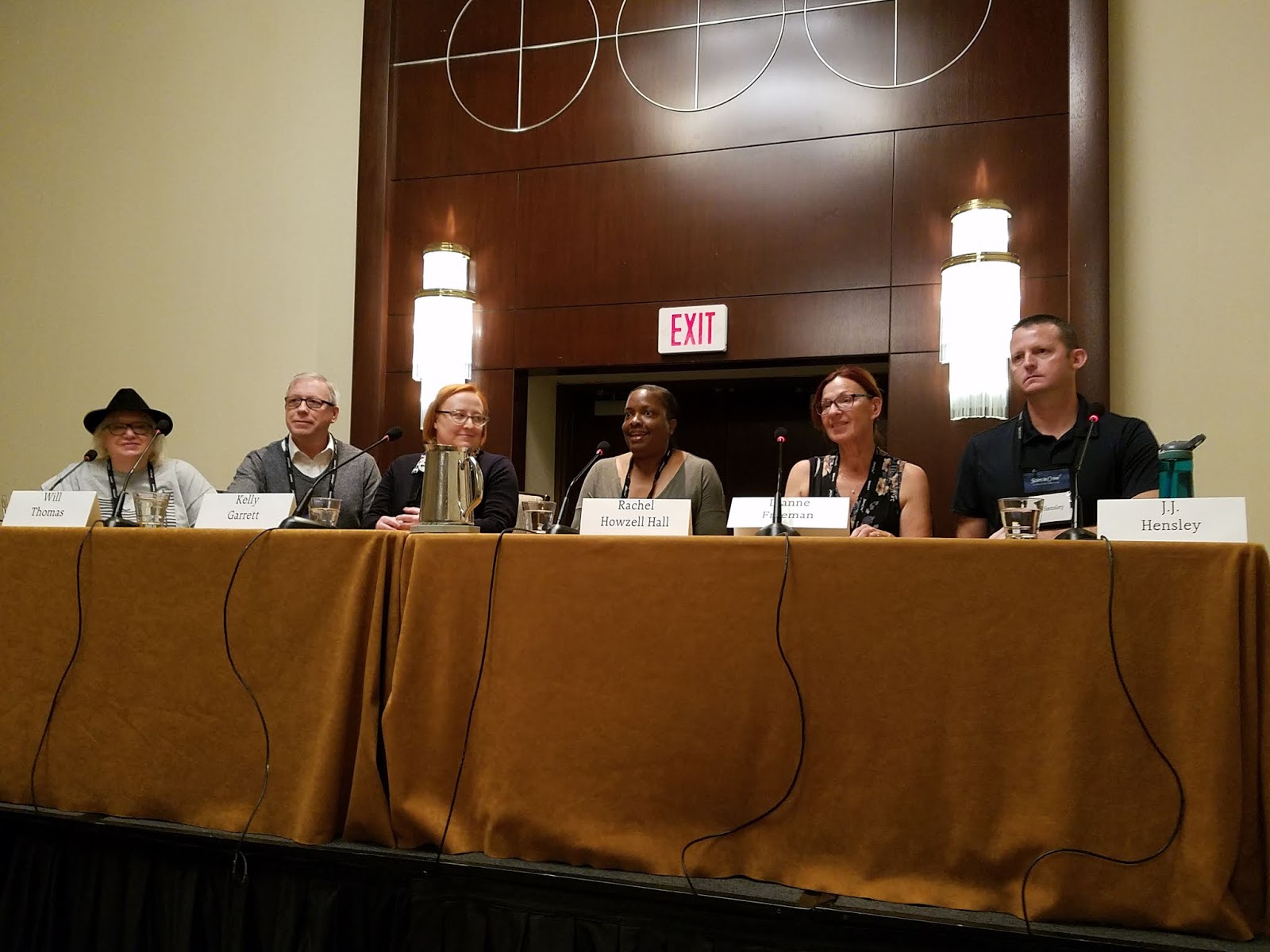
Bouchercon kicked off on Thursday with Susan’s panel and a rousing game of Who Wants to be a Mysteryaire with the gang from Jungle Red Writers. Lots of fun and laughs.


(FWIW, I suck at game shows. Just sayin’.)

Later, in the lobby, I ran into a fan of my Zoe Chambers series, Cheryl Aker, who generously gifted me with a pair of wooden squirrels she’d made herself! 


(If you’re asking, “Squirrels?” it’s a “thing” over on my Zoe Chambers Mysteries &Friends group on Facebook.) Sweetest moment of the entire convention for me!

Friday, I cheered on my former Pittsburgh mister in crime J.J. Hensley on his panel (come back, J.J.! I know Georgia is warmer, but we miss you!).

I also attended the first of the Poison Lady’s presentations. I always leave her workshops feeling…unnerved…but fascinated.

Saturday, I bravely attended the Poison Lady’s second presentation. The Q & A was as frightening as the workshop, with attendees eagerly asking about ways to slip toxic substances to people I can only hope were fictional victims in their books!

Lisa Unger interviewed Guest of Honor Hank Phillippi Ryan in one of my favorite events of the convention. I’ve known Hank for years and have heard her speak many many many times and STILL managed to learn a few fascinating tidbits about her.

That evening, I got to spend time with two of my favorite people, my former editor Rachel Jackson and my former (and current freelance) editor, Erin George. It was wonderful catching up with them in person!

Sunday morning, after rising early to pack and check out, I had my panel about the careers of fictional sleuths. Our crowd was small to start, although it grew considerably as bleary-eyed attendees, clutching coffee, wandered in. 


Next, Liz took part in a very funny panel about small towns, big crime. 

As soon as she finished her book signing, we grabbed a Lyft to the airport…where we had another delay. Thankfully only one hour this time.

I’m glad I went. It was wonderful seeing old friends and making new ones. We shared a lot of laughs and a few drinks—both alcoholic and caffeinated.

Who else was there? Leave a comment and share your favorite memory!  


Wednesday, September 4, 2019

An Interview with Liz Milliron by E. B. Davis


State Trooper Jim Duncan’s quiet overnight shift turns deadly when fire destroys a ski lodge at a local resort and the first responders find a man’s body inside. What starts as a suspicious accident quickly becomes sinister when the autopsy proves the victim is not the man who rented the cabin. Jim’s left with three questions. Who is John Doe? Why was he at the ski lodge? And who hated him enough to kill him?

Assistant Public Defender Sally Castle, still reeling after the events of several months earlier, tries to bury her feelings of guilt and fear in her work.

When an anonymous note from a secret admirer arrives at the courthouse, she brushes it off as an empty threat. As the missives, each one darker than the last, continue to arrive at her office as well as her home, Sally is forced to review all of the possibilities. Is the letter writer a person from her legal past? Or is the threat closer to home?

As the questions multiply, Jim and Sally are thrown into a race to find a murderer as well as a stalker…before Sally ends up facing more than an unwanted pen pal.
 
Heaven Has No Rage, kept me turning the pages. Her two main characters, Jim Duncan—a Pennsylvania State Trooper, and Sally Castle—a public defender, tell the story, which alternates between the two, pushing the story forward.
Liz Milliron’s second book in her Laurel Highlands mystery series,

Liz was previously interviewed by Grace Topping in August 2018 about her first book in this series, Root Of All Evil. Here is the link. Please welcome Liz Milliron back to WWK.
                                                                                 E. B. Davis
____________________________________________________

Your book is set in southwestern Pennsylvania. Are all the towns in the book outside of Pittsburgh? Frostburg is in Maryland. Where is Punxy?

Most of the places I use are in southwestern PA, yes. Punxy – Punxsutawney, home of the (in)famous groundhog – is slightly northeast of Pittsburgh, about an hour and a half drive. The Frostburg I mention is actually Frostburg, PA. It is about five miles away from Punxy.

What is a FTO?

FTO = Field Training Officer. In many police departments, after a recruit graduates from the academy, she spends time under the supervision of an experienced officer – kind of a probation period. That period is designed to evaluate the new officer’s conduct in real-world situations and reveal any issues that would not be uncovered in the classroom. Not every experienced officer is an FTO; it’s a special certification.

McAllister trained under Duncan and calls him Boss. She does a lot of research for him. Why? How does she have the time considering she has her own duties now?

McAllister’s use of the nickname “Boss” is an inside joke that goes back to Root of All Evil. She has enormous respect for Duncan because of events that transpired during her training period (and are talked about in Root). Because of that respect, she is willing to make time to help him out – even her own personal time.

What is the relationship among city/county-township and state police?

It really depends on the city/county/township. There are a lot of small towns in southwestern PA where the state police are the only police – like Confluence. When you dial 911, you get a trooper. Then there are places with a part-time force that is capable of handling small matters (like bar brawls), but they call the PSP when something big happens, like a murder. You have full-service departments, such as Uniontown, which only call the PSP for specialty support, such as lab services. And finally, big city forces like Pittsburgh, which only need the PSP for assistance (for example, PSP Special Emergency Response Teams and Pittsburgh SWAT will back each other up), lab services, or a higher-level incident (maybe the incident occurred in Pittsburgh, but the suspect has fled the city and there is a state-wide manhunt). In general, the various departments get along – but there’s sometimes some friction because…people.

Duncan is called a “trooper” or a “patrol” cop, but he is investigating as a detective. Do troopers investigate murders? Are there local cops who investigate? Are there also state detectives?

Here I am stretching the truth a little. No, a patrol trooper would not investigate a murder. He would respond to the initial incident, take statements, handle traffic, coordinate with emergency services, etc. However, once the immediate situation is handled, a call would go to the Criminal Investigation division for that Troop (there are several Troops in the PSP that cover various geographic regions. Duncan serves in Troop B.) That trooper, who is in plainclothes, would handle the investigation and is the PSP’s “detectives.” It’s not a rank, but a job within the PSP. If Duncan insists on being involved in murder investigations, he might have to consider a career-path change.

What is Ohiopyle? I assume it is in Ohio, which must be close by, but why is a Pennsylvania State Trooper providing security for an Ohio event?

Ohiopyle is both a town in the Laurel Highlands (in Fayette County, population 59 in 2010) and a state park in Pennsylvania. It is situated on the Youghiogheny River and has a lot of natural/outdoors activities available – hiking, biking (the Great Allegheny Passage goes through there), kayaking, canoeing, camping, etc. Trivia: the name “"Ohiopyle" is derived from the Lenape Indian phrase ahi opihÉ™le which means 'it turns very white', referring to the frothy waterfalls. During the French and Indian War, George Washington decided the falls were too dangerous to ford and took another route on his way to Pittsburgh.

What is a newsboy cap?

Those squashy caps with a tiny brim. Think the caps that newsboys wore in the 1930s when they stood on the street corners hawking papers.

Why does Sally keep second guessing Jim’s intentions? Why does she think she’s caused him pain?

Sally is having a crisis of confidence. Without revealing too much, she believes her decisions led directly to the events at the end of Root of All Evil, where Jim was put in a fairly dangerous and undesirable position. She believes he blames her for what he had to do. At the same time, he seems to care about her, so she’s a little confused.

Tish, Jim’s ex-wife, doesn’t help the situation when she gives Sally her perspective on Jim. Does she tell the truth or is she bitter?

Both. Tish and Jim married very young and Tish was not cut out for the life of a police officer’s wife. She had unrealistic expectations – such as he’d always be able to answer her call and chat in the middle of a shift, or that he’d want to discuss all the events of his day when he got home. And she wanted to live in Pittsburgh, where Jim definitely did not. So yes, she’s bitter but a lot of it has to do with unmet expectations. I guess she’s telling her truth.

Why do you use the term “actor” instead of suspect?

It’s another term police officers use for “suspect,” mostly when talking amongst themselves – the person who performed an action.

Sally has served in the district attorney’s office and is now working as a public defender. Why does she keep working in the public side of the lawyering business instead of private?

Out of law school, Sally wanted to uphold justice and still does. But when she was in prosecution, she saw a lot of people who couldn’t afford the pricey private lawyers and who deserved protection under the law – even if they were guilty. That’s why she went into public defense, so she could protect the people who couldn’t afford a private practice attorney.

I wasn’t sure how the money laundering worked in the buying and selling of properties. I thought that no matter how a property was bought, transactions of ten thousand dollars and above were always reported to the Feds. Isn’t that true? Wouldn’t the Feds question where the money came from?

Yes, you are correct. A person or business must file a form with the Federal government when receiving cash payments of $10,000 from one or multiple transactions. Getting into the details of how it all worked bogged down the pace of the story and wasn’t really necessary. The implication is the people involved in the scam knew how to “cook the books” so the feds wouldn’t get suspicious. And maybe they were anyway – it just doesn’t figure into the story.

Who gets Nero?

I’m not positive, but I think Nero would be returned to the service organization he came from. He would either be given another handler or retired and adopted to be a normal pet.

What’s next for Jim and Sally?

Book three, titled Broken Trust, comes out August 2020. In that one, Jim shows up to the scene of a dead body in a workplace to find it’s a friend. It’s kind of a “busman’s holiday” book because Jim’s scheduled to be on vacation since his sister and her kids are coming to visit, but he feels obligated to investigate not only because the victim is a friend but also because Jim helped get him the job. At the same time, Jim and Sally find their relationship tested all because of a little line in the Code of Ethics – that an attorney may break privilege in the event of a threat to person or property, but she doesn’t have to.

Sunday, August 4, 2019

Research, research, research!


First thanks to Annette for having me here at Writers Who Kill! So glad to be back.

As a literature major, I did a lot of research in college, most of it pretty boring (use of foil symbology in Shakespearean plays anyone?). When I graduated, I thought I’d left all of that behind me.

Then I started writing novels.

There’s a lot of research that goes into “making it up.” After all, unless you are writing speculative fiction or pure sci-fi/fantasy, you want things to be like real life, right? I mean, if you say your state cop got into a Lamborghini, someone somewhere is going to call you on it. Trust me. Been there, done that.

Unless you’ve created a fictional town and your cops just happen to drive Lambos, but I digress.

It’s pretty logical that historical fiction requires a lot of research. What were the dress styles in the late 1800s? When did Henry Ford create the assembly line? When were telephones commonly available in homes? What was the hourly rate for a line worker at Bethlehem Steel in the 1940s (I had to research that one)? How much was bus fare in Buffalo, NY in 1942 (had to do that one, too)?

By the way, it might be challenging to find it all, but trust me. The internet knows just about everything.

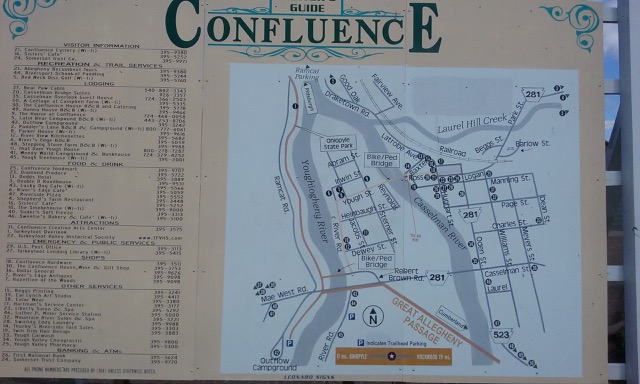
But even though I write contemporary fiction (meaning it takes place in current times), there’s still a lot of research. Take maps. I don’t write a fictional location, so maps are my best friend. What’s the cross street by the Fayette County courthouse? Google Maps to the rescue. I’ve spent more time there than I care to admit.
 
I spend a lot of time looking at this map
when Jim Duncan is at home
.

There’s also talking to people. After all, I’m not a public defense lawyer nor am I a cop…but I do write them, so I’d better get it right. I have two reliable sources for each on speed dial. The conversations usually go something like this:

Me: I’ve written blah-blah-blah. Would that happen?
Them: Not so much.
Me: Well, I need blah-blah-blah to happen. How would that work?
Them: Well, you could do it like this <insert long explanation>

It sounds kind of boring, but both these guys have great stories, so it’s not.

I make site visits to the Laurel Highlands frequently. This keeps me up to date on places and how the area feels/smells/looks in each season.
 
The interior of the very-real Lucky Dog Café,
Jim and Sally’s favorite Confluence eatery

And sometimes, well, the research gets just plain fun. Back in 2014, I attended Writers Police Academy, which is filled with law enforcement demonstrations, all of which are run by real cops. I mean come on. Watching SWAT blow off a door in an explosive breach demonstration? Who doesn’t like a good boom first thing in the morning?

All of it in the name of writing a better book.

So if you’re thinking of writing a novel and you won’t have to do any research because you get to “make it up,” think again. To quote Aislyn McAllister, “If I’d known about the research involved in this job, I might have chosen a different line of work.”

Nah.

About Heaven Has No Rage

State Trooper Jim Duncan's quiet overnight shift turns deadly when fire destroys a ski lodge at a local resort and the first responders find a man's body inside.
What starts as a suspicious accident quickly becomes sinister when the autopsy proves the victim is not the man who rented the cabin. Jim’s left with three questions. Who is John Doe? Why was he at the ski lodge? And who hated him enough to kill him?

Assistant Public Defender Sally Castle, still reeling after the events of several months ago, tries to bury her feelings of guilt and fear in her work. When an anonymous note from a secret admirer arrives at the courthouse, she brushes it off as an empty threat. As the missives, each one darker than the last, continue to arrive at her office as well as her home, Sally’s forced to review all the possibilities. Is the letter-writer a person from her legal past? Or is the threat closer to home?

As the questions multiply, Jim and Sally are thrown into a race to find a murderer as well as a stalker...before Sally ends up facing more than an unwanted pen pal.

Bio

Liz Milliron is the author of The Laurel Highlands Mysteries series about a Pennsylvania State Trooper and a Fayette County assistant public defender in the scenic Laurel Highlands. The first in the series, Root of All Evil, was released in August 2018. Liz’s short fiction has appeared in multiple anthologies, including Murder Most Historical and the Anthony-award-winning Blood on the Bayou. She is a past president of the Pittsburgh chapter of Sisters in Crime, as well as a member of Pennwriters and International Thriller Writers. She lives outside Pittsburgh with her husband, two teens, and a retired-racer greyhound.


Sunday, October 28, 2018

Coming Up for Air


I did it! I turned in my 8th Zoe Chambers Mystery (titled Fair Game) on time along with my thoughts about the cover art. After being overwhelmed with a back-to-back book release and deadline, the sense of freedom was exhilarating.

Someone recently asked me how I celebrate these things. Let’s see…

I ate chocolate. My husband and I toasted with a glass of mead, homemade by my good friend Tami McClain.

We bought a new car…
 
Hubby's new Crosstrek (which I borrowed for
my road trip)
Okay, that last item had nothing to do with the deadline. Hubby’s old car was nearing 200,000 miles and needed some major repairs. He was long overdue for a new vehicle.

He also let me and my travel buddy, Liz Milliron, take the new Crosstrek on a weekend road trip to Indianapolis for Magna Cum Murder, another nice way to celebrate. I didn’t even pack my laptop, although I did take my Chromebook to check email. It was nice being able to devote all of my convention time to hanging out with readers and making new friends as well as touching base with old friends. No retreating to my room to hammer out a scene or a chapter.
 
Glamming it up with travel buddy Liz Milliron at
the Magna Cum Murder banquet
Free! I’m free!

Since I’ve come up for air, I intend to go on a couple of dates with my husband, maybe catch a movie. I’m working my way through my to-be-read piles (shelves, mountains). And I’ve started my spring cleaning!

Yes, you heard me right. My spring cleaning. I’m well aware that it’s October.

However, I can’t get too used to the concept of having a life away from the fictional world where I spend most of my time. I need to make an outline for the next book. Maybe start playing with some opening lines. Because before too long, Fair Game will come back to me complete with edits and I’ll once again crawl into Book Jail with a deadline to meet.

The freedom of coming up for air is sweet but short-lived.


Do you celebrate your work accomplishments? How?

Wednesday, August 8, 2018

An Interview With Liz Milliron

by Grace Topping

My taste in reading is varied, but most of the time I favor cozy mysteries. However, once in a while I find a book in another genre that I just can’t put down. Liz Milliron’s Root of All Evil is one of those books. Although it is a combination police procedural and traditional mystery and has lots of chilling moments, it has elements of a cozy—no gratuitous sex, violence, or foul language. It was a pleasure talking to Liz about the first in her Laurel Highlands Mystery series and her characters, Public Defender Sally Castle and Pennsylvania State Trooper Jim Duncan.

Root of All Evil

Rumors of a meth operation in rustic Fayette County catch the attention of Pennsylvania State Trooper Jim Duncan. When he learns that Aaron Trafford, a man who recently dodged a drug conviction, has returned to the county, the conclusion seems obvious. Trafford has set up a new operation.

Meanwhile, assistant public defender Sally Castle’s colleague, Colin Rafferty, has become uncharacteristically nervous and secretive. Her suspicion that he’s hiding something serious is confirmed when she learns of a threatening visitor and discovers a note on his desk stating, “You’d better fix this.”

Colin’s subsequent murder is the first frayed thread in a complex web of deceit. Jim fears Sally’s stubborn determination to get justice for her friend will put her in a killer’s crosshairs, but Sally won't rest until she finds answers--even if it costs her everything.
www.amazon.com


Welcome, Liz, to Writers Who Kill.

You developed the characters of Sally Castle and Troopers Duncan and McAllister so well that readers come away knowing a lot about them, even down to their favorite drinks (Edmund Fitzgerald beer for Duncan and Mountain Dew for McAllister). For a police procedural, how important is it that we know the characters?

Liz Milliron
I think it’s extremely important in any book. Because that’s what readers relate to, right? A twisty plot is fun, but as a reader, I’m far more interested in the people and I don’t think I’m alone in that. For example, I posted about torturing Jim and Sally while I was working on book 3, and I immediately received an email from an early reader of Root who said, “Why are you messing with my couple?”

A big criticism of procedurals is they put plot and forensics before character development. Maybe that’s been true in the past, but I think it’s changing and I hope I’ve created characters people care about. I firmly believe that’s why they’ll buy book 2—to find out what Jim, Sally, and company are up to.

As a new trooper, McAllister’s assertive manner comes across as too aggressive, while Sally Castle admits she needs to be more forceful. How do women in positions like a state trooper or public defender strike a balance so they aren’t viewed as too aggressive or weak?

It’s tricky for women no matter what they do, but especially in positions that have been traditionally dominated by men. Be too nice and “feminine” and you’ll be dismissed as weak, but be too forceful and “masculine” and you’ll be criticized as a…well, witch (take out the “w” and insert another letter). But while it’s important for women in any profession to stand their ground, a cop and a lawyer are positions of power and affect more than just the woman and her coworkers. Women need to be true to themselves and not feel like they’re second-class, but there’s also no reason to be rude and domineering. If you want respect, you should show respect, without letting yourself become a doormat. Law is getting better, but police work is still overwhelmingly male.

You set your book (and previously your short stories featuring the same characters) in and around Uniontown and Pittsburgh, Pennsylvania. What has been the reaction of the people living in those areas to your stories?

People have been very enthusiastic. I met a couple that owns a business in Confluence, PA and they were extremely excited their town was going to be represented in fiction. The law librarian at the Fayette County courthouse in Uniontown requested a copy of Root of All Evilfor the library. To that end, I try to be respectful of the area and showcase its good parts. I want residents to be proud and happy I chose that area for my fiction setting. 

Are the bars and restaurants actual places? If I went looking for the Gray Line Diner for the best breakfast in the Laurel Highlands, would I find it?

It’s a mix. Dex’s is fictional, as is the Gray Line Diner. But the Lucky Dog Café in Confluence does exist. I thought I had made it up, but I visited one day and boom! There it was. I must have seen it on a previous visit and the name stuck in my back-brain until I needed it. The River’s Edge Café is also real—and I’ve eaten delicious meals at both. I generally shy away from using real businesses, especially if nefarious deeds are in the air, because I don’t want to negatively affect that business. This is obviously not the case for public spaces (like the county courthouse) or big businesses (like FedEx).

You seem to have good insight into the minds and actions of the state troopers, especially Duncan’s advice to McAllister. Do you have any experience in law enforcement, or this just a sign of good research?

It’s all research. I’ve attended citizens’ police academies with both the Pittsburgh Bureau of Police and the Pennsylvania State Police, as well as Lee Lofland’s Writers’ Police Academy. Because of that, I’ve had the opportunity to talk to a lot of active and retired law enforcement folks. I’ll never be able to really “know” what it’s like, but I write it the best I can. I do, however, have relatives who have military experience, including my husband and father (both 20+ years of service). There are a lot of similarities in the mindsets, and I use my experience as a daughter and wife of service members when writing.

One theme that comes across frequently in mysteries is the lack of cooperation between law enforcement agencies. City police detective Killian resists what he views as interference in his investigation by state trooper Duncan. In your research, have you found that to be the case, or is it a method for building conflict?

It’s not uncommon. In my PSP course, they talked about how some departments don’t want to report information for various reasons—too time consuming, too complicated, small departments are understaffed as it is and can’t spare the manpower to fill out forms, etc. And yes, there are a few officers in these departments who don’t want the state police “barging in.” They feel the same way about federal reporting requirements. I know from watching my husband (who works for a federal agency) that it’s tough to coordinate sharing of information, a lot of times simply because people don’t want to take the time. But it’s also a conflict-building technique. Inter-agency rivalry, that kind of thing.

Without giving too much away, bullying is another theme in your book. What message would you like to get across addressing these issues?

Bullying is not just a school-age phenomenon. It happens at all levels and stages of life, between anyone who has power and those who don’t. I don’t believe violence is the answer to bullying. At the same time, I believe you have to stand up for yourself and not be afraid to push back. Let the bully know you won’t be an easy target. I honestly do think that most bullies are not brave people. They are looking to take advantage of someone they think is weaker. Show them you aren’t weak and they’ll back off. But Duncan’s advice to McAllister on the topic is good, too. Demonstrating strength does not mean resorting to bully tactics yourself.

You got your start writing short stories. Other than length, what do you find the biggest difference in writing them? Which do you find more challenging?

Short stories are much more compact. You need all the elements—good characters, plot, setting, a twist, and vivid description—using the most compact language possible. In one of my short stories, I think it was “Batter Down,” Sally makes a comment about Rizzo, Duncan’s dog, being like a wife, and Duncan replies, “Well, he’s a lot more loving and faithful than she was.” With luck, that gets the description of his marriage and how he feels about his ex across in a dozen words.

I’m not sure which I find more challenging. Certainly, getting all those elements into a short story (especially when you are submitting where there is a word cap) is tough. While the 90,000 words of a novel give you more wiggle room, you have to be careful not to fall down a rabbit hole. Plus, the limited scope of a short story is a lot easier to keep track of than all the threads in a novel.

That’s not a very definitive answer, is it?

In your short story “Three Rivers Voodoo,” your character Violette Lemaire is a Louisiana transplant living in Pittsburgh. Since the southwest corner of Pennsylvania features prominently in your writings, are you basing your view of the area as a native Pennsylvanian or a transplant to that area?

I’m a transplant. I was born in Erie, PA, but grew up in Buffalo, NY. When I married in 1996, I relocated to Pittsburgh (my husband is also a transplant from Buffalo). Now that I’ve been here 22 years, I can’t imagine living anywhere else. But I do nurse a soft spot for Buffalo sports teams, even though I have lived in Pittsburgh as long as I lived in Buffalo (I will admit that having winning teams in Pittsburgh makes watching games more fun).

Like you, I had a career writing software manuals—something that nearly drove me to murder often. What motivated you to write mysteries?

I have loved reading mysteries for…forever. Like most, I cut my teeth on Nancy Drew, moved quickly to Agatha Christie, and then jumped to thrillers by Mary Higgins Clark, Frederick Forsyth, and Robert Ludlum. And I’ve had the idea I’d write a book for a long time, too. Naturally, it would be a mystery. I actually started writing in the late 90s, but then life happened. It wasn’t until I lost my job in 2011 that my husband said, “Why don’t you finish that book you started?” I picked it up again. I’d always envisioned writing a cozy, amateur sleuth, but when I looked at my shelves—crammed with thrillers, suspense, and procedurals—I realized I needed to change subgenres.

The thing that will keep readers from putting your book aside is the pace, which is excellent—no lags in your story. How do you keep the pace accelerating without wearing out your reader?

Thank you! I try to intersperse quieter scenes, ones that have more to do with the characters and relationships, with “action” scenes. It’s definitely a balance. Car chase after car chase is exhausting, but too many slower scenes and the pace begins to drag. My critique group helps a lot with that. They are great about telling me when the pacing has gotten too slow or too fast. And I try to remember that every scene, regardless of type, has to advance the story. The reader should come away with more information at the end of the scene than they had when the scene started, either about the mystery or the character.

Please tell us about your middle-grade fantasy series.

This was a pet project. It’s about a girl in eighth grade, who is kind of an outsider, and who escapes real world troubles by playing a video game. One day, she gets a new controller, which transports her into the world of the game. She has to fight villains and solve puzzles, and in the course of her adventures, learns some lessons about surviving middle-school. Bullying is a theme here, too, with the major lesson being “how do you stay true to yourself in the jungle of those middle school years?” When I started writing, my daughter was in 7thgrade and tackling those very questions, things I remembered having to face when I was in middle school. The writing was my way of trying to show her that it’s okay to be different and it really does get better as you get older. When the publisher folded, I got the rights back and I self-published four more titles. I need to write one more to wrap up the series, but…deadlines. The books were written under the name “M.E. Sutton.”

What’s next for public defender Sally Castle and Trooper Jim Duncan?

The second book in the series, Heaven Has No Rage, is already scheduled for release in August 2019. This one takes place in the winter. Duncan is called to the scene of a fatal fire at a local ski resort—but the fire isn’t accidental and the victim isn’t the man who rented the chalet. It’s up to Duncan to find out who he is, why someone wanted him dead, and why he was in another man’s rental. At the same time, Sally is the target of a secret admirer. Is he merely a pest, or will she find herself the recipient of more than just unwelcome attention?

Thank you, Liz.

To learn more about Liz and her works, visit her at www.lizmilliron.com.


Bio:Liz Milliron has been making up stories, and creating her own endings for other people's stories, for as long as she can remember. She survived growing up through reading, cutting her mystery teeth on Agatha Christie, Mary Higgins Clark and, of course, Nancy Drew. As an adult, she finds escape from the world of software documentation through creating her own fictional murder and mayhem. She lives near Pittsburgh with her husband and two teenage children, and fantasizes about owning a dog - one of these days. (Headshot courtesy of www.erinmclainstudio.com)