Showing posts with label #fiction. Show all posts

Thursday, August 27, 2026

Five Sure-Fire Ways to Kill Your Writing Career by Connie Berry


Writing is a Craft and a Career


My all-time favorite craft-of-writing book is Chris Roerden’s Don’t Sabotage Your Submission (published originally as Don’t Murder Your Manuscript). I learned so much from that book as a new writer that I’ve recommended it to others many times. The book covers no fewer than twenty-four newbie traps to avoid, including Bloody Backstory, Fatal Flashback, Dying Dialogue, and Killed by Cliché.

While Roerden’s focus is producing the best manuscript you can, I’d like to submit a few lessons I’ve learned about writing as a career. There are more ways to kill a budding career as an author than trying to sell a novel that isn’t ready for prime time.

Five sure-fire ways to kill your writing career:

1. Write in a vacuum.

Is your attitude “I don’t have time for all that. Just let me write.” The English poet John Dunne famously said “No man is an island.” That is certainly true for budding writers. We need the encouragement and inspiration of others. We need to learn and grow. We need to see beyond our own horizons. We need friends and colleagues.

2. Refuse to take advice.

Advice can be devastating, and writers can feel defensive. “What does she know??” The first time I got feedback from a developmental editor, I joked that I was on suicide watch. I wasn’t, but it was definitely a shock. Only when I finally took her advice and the advice of other writers along the same lines did I move forward in my career. Don’t assume you know best, even if you have an advanced degree in literature and writing as I did. You don’t know what you don’t know.

3. Treat other writers as competitors instead of colleagues.

Are you jealous when someone else gets a writing contract? Do you fail to give someone a five-star review because it feels like you’re aiding the enemy? My favorite motto from the writing community is: No one has to fail in order for me to succeed. That deserves to be cross-stitched and hung above our computer screen.

4. Defend yourself when you get a bad review.

This can be hard. When someone levels a criticism, everything in us rises up in defense—especially when the criticism is unfair or unwarranted. I got a one-star review once because the reader read politics into my book. Which was not only untrue but bizarre. Everything in me wanted to defend myself. But I didn’t. Replying in a snarky or self-defensive way to a bad review will only hurt your reputation.

5. Give up when success doesn’t happen quickly.

You know this one, don’t you? Winston Churchill, who knew a thing or two about discouragement, once said, “Never give in, never, never, never, never—in nothing, great or small, large or petty—never give in except to convictions of honour and good sense." The only manuscript you can submit is the one you finished.

How to give yourself the best chance of success

Simply take my five examples and flip them around:

1. Seek community.
2. Be willing to take advice.
3. Treat other writers as colleagues.
4. Let bad reviews die their miserable deaths.
5. Persevere.

I’d love to hear your thoughts!

Thursday, June 26, 2025

Resurrecting Old Memories by Connie Berry


Last week I had a long telephone conversation with my best friend from college. We haven’t seen each other in more than twenty years, but she and I were very close during our college years and spent almost a year in Europe together, attending classes and traveling between terms in her little baby blue Karmann Ghia. She taught me to drive a stick shift. I introduced her to my relatives in Norway. Long before there was such a thing as the internet, smart phones, or streaming music, we bought a small record player and several albums. We wore those albums out--literally.

It’s fun looking back. It’s also interesting to me as a writer because as we were sharing our memories (many decades later), we realized that the moments we recollected weren’t always the same.

For example, she reminded me of driving in the hills above Monaco. A crazy driver overtook us on a blind curve. If a car had been coming from the opposite direction, we would all have been killed. My response (as she remembered it) was to say, “I refuse to die in Monaco!” 

I don’t remember that at all.

Then I reminded her that we met an elderly woman in our Monte Carlo pensione who claimed to be of Russian nobility. We thought she was making it up until she escorted us into the private, inner rooms at the famous casino. The attendants bowed to her, and she pointed out other Russian ex-pats ("That’s Count So-and-So").

My friend has no memory of that elderly woman. What???

Time flies, and memories differ. Writers can use that fact to create ambiguity and to obscure clues in a murder investigation. Police will tell you that even immediately after a crime, eyewitness accounts will differ,  After many years have passed, people may have completely different memorites of something they both witnessed. Is one of them lying or is it simply a matter of human psychology? 

What is it that cements a memory in one person’s mind but not another’s?

Right now I’m playing with this concept in my WIP.

How about you? How could you use the fallibility of human memory in your stories?


Thursday, September 26, 2024

Seeing Your Plot As An Itinerary by Connie Berry

My husband and I love to travel. We enjoy seeing new things, meeting new people, experiencing life in a different way. What we don’t love is wasting time—showing up at a National Trust property, for example, only to find that it closed for the season two weeks earlier, missing the last ferry between islands in Norway, ending up in Paris on a Sunday and Monday when many tourist sites and restaurants are closed. Yes, these things happened to us in the past.

That’s why I always do a bit of pre-planning now. Knowing how many days we have, I make an itinerary, noting the driving distance between stops. I book places to stay overnight, and I think through each day and the possibilities open to us. Where might be a good place to have lunch? Should we take the boat ride on the lake or get advance tickets to the museum? But here’s the point: our most memorable experiences are almost always things we didn’t plan (with a few photo):


Meeting an accordion maker and his wife in a small Austrian village


Joining the festivities as a bridal couple marched to church in Dubrovnik


Being serenaded by a Cornish men’s choir out for a weekend holiday in Devon (wish I could have uploaded the video!)


Seeing an elderly Italian man cry as he thanked us as Americans for liberating his small mountain village in WW2

Being kicked out of four taxis in Beijing because we didn’t understand their zoning system (or their language)


Watching Prince William’s new girlfriend, Kate Middleton, navigate the paparazzi as she arrived at a wedding in the Cotswolds (photo by one of our travel companions, Patti)


Plotting a novel is a little like planning an itinerary—at least it is for me. I’m what people call a “tent-pole” plotter. I know the major plot points, twists, and reveals in advance because I don’t want to waste time writing myself into a corner. But the best ideas usually occur to me in the process of writing.

Last week, for example, I was doing a bit of online research for my WIP when I happened upon a strange phenomenon connected to AI. I was fascinated by it and immediately saw how I could use it in my plot, adding a layer of intrigue to one of the characters and tweaking the plot to give it greater depth. I couldn’t have planned it ahead because I didn’t know it existed.

These “plot thickeners,” like serendipitous travel experiences, can’t be planned out in advance. They just happen. And when they do, they are almost always exactly right.

Thinking of my plot as an itinerary—a list of possibilities, stops along the way, with room for the unexpected—makes sense to me. My “tent poles” give me confidence to know I will make it to the end of the journey, but the spaces between them leave room for the unforeseen and fortuitous.

Do you leave room in your plot for the unexpected?

What is the best unplanned plot point you’ve ever used?


Thursday, August 22, 2024

Would Jane Austen Be Published Today? by Connie Berry


This summer I’ve been rereading all the Jane Austen novels—actually listening to them on Audible, which is a slightly different experience. The narrator is all-important. Fortunately, with dear Jane, lots of alternatives are available.

I’ve really enjoyed this Austen binge, and it has occurred to me that this time through that I’m approaching these famous novels from the perspective of a writer rather than a reader. Which begs the question: Would the Austen novels be published today? Here’s my (purely personal) take:

* Pride and Prejudice, Sense and Sensibility, Emma, and Persuasion (probably in this order) have captured the hearts of readers from the Regency until today, more than two hundred years. I fell in love with them in high school and haven’t changed my mind one bit. In fact, now that I write novels myself, I appreciate them even more for their memorable characters, sparkling wit, fast-paced plotting, and realistic (if historical) dialogue.

* Mansfield Park not so much. I don’t remember disliking it when I read it first, but this time, I found myself irritated by the two main characters. Fanny Price, in my opinion, is weak, insipid, and colorless. Miss Austen feared readers wouldn’t like Emma Woodhouse, but for all her faults, Emma has spirit. And who doesn’t love a flawed character who learns and grows with experience? Miss Price learns nothing and falls into her good fortune through no qualities of her own, except perhaps patience. Her love interest, Edmund Bertram, is a pompous, self-righteous prig—second only to the infamous Mr. Collins in Pride and Prejudice. And that vague, unsatisfying ending? Any editor worth her salt would have insisted on a bit more drama.

* Northanger Abbey is another disappointment. Usually billed as a satire on the popular Gothic novels of Austen’s day, the Gothic elements are mostly confined to a relatively small section of the novel and seem to me silly and wholly unjustified. The heroine, Catherine Moreland, is another irritating character, jumping to ridiculous conclusions, which she then just as precipitously drops. Even more irritating are the author’s frequent intrusions into the fictional world, which serve only to make the story less compelling and more contrived.

I have one more story to go, one I’ve never read—Lady Susan, an epistolary novella, written in 1794. Called Austen’s “most scandalous novel,” it wasn’t published until 1871, fifty-four years after Austen’s death. Maybe I’ll find out why.

Okay, I’ve had my say. Now how about you Austen fans out there, both readers and writers—what are your thoughts?


Thursday, January 26, 2023

The Imposter Syndrome by Connie Berry


Almost every author I know has it—the feeling, deep down, that whatever success they’ve achieved in their writing career won’t last; that the book they’re working on now will never come together; and that their next book will never be as good as their last one.

In every book I’ve written, there has come a time (usually late at night in the dark) when I think, “Nope. This time I can’t pull it off. I’ve written myself into a corner. I’ll have to give up.” Fortunately (so far), I haven’t given up. I’ve soldiered on, counting on my unconscious, creative brain to offer suggestions, fill in plot holes, and give me renewed hope.

January has been an encouraging month for me—mentions on several “Best Of” or “Favorites of 2022” lists. And then an Edgar nomination. Believe me, I’m thrilled. But that old imposter syndrome suggests it’s all been a fluke. I’m trying hard not to listen.

If you’re plagued by the imposter syndrome, I have some encouragement and a practical suggestion.

·       Encouragement: You can pull it off. Yes, you can. You’ve done it before. You can do it again. Stop fretting and get to work.

·       Suggestion: When plot holes loom and everything seems hopeless, make a list of possible solutions, the crazier and more off-the-wall the better. If familiarity breeds contempt, toss out the familiar. In my experience, desperation breeds creativity.

Have you experienced the imposter syndrome? How do you battle against it? 

Tuesday, November 29, 2022

Lady Barbara's Christmas Miracle by Connie Berry


 Vivian Bunn frowned at the boxes and tissue paper strewn across the floor of Lady Barbara Finchley-fforde's sitting room. Decorating Finchley Hall for the holidays used to be more a matter of deciding than actually doing the work. But since Lady Barbara’s once-full staff had been whittled down to Francie Jewell, there was nothing for it except to pitch in. Francie, the cook and maid-of-all work, would tackle anything, but if she were put in charge of Christmas decorations, they'd probably end up with a fake tree in the Great Hall and inflatable snowmen in the courtyard.

Vivian spoke—and thought—in italics.

"Oh, fudge!" Lady Barbara crammed a wad of newsprint back into a cardboard box and brushed back her silver-blond hair with a forearm. "We may as well give up, Viv. She's simply not here."

            Vivian clambered to her feet, sending an old shoebox hurtling across the room and almost toppling the anglepoise lamp on the side table. "Impossible. I packed her myself."

            "But where, dear?"           


"That's just it." Vivian began rummaging through a carton she'd already searched twice. Tissue paper floated up perilously close to the fire in the hearth. "I can't remember exactly where, but she's bound to be here someplace."

            The two old friends had been searching for the angel that had topped the Finchley Hall Christmas tree every year since young Queen Victoria's reign. Time had taken its toll on the froth of silk netting, silver tinsel, and creamy ostrich feathers. The angel's gauzy white dress had turned a dingy shade of gray. Her halo was tarnished and hopelessly crimped. Her spreading wings had lost half their feathers. Worst of all, the angel's lovely papier-mâché face had cracked, and the tip of her nose was missing. Beside the point, thought Vivian. At Finchley Hall, traditions marched on through royal scandals, currency devaluation, and Labour governments.

            "I can't imagine Christmas without her.” Lady Barbara's hands flew up to cover her face. " Oh, Viv. Everything's changing. It's too much. It's just too—" She cleared her throat to mask a sob.

Vivian brushed away a tear. Lady Barbara had grown decidedly thinner these past weeks. The shock of what the press was calling "The Finchley Hall Murders" had deepened the creases on her brow and taken the roses from her cheeks. But in the end, it had been the demise of the Hall's internship program—and the revenue stream it provided—that convinced her she could no longer cope with the rising damp, the dodgy electrics, the crumbling plaster friezes, and the ancient boiler that had been on life support for at least three decades. With the ringing of the bells on January first, the Elizabethan manor house, home to the Finchleys for almost five hundred years, would belong to the National Trust.

Lady Barbara wouldn't be chucked out, of course. She would continue to occupy her private rooms in the east wing, but the change in ownership would put an end to the old Christmases. No more villagers gathering in the Great Hall for eggnog and figgy pudding after Christmas Eve service at St. Æthelric's. No more carols sung 'round the tall Nordmann fir in the gravel courtyard. No more angel gazing down benignly on the portraits of Finchleys Past.

It was all just too tragic.

            "We've overlooked her is all." Vivian tried to sound cheerful and positive. "Or maybe Francie forgot to bring one of the boxes up from the cellar. Shall we find out?"

            "Not now." Lady Barbara closed her eyes and massaged her forehead. "I'm getting one of my headaches."

Lady Barbara's headaches were becoming more frequent. The diagnosis, corneal dystrophy, a genetic condition common in the Finchley family, would never leave her completely blind, but it was incurable and progressive.

            "Tomorrow, then." Vivian snagged her olive raincoat and wide-brimmed hat from the sofa. "We'll find her tomorrow."

            "Tomorrow I'm opening the Christmas Craft Market for the Ladies' Auxiliary."

            All right, then, the day after tomorrow—Wednesday."

            "Sorry, Viv. That won't work either. Mr. Millbank is coming from the National Trust. Decisions to make, you know. I'm giving him lunch. Then we're taking a tour of the estate. Could be hours."

            "Then I'll search myself. Don't worry. I know the angel's here somewhere," Vivian lied. "I can feel it." 


Vivian's torch bounced along the path as she made her way toward her thatched bungalow on the far side of Blackwater Lake. The sky was inky black. Light from a near-full moon turned the layer of snow on the tree branches to diamond dust.

Had the angel really been misplaced—or, more likely, had she been discarded when the drains clogged last spring, flooding the cellar? Vivian pictured the soggy mess Francie had carted to the incinerator in an old laundry basket.

She felt sick.

Poor Barb. She'd accepted her progressive loss of vision with courage. Then to lose the Finchley estate as well—and to suffer the deprivation with such dignity and grace. Everyone said Lady Barbara had a core of steel, but even steel has a breaking point. Would the loss of the Christmas angel be the final blow, sending her into a downward spiral?

Something had to be done—but what?

Vivian pictured Lady Barbara squinting at the box of old photographs they'd found amongst the holiday decorations. Such a pity. To no longer see the faces of departed loved ones, to lose sight of—

Vivian stopped in her tracks. The answer was staring her in the face. With Lady Barbara's failing eyesight, perception was all that mattered, surely. And feelings.

            Back at Rose Cottage, Vivian raced to her favorite chair and picked up the telephone receiver. Fergus, her elderly pug, snorted as he hopped on his hind legs, begging to be picked up. "Give Mummy a minute." She punched in a number she knew well.

            "I'm sorry. We're closed now," came the familiar voice of Ivor Tweedy. "Open in the morning at ten."


Ivor, proprietor of The Cabinet of Curiosities, Long Barston's antiquities shop near St. Æthelric's on the High Street, was Vivian's old school chum. She couldn't help smiling.

He'd had a bit of a thing for her in the Fourth Form. She suspected he still did.

            "Ivor, it's me—Vivian. Listen, I know Victoriana isn't your thing, but I'm wondering if you know where I can put my hands on one of those old-fashioned Christmas tree angels. You know the kind of thing. White dress, silver halo, feathered wings. About twelve inches high."

            "I might do. Christmas gift? Not much time. If you'd asked sooner, I could have..."

            "Never mind that." The words came out more sharply than she'd intended. She softened her tone. "The angel at the Hall has gone missing, and Lady Barbara's in a bit of muddle over it. Been in the family for generations. She won't admit it, of course, but she's quite emotional—this being her last Christmas and all."

            There was a sharp intake of breath. "She's dying?"

            "Of course not. She's losing her home. End of an era. I'm sure she sees the loss of the angel as a kind of omen."

            "Lady Barbara's not the superstitious type. Never has been."

            "The point is—" Vivian enunciated carefully, as she did when Fergus pretended not to understand her instructions. "I want this Christmas to be a real send-off. Revive all the old traditions. Pull out all the stops. And that means that angel must be at the top of the tree—right where she belongs."

            "But she's missing."

            "Yes."

            "And yet she must be there."

            "Yes."

            "I think I see what you're getting at," Ivor said slowly. "You're planning to replace the missing angel with a substitute. Lovely thought."

            "No!" Was the man purposely trying to be obtuse? "I'm not replacing the angel. I'm finding her—so to speak."

            There was a brief silence. "Don't tell me you're going to try to pass off a new angel as the old one."

            "You make it sound like a crime. And the new one won't be new. It will be old. With Lady Barbara's vision, she'll never notice the difference. 'What the eye doesn't see, the heart doesn't grieve over'—isn't that how the saying goes? Anyway, nothing is going to spoil Lady Barbara's last Christmas as Lady of the Manor if I can help it."

            "Oh, all right. How long do I have?"

            "We're trimming the tree on Wednesday."

            "Wednesday?" Ivor screeched. "That's only two days away."

            "Wednesday evening. Bags of time." 
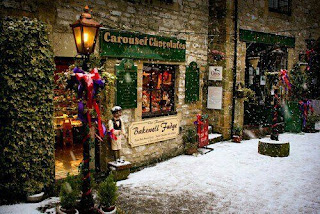

            Wednesday dawned wet and mild. Overnight, the temperature had inched up a few degrees, turning Long Barston's layer of snow to slush. Christmas shoppers on their lunch breaks scurried along the High Street under black umbrellas as a Salvation Army bell ringer brazened it out in the shelter of the Chinese take-away.

            The shop bell rang as Vivian Bunn bustled into The Cabinet of Curiosities. Raindrops ran in rivulets down the front window. She wrinkled her nose. The dampness outside intensified the musty smell of old wood and even older dust.

Ivor Tweedy stood at the sales counter, examining an ivory celluloid box. He looked up. "Located her in a shop in Bury. Lucky for you, the fellow was driving down to Sudbury this morning for a granddaughter's school Christmas pageant."

"Ivor, you're a miracle worker." Vivian peered at the angel nestled in wads of cotton wool. "Spitting image of the real one. A bit clean."

            Ivor winced. "Don't tell me you're going to bang her against the wall a few times or drag her through the mud. She's a valuable antique."           


"I'm not going to damage her, if that's what you're afraid of. Just tone down the white dress a bit. Maybe pluck a feather or two. Anyway," she rushed on before Ivor could protest, "all I have to do is tell Lady Barbara I found her—then have Francie get the ladder and install her at the top of the tree. Just in time for Christmas Eve." Vivian tucked the box into her tote bag and handed Ivor a check.

            "And you really believe Lady Barbara won't notice the difference?"

            "From twenty feet in the air? Not a chance."

            "Well, good luck."

            "Thanks, Ivor. You'll be there, of course, after the service."

            "Wouldn't miss it for the world."
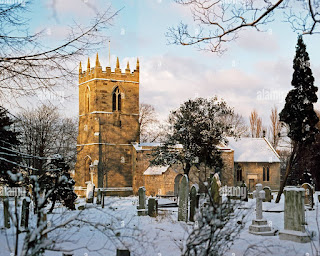
 

            The bells of St. Æthelric's were still pealing out Angels We Have Heard On High as Vivian,
Lady Barbara, and a line of villagers picked their way through the brick-walled Elizabethan garden and along the flagged pathway into the gravel courtyard of Finchley Hall.

The Nordmann fir had been hung with lights, giant silver balls, and sparkly flocked snowflakes. Candles gleamed in the Hall's mullioned windows. An enormous wreath hung on the oaken door, which was opened by Francie Jewell, looking uncharacteristically Dickensian in a trim black dress with a frilly white apron and cap.

"Welcome, lords and ladies." Francie grinned and a bobbed a curtsey. "Coats in the library, if you please. Refreshments in the Great Hall."

Vivian handed her olive raincoat to Francie and helped Lady Barbara out of her ancient silver fox jacket.


The Great Hall had never looked lovelier. Twin green velvet serpentine-back sofas flanked the roaring fire. Candles on the mantelpiece illuminated the Finchley coat of arms molded in plaster pargeting. A thousand fairy lights winked on the Christmas tree, set up near the full-length portrait of Sir Giles Finchley, who'd built the house in 1588.

"This is it, Viv." Lady Barbara squeezed her friend's hand. "The final Christmas."

"Not final, dear. Just different."

 "This time next year we'll have tourists lining up for hot chocolate and Christmas cakes in the Archives building. Did I mention they're thinking about turning it into a café and shop? And children visiting Father Christmas in the Stables."

"Will that be so bad?"

"Not at all." Lady Barbara smiled. "I'll enjoy watching the festivities—what I can see of them, anyway. But tonight everything is exactly as it should be—exactly as it always has been." Her eyes glistened. "Look at the tree, Viv. Just like the ones I remember as a child."

Vivian's eyes moved to the top of the tree. "The angel!"

"Yes," Lady Barbara said. "Isn't she perfect?"

A man in a plaid jumper took Lady Barbara's arm. "Come, say hello to my daughter and her kiddies," he said. "Visiting from Australia."

Vivian's eyes were glued to the top of the tree.

The fairy lights seemed to swim together. Her breath came in shallow puffs. She grabbed the edge of a Hepplewhite table. How could this be?

Ivor Tweedy took a sip of his eggnog. "I have to hand it to you, Vivian. You pulled it off. Congratulations."

"No, I—" She struggled to get the words out. "The angel. Look at the angel."

Even from a height of twenty feet, the cracked face and missing nose were clearly visible.

"But that's...it's...." Ivor's words trailed off.

"It's a miracle," Vivian said slowly. "A real Christmas miracle."

"I need my glasses."

"I need a drink." Vivian cleared her throat and headed for the bar set up in the entrance hall.

Ivor stood alone, contemplating friendship and love and miracles.

Lady Barbara threaded her hand through his arm. "Like the angel?" She raised one eyebrow. Her mouth twisted in a smile.

"You knew?"

"I'm not totally blind. And I'm not a complete fool."

"Where did you find her?"

"In an old shoebox—got shoved under the sofa somehow."


"Shall we tell her?"

Together they watched Vivian take a long swig of something amber-colored. She pulled a face and blew out a breath.

"No. Look at her." Lady Barbara leaned close and whispered in Ivor's ear.

"Why spoil the miracle?"

The End.

Thursday, August 25, 2022

Those Who Forget the Past by Connie Berry


A Journey Into Our Past

One of my favorite days this summer was a visit to Mount Vernon, George Washington’s home on the banks of the Potomac. My guide was Grace Topping, a good friend and fellow WWK blogger. I’d been in Alexandria for an author event, and since I had a late flight back to Ohio, I phoned Grace to see if we might have lunch and catch up. My last-minute thought turned into a memorable day.

I’d visited Mount Vernon as a child. My mother, a former elementary school teacher with a passion for history, made sure family vacations included lessons from the past—lots of them. We literally never passed a historical marker. Now, as an adult, I saw eighteenth-century America with new eyes.

Lessons From the Past

Washington’s decision to forfeit power and return to private life impressed me, as did the foresight of the Mount Vernon Ladies Association who, in 1860, purchased the near-decrepit house and opened it to the public. The day was beastly hot, and I pondered again how people lived without the comforts we take for granted—central heating, air conditioning, refrigeration, electricity, indoor plumbing. More than that, I thought about the many enslaved people whose job it was to make life as pleasant as possible for the Washington family while their own lives were considered unimportant—if they were considered at all.

With my mind very much on the past, we headed back to Grace’s car. On the way, we encountered a woman and a young boy, perhaps fourteen or fifteen, who were arriving for their visit. As we passed them, we heard the boy ask, “Does George Washington still live here?”

What?? 

Do we still teach history in our schools or had this boy simply not been paying attention?

Have We Forgotten Our Past?

“Those who fail to learn from history are doomed to repeat it.” The quote has been attributed to a number of people, including the Irish economist Edmund Burke, the Spanish philosopher George Santayana, and Winston Churchill. How do we reconcile that statement with Thomas Jefferson’s quote about history being written by the victors?

The lesson I learned at Mount Vernon is that history must tell the whole truth, the unvarnished truth, or it isn’t history.

Using the Past in Fiction

Which brings me to fiction-writing. A few years ago I wrote a blog with my top ten tips for creating memorable characters. I talked about creating fully realized characters with skills and  abilities, disabilities and struggles, strengths and weaknesses, fears, failings, and flaws. The characters we create should also have a past—a personal history some call “the rich, full life” with secrets, regrets, successes, failures, and families who have shaped them for better or for worse. Much of our characters’ past histories will never make it onto the page—authors know a lot more than they tell—but our characters’ past lives are what motivate and enrich their present actions, thoughts, feelings, and responses. Giving our characters a personal and cultural history puts their lives in context and helps us reveal their uniqueness as human beings.

We're Not Doomed to Repeat the Past--Neither Must We Forget It

What lessons from the past, personal or cultural, have shaped your life?

How have you used the history of a fictional character to add depth and complexity?