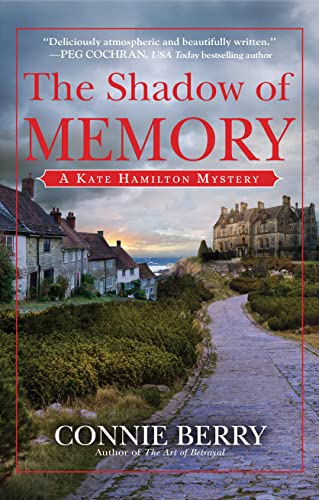
In Connie Berry’s
fourth Kate Hamilton mystery, American antiques dealer Kate Hamilton uncovers a
dark secret buried in Victorian England.
As Kate Hamilton plans her upcoming wedding to Detective Inspector Tom Mallory,
she is also assisting her colleague Ivor Tweedy with a project at the
Netherfield Sanatorium, a former Victorian insane asylum, which is being
converted into luxury townhouses. Kate and Ivor must appraise a
fifteenth-century painting and verify that its provenance is the Dutch master
Jan Van Eyck. But when retired criminal inspector Will Parker is found dead,
Kate learns that the halls of the sanatorium housed much more than priceless
art.
Kate is surprised to learn that Will had been the first boyfriend of her friend
Vivian Bunn, who hasn’t seen him in fifty-eight years. At a seaside holiday
camp in 1963, Will, Vivian, and three other
teens broke into an abandoned house where a doctor and his wife had died under
bizarre circumstances two years earlier. Now, when a second member of the
childhood gang dies unexpectedly—and then a third—it becomes clear that the
teens had discovered more in the house than they had realized.
Had Will returned to warn his old love? When Kate makes a shocking connection
between a sixty-year-old murder and the long-buried secrets of the sanatorium,
she suddenly understands that time is running out for Vivian—and anyone
connected to her.
Amazon.com
Although The Shadow of Memory was set in the
summer, I got a distinct chill while reading. While on holiday, bored teens participate
in a detective game of whodunit. Sixty years later, they are being murdered one
by one. Kate’s friend and landlord, Vivian, was one of those teens. It’s a
haunting tale that disturbs Vivian’s happy memories of her camp days and of her
long-lost first love. It also provides the basis for a great plot. I love how
authors bring together old and new mysteries into a single story.
This is Connie Berry’s
fourth Kate Hamilton mystery. The Shadow
of Memory was released on May 10th. You can read my interview
with Connie on her third book, The Art of
Betrayal, here.
Please welcome WWK
blogger and author Connie Berry. E. B. Davis
Would you humor us by telling a
Beowulf joke?
Only if you
insist! With a master’s degree in British history and literature, Kate realizes
that a) no one will get the jokes, and b) no one cares. You’ve been warned!
Q: How did Beowulf defeat Grendel?
A: He simply disarmed him.
Those familiar
with the eighth-century epic poem will get the punchline.
Kate seems skeptical and pessimistic
in this book. She has doubts about the authenticity/value of a Dutch medieval
painting that Ivor must appraise for no apparent reason. She wonders if anyone
would want to live in a former lunatic asylum, even if luxuriously renovated.
Having found the body of an elderly man, she re-visualizes the death of her
husband. What’s at the root of Kate’s pessimism?
Well, I didn’t
set out to portray Kate as pessimistic in this book, although she freely admits
that unlike her mother, who is always sure things will turn out well in the
end, Kate is always pretty sure they won’t. This stems from a history of losing
three very important men in her life without advance warning—her Down syndrome
brother, her father, and her husband.
What I did intend
was a sense of tension and uncertainty on Kate’s part. Her life is at a
crossroads. Is she willing to risk giving her heart again? Policing is a
dangerous occupation, after all. And while she is in love with Tom Mallory, the
question of where and how they will live as a married couple is undecided. They
both have families and careers—on separate continents. There’s also the problem
of Tom’s mother, who has done everything in her power to separate them. And on
top of everything else, Kate is aware that her dear friend Vivian’s life is in
danger.
What is the history of medical insurance in the UK? It was
once private, like ours here in the US. And then they socialized it. Did the
government buy all the private facilities? That sounds like a very expensive
proposition.
The National
Health Service in the UK was introduced in July of 1948. From that time,
all UK residents were given the right to access
health services offered by doctors, nurses, midwives, and dentists without
having to pay directly. It’s not free healthcare.
It’s shared healthcare, paid for by taxes. According to the original brochure: “Everyone - rich or poor, man,
woman or child - can use it or any part of it. There are no charges, except for
a few items. There are no insurance qualifications. But it is not a charity.
You are all paying for it, mainly as taxpayers, and it will relieve your money
worries in time of illness.”
There were health systems in
place before 1948, helping low-income people pay their medical expenses, but
after 1948, health care was nationalized. When my husband and I were in Northern
Ireland a few years ago, he developed a bad cough and was treated at the local
hospital. When he tried to pay, he wasn’t allowed.
The NHS didn’t buy all the
private health facilities. There are still private doctors and facilities in
the UK for those who can afford them. Some private facilities found they could
no longer compete with the NHS and went out of business. Others, like
Netherfield Sanatorium, gifted their assets to the nation.
Medical care in the UK isn’t as
rosy as it seems. Along with an aging population, there’s a shortage of doctors
and other medical workers, who are expected to work many hours for a very modest
wage. There are also long waiting lists for surgeries like hip and knee
replacements, which means those who can’t afford private care must wait and
those who can afford private care often elect to have their surgeries
elsewhere.
Tony Currie wears two hats that
could be in conflict. What is the relationship between the Cliff House Board of
Directors and Pyramid Development, the construction company renovating Cliff
House, otherwise known as the former insane asylum.
As Kate learns,
the renovation of Netherfield Sanatorium is an expensive proposition and not
without its risks. As a savvy real estate developer specializing in historic
renovation, Tony insisted that a group of local investors have skin in the
game. The board of directors of the Cliff House project all have a vested
interest in the success of the project, but the lion’s share of the risks (and
potential profits) are Currie’s.
Where did the Cliff House board get
the Jan Van Eyck painting?
The painting
attributed to the Dutch master Jan Van Eyck was purchased in the mid-nineteenth
century by the founder of Netherfield Sanatorium, self-styled doctor of
homeopathy and a purveyor of patent medicines. Horace Netherfield saw the
painting, “Christ Healing the Demoniac,” while traveling in France and
purchased it with the intention of making it the centerpiece of the asylum. He
was struck with the emotional power of the image and thought it would give hope
to those with mental illnesses.
Kate has a special sixth sense. When
an old artifact is the real deal, she knows it and gets an emotional vibe from
it. Kate’s lack of a reaction to the Van Eyck painting causes her to doubt its
authenticity. And yet, she does get a sense of treachery and danger. Doesn’t
that sense count toward her ability?
I suppose it does
count, but the impressions Kate gets—a feeling, a word, a phrase—never help her
solve crimes (there’s no paranormal activity going on), but these experiences
do alert her to the possibility that all is not as it seems. Kate chalks up her
“gift”—or as she sees it, her “affliction”—to her notoriously over-active
imagination. Since Kate has never been able to fully understand or explain this
sixth sense, I certainly can’t. I will say, though, that Kate suspects her
father had the same ability.
Provenance, attribution, technique,
signature, and scientific analysis are the elements that Ivor states that make
up an appraisal. Is this true or are there more?
These five
elements are the standard in authenticating fine paintings—at least they were.
Attribution, a matter of the appraiser’s experience and expertise, was
especially important. In today’s world, scientific analysis has taken the
forefront. A number of paintings attributed to well-known artists have recently
been proven to be forgeries. Sotheby’s, for example, sold a gorgeous “Frans
Hals” painting, “Portrait of a Man,” to an American collector for ten million
dollars. When subjected to scientific analysis, the painting was proven to be a
forgery. Sotheby’s reimbursed the purchaser. After a lengthy court battle, the
art gallery that sold the painting to Sotheby’s was forced to repay them more
than five million dollars. The very sophisticated forger is now thought to have
produced over twenty-five old masters, one of which, “Venus” by Lucas Cranach
the Elder, was owned by the Prince of Lichtenstein. There are probably others,
as yet undetected, in museums and private collections.
Why did Kate assume that Vivian was 80
years old? Although 74 or 75 isn’t that far off, does Vivian seem old fashioned
or physically old? Does Vivian need a knee replacement?
Eighty is the new
sixty—isn’t that what they say? People in their seventh and eighth decades of
life can appear much younger than their age or much older. Vivian Bunn is an
old-fashioned lady, which is probably why Kate assumed she was older than she
is. She’s been the stout, sturdy, bossy type that some in the UK call “Boadicea
in Tweed.” But in this book, Kate notices a slight unsteadiness in Vivian’s
gate, which makes her wonder if her friend is in need of a hip or knee
replacement. That remains unresolved.
Vivian makes Beef and Barley stew with brown bread and
Wensleydale Cheddar. This sounds like a winter meal to me. Isn’t it August?
Doesn’t swimming weather ever come to England?
Due to the Gulf
Stream, the climate in England is far more temperate than it is in the United
States, even though the British Isles sit at a higher latitude—which means the
winters are milder and the summers cooler than they are here. Brits think
nothing of wearing wool cardis and tweeds year round. The average temps in
Suffolk in late August/early September (the book ends on September 11) reach a
high of 65 degrees Fahrenheit and a low of 48. Yes, England can have very warm
periods as well, but they are the exception rather than the rule. The last really
big heat wave in Britain (2016) saw high temperatures reach more than 100
degrees Fahrenheit. Since few people have home air conditioning systems,
hundreds of people (mostly elderly) died.
Although Tom is agreeable to live
anywhere, he has essentially put the decision of where they will live on Kate.
He isn’t really being helpful, is he?
Tom is
head-over-heels for Kate—isn’t that nice?—and he truly wants her to be happy.
That’s why he is willing to move anywhere. Besides, he now has an offer to work
for an international private investigations firm operating out of Toronto,
Canada, which means he has a job no matter where they end up. But Tom worries
that without her antiques business in Jackson Falls, Ohio, Kate will feel like
a fish out of water. Actually, Kate’s motivation is to make Tom happy, too, so
they find it hard to come to a decision. Kate’s one non-negotiable—which she
hasn’t yet laid out in so many words—is that she will not live with his
mother in Tom’s farmhouse. The problem is, Tom’s mother, Liz, doesn’t have the
cash to buy a house of her own, and Tom would never put his mother out on the
street. Plus the farmhouse is where Tom’s daughter, Olivia, grew up. This
dilemma weighs upon Kate’s mind.
Why does Kate question if she is
suffering from pareidolia? And please define the term.
Pareidolia is the tendency to see recognizable images in
random patterns—like people who see human faces in the grilles of old
automobiles. Kate is good at noticing details and recognizing patterns. As she
is contemplating possible connections between Netherfield Sanatorium and the
abandoned house explored by the teens in 1963, she wonders if she is imagining
the patterns—"like people who see the image of the Virgin Mary in a
grilled cheese sandwich.” Scientists say we are primed to see faces in the
natural world. Is there really a pattern in those long-ago events, or has Kate
imagined one because she wants there to be a connection?
What is with the AE in Æthelric?
The letter Æ is a dipthong, introduced into Britain by
Norse settlers during the Anglo-Saxon period, three centuries before the Norman
Invasion. It was used in Old English to represent a vowel that’s pronounced in
Modern English as aah (ash, fan,
happy). Today we mostly just spell that vowel with the letter “a”
because of the Great Vowel Shift. The Great Vowel Shift was a change in the
pronunciation of English vowels that took place in the late Middle English
period—think roughly Chaucer to Shakespeare. This shift, which coincided with
the introduction of the printing press, had a profound effect on English
phonology—the way the English language is actually spoken. Why did it happen?
Scholars have theories, but no one really knows.
What is treacle bread?
Treacle bread is
a dense, brown bread made with coarse, wholegrain flour and unsulfured
molasses. It’s a country loaf, easy to make—even for me! Martha Stewart has a
wonderful and very simple recipe, which you can find here: Treacle Brown Bread Recipe | Martha Stewart
Why were the Victorians crazy for
taxidermy? I remember my grandmother having a mink stole that closed using the
paw/claws as hooks—very creepy!
I remember the
same thing and felt so sorry for the little animal. But the Victorians took
taxidermy to ridiculous extremes. In their passion for natural history and
whimsical fantasies, they collected anthropomorphic tableaux set in
glass—animals posed in human-like situations: hedgehogs ice-skating, kittens at
a tea party, foxes teaching a class of bunnies. Victorian women perched
stuffed birds and small animals on their hats. Death was an ever-present
reality in the nineteenth century, and in addition to taxidermy, Victorians cut
hair from the corpses of their loved ones and wove it into jewelry. They also
frequently had photographs taken with dead relatives before burial, propped up
with wooden frames or other family members.
Why doesn’t Tom’s mother like
Americans?
That’s a good
question—one which Tom has never adequately explained. My theory is that Liz
Mallory enjoyed her relationship with Tom’s dead wife, Sarah, because Sarah was
malleable and easily handled. And, of course, after Sarah’s death, Liz moved in
to take care of their daughter, Olivia. Slowly, she began to think of the
household as her own. Kate represents a threat because she is definitely her
own person—and now the most important person in Tom’s life. Liz also fears that
Kate will talk Tom into moving to the U.S.
Is Tom from an aristocratic family?
Who is Uncle Nigel? What happened to Tom’s father?
Tom’s background
has been a bit of a mystery to Kate. When they met in the Scottish Hebrides, he
told Kate he spent his summers with his Uncle Nigel Hartley in Devon—“summer
camp in a castle.” When she questioned him further, Tom said the house merely
looked like a castle to him as a small boy. Later he told Kate that Uncle Nigel
paid his fees when he went up to Oxford.
But there’s been an
estrangement in the family. Nigel disapproved of Tom’s mother’s marriage to
Tom’s father—on solid grounds as it turned out, since Tom’s father was after what
he hoped would be her fortune. Liz was so incensed at her brother’s
interference that she cut off all ties with him and refused to take a penny for
herself. With his hopes of wealth dashed, Tom’s father had an affair and
abandoned the family. He is now dead. To date, Kate has not met Nigel or visited
his estate, Fouroaks.
What’s the story on the ring Tom
gave to Kate for their engagement?
The ring is a
family heirloom. The center stone, a square Assher-cut diamond, was purchased
by Tom’s great-great-grandfather Hartley in South Africa in the 1880s. In 1921,
his son (Tom’s great-grandfather) had it set into a ring for his bride. It’s
been passed down to each generation. Since Uncle Nigel could never settle on
just one girl, the ring now belongs to Tom.
What is dendrochronology? Infrared
reflectography? Craquelure? Mass spectrometry?
These terms are
all part of the scientific process of examining old paintings.
·
Dendrochronology is the process of examining tree rings in old
wood to accurately pinpoint the date when the tree was felled. It’s remarkably
specific. Since many old masters were painted on wooden planks, dating the wood
helps date the painting.
· Infrared Reflectography is a non-destructive imaging technique that detects
the presence of specific pigments in a painting. The process can also reveal what lies beneath the
surface of a painting—underdrawings, for example, or pedimenti, the
revisions an artist might make during the process of creation.
· Craquelure refers
to the natural pattern of cracks that develop in the paint or varnish of a
painting over time. This is a great way to detect a forgery because natural
craquelure is almost impossible to reproduce, although there are some
techniques involving formaldehyde and a special baking process that produce
results that appear genuine to all but a trained eye.
· Mass Spectrometry is so complicated that describing it is definitely
beyond my mental ability. I can tell you that, among other things, the process
can isolate tiny amounts of the radioactive isotopes unleashed across the globe
after 1945. If these isotopes are found in a painting that is said to have been
painted in the sixteenth century (or even the nineteenth century), that
painting is forgery.
Is it true that at the turn of the
nineteenth century, people wore small portraits of their lover’s eyes?
Courtesy of the Smithsonian Museum
Absolutely true. The
fad started in 1785 when England’s Prince George (later King George IV) sent a
tiny portrait of his eye to Maria Anne Fitzherbert, the Catholic widow with
whom he’d fallen in love and was trying desperately to marry. According to
English law at the time, such a marriage was not allowed, and although the
couple actually did marry in a secret ceremony, the wedding was declared
invalid. George later married his cousin, Caroline of Brunswick. Anyway, for
the next fifty years or so, Lover’s Eyes were a fad. Lovers would exchange portraits of their eyes,
painted on bits of ivory no bigger than a fingernail and set into gold frames,
sometimes surrounded by precious gems or pearls, and tucked close to the heart
or worn openly for all the world to see. Both men and women wore them, with the
identity of the subject a mystery. All part of the fun.
Does Ivor know hypnotism?
Ivor knows all sorts
of amazing things from his travels around the globe with the Merchant Marine.
While in northern Mongolia, he learned a technique, akin to hypnosis, to take
someone back to a previous time through recovered memory. Since Vivian’s life
depends upon her memory of what she and the other young teens found in the
abandoned house fifty-eight years earlier, Ivor takes her back to that place
and time so she can mentally relive the experience. Remember, this is fiction.
What’s next for Kate?
It appears Kate is
heading for a wedding, but we’ll have to wait for the next book to find out.
You never know!