Showing posts with label writing research. Show all posts

Monday, July 22, 2019

A Writer's Peril by Nancy L. Eady

I have a problem – I need to kill someone. I not only need to kill someone, but I must do it in a very specific way. The murder must be done with poison via something dissolvable in liquid and administered via the route of getting hair colored at the salon. I have been casting around in my mind for various options, and nicotine is a possible solution to the problem. Of course, before I can select nicotine as the instrument of choice, I will have to confirm that it is 1) dissolvable, 2) hard (but not impossible) to detect and 3) uncommon. I also need to be sure that enough of the darn stuff can get into a human body to cause death if done via hair coloring, and that it will not travel through latex or rubber gloves.

Fortunately, the person I must kill is fictional, and truth be told, it’s not really me that’s going to do the killing but a yet-to-be named woman who is the sister of the deceased woman whose husband then married, horror of horrors, a younger woman. The husband is going to bite the dust first, though, through the manipulation of his heart medicine into a dose stronger than needed. I’m still working through the what, why and how to’s of that one, as well.

As most of the American population these days, my chief resource tool is my computer, particularly Google. It wouldn’t bother me except for my vague suspicion that someone somewhere is monitoring every question I throw out to Google. A large number of queries about nicotine poisoning might raise a few eyebrows at any surveilling government agency. And heaven help me if anyone I know suddenly drops dead from nicotine poisoning!  How hard will that be to explain to any investigating authorities? 

I know for a fact that Google at least monitors my activity, because the ads I receive on various web sites are related to things I have already researched. Which is the other problem with a cluster of questions around one specific topic. I don’t want to receive a jillion advertisements about poisons, cigarettes or vapes as a result of my research. I’m not interested in buying any of them. On the other hand, if all the ads I see are for things I don’t want to buy, I should save a lot of money. I guess it’s time to check my bank balance and see how much I need to save! 

This problem is not one I anticipated having when I decided to write mysteries. What unexpected problems have you encountered in either your professions or your hobbies? 

Sunday, October 29, 2017

From Print to Web to Social Media: Discovering New Research Resources


by Julie Tollefson

As a reformed journalist (four years as a copy editor for a daily newspaper before I jumped ship—first to business and then to higher education), I have a soft spot in my heart for good journalism. And my love is strong for work that seriously examines the stories, challenges, and triumphs of the people in my part of the world, the largely rural central United States.

Great journalism that also informs and strengthens my fiction writing? Score!

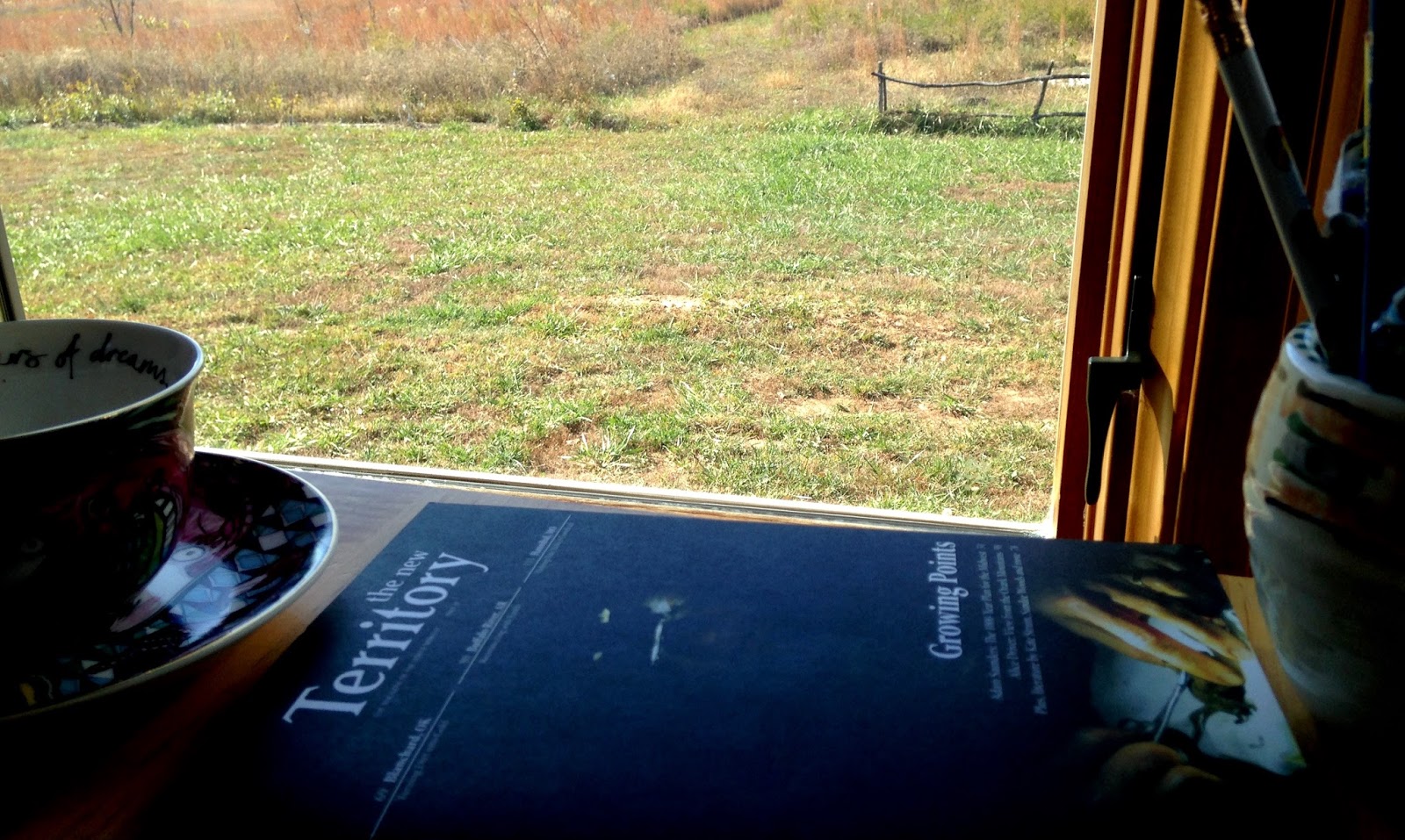
A couple of years ago, The New Territory, a magazine with a mission to “cultivate connections among the land, people and possibilities of the Lower Midwest,” launched.

It’s a beautiful magazine, published quarterly and filled with personal essays, photography, fiction, poetry, art, and the kind of quality journalism that takes a deep dive into important issues. Its focus may be Kansas, Oklahoma, Nebraska, Arkansas, and Missouri, but the stories have significance beyond their borders. Conservation. Transportation. Health care.

Its insightful articles are also a terrific resource for my fiction, most of which is set in small towns in what some people deride as flyover country.

This past week, The New Territory’s role as one of my writing resources took a new turn when it hosted a Facebook Live event with Michael Noll, whose short story “The Dependents” appeared in the magazine’s second issue. (“The Dependents” is this month’s free story of the month on The New Territory website.) For forty minutes or so, Noll gave a mini-class in fiction writing, character development, and place as an integral story ingredient. If you have time to spare, especially if you’re a writer, check out the October 25 video on the magazine’s Facebook page.

Because of that Facebook Live event, I visited Noll’s website, Read to Write Stories, and found a treasure trove of writing resources: an extensive collection of author interviews and writing exercises—in categories such as Exercises to Help Find a Premise and Exercises for Structure—based on excerpts of published essays, novels, and more. The interviews I’ve read so far have been enlightening, and I’ve bookmarked the site for the future.

My younger self, from the pre-Internet era, would be overwhelmed by the sheer volume, diversity, and availability of resources for writers today. The ones described here—from traditional print journalism to websites to social media—represent just a tiny slice. As a writer, what are your favorite resources for research or honing your craft?

As a reader, what are your favorites for learning about writers or books you might be interested in?

Saturday, October 29, 2016

Seneca Village in Central Park by Kait Carson


Part of my growing up years were spent near New York City. My parents, both native New Yorkers, thought knowing the joys of the city was vital to their child’s formative years.

I should preface this by saying I was a late child. My closest sibling is nine years my elder. I was also the only girl. By definition in the fifties and sixties, I was Daddy’s girl. It was my father who undertook my NYC education. We made trips to the Metropolitan Opera twice a year, Radio City Music Hall for the Christmas show, the Statue of Liberty (climbed those steps a million times it seemed), the observation tower of the Empire State Building, the Museum of Natural History, the Hayden Planetarium, Carnegie Hall for a concert, and the Bryant Library (the one fronting Bryant Park with the lions). We also attended the Macy’s Thanksgiving Day Parade, the Christmas Tree lighting at Rockefeller Center, skated in the Rockefeller Center rink and the Wolman Rink in Central Park, and rambled through the park. So many visits to the Park that I had a personal acquaintance with Balto, the statue dedicated to the dog who carried the diphtheria antitoxin from Anchorage to Nome, and climbed the Alice in Wonderland statue annually until I was nine.

Had you asked me I would have told you I knew everything about Central Park. That it was designed by Fredrick Law Olmstead and Calvert Vaux. That it was entirely constructed in the center of the city from land that had been farms and a few small settlements in the 1850s. That Olmstead and Vaux were chosen because their vision was to populate the park with native plant species. A very advanced ecological view at the time. That nearly every park feature was manmade including the waterfalls. That there is only one straight walkway in the park, the Mall. That the carousel had golden rings and if you caught one, you got a free ride. Wonder if it still has the rings.

Yep, a lot to know. I also knew that unless you were going to Tavern on the Green, you did not go into the park at night. That the park was deteriorating and was a high crime area. That didn’t stop us from skating there—the Wolman Rink is on the periphery. Nor did it stop the youth of New York City from invading the park on March 7, 1970, the day of the full solar eclipse. We gathered in Central Park near the Sheep Meadow. There’s a large rock there. We proved our trust in people under 30 by diving off the rock and expecting to be caught by our fellow compatriots.

But what I didn’t know proved to be very interesting. Recently I saw a book on the Barnes & Noble discount shelf. Death Angel by Linda Fairstein. The cover featured a depiction of the Bethesda Angel, also called the Angel of the Waters who overlooks the Lake in Central Park. I scooped the book up expecting to visit again so many of the sites of my childhood--although in a cleaner, safer park than I knew in my youth.

Have you ever heard of Seneca Village? I never had. Seneca Village was an African-American settlement sacrificed to the building of the park. Now, don’t misunderstand, villages and farms dotted the park and all were lost to eminent domain when the park became a legislated reality. Seneca Village was not singled out. But it was unique.

Founded in 1825, Seneca Village was arguably the largest settlement of free African-Americans in the US and definitely the largest in New York City with residents (African-American, German, and Irish) numbering approximately 264 in 1857 when the property was purchased by city.  In addition to numerous houses, there were three churches and a vibrant village. It is believed that half of the residents of Seneca Village had the vote, which required owning property valued at $250. Residences in the Village ranged from shanty structures to property worth $4,000. I have no idea what that translates into in 2016 dollars, but I’m betting it’s a bucket. When the land was taken in 1857 the residents of Seneca Village were displaced and never again united in a community. What a sad commentary.

In 2011, Columbia University, my father’s alma mater, began the controlled excavation of Seneca Village. Among the relics found, were pottery shards and relics of the people who lived in the village long buried beneath the green fields of the park. These discoveries form part of the premise for the story of Death Angel.

Without Linda Fairstein’s book, I would never have learned of Seneca Village. Have you ever read a work of fiction that made you investigate further? What did you learn?

Saturday, March 5, 2016

Moving Beyond The Research: A guest blog by Clea Simon

One of the great joys of writing fiction is the freedom to create. We invent characters and then build the worlds for them to inhabit. We throw them into impossible situations, and then we find a wormhole for them to crawl out of. Unlike journalists or other nonfiction writers, we get to simply make stuff up.

However, to give our characters and their worlds verisimilitude, we have to do our research. For while we are spinning tales, we want them to be believed. We need them to be believable. That means if you place your hero in a real city, you can’t have him skip from one part of town to another in an unrealistic time frame. If you kill someone with a particular poison, you should make her final agonies realistic – and that means knowing just what spasms (or whatever) that particular alkali would provoke.

In crime fiction, particularly, we have to know how to kill people. We have to know our guns (if we use them) and our poisons (ditto). Few things will turn readers against a mystery writer than a mistake in something that is more or less easily checkable. And that’s as it should be. Fiction works when the reader can believe in it, when the reader can suspend disbelief and hand over her or his trust to the writer.

That doesn’t mean that we are bound by the physical world, or by the results of our research. If anything, research best serves as a starting point to show us processes – how things work. Once we understand those step-by-step processes, then it is often incumbent on us to move beyond research and reality. And that’s where the fun comes in.

In other words, no matter how fanciful our characters, we have to ground them in reality – of a sort. Does your heroine turn into a butterfly? At least have a working knowledge of pupae and metamorphosis.

This is of interest to me, because I write books with cats in them, and the cats have certain capabilities. In my new book, The Ninth Life, the feline narrator observes things that his human counterpart doesn’t. Of course, I based this on what I know of cats – of their superior senses of smell and hearing, of the way they can read the air. (I have written one nonfiction book and numerous articles on cats.) If I want readers to believe in Blackie, my sentient cat, I needed to make him, first, a believable cat.

This holds true even for smaller details: I have a drug, which I’ve called “scat,” in the book. I liked the play on the cat term – and also the term for animal dung – and modeled both its effects, manufacture, and usage on several drugs: crack cocaine and methamphetamine. It is neither, and, really, it’s a small part of the book. But when Blackie’s sensitive nose shrinks back at an acrid burning smell, I want that smell to be right.  Because my readers are not cats, and they are probably not addicted to drugs. But for a moment, I want them to believe they could be. I want to have gotten it right.

Simon is the Boston Globe-bestselling author of 19 traditional/cozy mysteries in the Theda Krakow, Dulcie Schwartz, and Pru Marlowe pet noir series, most recently Code Grey (Severn House) and When Bunnies Go Bad (Poisoned Pen). In March, her 20th mystery, The Ninth Life (Severn), launched the Blackie and Care series. A former journalist, Clea lives in Massachusetts. Although her books are getting darker, they still always include a cat. She’s not sure why. www.CleaSimon.com


Sunday, August 30, 2015

Shoot? Don’t Shoot?

Last week I attended Writers' Police Academy sponsored, in part, by the Sisters in Crime. This year it was at a wonderful facility outside Appleton, Wisconsin. That’s less than a four-hour drive for us (right around the block in Yooper terms), so Jan and I both attended.

I was lucky enough to sign up for several special small-group classes. Crime Scene photography was excellent; it helped me understand how those folks actually work a scene using digital photography. I won a lottery and participated in a “Simunitions” exercise in which three of us attempted to extract an armed person for whom we had a warrant from a house. We were not sure if other people, including a baby, might still be in the house.

The class I want to discuss today is called MILO, an extremely realistic interactive training program.

For fifteen minutes two of us worked with an instructor and the MILO simulator. The instructor first provided a refresher on the basics of handgun control (both of us had experience shooting handguns). Next we discussed when it is appropriate for a police officer to fire his/her weapon: the key being that an officer should not shoot until feeling endangered.

The two of us took turns with the simulations. The first simulation had an angry man brandishing a knife. In scenario one he was (I think) thirty-one feet away. Was I endangered? No. I had plenty of time to shoot before he could run at me with the knife. When he did finally run, I shot. Because he kept moving, I kept shooting until the guy went down.

Lesson one: keep shooting until danger is removed.

I repeated the knife-wielding man scenarios with the guy at twenty-one feet and eleven feet. At eleven feet there is very little time between the man making a threatening move and the necessity of shooting. Very little time.

I managed those three scenarios successfully. The other student waited too long in the eleven-foot scene and was “killed.”

A little cop humor
We did several other scenarios. In all cases I correctly chose when to shoot. However, I did die in one scenario. I responded to a bank robbery by an armed man. He exited the bank, money in one hand, gun in the other. I made the correct decision of when to shoot, but then I made a rookie error. I developed tunnel vision, focusing on the downed gunman because he might not be dead and he still had the gun in his hand.

I missed seeing a car parked at the curb with the getaway driver. The screen went red when that person got off several shots before I located the problem and fired back.

Our last scenario involved both students. We were in a two-person patrol car and had made a traffic stop of an erratically-driven car. Out pops a guy pointing a gun at his head, threatening to blow his head off if we come nearer. Then he starts taunting us to shoot him. This was possibly a suicide-by-cop situation. We’re yelling at the guy to drop his gun and stay by his car. Eventually, he started moving toward us, still waving the gun more or less at his head.

Shoot? Don’t shoot?

He’s still coming toward us, waving the gun more or less at his head.

Shoot? Don’t shoot?

The waving gun is now pointed less frequently directly at his head, the gestures become loopier.

Shoot? Don’t shoot?

Crime scene photography
Both of us made the wrong decision. My partner never shot. Once the gunman reached the back bumper of his car (the line I had mentally drawn in the sand), I fired a shot into the dirt and when he kept coming, I shot his leg. According to the instructor, given the gunman was not following directions and was waving the gun around (and could easily change one of those loops into a shot at us), I had chosen the correct time to fire. However, I should have aimed for the center mass. Police officers do not shoot for extremities (or shoot the weapon out of the person’s hand). They are trained to focus on the chest through head area.

One thing the two of us didn’t do in that exercise, which many students do and which also happens a lot in real life is fire solely because the other person fires. It’s a tension-induced reflex. Combined with training to keep shooting until the opponent is no longer a threat, this reaction is often responsible for the massive number of bullets fired in some shootouts.

The exercise provided me with insight into police shootings I would never have gotten from television and printed news. Sometime it may even make it into a story.


~ Jim

Thursday, October 24, 2013

Accidental Research Helps a Plot


Rosemary Krupar, a third grade teacher I taught with who has remained a friend, asked me if I’d like to go on a field trip on a day when there was no school. She’d set up three local stops with Matt Sorrick, a professor of science education from Hiram College who would lead and instruct the students in the world that exists in nature. Well, I didn’t have the time to give up a whole day, but I was too tempted by what seemed like a fun day to refuse her offer.

So last Friday we met in the school parking lot. Rosemary was there when I arrived as well as one student. Soon six more students came along with one father, who took the day off to experience this with his daughter, and Matt pulled up in the college van.  Everyone piled into the van while I followed in my car since the last stop was only about five miles from my home.

Our first stop was at the Monroe Orchard and Farm Market. It was far more interesting than I’d thought it would be. Sue Monroe told us everything we could possibly want to know about running a large orchard of fruit trees – 27 varieties of apples alone, as well as peaches, cherries and pears. They also grow raspberries and strawberries and have a large field of pumpkins, and they make maple syrup during maple syrup season. She gave us some of the history of the farm which has been in her husband’s family since 1938, but it was much older than that.

After we walked around a bit in the orchards we went inside through their selling area with so many delicious things to choose from. From there we entered the area where the apples are sorted and cleaned. Her daughter Amanda was working there. Amanda and her sister were former students of mine. She got a degree in botany and is now working in the family business in that capacity as well as doing other things that needed done. Apples were in a machine being washed with water. When they came out they bounced down rollers until they got on a big circular drum like table with a felt top where they were again jostled about as they dried. 

Amanda picked each one up, inspected it for any defects and then only if it was perfect, did she put it in a plastic bag for sale. Any blemished apples were relegated to a separate container for cider.  To make the best cider, I learned, there should be at least four different kinds of apples. Using only one variety makes a cider that isn’t as tasty. From there we went into a large insulated room filled with huge crates of apples going up to the ceiling. Those had to be put in place by fork lifts. The next room had tall shelves filled with bagged apples ready for sale. Our next stop was a working area where we were each given a fresh, crunchy, juicy apple to eat and a small cup of cider while Sue Monroe answered any questions the students or adults had. Before we left, we went outside and up a large embankment to the doors the barn we’d been in that’s more than a century old. There we saw that it was jam-packed full of wooden crates they make in the winter months.


Our next stop was the Hiram Biology Field Lab where we looked at snakes, toads, frogs, fish and salamanders before our lunch. 

After eating we explored the woods looking at various things Matt  pointed out. The kids hunted for and found numerous salamanders. Matt instructed them on how to handle them carefully, identify the type, and to return them to the place where they were found as well as replacing any log turned over to its original position since under each log is a mini habitat.
Our final stop was Nelson Ledges State Park with large rocks, crevices, cliffs, a waterfall, and narrow tunnels between huge rocks; a fun, but very dangerous place for kids who don’t listen and insist on climbing and running. Matt told us the geology of the rocks brought down by the huge glaciers and what in many places caused a split between what was once a single huge rock formation into two separate ones.

Our seven students were actively involved and interested, but kept the four adults on their toes as we moved on from place to place. I think I was a little more nervous than the other three because one of my former students fell to his death there when he was a fifteen year old Boy Scout on a hike with his troop. His father was the Boy Scout leader. There have also been a lot of other accidental deaths and serious injuries from falls there over the years.


It was a good day. The weather was cool, but sunny. I got my kid fix, and they were good even though they were dashing around like playful puppies everywhere we went. The adults were pleasant companions and the young father and I really hit it off getting acquainted. He was also kind enough to help me across rocks as we crossed back and forth across the stream at the field station and also around and over rocks blocking paths at the ledges. One narrow crevice we went through ended in a rock too high for me to step up on so Matt gave me a hand there. The kids just shimmied up. We’d had a lot of rain the previous week making the rocks and leaves on the ground slippery in places so I moved carefully.


So what part of this fun day is going to be used in a book? I doubt if Nelson Ledges will be or the Hiram Biology Field Station, at least for now. In book five “Murder in the Corn Maze” which has no plot yet. I am going to use what I’ve learned about running a huge orchard business. It’s the right time of year; they’re busy, and I know where to go when I need more questions answered. Next week I’m also planning on going to a corn maze for the first time for more research for that book.

What fun things have you done that ended up being in a book or short story?

Or if you’re not a writer, what have you done that you think would work well in a plot?