Showing posts with label SinC Guppy Anthology. Show all posts

Monday, February 10, 2025

What's On Your TBR? by Shari Randall


 Yes, I've been a bit quiet lately. As my younger daughter says, life has gotten a bit "lifey." But it's in these "lifey" times that it's wonderful to escape into a good book. Tonight I'll be diving into Louise Penny's The Gray Wolf and I'm looking forward to getting my copy of the eighth Guppy anthology: Gone Fishin' Crime Takes a Holiday.

What's on your bedside table tonight?

Saturday, January 28, 2023

The Feast after the Famine by Kait Carson

It’s been a long time since I’ve seen my name attached to anything beyond blog posts. So long that I was beginning to wonder if I was a writer or a wannabe. Scary thought, that. I mean, if I wasn’t a writer who was I? Don’t answer. That’s exactly what I was afraid of. So, I am pleased and grateful to announce that good news on the publication front is afoot. January and February bring a bumper crop of publications and some of these efforts come with a learning curve.


Death by Blue Water, a novel originally released by Henery Press, is re-released in Kindle form on Amazon. My rights reverted in 2019 and I dithered mightily over the next step. Would anyone care about a previously published novel? The fact is, I cared, and while the first two books of the series were previously published, there is a third book that wasn’t. Decision made. The book released on January 24th. I needed to learn formatting, I was fortunate to have Polly Iyer design my cover, and I decided that unless it sells well, I’m leaving it as a Kindle.


Being my own publisher was new territory. To compensate for my learning curve, I put the book on pre-order to give me the opportunity to correct any missteps. I wouldn’t do that again with a re-release, but I will with new material. I have also been careful to specify that the book is a re-release. Anything else feels dishonest to me. Now that it’s out there, I’m eager to flex my publishing muscles with the next one. There has been one nice surprise – copies of my backlist are also selling. I hadn’t expected a cross-series effect.


Yesterday the Seventh Guppy Anthology Hook, Line, and Sinker released. I was Guppy president when the first anthology was in the planning stages, so there is a lovely symmetry to the publication. This is the first time I’ve written a story for consideration in the Guppy anthologies, and the acceptance of my story, “Gutted, Filleted, and Fried”, thrilled me. The anthology topic is cons and their marks. It was delicious to write a tale where no one dies and deceit rules.


I’d like to give a shout out to blog members Susan Van Kirk, Debra Goldstein, and Jim Jackson for all they did to bring this anthology to life, and for keeping me, and twenty-two other writers, in line and on task! Let me not omit deepest thanks to non-blog members Carol L. Wright, who worked with Debra herding the writer cats, and of course, Emily P.W. Murphy for her stellar editing and cover design.


Our serial story, Broken Hearted Killers, a gift to Writers Who Kill readers, will premiere on February 1st and run through the 18th. This was such a fun project. I’d never been involved in a multi-author serial story before. Watching the story evolve week by week was a hoot and an education. When my turn came, I was paralyzed with fear that I wouldn’t live up to the high-quality writing that went before. In the end, I took my courage in both hands and decided to just have fun. I’m hoping our readers will agree it works.


The month will round out with publication of Chicken Soup for the Soul: Lessons Learned from my Cat. It’s no secret I’m a cat lover. My story, “Blood is Thicker than Water”, recounts a 2012 Thanksgiving week night when someone dumped two kittens and a mama cat in my yard. Catching kittens is like winning a greased pig contest. They’re fast and wily. If Cub hadn’t been so protective of his littermate Piper, the story would have ended differently. Piper and Cub, the kittens, and Jenny the mama all found their furever home that night. Cub is on my desk as I write this.


It's been quite a busy two months after a long, fallow, period. I hope to do it again soon.


Writers and readers, how has the start of 2023 been for you?

Tuesday, January 17, 2023

The Guppy Anthology Legacy

by Paula Gail Benson

Today’s message builds on yesterday’s post by Debra H. Goldstein. The anthologies organized and published by the online Guppy Chapter of Sisters in Crime have had a wonderful and pervasive influence not only in nurturing both new and established authors, but also in encouraging more people to read and try their hands at the craft of short stories. The recently released Hook, Line, and Sinker is the seventh in the series and features twenty-three stories, including three by Writers Who Kill (WWK) partners Kait Carson, Mary Dutta, and KM Rockwood. In addition to Debra H. Goldstein’s (along with Carol L. Wright’s) work in organizing the endeavor, Guppy President Susan Van Kirk’s writing the introduction, and James M. Jackson’s Wolf’s Echo Press being the publisher, WWK partners can claim some serious bragging rights in this volume.

Looking at the history of series titles, the members who wrote the introductions, and the editors who worked with the authors to make the stories exceptional, one realizes the great scope of talent that has gone into producing these anthologies.


 Here’s the list:

Fish Tales (2011), introduced by Chris Roerdan and edited by Ramona DeFelice Long

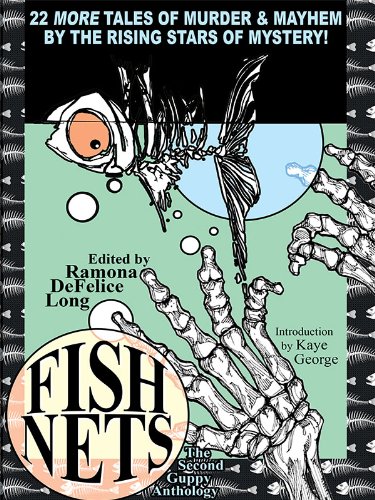
Fish Nets (2013), introduced by Kaye George and edited by Ramona DeFelice Long

Fish or Cut Bait (2015), introduced by Michelle Drier and edited by Ramona DeFelice Long

Fish Out of Water (2017), introduced by James M. Jackson and edited by Ramona DeFelice Long

Fishy Business (2019), introduced by Debra H. Goldstein and edited by Linda Rodriguez

The Fish That Got Away (2021), introduced by Susan Van Kirk and edited by Linda Rodriguez

Hook, Line, and Sinker (2023), introduced by Susan Van Kirk and edited by Emily P.W. Murphy

Check out the contents of these volumes and you’ll find familiar names: authors who have written successful mystery series, received awards, and served in distinguished capacities among numerous writing organizations. Many have credited being in the Guppy Chapter as a motivating experience. Thankfully, many also remain as Guppies and are generous in offering advice and information to other members.

My story, “The Train Is On The Tracks,” appears in Fish or Cut Bait. While it was not my first published story, it represented a unique opportunity in many respects.

First, we received feedback from the anonymous judges who made the selections. For that volume, there were three judges: one very complimentary, one very negative, and one right in the middle. Because my story was loosely based on an incident that happened at my work, I found it amusing that the negative judge criticized it as something that could never happen.

Second, we had the extreme good fortune to work with a talented and caring editor. Ramona DeFelice Long truly put her heart into our volume. She spent a great deal of time with each of us. Georgia Ruth’s story, the first in the anthology, later was included in a best mysteries of the year. Later, I worked privately with Ramona on several stories and will treasure her wise advice and counsel. I know from being a WWK partner of Linda Rodriguez what a fine writer and editor she is. I’m very impressed that Emily P.W. Murphy not only edited but also designed the cover for Hook, Line, and Sinker.

Why not start your new year right by reading a short story a day? Here’s the group of authors you’ll find in Hook, Line, and Sinker:

C.N. Bucholtz, Lida Bushloper, Susan Daly, Steve Shrott, Kait Carson, Judith Carlough, Sandra Benson, Sally Milliken, Wrona Gall, M.R. Dimond, Mary Dutta, Kim Keeline, Sharon Taft, Merrilee Robson, Lisa Ann Rothstein, KM Rockwood, Frances Stratford, Jane Limprecht, Vinnie Hansen, Ann Michelle Harris, A.W. Powers, Kate Fellowes, and M.A. Monnin


Wednesday, September 22, 2021

The Fish That Got Away Anthology Authors by E. B. Davis

When this anthology interview ran, we had no ePub to promote--now we have one. Here is the link: The Fish That Got Away. Please consider adding this anthology to your library. 

The Fish That Got Away is the sixth anthology of Sisters in Crime’s Guppy Chapter. Sisters in Crime promotes women crime writers. The Guppy chapter originally was formed for those great but unpublished writers, helping to get them published. For inclusion in the anthologies, like in the marketplace, unpublished authors must compete against each other and published authors for their stories to be included. Their stories must meet the standards. The judging was blind, but had to be stand outs from the other entries. The competition is stiff. Susan Bickford, one the authors, not only has been published multiple times, but she has also been nominated for an Edgar and Left Coast Crime Awards.


I decided to ask each author one question about his/her story. WWK’s Linda Rodriquez served as the professional editor. Please welcome the authors of The Fish That Got Away too WWK.                                                                              E. B. Davis                                        


The Fish That Got Away Editor Linda Rodriguez


Does the organization for which you work set the parameters of your relationship with the authors?


Yes, the Guppies did set parameters for the relationship between editor and writers. I worked directly with each writer on their story for the book. We had direct back and forth virtual conversations around their work and ways to make it stronger. Guppies, however, set firm boundaries in place for writers who had problems with the anthology as a whole and its publication process. They had a coordinator to whom writers were directed to turn with these issues. The only things the writers and I dealt with directly were aspects of their actual writing--style, characterization, plot, pacing, and various kinds of line and copy edits. I really appreciated this, since the bulk of my responsibility was to strengthen each writer's work to make it part of a stronger whole. Any complaints about anything else, I simply directed to the coordinator, who handled them brilliantly. That is the ideal situation for an editor of an anthology.


“To Every Season” by Mary Adler


Do two wrongs make a right?


Are there two wrongs in the story To Every Season? I would argue that there was only one wrong––the continuing series of murders and acts of cruelty committed by an evil actor who flaunted their crimes and made it clear they would not stop killing. The other actor committed an act in defense of others, one that in their view (and mine) was justified. They did not act in revenge, but to prevent further harm. We can quibble about the lack of imminent danger that a self-defense claim might require in court, but the facts in the story show that the perpetrator was guilty and would continue their sadistic crimes if someone did not stop them. 


“Black On Black In Black” by MB Dabney


What profile would Kendall have concocted for the killer? 


Kendall originally had two options in mind when the crime spree began. The first was an obvious one.


The killer is a man with issues involving around a woman who has injured him. Or at least he feels injured in his mind. In this case, the woman is his mother.


Growing up he watched his mother violate her wedding vows repeatedly with other married men, leaving both her son and her husband powerless to do anything about it. While the son loved his mother and wouldn't harm her, he is killing the demons in her over and over again by killing other women who cheat.


But Kendall has finally suggested a second option -- that the killer is a woman. Her plan would be to further suggest that the sexual clues in the crimes are false leads. The killer's victims all have some other connections to each in non-sexual ways and that the killer has a list that she is working through. Kendall would say that she and the FBI have yet to discover the connection and who is on the list. 


“The Pearl Necklace” by E. B. Davis


Why did you set your story in 1961?


I’m drawn to the early 1960s. This is the second story I’ve written during that time. In 1961, I was six-years-old and have few memories of the era. The Korean War was ending. Vietnam hadn’t started, at least officially. The country was powerful. Those attributes were reflected in the cars, which were also powerful and glamourous. The car with the swivel front seat was real. NASA was set to start an epic era of dominance in the space race. I like the music: Elvis, Patsy Cline, Ricky Nelson, The Shirelles, Mary Wells, Chubby Checker…. I know there were horrendous social problems, a bit of which I revealed in my story, but perhaps due to the Kennedys, it seems a mythical time.


“No Nothing” by C. M. Surrisi


When did the story take place and are there still resistance fighters?


The story took place in 1974. It was a time when the Polish People’s Republic was characterized by a constant struggle for democracy. And yes, there are still resistance fighters all over Europe and the world, because there are not only the remnants of fascist dictatorships but new ones are on the rise. In fact, it is not so very imaginary that a fascist regime may attempt to take hold right in our very own backyard and bakeries all over America will become conveyors of breads of hope for liberation.


“Greetings From The Board” by Mary Dutta


Do you live in an HOA community? Have your worked on the board?


I used to live in a subdivision with an HOA, although I never served on the board. There were some contentious email chains about revisions to the covenants, and the debate over allowing residents to keep chickens got downright nasty. (The chickens lost, by the way). Despite all this, I'm happy to report that no one ever resorted to murder.


“Quarry” by Susan Alice Bickford


Is character shaped by experience or does character define experience?


Katie starts “Quarry” as a victim of her life. About to turn eighteen, she feels trapped and molded by her abusive father, a vet with severe PTSD, her mother, who seems to have no agency of her own, narrow-minded rural neighbors and fellow classmates. This makes her prickly, judgmental and unempathetic. By the middle of the story, she realizes that she must change or risk losing everything, perhaps even her life. Only by taking control can she become the master/mistress of her own fate.


“Catch and Release” by Mark Thielman

 What was the worst miscarriage of justice you’ve seen in your legal career? (Which was how long? Was this a fantasy you’ve envisioned for a while?

I’ve been an attorney for nearly 35 years. Most of that time was spent as a prosecutor. Over the years, I’ve seen a number of my cases end in acquittal. The ones that linger are the child abuse cases. There is never an easy way to explain to a child why the jury did not convict after she summoned up the courage to testify.

Following an acquittal, I’ve usually retried the case in my head. The outcome was different there. I’ve trusted that karma will get distributed somewhere down the line. I never really fantasized about settling the score, except by trying a better case. [There is a bit of a spoiler alert here.]

As for the greatest injustice, I supervised a prosecutor who convicted a defendant. He was subsequently exonerated. The U.S. Supreme Court in Berger v. United States reminds us that while [the prosecutor] may strike hard blows, he is not at liberty to strike foul ones.

“Dead Armadillos Don’t Dance” by Kari Wainwright


Your character uses a three-in-one car tool. I was given one of those car tools thirty years ago by my mother. I have never had to use it. You found three uses for it in your story. Outside of fiction, have you ever used it?


The short answer is NO. I've never used the car tool in real life. I do carry one in my car console, but sometimes I wonder if I'd be able to keep my wits about me if my car was stupid enough to drive into a canal. Fortunately, I still don't know the answer to that question. Regarding the story, “Dead Armadillos Don't Dance,” I realized I needed the tool to help my heroine get out of the car. I had her put it in her pocket, not knowing at the time if she would need it in the future or not. But, of course, if the author does something of that nature, she needs to use it again. Thank goodness, my heroine cooperated and used it twice more, which felt like serendipity.


“The Case of the Abused Artichoke” by Cynthia Sabelhaus


As a mother, I would have given Alli “instruction” about wandering away during a crime/fire. Why didn’t Maggie give Alli grief?


When 14-year-old Alli disappears during the store’s power outage, Maggie is too consumed with worry to question why her daughter wandered away. Later, after Alli is found safe and has a reasonable explanation for her actions, Maggie puts her angst aside when she realizes the experience may be a turning point in Alli’s acceptance of the new town where they have recently moved. 


“Wild About Saffron” by Marcia Adair


 Why wouldn’t Saffron have burned the evidence?


In the ’60s when the crime took place, DNA forensic testing didn’t exist. At the time, Saffron could never have imagined that police would find DNA on the pillow that she and her lover used to smother her husband. But why did she keep the pillow even after DNA forensic testing became available in the mid-’80s? Had she forgotten she had it? Was it a trophy? Or did it contain a secret message from beyond the grave meant only for one man? As the reader will discover, her reason will reveal the heart of her character. 


“Good Neighbors” by Victoria Kazarian


Were you ever paranoid that someone would snatch your kids when they were little? (I was!)


I was always terrified that my children would be snatched. For one thing, my kids are extroverts with no fear of other human beings. The stranger-danger thing was a foreign concept to them, no matter how many times they heard it in school. My youngest is on the autism spectrum and has had a series of obsessions with tech devices and appliances. When he was six, he was obsessed with cell phones and knew all the models and their features. I took him to the park one day, and five minutes later he was gone. I found him sitting on a bench with a stranger, swinging his legs as he explained how to change ring tones.


“Stress Kills” by Cheryl Marceau 


After writing this story, are you scared to get a massage?


The idea for the story actually came to me mid-massage one day. My massage therapist uses eucalyptus oil on the face cradle to help keep nasal passages open. I smelled the eucalyptus and began to wonder how a massage therapist could kill someone without being discovered, and spent the rest of that appointment working out the plot of the story. Once it became safe to get massages again, I was back on the table. However, I must confess I will never again be able to schedule an appointment with a handsome male massage therapist.


“Granddad’s Blood Bait” by Gene Garrison


Do you still catch and eat catfish after writing this story?


It's been many years since I've sat on a riverbank at twilight and enjoyed fresh-caught catfish, dipped in mush and fried in a cast-iron skillet over an open fire. 


Still, each time I see a whiskered catfish on ice in the seafood section, my heart warms with memories of my real Grandfather, who was NOT a serial killer, but did teach me all I know about fishing!


Granddad didn't put all his eggs in one creel, either. He also made his own potent stink bait (with limburger cheese and other unmentionable semi-edibles) to catch a variety of local fish. I well remember the time a 'weaponized' batch of his stink bait exploded on the service porch at the back of the house. But that's another story.


“The Legend of Bahama Bobby” by Melinda Loomis


Why is Key West a great place to get lost but not to hide?


I think it’s a great place to get lost because no matter how quirky you are, you’ll fit right in. You can get lost in a crowd. But it’s ultimately not a great place to hide because if you’re discovered there’s nowhere further to run. It’s the southern-most tip of not just Florida, but of the entire country. I think of it as a criminal trying to escape by running down an alleyway thinking it will lead to freedom, only to realize that he’s run into a dead-end. It seemed like a good idea, but now he’s trapped.


“Releasing Lives” by P.A. De Voe

 What is the Releasing Lives festival all about?


The Releasing Lives festival is a Buddhist festival for people to earn merit by releasing something that might otherwise be killed, ex., fish, snakes, other animals/sentient beings. Buddhists see an individual's life as a ledger—merit on one side, demerit on the other. As you can imagine, it's much easier to build up demerits than merit points. Also, people can perform this good deed for themselves or for someone else. This ledger is important because what you are reborn as (ex., male human, female human, other sentient being such as a worm or wild animal) depends on what your ledger looks like when you died. 


“Killer’s Cruise” by Joseph S. Walker


Why didn’t Dent just hide?  Or was it revenge for the dog?


I think it's a combination of just not liking his old partner much and being afraid that the death of a prominent passenger would bring too much attention.  And of course, Dent is, by training and inclination, a killer. His reaction to a perceived threat is bound to be extreme.


“Book Drop” by Sarah A. Bresniker


As a librarian, what was the most unusual item dropped into the drop box?


Actually, our library had a fancy new book drop that only let in library books with special tags in them, so we got very few surprises. Occasionally, kids would manage to stuff in leaves or bits of trash, but nothing too interesting. However, there are whole Reddit threads dedicated to the things librarians have found in their book drop, from kittens to drugs to all of the gross things you immediately imagine! Yet another way that technology has taken the mystery out of everyday life!


“The Last Laugh” by Lori Roberts Herbst


Why does the bearded lady only sleep with clowns?


For one thing, when you work in a traveling circus, your options are a bit limited. Of all the circus workers, clowns provide the most fun and joy. They live to entertain. Plus, those big feet...Need I say more?


“The Canine Caper” by Michele Bazan Reed


Do you have an Airedale? Were they really used for missions in WWI?


For more than 40 years, my husband and I lived with Airedales, and he grew up with one. We loved them for the same reasons the people in the 1920s did: their intelligence, loyalty and fun-loving nature. Our last Airedale was the late, great Louis, and the character of Raffles was modeled after him. They were used as messengers in World War I for their bravery and tenacity. The battlefield noises didn’t frighten them and they would complete their mission even if wounded. An Airedale seemed the perfect choice to outwit “The Hound.”


“True Colors” by C. M. West


Why did your main character want to find Butterfly?


For those of us who have an amateur sleuth main character in our mysteries, the question of why the person becomes involved, why they care, and why they don't just call the police is a perennial issue. The main character, Tru James, is an artist and he finds himself in an unique position when he sees a street art portrait of a missing teen. It is apparent the street art community knows something about the lost child, but no one is willing to talk to police for fear of the substantial fines and penalties graffiti art accrues. It is an anonymous culture. However, Tru is different, uniquely connected to the art community, and he cares about making a difference—so he takes on the search. Who doesn't feel the pull of sadness and powerlessness when a photo of a missing child is on your milk carton? If you had the chance to help find a missing kid, wouldn't you help? 

Wednesday, May 22, 2019

Guppy Fishy Business Authors' Interview by E. B. Davis


Killer hooks and fishy characters will lure you into this fifth anthology from the Guppies Chapter of Sisters in Crime. This volume nets you twenty-two crafty capers featuring slippery eels, wily sharks, and hard-boiled crabs. From ultra-modern computer crimes to old-fashioned confidence tricks, these tales are sure to satisfy your appetite for great short mystery fiction.


I had many reasons for wanting to interview the authors of this anthology, especially since WWK’s Linda Rodriguez edited this volume and Debra Goldstein wrote the forward in her role as SinC Guppy President and as one of the authors.

Although the promotional paragraph above was taken from Amazon, Wildside Press is the publisher. There are many reasons to buy Fishy Business, twenty-two of them because each story is a reading pleasure. Two of the other stories are from WWK bloggers, KM Rockwood and James M. Jackson. You may want to buy the anthology directly from Wildside. I have provided the link to their website. Thank you, John and Carla!

Please welcome the authors of the fifth Guppy anthology, Fishy Business to WWK!                                                                                                        E. B. Davis


The Wannabe, by Lida Bushloper
Is revenge sweet or cold?
I don't know if other people feel this way, but I have fantasies about inflicting punishment on people who prey on women, the elderly or who hurt animals. So often it seems, the law is slow, lenient or ineffective. Of course, it's a fantasy. I'm equally against vigilante justice in every and all cases. Nor do I believe I would ever have the guts to really hurt someone. Still, part of me can't help but root for Kate. I hope she gets away with it.

Nova, Capers, and a Schmear of Cream Cheese, by Debra H. Goldstein
Are older people more predictable than younger ones?
Although older people often make references to “the way we did it” or “I wouldn’t have ever considered …,” I think they are less predictable than younger people. Why? Because while age brings institutional knowledge and some rigidity, it gives individuals tested work around skills as well as an excuse for filters and behavioral norms to be ignored.

Windfall, by Rita A. Popp
Nurture or nature? Which do you think contributes more to character?
Excellent, tough question! As it applies to "Windfall," I'd say nurture. In the story two girls, Trina and Jill, shared a stint as foster children but have had very different lives since then. Trina was adopted into a stable family while Jill wasn't so lucky. Jill sees her alcoholic father only from time to time, when he needs a handout. It's no surprise that Trina comes across as the good girl of the pair drawn into a caper by motorcycle-riding Jill, "hell on wheels."

Who Stole My Lunch?, by Kate Fellowes
Why does your main character dismiss the boss as a suspect?
Years and years ago, I had a boss who we only saw twice a day: once when she came into work in the morning and again when she left at night.  Her world as Boss never overlapped with our world as employees. I imagine Mr. Schultz is a lot like her, vaguely aware that others exist in the building, but too wrapped up in her tasks to ever focus on them or socialize.  Eat in the staff lunch room?  I don't think so!  And if he would never set foot in the lunch room, he would never open the fridge.  Hence, he couldn't possibly be the thief.

Nine Lives of Husbands and Wives, by Chelle Martin
What are the elements of spite?
Merriam-Webster defines spite as petty ill will or hatred with the disposition to irritate, annoy, or thwart. My story features a husband and wife who focus solely on custody of a cat, but not because either loves their pet. Their reasons for wanting the cat are solely selfish and, without giving away the story, cause them to focus so much on “winning” that they don’t realize they are being swindled.

The Lost Mine of Don Fernando, by Anna Castle
“A nervous mark was an easy target.” Why? Wouldn’t someone nervous be on the lookout?
I don’t know what I was thinking when I wrote this particular sentence! I wrote this story more than a year ago, remember. Probably that this particular mark would jump into their net faster, if he feared imminent obstruction or competition.

Scrabble-Rousers, by K.M. Rockwood
Are there too many Miss Shannons at senior centers?
The Miss Shannons of this world are very well intentioned and are sure they know what's best. They exist anywhere there is a need for caretakers or counsellors. The problem is that they lack empathy, and don't realize it. If only the clients would accept their superior knowledge and cooperate with the proper agenda, everyone's health and lives would be so much better.

Room and Board, by Vinnie Hansen
Is there such a thing as a surfing addict?
Yes, people can be addicted to surfing. Take Santa Cruz legend Jack O’Neill who invented the wetsuit just so he could spend even more time in the Northern California water!

Payout Payback, by Susan Bickford
How much data is stored in copy machine memories?
It depends on the machine. Home / small business units might have 256MB-1GB of RAM (memory) plus a hard drive ranging from 40 GB – 2 TB. Professional business type units sometimes have up to 1.5TB of RAM and at least that in storage on a hard drive. Usually the drives will start over-writing on when they fill up.  You might want to think twice about just dumping your old printer at the local eWaste site.

My Night with the Duke of Edinburgh, by Susan Daly
Do instigators like chaos or orchestration?
Oh, in my story, my instigator is definitely an orchestrator.  He winds up the various players with a goal and a motivation and added a goodly dose of inspiration, then steps back and lets it all take its course.   

The A-List, by C.C. Guthrie
If branding and promotion are best left to professionals, what should authors do?
The premise of my story is built around a branding and promotional effort that doesn’t end well.

I’m just starting my career as a published short story author, so I don’t know that I’m in any position to give advice. I will say - and this applies to life in general - do lots of research, and ask questions. It’s been my experience that cautionary tales can be just as instructive as good advice.

The Great Negotiator, by Raegan Teller
Is no negotiation a form of negotiation?
Even though negotiation is, by definition, a discussion aimed toward reaching an agreement, Jerry, the protagonist, used a “no negotiation” approach as leverage. In the end, he got what he wanted. Or did he? Maybe what he wanted was something even more sinister. Hmmm.

For Want of a Grade, by T.Y. Euliano
Simon did Blake good in the end, but was he really a friend?
Hmmm, that's an interesting question. Simon owed Blake for taking the fall earlier when they stole exams. Blake's not the sharpest tack in the box, but Simon isn't really out in the world either, living in his mother's basement and "working" from home. I don't think he probably knows much about friendship, and in his mind, it was mutually beneficial. No doubt he took advantage of Blake, but in his world, perhaps the ends justify the means.

Exit Interview, by Beth Green
Do you play chess?
No, I don’t play chess myself —but I am tickled you asked! While I was planning to write Exit Interview I read a few blog posts about chess strategies and their relationship to plotting (particularly for figuring out villains’ dastardly moves). I read through several of those and they eventually took me to reading about ‘gambits’ in general. If you’re curious, this is one of the posts I bookmarked during that period:  
https://tvtropes.org/pmwiki/pmwiki.php/Main/XanatosGambit (though I’m not sure how much of a Xanatos Gambit you’ll find in my story!).

I also took inspiration from chess for the story in that, in chess and in crime fiction, each piece or character has a specific role. I thought it was fun to mix up the players—what happens when you ask an assassin to do a thief’s job?—and it evolved from there.

The Dark Underground, by Steve Shrott
Is the world of librarians full of bullies and intrigue or do librarians possess great imaginations?
I personally believe that librarians are fantastic! I want them to know this because I don't think they receive enough praise and because I hope it will get me a discount on the thirty-seven dollars I owe in fines.

Unfortunately, I can't help the way my characters feel about them. Lionel Krebbs, the book shelver in my story thinks the library is a place of intrigue. Well actually, he thinks it's a 'secret underground society of evil library lieutenants who work in the shadows.' Of course, he may have read one too many books about conspiracy theories as he's convinced the head librarian wants to…well you'll have to read the story.

It Tastes Like Cardboard, by Joan Leotta
Is your main character a one-trick pony or is she lazy?
It’s not that she is lazy—wow, she works hard at her schemes and makes those Fit-Byte bars with care. It is simply that at some point in her development she was derailed from the normal course of development. She can no longer see a path to any legitimate use of what is considerable cooking talent. When she works at the soda bar, she works hard—she is creative but then soon turns her creativity to scamming once again. Plenty of energy—not lazy, just not normal.

Sadly, she is like many real-life people who, for some reason or other, at some point in their lives are thrown off the normal and catapulted in to a world where they had to pit their wits against the best way of doing things in order to make a living. These people are not lazy, but often have low self-esteem and no idea how to reset their paths and are suspicious of those who try to help them move into the world of “normal.”

The Hollerith Effect, by Andrew MacRae
Is the Hollerith Effect real? Were punch cards used in another capacity before their use in early computer technology?
The Hollerith Effect grew out of a thought experiment from the late 1970s when I had to stay late on the night of February 28th and manually switch our IBM mainframe computer’s date to February 29th at midnight on Leap Day. How, I wondered, could it be used in a story. Could it work? Maybe, just maybe back then. Could it work today? To that, I plead the Fifth.

As to the history of punch cards, Joseph Jacquard invented them for use with his automated loom at the dawn of the Industrial age. Hollerith, who really was born on Leap Day, adopted the idea for storing data with the code he invented. To obtain the best precision in cutting millions of cards, he contracted with the US Mint. That’s why computer punch cards are the same size and shape of the US dollar bill back in the 1870s. That’s also why computer screens and printers had maximum of eighty characters of text on each line – that’s what would fit on a punch card the size of a dollar bill in the 1870s.

The Fork, the Spoon, and the Knife, by T.G. Wolff
Were the actors’ roles naturally acquired or were they studied, learned and then assumed?
With a man like Charley Danger running the job, everything is natural. In this caper, Danger was recovering an heirloom dagger created by his great-great-great grandfather for the woman he intended to marry. There was no getting the woman back, but the dagger was coming to the home of Danger’s best client as part of a private art exhibition. His plan from the beginning was to steal the blade in front of the gala audience. To pull it off, he needed a distraction, a thief, and a getaway man. Danger opened his little black book, looking at the names and seeing skills. When curtain went up, the stage was set with diva known as Spoon, a slight-of-hand pro named Mysterio, and a rubber-laying drive master called Fast Willie.

The Funeral Home Heist, by MaryAlice Meli
I hate to ask, but was this fictional crime based on a real one using crematoriums?
I hate to tell you, but everything in this story is fictional. The idea evolved as the story did, slowly with the usual plot bumps. I never heard of a real crime involving crematoriums but, who knows, ain't nuthin' new in story making.

Power of Attorney, by James M. Jackson
I’d never heard of “checking kiting.” What is it? Is it less likely in today’s world of electronic banking?
In its simplest form, check kiting is writing a check without a bank balance to support it. It received its name because like a kite, the bad check is floating on air. Traditionally, check kiting involved moving money by writing checks between two or more bank accounts, timing deposits so no checks bounced. With electronic clearing houses, that kind of check kiting is much less common than it was. Other forms are alive and well.