Showing posts with label Judy Alter. Show all posts

Sunday, June 30, 2024

The House at 1340 by Judy Alter


It is no coincidence that when Irene Foxglove decides to take a solo apartment in Chicago, she chooses the Madison Park Hotel. Nor is it a coincidence that when Chance Charpentier buys a house for the children he has rescued from their brutish father, it is the house at 1340 Madison Park. Madison Park is a three-block long oasis on Chicago’s South Side, a narrow park lined mostly on one side with houses the age of 1340 and on the other side apartments probably slightly newer. A tiny, one-way drive circles the park, with a turn-around about halfway along. Good luck should you want to find a parking place. Most houses on the north side of the park have one-car garages, many rebuilt to eliminate the skinny garages of the early 1900s.

Those twists in Irene in a Ghost Kitchen are me working in a bit of personal nostalgia. I grew up in that house, and my family still refers to it as 1340. A two-and-a-half story duplex built in the early 1890s for the Columbian Exposition, it is, as one of my kids described it, a red-brick brownstone, with decorative stonework and the requisite bay window. When I was a child, the houses in that part of Madison Park had wooden front porches, but the area has been gentrified now, and the porches are gone, replaced by trendy landscaping with Japanese maples and other plants utterly foreign to the South Side of Chicago. In my day, the lot next door was my father’s garden, a wonder that bloomed from spring until Chicago’s winter weather sent it to sleep for the year. Today, a house, supposedly designed to resemble 1340, stands in Dad’s garden.

Not too many years ago I took my four grown children to Chicago. They had never seen my Hyde Park/Kenwood neighborhood, Madison Park, or 1340. They knew, because I had told them, that there was not much money when I was a child. My dad was a physician but a salaried educator rather than one who saw patients, and he supported his mom and sister in Canada as well as us. When we drove up to the house, there was profound silence as the kids stared and then, at last, one let out an awe-struck, “Mom!” My parents bought the house and extra lot in 1936 for about $6,000. The last I knew it was on the market for somewhere well over a million dollars.

After my parents retired and sold 1340, the house suffered through a series of owners, some not at all respectful of its age or classic touches like the pink marble fireplace—replaced by a wooden Swedish modern monstrosity. Today it is stark and modern throughout, but in making it part of Irene’s story, I kept it as it was when I lived there—a living room with two couches and a baby grand piano, one lone bathroom, and the 1950s kitchen Mom was so proud of with white-washed knotty pine cabinets and turquoise Formica and linoleum.

I’m a pantser—no outline for me ahead of writing and very little planning. I tend to think if I can get that first line, I’m off and running. So I certainly didn’t plan ahead to include Madison Park or 1340 in Irene’s ghost kitchen adventure. But a classic bit of wisdom advises authors to listen to their characters, and in this case, I think Irene clearly told me she wanted to move to the Madison Park Hotel. Then Chance told me he’d buy the house at 1340 for the rescued children. I hope readers think my bit of nostalgia works.


About Judy Alter

After an award-winning career writing historical fiction about women in the nineteenth-century American West, Judy Alter turned her attention to mystery fiction and never looked back. She is the author of four series: Blue Plate Café Mysteries, Kelly O’Connell Mysteries, Oak Grove Mysteries, and the current Irene in Chicago Culinary Mysteries. For almost thirty years, Judy was director of the TCU Press. She is a member of Sisters in Crime, the Guppies subchapter, the Texas Institute of Letters, and Story Circle Network; she is listed in the Halls of Fame of Texas and Western Writers of America. She is also the author of two cookbooks and a food blog, Gourmet on a Hot Plate.


Saturday, January 1, 2022

The Food Wars by Judy Alter

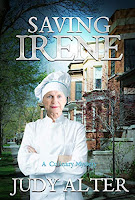
Saving Irene

Irene Foxglove wishes she were a French chef. Henrietta James, her assistant, knows she is nothing more than a small-time TV chef on a local Chicago channel. And yet when Irene is threatened, Henny tries desperately to save her, wishing always that “Madame” would tell her the truth--about her marriage, her spoiled daughter, her days in France, the man who threatens her. Henny’s best friend, the gay guy who lives next door, teases her, encourages her, and shares meals with her, even as she wishes for more. Murder, kidnapping, and some French gossip complicate this mystery, set in Chicago and redolent with the aroma of fine food.


Irene in Danger

Want a French recipe? Irene will teach you to make salad niçoise. Want murder and mayhem? Irene seems to attract both. With one week until her wedding, Henny James is convinced Irene’s arrival from France will ruin the biggest day of her life. If Irene doesn’t, Henny’s mother might, clashing with Irene over everything. Henny has one week to save Irene. But then, she has more on her mind, like smuggled cocaine, a murder, a kidnapping, the constant sure knowledge that she and everyone around her is in danger, and the dreaded possibility she and Patrick might have to cancel the wedding.

Can Henny save the wedding? Recipes included.


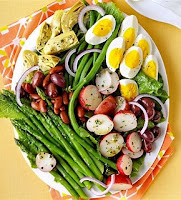
Salade Niçoise

Here’s one recipe from the books you might like.


Salade Niçoise is built around tuna—in France, undoubtedly fresh tuna, but a high-quality, canned variety is perfectly acceptable. Henny likes to do it with canned albacore in olive oil.


Olives, green or ripe, are traditional, but Henny omits them because olives are on the short list of things she just doesn’t eat, along with bell peppers. If you like them, you may want to add strips, preferably of red peppers. Anchovies are a truly French contribution to the salad, and if you like them, they add a wonderful zing. Julia Child added an anchovy filet, twisted, on each hard-boiled egg quarter and scattered capers and chopped parsley on the finished salad.


The thing about this main-dish salad is you can create it to your taste. Choose the vegetables you prefer, but with an eye to color and appearance. Suggestions include tiny baby potatoes, peeled, boiled, and cut in quarters, if necessary; haricort vert (those tiny French green beans); artichoke hearts quartered; cherry tomatoes; hard-boiled eggs. Sometimes Henny adds tender, young asparagus spears if in season. She believes in simplicity—too many vegetables spoil the presentation.


Pour a little dressing over the potatoes when they are warm—they’ll absorb it better. Each vegetable and the tuna should be seasoned with a little dressing before becoming part of the arrangement. Lay out the vegetables and tuna in an attractive pattern, either on a platter or individual plates, on a bed of lettuce. Some cooks group ingredients; others prefer a more casual arrangement. Pour any remaining dressing over. If you need another batch of dressing, by all mean make it. You don’t want soup, but you don’t want a dry salad.


Vinaigrette is the traditional dressing for Salade Niçoise. Here’s the one Henny frequently uses (enough for two individual salads):


¼ c. olive oil

2 Tbsp. red wine vinegar

2 Tbsp. lemon juice

1 clove garlic, pressed

1 tsp. Dijon mustard

½ tsp. salt

¼ tsp. pepper


About Judy Alter

After an award-winning career writing historical fiction about women of the nineteenth-century American West, Judy Alter turned her attention to contemporary cozy mysteries. Several of her Kelly O’Connell Mysteries and Blue Plate Café Mysteries were published by Turquoise Morning Press and are still available. When her publisher went out of business, she became an indie publisher and barely looked back. Find her and a list of her books at http://www.judyalter.com Her avocation is cooking, and she is the author of Cooking My Way Through Life with Kids and Books, Gourmet on a Hot Plate, and Texas is Chili Country.

Where to find Irene in Danger and Saving Irene

Irene in Danger: An Irene in Chicago Culinary Mystery - Kindle edition by Alter, Judy. Mystery, Thriller & Suspense Kindle eBooks @ Amazon.com.

Saving Irene: A Culinary Mystery (An Irene in Chicago Culinary Mystery) - Kindle edition by Alter, Judy. Mystery, Thriller & Suspense Kindle eBooks @ Amazon.com.


Saturday, September 19, 2020

Second-guessing Your Published Book by Judy Alter

Let’s say you’ve researched, plotted, planned, and your book is at long last ready. And then you come across something—an article, a blog post, even a TV show—that might challenge what you’ve written, a la change the characters or background or even the story. It happened to me twice lately.

Saving Grace, my stand-alone culinary novel, indie published, was all set a week before the launch date, posted to various sites, not beyond change but only with difficulty. And then I took a Zoom cooking class from a chef and did some research for an online class titled, “Creating a Fictional Chef.”

The cooking class was taught by Scottish National Chef Gary Maclean in his own kitchen. He was alone in his kitchen; my fictional chef, Irene Foxglove, has an assistant, narrator Henny James, for her TV show, a gofer who hands her pre-measured ingredients and takes away dirty dishes. Chef Maclean kept handing used items off to his right, and I hoped there was a Scottish version of Henny just off camera dealing with all those things.

A camera pan of the kitchen at the end of the show proved me wrong. The chef had simply been piling dirty dishes, etc., on a counter and in the sink. He had one heck of a mess to clean up after the camera went off. But maybe he had an after-hours Henny.

Chef Maclean told us proudly that his kitchen was designed with television production in mind. It was not large but boasted a bank of four, chest-level ovens, with four refrigeration units below them. I know from a short stint in the restaurant world, you don’t need a big kitchen unless you have a big staff. But the Scottish kitchen looked like a ballroom compared to the tiny kitchen in the corner of a TV studio from which Irene and Henny prepare meals.

None of this would have made a serious difference to my novel. The research for the online class was another matter. I discovered that I had blindly fallen into the trap I’ll warn students about—stereotyping my chef. Irene is female and inclined toward French ways; she even wears a toque which few actual chefs do these days. The only thing I got close to right is that she’s female.

For several hundred years, commercial kitchens were dominated by French men; today they are open to men, women, and others of many different nationalities. Despite Julia Child, French cuisine is almost passé, its rich sauces replaced by the intriguing flavors of Middle Eastern cooking or Asian or South American. American food today is truly a melting pot of traditions and flavors and dishes. It’s a concept Irene doesn’t get.

Lucky for me, my last-minute discoveries didn’t render my book hopeless. It still came out on time, and I’m still proud of it. But I won’t soon forget that sinking feeling of suspecting I might second-guess myself. Maybe next time, I just won’t read anything relevant for three months prior to publication.


Saving Grace

Irene Foxglove wishes she were a French chef. Henrietta (Henny) James, her assistant, knows she is nothing more than a small-time TV chef on a local Chicago channel. And yet when Irene is threatened, Henny tries desperately to save her, wishing always that “Madame” would tell her the truth--about her marriage, her spoiled daughter, her days in France, the man who threatens her. Henny’s best friend, the gay guy who lives next door, teases her, encourages her, and shares meals with her, even as she wishes for more. Murder, kidnapping, and some French gossip complicate this mystery, set in Chicago and redolent with the aroma of fine food.


After an award-winning career writing historical fiction about women of the nineteenth-century American West, Judy Alter turned her attention to contemporary cozy mysteries. Several of her Kelly O’Connell Mysteries and Blue Plate Café Mysteries were published by Turquoise Morning Press. When her publisher went out of business, she became an indie publisher and barely looked back.

Born in Chicago, she has made her home in Fort Worth, Texas for over fifty years. She lives in a tiny but charming cottage with her dog Sophie. Cooking and food studies are her avocation, but she now cooks in a four-by-six kitchen with only an induction hot plate and a toaster oven. She’s even written a book about that: Gourmet on a Hot Plate.

Saturday, February 14, 2015

Marketing a Mystery...or a Marketing Mystery by Judy Alter


 In spite of numerous books in print, I’m at best a low mid-list writer. My Amazon rankings would embarrass many authors and so would my income, but that’s not why I write. I write because I enjoy it, and because people write and tell me in person how much they like my books. So I plug away, not expecting a miracle to happen. But in a small way, one has happened.

Before I turned to mysteries I wrote about the American West and mostly about the experiences of women in the nineteenth century when the land was new and challenging and full of promise.

 In 1984, my first adult novel, Mattie, was published in Doubleday’s Double D Western series, a low-end series sold on subscription, mostly to prisons. Mattie is based on the life of Dr. Georgia Arbuckle Fix, who practiced medicine on the frontier of western Nebraska, learning to “read” the prairie, so she didn’t get lost on trips of thirty miles or more. Her experiences were recorded in enough primary sources that I could verify them.

Legendary western author Mari Sandoz did a much better job with Arbuckle’s life in Miss Morissa. But my novel won a Spur Award from Western Writers of America as Best Western Novel, leading one disgruntled male author to comment, “That category has always been for the male action adventure.”

Eventually Doubleday discontinued the series and was absorbed by a conglomerate. Rights reverted to me, and a funny thing happened on the way to the market. In 2010 I formatted the novel and a collection of my short stories (Sue Ellen Learns to Dance and Other Stories) and put them on Kindle at 0.99—those were the days when we were still experimenting with price point. My first check from Amazon was for $11. No riches there. But then the checks began to increase in size, peaking at a figure that was astounding for me. I still get a nice check from Amazon monthly—not as much as those high-rolling months but more than enough for lunches for a month. Mattie has, today, 371 reviews and gathers two or three new ones every month. Average rating is 4.3 stars. The short story collection sells modestly at best, so all this nice activity is due to Mattie.

As authors, we all look for the magic key to make our books sell well over the long term, and I wish I could look to Mattie for an answer. In truth, the longevity of this book puzzles me. I don’t market it much, although from time to time I feature it on my Web page. It has a good, solid cover but not a real eye-catcher. I never advertise it, and I don’t think readers give a fig about awards when they’re choosing the next thing to put on their e-reader—especially awards that are thirty years old. I really can’t explain it except to say perhaps it’s the 0.99 price—even though we’ve been told about a low price demeaning our work.

At any rate, I’m waiting for the sales fairy to sprinkle magic dust on another of my titles—for instance, The Perfect Coed, my first self-published title, could stand a little magic dust.

About Judy:
Judy Alter is the author of five books in the Kelly O’Connell Mysteries series: Skeleton in a Dead
Space, No Neighborhood for Old Women, Trouble in a Big Box, Danger Comes Home and Deception in Strange Places, two in the Blue Plate Murder series, in which she moves from inner city Fort Worth to small-town East Texas to create a new set of characters in a setting modeled after a restaurant that was for years one of her family’s favorites.

Before turning to mystery, she spent almost thirty years as director of TCU Press and writing about the American West. Her western work won several awards, including a Lifetime Achievement Award from Western Writers of America. She was inducted into the Texas Literary Hall of Fame in 2011 and is a member of the Texas Institute of Letters, Sisters in Crime and the Steering Committee of the Guppies. She is the single parent of four and the grandmother of seven. She and her Bordoodle, Sophie, live in Fort Worth, Texas.

Follow Judy at http://www.judyalter.com or her blog. Look for her on Facebook and on Twitter she is @judyalter. On Google+ find her at https://plus.google.com/u/0/101935245186534208205/posts