Showing posts with label writing spaces. Show all posts

Sunday, June 29, 2025

Tell me Where you Write

By M.E. Proctor

Getting a peek at writers’ working spaces fascinates me. Faulkner’s office at Rowan Oak (Oxford, Mississippi) is simple and spare. I think his horses had more room. I love the picture of Stephen King’s messy nook on the cover of On Writing. Roald Dahl had a cozy shed. Jean-Paul Sartre (and other luminaries) scribbled at the CafĂ© de Flore, in Paris. Liters of coffee in the morning, harder stuff later on? What did that check run up to? Did they have a deal with the owner?

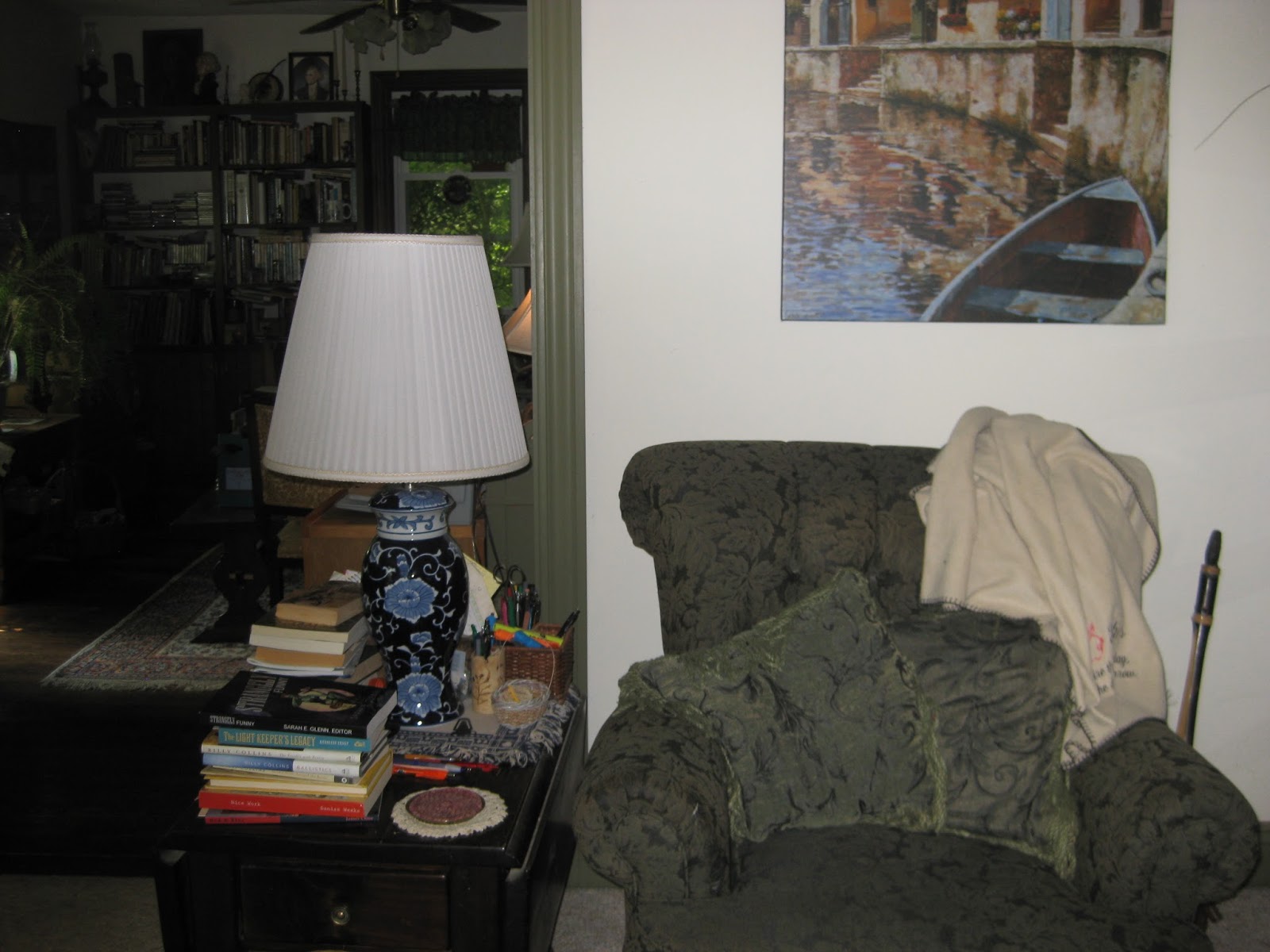
When people post a picture of their workspace on social media, I’ll look at it with a magnifying glass wondering what it says about them. Messy or tidy, whose books are displayed prominently, do they have posters of their covers, a resident pet (cat, dog, goldfish), a comfortable chair, a favorite mug? A Hall of Fame, a Board of Rejections? Everything tends to be curated in this world of appearances and influencers. Which begs the next questions: How much do these authors want me to see, and does it tell me anything about what they write? I know a science-fiction writer who has a model of the Millennium Falcon hanging over his computer. I’m green with envy!

I am a detective at heart, and these are clues.

 My husband, who’s also a writer (James Lee Proctor), has a small cabin tucked next to the house where he retires to work, listen to music, do research on our next trip, pay bills … The whole point is personal space, so when I have to ask him something, I go knock on the door. Or even better, I call him. It’s a wonderful place with old Texas maps on the walls and sports memorabilia sprinkled around. When I want to make a good impression, I borrow it for Zoom calls.

A few years ago, thinking I should have a similar setup, we arranged a space for me in what was supposed to be a garage and ended up being a woodworking shop. There’s a cool baroque desk that we found in a flea market, a swivel chair straight out of Sam Spade’s office, a lamp like in the Pixar logo, shelves, posters on the wall, everything a writer might need.

I’ve never used it.

Instead, I’ve set camp at one end of our long dining room table. When we have more than four guests, I have to clear out. Sometimes I’m ensconced in a big armchair with my laptop, or plonked down in a rattan chair on the back porch. I’m clearly not a ‘nester’. I also have a hard time working in quiet places. It goes back ages. I did my school homework in the kitchen with the entire family going about their business, studied for high school exams in the sitting room with the TV or the radio on, and have clear memories of hauling my books and notes to a blanket on the lawn, despite persistent hay fever.

 Noise doesn’t bother me. When I’m ‘in the zone’, I don’t hear anything. Right now, I’m deep in the follow up to Bop City Swing, a retro-noir written in collaboration with crime author Russell Thayer, and unless there’s a thunderstorm making the windowpanes rattle (there’s one looming on the horizon as I write this), I won’t stir. I’m in Kansas City in 1952 dealing with mobsters, dames, a cattle show, and an unnerving contract killer. Nothing around me is remotely related to any of that. Where I write won’t reveal anything about what I write.

But it might say a whole lot about who I am …

 So, what’s your writing space like? You know I want to know.

About Bop City Swing

According to one reviewer:

“…a tale that twists and turns like a brakeless ride down Mulholland Drive in a 1940s Caddy.”

San Francisco. 1951.

Jazz is alive. On radios and turntables. In the electrifying Fillmore clubs, where hepcats bring their bebop brilliance to attentive audiences. In the posh downtown venues where big bands swing in the marble ballrooms of luxury hotels.

That’s where the story begins, with the assassination of a campaigning politician during a fundraiser.

Homicide detective, Tom Keegan, is first on the scene. He’s eager, impatient, hot on the heels of the gunman. Gunselle, killer for hire, is no longer there. She flew the coop, swept away in the rush of panicked guests.

 They both want to crack the case. Tom, because he’s never seen a puzzle he didn’t want to solve, no matter what the rules say. Gunselle, because she was hired to take out the candidate and somebody beat her to it. It was a big paycheck. It hurts. In her professional pride and wallet.

 The war has been over for six years, but the suffering and death, at home and abroad, linger behind the eyes of some men. And one young woman.

(Amazon link: https://www.amazon.com/dp/B0DPJBGPT8)

M.E. Proctor was born in Brussels and lives in Texas. The first book in her Declan Shaw PI series, Love You Till Tuesday (2024), came out from Shotgun Honey, with the follow up, Catch Me on a Blue Day, scheduled for 2025. She’s the author of a short story collection, Family and Other Ailments, and the co-author of a retro-noir novella, Bop City Swing. Her fiction has appeared in Vautrin, Tough, Rock and a Hard Place, Bristol Noir, Mystery Tribune, Shotgun Honey, Reckon Review, and Black Cat Weekly among others. She’s a Shamus and Derringer short story nominee. Website: www.shawmystery.com – On Substack: meproctor.substack.com.

Tuesday, February 26, 2019

Rooms of My Own

Virginia Woolf will be remembered for many things, but for me, the essay “A Room of One’s Own” is her crowning glory. And while I know that Woolf is speaking of “room” in both its literal and metaphorical sense, I can’t help but breathe a “thank you” to Virginia every time I sit in my home office and begin writing.

It’s not big, this room of my own, maybe twelve by twelve, one hundred and forty-four square feet. There’s a desk, and a loveseat, and a coffee table that belonged to my grandmother. There are old bookshelves that belonged to a great-uncle, plus file cabinets and wastebaskets and three original works of art that were gifts from people I love. I have rocks and crystals everywhere — baskets and bowls of gem clusters and river stones, citrine and calcite on the windowsill, a labradorite paperweight, a selenite crystal ball.

The desk sits right in front of the window overlooking my front yard. It’s an eastern view, so the rising sun illuminates my work area with hazy rose gold light. Right now, it’s on the cusp of spring here. The calamondin orange tree gives off a dizzying scent; the brown spent leaves fall from the live oak, making way for new growth. Soon the green will get brown-edged and crispy with the broil-and-bake temperatures that are coastal Georgia summers. But for now, all is moist and vernal and misty-gray in the morning. 

As you can probably tell, my room of my own has to be a room with a view. I recently read another author’s blog post on how much writing she got done in a boring room with nothing to distract her from her task. But I am not such a creature. I write best when my eyes have something to feast on while my brain chugs along (my brain itself requires caffeine, but that’s another story).

One of my best writing afternoons was spent in Colorado Springs when I snuck away from the Left Coast Crime festivities and hunkered down in my room with hot chocolate on the nightstand and a dazzling snowscape through the balcony window. As a child of the South, I was stunned and delighted by all the white stuff, and found the creative engine stoked by a view I never get at home. 

At the other extreme, I found the desert sands of Scottsdale to be just as inspiring. I was there during a spell of rainy weather that had the temperature hovering in the low sixties instead of the predicted nineties, so I replaced my planned umbrella drink with yet another hot chocolate. Luckily, the desert has a gravitas and bigness that opens up new vistas in the imagination, regardless of temperature.

 One of my most memorable writing rooms was mobile—the sleeper compartment on the Amtrak train from Savannah, Georgia to Albany, New York. I spent that 22-hour trip working with an ever-changing view, happily sequestered in a tiny, moveable space all to myself (and with a dining car two doors down – I cannot begin to tell you how much my productivity increases when someone else takes care of the cooking).

I’m curious about the rooms of your own — what does your fantasy writing space look like? Care to share?
*     *     *

Tina Whittle writes the Tai Randolph/Trey Seaver mysteries. The sixth book in this Atlanta-based series—Necessary Ends—is available now. Tina is a proud member of Sisters in Crime and has served as both a chapter officer and national board member. Visit her website to follow her on social media, sign up for her newsletter, or read additional scenes and short stories: www.tinawhittle.com.


Tuesday, June 26, 2018

Where We Begin


“All writers are local somewhere.” – Flannery O’Connor

I have always been fascinated with writerly spaces. Mine is my office, which is filled with things that inspire me to be creative: a comfy loveseat with a view of dogwoods and azaleas, shelves lined with my most cherished books, bowls of crystals and stones to run my fingers through. When I enter this room and sit down, my brain recognizes the cue and shifts into appropriate gear.

I have toured Ernest Hemingway’s Key West home, where I laid eyes upon his desk and petted his six-toed cats. I have knelt in wet grass and smelled the daffodils that inspired William Wordsworth. And last month, I stood by the window where the young Flannery O’Connor first gazed at Savannah and began to write about the South that she saw through that wavy glass.

The Flannery O’Connor Childhood Home sits on Lafayette Square, one of Savannah’s twenty-four downtown mini-parks arranged in a neat grid pattern. It is grassy and shaded with live oaks, the murmur of traffic mingling with the burble of a fountain. Much about it has changed since Flannery lived there in the early decades of the twentieth century, but one thing has remained the same: it provides a stunning view of the Cathedral of St. John the Baptist, the Mother Church of the Roman Catholic Diocese of Savannah.

Flannery attended mass at that cathedral every single morning, along with her mother. It was one of the first things she ever saw as a baby, its spires dominating the landscape just outside the window next to her bassinet. In a similar fashion, her Catholicism would loom large in her writings, though not always as obviously or picturesquely. As Flannery herself explained, “I think it is safe to say that while the South is hardly Christ-centered, it is most certainly Christ-haunted.”

The rest of the home was equally revealing, richly restored with help from the Savannah College of Art and Design, whose students researched and replicated the décor as closely as possible, from the colors of the paint to the gilded gold trim that runs along the top of the walls, an opulent touch in an otherwise modest dwelling.

We saw the bathroom where young Flannery would hold “reading salons” with her friends, arranging pillows in the bathtub and decorating the toilet with fresh flowers (she would get in trouble many times for flushing those flowers, and also for featuring Grimm’s Fairy Tales in her readings—the violence and bloodshed in those stories delighted the precocious Flannery but terrified her more sheltered playmates). We saw the yard where she taught her chicken to walk backwards, which so startled her aunt that she called in a film crew (you can watch that video of Flannery and her amazing chickens, for even though the fowl refused to perform its trick for the camera, the director managed to fix the problem just fine, as you can see for yourself here).

We also saw her library, which is filled with Flannery’s books. Some of them contain what amounts to one-star reviews written in her elementary school handwriting. She was a harsh critic—“I didn’t like this book very much,” reads one summation—but she obviously loved the concept of books as much as she loved language and words and stories. Her devotion shows everywhere you look.

I look now at my own writing space with fresh eyes. Though I do not think my childhood home will be immortalized, I do think I can learn a great deal about my writerly self by pondering the view from my bedroom window. Scuppernong vines planted by my father stretch along the edge of dense woods, a liminal zone where wildness meets civilization. It looks safe out there, but the lush grass grows tall in the spring and hides rattlesnakes and cottonmouths. The train no longer runs behind those trees, so I no longer hear that lonesome call in the night.

Except that I do, no matter where I live and write. Just like I imagine Flannery always saw those elegant French Gothic spires, even on her farm, even on her sick bed, even with her eyes shut. 
*     *     * 

Tina Whittle writes the Tai Randolph mysteries for Poisoned Pen Press. The sixth book in this Atlanta-based series—Necessary Ends—is available now. Tina is a proud member of Sisters in Crime and serves as both a chapter officer and national board member. Visit her website to follow her on social media, sign up for her newsletter, or read additional scenes and short stories: www.tinawhittle.com.


Thursday, August 22, 2013

MY WRITING SPACE


In the July/August 2013 issue of Writers Digest seven authors took the readers behind their desks to look at the totems that inspire them and keep them writing. I looked around and didn’t find any inspirational totem. Woe is me. But the article did inspire me to write about my writing space with pictures. (A disclaimer here – I cleaned it up before taking pictures or at least what you can see.) A while back I remember Sandy Parshall posting pictures of her writing spot and other Guppies, a chapter of Sisters in Crime, followed with pictures of their own writing spots, too.


My nesting chair where I write early mornings.
Recently Edith Maxwell on the Guppy anthology blog (http://fishtalesanthology.blogspot.com)
blogged about going on a writing retreat somewhere by water and staying in a monastic room and how much writing she could accomplish there. She didn’t say where it was. The following week Gigi Pandian blogged about writing in coffee cafes and how her writing flows there. I know some of my fellow bloggers have written about writing in cafĂ©s or coffee shops, too. So that got me to thinking about where I write best even though I don’t have any inspirational writing totems in my clutter, or if I do, I can’t see them to have them inspire me.


Twice I attended Seascape Writers Retreat in Connecticut, and while it was a good experience in many ways, I couldn’t write in the afternoon set aside for writing. We were to work on making changes from the critiques we’d received. Instead, I took a walk in the woods or read in my room.

My library.dinning room table where I write.
I have never been able to write at workshops where a prompt is given to us, either. I sit there distracted by all the others writing furiously to finish their great ideas in the ten to fifteen minutes allotted to us. Finally, I start writing something, but it’s too brief and pathetic to share with all the other brilliant and talented writers willing to share their work. The truth is that except for my journal which I can write in anywhere, I can’t write anyplace other than my home. As for the journal, it doesn’t contain anything anyone would want to read anyway so it doesn’t matter where I write it. It’s more a litany of what I did that day, where I went, what I saw, etc. In fact, the only way anyone would want to read it is if they suffer from insomnia, maybe.

Where I edit my final drafts. 
So in spite of daily distractions from phone calls from family, friends or telephone solicitors - no I don’t have caller ID because I don’t want family or friends to think I’m screening my calls when I don’t answer - and the distractions of my dog or cats deciding it’s time for me to pay attention to them, I still do my best writing at home - but only in specific places. I write poetry or my blogs in my nesting chair in the living room usually in the mornings with coffee and before I have my breakfast. I work on the first draft of short stories or my books at the table in my library/dining room/office in one particular spot. All my work starts out written in long hand on notebook paper with a pen before being typed into the computer. I do all my editing on the computer. There have been a few times I’ve written on the patio in the summer, but that is rare because I get distracted by birds at the feeder or hummingbirds at the hanging flowers or even an annoying fly or yellow jacket.

In the same Writers Digest article I mentioned at the beginning, the totem that resonated with me was J.T. Ellison’s. When she first started writing, she wrote to Stuart Woods, a well-published author, for advice. He wrote back and said, “There are no rules except those you create page by page.” So she keeps those words on a sign on her door. I think that’s not only a good rule for our actual writing, but also for where we are most comfortable writing. For me it’s at home alone except for my mostly sleeping critters.

Actually, after I'd typed this and sent it for review, Gilda, a friend of mine in one of my book clubs sent me this picture. I think I'll frame it and use it for my totem because actually it expresses my view, too.


Even if you write nothing more than letters or cards to someone, where do you write best?