Showing posts with label author panels. Show all posts

Tuesday, September 19, 2017

Killer Nashville 2017


by Paula Gail Benson

Going to a writing conference is a wonderful experience. Each has its own personality and focus. For me, Malice Domestic, which occurs near Washington, D.C. at the end of April or beginning of May, is a warm family reunion of readers and writers, all relishing the strategies for puzzling out traditional mysteries. Bouchercon--taking place this year in Toronto, Canada--gathers together writers from all the mystery genres, from cozy to thriller, in a huge celebration of variety and skill.

Killer Nashville is the one conference I’ve attended that consistently has the effect of revving my writing engine. Although it welcomes both readers and writers, its primary focus is on the writing craft and criminal process. It features experts discussing developing characters, structure, and marketing as well as accurately portraying poisons, police procedure, and protocols. Each year, a member of the Tennessee Bureau of Investigation sets up a crime scene and participants try to solve who did it. The lucky winner receives a free registration to the next year’s conference.

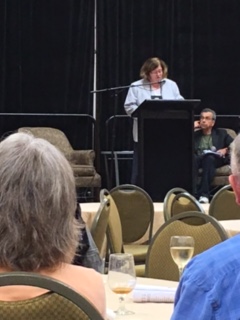
I have a lot of gratitude for Killer Nashville because it gave me the opportunity to be in the anthology Killer Nashville Noir: Cold Blooded (for “A Matter of Honor” written with Robert Dugoni) among such fabulous talents as Jeffrey Deaver, Anne Perry, and Catriona McPherson. This year, I delighted in being introduced by Guest of Honor Chris Grabenstein to publicly read the opening of the story.
Reading from "A Matter of Honor"

Clay Stafford, the founder and creative genius behind Killer Nashville, gives those attending lots of opportunities to serve on panels. This practice helps authors to develop their confidence in appearing before their peers and also helps panel members to meet and bond. I felt very fortunate this year to participate on four panels.

Subplots Panel
Creating and Weaving Subplots was moderated by Kelly Oliver (who won the Silver Falchion for Best Attending Author) and included Mary Davidsaver, Susan Page Davis, Tracee de Hahn, and Rick Helms (whose extensive work with the South Eastern Chapter of the Mystery Writers of America was recognized with the Magnolia Award). Catherine Dilts did a great job in providing a panel summary in her blog.

Writing Medical and Legal Thrillers, moderated by Charley Pearson and featuring Claire Applewhite, Judith Lucci, Linda Petrilli, and Doug Woodward all with medical backgrounds (I was the sole representative for the legal field), had a fascinating discussion about how reality and imagination can develop truly riveting stories that carefully adhere to medical or legal principles.
Medical/Legal Thriller Panel

I always love talking about writing short stories. Our panel moderated by Jenean McBrearty was a particularly fun group, including my pals Debra Goldstein and Robert Mangeot and new friends Warren Moore (who teaches at Newberry College in South Carolina) and Kathryn Lane (whose novel Waking Up in Medellin won the Silver Falchion for Best Fiction Adult Suspense). Again, Catherine Dilts provided a terrific summary.

Short Story Panel
My final panel, about writing with a collaborator, had just one person attending, but led by our moderator Mike Rubin, we went forward and enjoyed a lively discussion. Barbara Collins, Max Allan Collins (another Guest of Honor), and Susan Page Davis were the other panelists.

Being at Killer Nashville led me to become involved with the board of SEMWA. We have an enthusiastic organization. Our president Maggie Toussaint is a dynamo and board members Stacy Allen, Nancy Sartor, Susan M. Boyer, Phil Hardwick, and John Gordon work diligently to organize programs and retreats to benefit our members. Past President Beth Terrell continues to provide us with wise counsel, and we were very proud and celebrating with her when she was honored with the Builder’s Award at this year’s Killer Nashville. 

Over the years, those who have come as Guests of Honor or attendees have enjoyed the experience so much that they have created four scholarships to enable other writers to attend. Past scholarship holder and a Claymore finalist this year (and a writer to be watched), Kathleen Donnelly, spoke about what the opportunity to attend Killer Nashville had meant for her writing career. Her speech is published on The Stiletto Gang blog.

If you have an interest in a smaller conference that concentrates on writing skills and expert procedural information, please consider coming to Killer Nashville. I think you’ll find a place where you’ll want to return.

How do conferences enrich your writing?

Saturday, June 25, 2016

Meeting and Greeting – A Marketing Plan – Part Deux By Kait Carson


As a member of the Gulf Coast Chapters of Sisters in Crime I attended a marketing day at the Sarasota Barnes & Noble. I have to admit, initially I only did it because I thought I had to. Not for me, but for my publisher. First of all, Sarasota is 100 miles away from my home—and that’s a crow flies distance.  Second, I had to be there by 9:45 AM. Third, like most writers, I’d rather hunker down in my cave and write. Fourth, the Florida rainy season has been hitting with a vengeance most days this week and the thought of driving an hour and a half through gator gushers... Why then, did a reasonably sane woman leave her house at 6:30 AM with thunder lighting the western sky? Did I mention about my publisher? And, oh yeah, bookstores are catnip to a writer.
This is the second part of a two-part blog, the first part appeared on Motive Means Opportunity on Monday, June 20, 2016.  Tricky, huh.
I previously mentioned the book signing table up front. I have to admit; it was a pretty intimidating place to be. There I was, books on display, sitting right smack dab at the front door. Behind me the Sisters in Crime poster was in full display. My role was clear—I’m here to sell you some books. I felt like the perfume lady at the mall. Nobody wants to get that squirt. The poor woman must have face ache at the end of every shift. To say nothing of self-esteem issues!
My second thought was far less personal. If someone had asked me (and I base this on my sales and on the sale of other writers) I would have said that book stores were in their death throes. The majority of my sales are e-books. It’s rare to see someone with a paper book anymore. These days, it’s far more common to see someone with an e-reader. The volume of folks coming through the door, and the volume of folks walking out the door with packages told a far different tale.
My third thought really warmed my heart. I loved the number of kids running (not walking) into the store. Parents well and truly in their wake while the kids bargained for more than one book. It was exciting to see this new generation of readers. One family walked in and the older child ran to the children’s table, grabbed up a book, thrust it at her younger brother and said, “You have to read this, it was my favorite when I was your age.” It was intoxicating to see the whole family in the checkout line – each with at least one book in hand.
Following my abysmal performance at the solo signing table it was time for lunch and then a panel discussion. I’d never participated in a panel so I was very intrigued to see how they worked. Wendy Dingwall was the moderator (she’s also President of the Gulf Coast Sister in Crime Chapter) and I shared the podium with Susan Klaus and Shannon Esposito. Many of you may know Susan from her Authors Connection radio show as well as her books She writes both thrillers and fantasy. Shannon writes two cozy series, one featuring a pet psychic, and the second featuring a yoga instructor who runs a doga (doggie yoga) class. Two great co-panelists.

Wendy had some really fun and insightful questions for the group and each of us had a turn to answer. What amazed me was the similarity among the responses. All three of us felt that marketing was the hard part. What we really wanted to do was spend our time writing. We’d each thought if we wrote it, readers would come. That would be osmosis marketing. It didn’t work for any of us. Our books were all character driven. Didn’t matter what we plotted. At some point, the characters took over. We differed on our themes, the degree of heat in our books and how we approached our writing.  It was as much of a learning experience for me as it was for the audience. And the audience questions were really, really, insightful. They wanted to know where the characters come from. How much of us were in our books. Did we really write for our own motives or to tell a great story? 
Would I do it again? In a heartbeat. I had a great time, and I think the audience did too.
Kait loves to hear from fans, check out her website at www.kaitcarson.com; follow her on Facebook at www.facebook.com/kaitcarsonauthor, on twitter at @kaitcarson, or e-mail her at kait.carson@gmail.com.

Monday, September 28, 2015

Notes to Self: My First Author Panel


Last week I had my first author panel.

I survived!

A group of Sisters in Crime authors with stories in the multi-award nominated (I love typing that, even though my story was not a nominee) anthology Chesapeake Crimes: Homicidal Holidays did a panel at my library. Donna Andrews, Barb Goffman, Clyde Linsley, Cathy Wiley, and I met on September 19, AKA Talk Like a Pirate Day, to chat about the anthology, writing short stories, and how we use the holidays in our work.

The other authors, panel veterans all, spoke knowledgeably about their writing processes, shared amusing stories about their research, spoke gracefully about their books without a hard sell, and in Cathy’s case, grabbed the audience by dressing up as one of their characters (in her case, a pirate). Was the audience engaged? The panel went for two hours and several attendees asked for another Sisters in Crime visit, so I would say so.

I actually felt a lot more comfortable on the panel than I had expected. Talking with strangers all day at work, and doing story times and school visits paid off. It was great to be on a panel with such collegial folks who definitely had panelist skills and a great comfort level talking about themselves and their work.

I learned so much that day and had a wonderful time, but I also discovered areas for improvement. Just as a director gives a theater cast notes on what they can do to improve their performance, I have Notes to Self to improve my panel performance.

Panel Notes to Self

1.     Do not forget that you are on a panel. I adore going to author panels to get the inside scoop on the writing process and to spend time listening to my favorite authors. I am embarrassed to admit that I was having such a good time listening to the other panelists that at times I FORGOT that I was on the panel. I blanked out when a lady in the audience asked me the softest of softball questions. Note to self: No matter how much fun you are having listening to the other panelists, remember where you are!
2.     Some people are talkers and some are listeners. I am a listener. You have to talk on a panel. Note to self: Talk.
3.     Not only do you have to talk, you have to talk about yourself. Horrors! To a native New Englander like me, this is like saying you have to chew with your mouth open. Note to self: Get over it.
4.     Not only do you have to talk, you have to talk with other writers. Let’s face it. Writers are verbal people. If you have mastered the verbal judo that lets you slip gracefully into a conversation, please share. Donna Andrews’ right ear was treated to me saying a variety of word bits like “Th-“ and “Ye-“ as I tried to jump in but never quite finished a sentence. Note to self: Observe how other authors find their way into the conversation.
5.     Show people your books. OK, this was a big time fail. I had brought a copy of the book under discussion, but I forgot the anthology with my other story, “Keep It Simple” in Chesapeake Crimes: This Job Is Murder. (See how I did that?) Folks asked about This Job Is Murder and I didn’t have a copy of that anthology to show them. Yikes! Panel 101, right? Visual aids. Note to self: Make sure you have a copy of all books that are pertinent to the panel’s topic.


Any further notes for newbie panelists? Please share in the comments.

Monday, September 14, 2015

My First Author Panel by Shari Randall

In a week, I’ll be appearing on my very first author panel along with accomplished authors of many short stories and novels, award winning and nominated authors, plus one New York Times best selling author.

And me. Two whole published short stories under my belt. It will be, as they say, my first rodeo.

We’ll be discussing the stories we wrote for the anthology Chesapeake Crimes: Homicidal Holidays, the short story in general, and how we use the holidays in our writing. I think I'll be fine talking about my own story and how Halloween inspired it. Check.

But I started having nightmares, er, wondering what would I say if someone asked me  What is a short story? In all the books on writing that I have read, debate continues about what exactly constitutes a short story, or any story really. The conventional wisdom is that you have a story when a character undergoes a change. I thought this was dyed in the wool, rock bottom, boilerplate wisdom. In a story, a character must change.

Aristotle considered three parts to a story: Reversal, suffering, and recognition. Recognition is what we would consider “epiphany” or a culmination, when a character reaches a state of enlightenment about his life and gains some new self-knowledge. A change.

Using Aristotle’s definitions, my story “Disco Donna”, was not a story, short or long. There was definitely no epiphany, just the resolution of a long-ago crime by three teenage girls applying their own understanding of the Teen Girl’s psyche.

Without this element, had I written a short story at all? Was I a fake? I decided to do some research and turned to the thickest, heaviest book on writing I could find.

In The Making of a Story, Alice LaPlante quotes the novelist John L’Heureux in his disagreement with this writing “rule.” He doesn’t believe that all stories must follow the something’s-gotta-change model. Instead, he says, writers must “Capture a moment after which nothing can ever be the same again.”

Now here was a revelation! “This definition” La Plante writes, “drives home the fact that change is not necessary. Change can be offered to a character – and declined. The “crisis” of a piece can be of negative, rather than positive action: something not done, a sin not committed, an act of grace not performed. But a moment of significance has passed, and things cannot be the same again.”

Ah ha! After my detectives endure and triumph through a dangerous “moment of significance,” things for them will not be the same again.  One could argue that this is a kind of change – they’re survivors – but L’Heureux broadened my understanding of what makes a story and opened new possibilities for me.


Maybe I’ll have something to say on the panel, after all.

Any advice for a first time panelist?