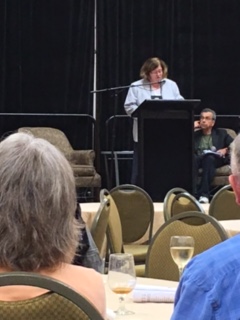
Killer Nashville, formerly held in
August and now scheduled in October, bills itself as “A Place for Thriller,
Suspense, Mystery Writers and Literature Lovers” and offers the array of talent
found at Malice Domestic and Bouchercon along with a sincere effort to provide
writers with the skills, knowledge, and contacts to progress in the writing
business.
This year, I learned a great
deal from the two panels I moderated.
 |
| Michael Rubin, Robert Rotstein, Douglas Jones, & PGB |
“Ask
an Attorney: Belly up to the Bar and Ask your Questions about Legal Procedure”
featured Douglas Jones, Robert Rotstein, and Michael Rubin as panelists. Our
topics included courtroom procedure, copyright, defamation, and planning for your
literary estate.
In “Double-Duty Dialogue: How to Write Dialogue That’s More
Than Just Talk,” Earl G. Fisher, Linda Fisher, Rae James, Joseph Terrell, and I
launched into a rousing discussion with our audience about what to include and
exclude from dialogue exchanges, and how to use dialogue for multiple purposes,
particularly advancing plot and developing character.
 |
| Linda Fisher, Rae James, PGB, Earl G. Fisher, & Joseph Terrell |
 |
| Robert Dugoni |
A special reason that I
attended this year’s Killer Nashville was the launch of its first anthology, Killer Nashville Noir: Cold-Blooded.
When Robert Dugoni was approached to contribute a “southern” story, he kindly asked
a mere novice he met at the South Carolina Book Festival to collaborate and help
make the story authentic. Through his generosity, I received not only a
personalized master class, but also a writing credit with a New York Times
bestselling author in a collection featuring notables of the mystery, suspense,
and thriller genres. Our story, “A Matter of Honor,” takes place in the South
Carolina Statehouse and has agent B.A. Azevedo investigating the murder of a
legislative aide who may have been killed by a senator’s daughter.
 |
| Clay Stafford |
Clay Stafford, founder of
Killer Nashville as well as editor and contributor to the anthology, said his
intention was to gather together a group of good stories. I believe he met his
goal. Each tale captures the imagination with intricate plots, diverse
characters, and fascinating settings. It’s a great honor to be part of this
collection.
Here are just a few tidbits
to peak your curiosity about the other stories:
Jefferson Bass’ “In Plain
Sight” -- The writing team of Jon Jefferson and Dr. Bill Bass speculate on how
an extra body might find its way onto the University of Tennessee’s renowned
Body Farm.
Catriona McPherson’s “Kissin’
Don’t Kill” -- An elderly widow’s final goodbye to her husband may not be as
grief-stricken as it appears.
Baron R. Britcher’s “Ripple”
-- A former LA cop living in Hawaii helps his buddy, an ex-Seal and current NSA
officer, recover evidence of State secrets, including a manuscript hidden by a
boy being pursued by murderous agents.
Donald Bain’s “The Hunt for ‘Skippy’
Walker” -- Can a defendant be exonerated for a murder committed by his
imaginary friend?
C. Hope Clark’s “Rich Talk”
-- While a defense attorney tries to figure out how to deal with his cheating
wife and law partner, his butler carries out instructions to the letter.
 |
| PGB, C. Hope Clark, & Daco |
Jonathan Stone’s “Mailman” --
George Waite reacts as only a mailman can to a mysterious new neighbor in the
community where he has made deliveries for 35 years.
Maggie Toussaint’s “High Noon
at Dollar Central” -- Toussaint’s Dreamwalker protagonist investigates burglaries
where special crocheted angels have been left at each scene.
 |
| Daco, Maggie Toussaint, & PGB |
Jeffrey Deaver’s “Repressed”
-- A professor’s discovery of his repressed memories leads to an unexpected change
in his life circumstances.
Blake Fontenay’s “The Coal
Torpedo” -- Allan Pinkerton tells President Andrew Johnson the background story
of a perceived historical accident that actually was a planned mass murder.
Jon Jefferson’s “Giving Blood”
-- A grieving widower finds that his habit of donating blood might be the
perfect means of extracting revenge.
Anne Perry’s “Shutter Speed”
-- After WWI, a female photographer aiming for pictures of Wallis Simpson could
have captured the image of a killer in a nighttime brawl with a peace group.
Heywood Gould’s “He’ll Kill
Again” -- A janitor tries to warn a police officer about a serial killer. Will
the officer listen?
Dana Chamblee Carpenter’s “Lullabies
and Lightning Storms” -- The people of Gideon, a small town, are both attracted
to and repelled by a bubble girl who tells their futures through song lyrics.
Mary Burton’s “The Keepsake”
-- A cold case is resolved through forensic evidence in the Nashville bar where the
murder took place.
Jaden Terrell’s “Peace,
Sometimes” -- On a visit to a psychiatrist’s office, a convicted rapist and
murderer escapes with his new lawyer as hostage. Or, is that only how it seems?
Eyre Price’s “Sad Like a
Country Song” -- When a struggling country artist kills for what he knows to be
the perfect song, he learns he’s intruded upon a deal made by the devil.
Steven James’ “Second
Thoughts” -- A boyfriend seeking revenge for his girlfriend’s rape begins to
wonder if his victims deserve his vengeance.
Daco’s “The Virgo Affair” -- When
Agent Jordan Jakes is assigned to get close to an inventor who owns a DC bar,
she finds the situation complicated and potentially lethal.
Clay Stafford’s “Savage Gulf”
-- A high school reunion leads to unexpected complications from several hidden
love triangles.
I hope you might check out Killer Nashville Noir: Cold-Blooded.
Haven’t you been looking for a few really good short stories? What other short story anthologies would you recommend?