By Grace Topping
One of the absolutely best things about being a member of the mystery writing community is seeing members of the community succeed. Watching author Terrie Farley Moran gain accolades for her short stories and win an Agatha Award for her first novel was exciting. But learning that she is to be the new voice for the much-loved Murder, She Wrote series is beyond thrilling. Murder She Wrote: Killing in a Koi Pond, which will be released on June 8, 2021, is Terrie’s first entry into the Murder, She Wrote world. Terrie joins us at Writers Who Kill to talk about this new direction in her writing career.
Murder She Wrote: Killing in a Koi Pond
Back Cover Copy

When a friend’s husband dies while Jessica Fletcher is in town visiting, Jessica’s vacation turns into a murder investigation in this latest entry in the long-running USA Today bestselling series.
After traveling to Bethesda for a mystery writers’ conference, Jessica Fletcher decides she’s earned a vacation and takes a train to Columbia, South Carolina, to visit her old college friend Dolores, who has recently married her third husband, Willis Nickens, a wealthy and cutthroat businessman. They’ve moved into an opulent historic home with plenty of space for guests, and Jessica is ready for a week of shopping, gossiping, and relaxing at the grand estate.
But the morning after she arrives, Jessica discovers Willis facedown in the koi pond, and despite what the police think, she’s sure foul play is involved. She hadn’t known Willis long, but it’s clear to her that he didn’t concern himself with making friends. The question isn’t if her friend’s husband was murdered but by whom.
Welcome back to Writers Who Kill, Terrie.
Hi, Grace. It’s terrific to be here again.
First of all, a hearty congratulations on joining Jessica Fletcher and becoming the new co-writer of the Murder, She Wrote series. That was quite an accomplishment. Can you please tell us how that came about?

At the beginning of the pandemic quarantine, St. Patrick’s Day 2020, while I was dancing to Irish music, baking soda bread and bemoaning that there were no parades, my agent called and asked if I would be interested in writing the next few books in the Murder, She Wrote series. Before she could even outline the details of the project, I shouted a resounding “YES.” I have no idea how the offer came about. I may have been the first writer approached or the fortieth. My best guess is that I had been writing for a number of years under the Berkley imprint. The editorial staff is extremely familiar with my work, and I presume they thought my writing style would be a good fit for Murder, She Wrote. I will be forever grateful for this opportunity to write about my favorite amateur sleuth, Jessica Fletcher.
What was the biggest challenge you faced taking on this much-loved and long-running series?
The biggest challenge by far stems from the fact that the series has had such a long, successful life. There are more than two hundred fifty television episodes, which are still broadcast around the world daily. Fifty-two books were written in the series before I came on board. Since some of the early books were written while Murder, She Wrote was still on prime time television, the books are not exactly successors to the television series. Over time there have been many changes. For example, in the books, Sam Booth is no longer the mayor of Cabot Cove. He has been replaced by a man named Jim Shevlin, and Jim’s wife, Susan, is now the town travel agent, replacing Phyllis Grant. So I have to be extremely careful to keep my facts straight. I would hate to write a character as one of Jessica’s pals in a book only to find they were the murderer in a book written some time ago and are now sitting in a jail cell. The other issue from a writer’s perspective is that in the television episodes there are many scenes without Jessica being present. She may or may not learn what happens in those scenes later in the episode. The books are written in first person so Jessica either has to see what happens or someone has to tell her what they witnessed.
With your second Murder, She Wrote book coming out in November, Murder, She Wrote: Debonair in Death, it appears you don’t have much time between books. How many books will you be writing for the series—until they tell you to stop? And how often will you be releasing them?

My contract is for four books, two a year or basically a book every six months. Book number fifty-five, Killer on the Court (that is a tennis court) will be released in May 2022. My contract ends with book fifty-six, although there is always the possibility of renewal.
As the first woman to be co-writing the Murder, She Wrote series, what do you hope to bring to the series?
Well, Jessica and I do have gender in common, so there may be a bit more “girl talk” between Jessica and her female friends than we have seen in past books. In Murder, She Wrote: Killing in a Koi Pond, Jessica not only tries to protect her friend, Dolores, from the sheriff’s obvious interest in her as chief suspect in her husband’s murder, but she can relate to Dolores being suddenly thrust into widowhood. Through her own experiences, Jessica is able to be of comfort to Delores. Although I have not experienced widowhood myself, I have witnessed friends who have supported each other through the devastating trauma of spousal loss, and that role definitely suits Jessica.
You have co-written books before, namely working with Laura Childs on her Scrapbooking Mystery Series. What challenges do you face, if any, working with another writer?

Laura is a dream collaborator. She is filled with creative ideas and has a very strong sense of the book before we’ve written a word. Still, writing is a solitary endeavor. So I would say the challenge of writing as a team is the fact that consulting with each other is an absolute must. On my own I can take a sharp turn with the plot or the actions of any character, but once you have a writing partner, that freedom is lacking, you cannot make major changes without consultation.
Many readers know you from your numerous and well-received short stories. What made you include novels in your repertoire?
My first attempt at writing was a cozy mystery novel that went nowhere. While I was shopping it around and getting battered by rejections, the New York Tri-State Sisters in Crime Chapter put out a call for submissions for a short story anthology. I submitted a story called “Strike Zone” and was elated when it made the cut. I have always loved the concept of shorts and focused on them for the next several years. But I kept shopping the novel, and finally an agent, the wonderful Kim Lionetti, took pity on me and signed me on as a client, provided I would commit to writing another novel. She, like everyone else, believed my first novel was not saleable.
It was a pleasure being in the audience at Malice Domestic when you received the Agatha Best First Novel Award for your book, Well Read, Then Dead. What was it like winning that award for your first novel?
The honor of being nominated was so overwhelming that I never seriously considered the fact that I might win. What I remember most clearly of that wonderful evening is the joyful response from the attendees, most especially from the other Best First nominees. The communal spirit of the writing community continues to amaze me.

As a reader I love short stories, and I have since childhood. In fact, when I was about eight or nine my parents took me to see the stage production of South Pacific. My father, who had spent four and half years in the Pacific during World War II, told me that the musical was based on a book of short stories called Tales of the South Pacific, written by James Michener. Of course, there was a copy of the book in the bookcase in our living room. I read it and that was the beginning of my love for short stories. Eventually my love of shorts and my love of mysteries meshed.
Now that you are writing the Murder, She Wrote series, will you be continuing with the Scrapbooking and Read Em’ and Eat mystery series?
The Read ’Em and Eat series was not renewed by Berkley, and I made the decision not to take it to another publisher or to self-publish. As to the Scrapbooking series, which I co-write with the talented Laura Childs, Berkley would like to see more books in the series. Laura and I have talked about it, but we are both working on multiple projects and cannot find a way to coordinate at this time. Still, I never say never.
You visit grandchildren in two different states several times a year. Does going back and forth play havoc with your writing routine? Are you more productive in one place than another?
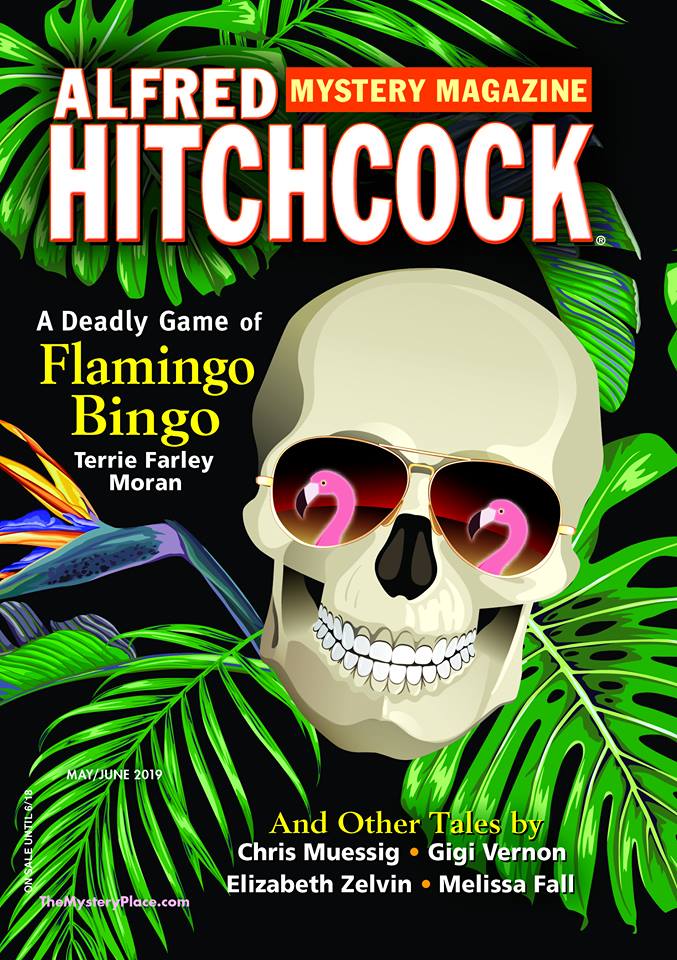
When my first two grandchildren were born twelve days and thirteen hundred miles apart, I quit my job in the real world so that I could bounce back and forth spending time with each of them. For the first year of their lives, I traveled from state to state on alternating months. Now I make the trip five or six times a year. I am an extremely slow writer, so I cannot afford to let anything interfere with my writing. Visiting grandchildren is the exception that proves the rule. Generally, I do not write on travel day, the day before travel day, or the day after. Otherwise I write or do some writing related work every day. My motto is: Writing is a job. Publishing is a business.
Readers who follow you enjoyed vicariously the trip you made to Ireland with your family. Do you have any travel plans for when it becomes safe to travel again?
When it comes to travel, I will be absolutely thrilled when I can attend Malice Domestic and Bouchercon once again. As to family travel, we have no definite plans. In addition to the Ireland trip, we have had a number of “gatherings of the clan” over the years, but now the grandchildren are growing up. Several have part-time jobs, two will be in college next year, and two more the year after. We had enough trouble figuring out a travel schedule when we only had to deal with two school districts. Adding colleges and jobs to the mix makes travel unlikely, but again, you never know.
What are you working on now?
I am writing Murder, She Wrote: Killer on the Court, which is set in my home borough of Queens in New York City. Jessica is visiting her nephew Grady, his wife Donna, and their son Frank at a vacation beach bungalow, and Donna’s boss is murdered on the nearby tennis court!
Thank you, Terrie.
To learn more about Terrie Farley Moran and her work, follow her at www.Terriefarleymoran.com