Showing posts with label Seamus McCree. Show all posts

Wednesday, September 17, 2025

An Interview with James M. Jackson by E. B. Davis


Two years undercover. One phone call. Zero margin for error.

FBI Agent Ashley Prescott has spent two years undercover as Niki Foster, earning the trust of Patriots for Freedom—an extremist militia. As the Bureau’s only window into the group—and their Chinese linguist and arms go-between—she’s the only one who can stop an imminent weapons sale and their plot to tear America apart with targeted assassinations.

Then her estranged billionaire father vanishes after leaking classified intel—details that threaten to expose her and could only have come from inside the FBI.

HQ plans to shut down her op, claiming she blew her cover. Ashley knows what that means: the Bureau will nab a few small fry and proclaim victory, while the militia leaders disappear, the arms shipment remains a threat, and the traitor wrecks other lives.

Racing between Minnesota to track down her father and D.C. to maintain her cover, she has ten days to stop the plot and expose the FBI leaker. With ex-SEALs closing in and her own agency against her, going rogue is her only shot at saving the country—and her own survival.

When the system turns against you, justice becomes a one-woman war.

Amazon.com


If you’ve read James M. Jackson’s Seamus McCree mystery series, you know that he doesn’t write simplistic, sentimental books. Niki Undercover, the first book in his new Niki thriller series, exemplifies his complex plots, fast pace, and deep characterization. Set over the course of two weeks, I didn’t always know where the plot would lead. But I always knew each character because they were distinctly drawn.


Most people have complex family situations, but I doubt anyone has the family issues that FBI Special Agent Ashley Prescott has—and those issues interfere with her job. Being undercover, that interference could mean her death. But then, someone doesn’t care all that much about her life. She calls her father Robert because she never considered him a dad. One phone call and Ashley’s life is turned upside down, which means she might not be undercover anymore.


Niki Undercover is available on Kindle Unlimited.


Please welcome WWK’er James M. Jackson!   E. B. Davis 


Niki was a supporting character in the Seamus McCree series. How long have you known that you wanted Niki to become the primary character in another series?


Niki appeared in Cabin Fever (Seamus McCree #3) when she worked her first undercover assignment. That was 2010. She had a cameo appearance in the novella “Low Tide at Tybee,” and then appeared with Seamus in the short story “Power of Attorney,” which takes place in 2019. (All my stories occur in “real time.”)


That’s when Niki began advocating for her own stories. I started writing Niki Undercover, but in between drafts, I completed Granite Oath (Seamus McCree #7) and Hijacked Legacy (Seamus McCree #8). She appears in both stories, which take place after the events in Niki Undercover.


“I don’t pretend to be Niki. I become Niki.” (Loc. 127) Although Niki is donning a new persona, she still is an FBI agent—just not herself. Has Ashley taken method acting classes?


Not formally, but she’s had acting coaches. FBI training for undercover operators includes lots of role-playing. Niki learned that the best undercover agents don’t role-play; they become the part. It’s one difference that makes her so successful (and keeps her alive).


What is a burr haircut? Is it like a buzz cut? Why does Ashley style her hair like that?


A burr haircut is a type of military-inspired haircut in which the hair is trimmed evenly all around to less
than an eighth of an inch. Ashley likes it for three reasons (1) it’s super easy to maintain, (2) it gives her a tough-guy vibe that helps her undercover assignment infiltrating militias, and (3) she can wear any wig over it to fit whatever role she is playing.


I assume an Accuracy International Arctic Warfare Magnum is some super sniper rifle. Are wind speed and direction really factors in marksmanship?


With a sniper rifle that has confirmed kills from over a mile distant, gravity and wind speed have a major effect on where the bullet strikes. Over a quarter mile (easy pickings for a sniper) the bullet drops about four feet. A 15mph perpendicular wind could push the bullet almost a foot. While not as big as gravity, not getting your adjustments correct means a miss, not a hit.


What contention does Ashley have with her colleague Special Agent Rick (spelled-with-a-silent-P)? He has family connections, doesn’t he? How did Rick know about Seamus? It seems that even though Ashley doesn’t like Rick, she does trust him. Why?


Ashley thinks Rick represents much of what she does not like about the FBI. His father was an FBI big-wig; and she thinks he is a misogynist, always making crude jokes. Rick used his connections to snoop in Niki’s personnel file, where he read the information about her first undercover assignment, when she ran into Seamus. Despite that, Rick is there when she needs him. Willing to admit she might have been wrong, she learns to trust him.


In an ambush, Malachi recognizes exSEALS, like himself, trying to kill Ashley. What is a “bone-frog” tattoo?


It’s a tattoo of a frog’s X-ray showing only the bones. I tried to find an image I could paste here without violating copyright and couldn’t find one. An internet search will get you lots of pictures.


Some of Malachi’s traits are laughable. After killing a man, Malachi refuses to let Ashley drive the rental car because she isn’t on the rental contract. And Robert made him the corporate conscience. Is he a contradiction or what?


Malachi was raised in The Church of Jesus Christ of Latter-day Saints and has a strong moral core. Robert made him the corporate conscience because he refuses to lie. Ashley soon learns that’s not the same as always telling the truth. Malachi would consider the killing regrettable, but necessary. Cheating on a contract is lying. He does not find those to be contradictions.


Ashley is thrust into first professional testing, then a life-threatening ambush—the source of which she is unsure of—and then a complex family situation, which in turn becomes a corporate problem when Robert goes missing. How does Ashley react to becoming CEO of her father’s company, all the while being an FBI undercover agent?


Ever since she was a kid and watched the Twin Towers fall, she’s thought her mission in life was to protect her country. That’s why she fought off all Robert’s attempts to bring her into the family business and chose instead to join the FBI. To her, all this other stuff distracts from her life’s work. She’s angry to find herself in such a position and overwhelmed by the responsibilities, and wants to wring Robert’s neck for putting her in a position where she doesn’t feel in control.


I loved the little old busybody lady next door to Robert’s house. Does every neighborhood have one?


I hope so. They’re the heart and soul of neighborhood-watch committees—especially when they are a committee of only one.


Why did Robert call Ashley Socrates?


Robert (like George W. Bush) had nicknames for everyone. He called Ashley “Little Spitfire” because as a kid she was a bundle of unfocused energy. “Socrates” is what he called Tabitha because she is always asking intelligent questions.


Ashley becomes aware that there are big problems at Pendergast Holdings, such as bribing federal officials, environmentally unsafe products, and embezzlement. Is this why Ashley brings Seamus into Pendergast Holdings?


For years, Seamus led the financial crimes division of Criminal Investigations Group and is an expert forensic accountant. Plus, she has trust issues, and he’s one of the few people in the world she does fully trust.


What is a “dark terminal?” What is a TOR?


A dark terminal is a device that connects to the dark web—a portion of the internet that standard browser searches can’t find because they require passwords. Often those devices use software like TOR, “The Onion Router,” which is a network designed to provide users with anonymity and privacy while browsing the internet. The U.S. Navy developed it to encrypt messages and split them into pieces that each travel a different route before coming together at the end point. Bad actors often use it to access the dark net.


Did Seamus really use the word “sprong?”


Yup. The sentence, which refers to Niki is, “What I hear is a coiled spring wound so tight it’ll soon sprong.”


How does Ashley function without sleep, especially when she also has a few drinks, such as a Manhattan? In light of all of that, why does she have a no-caffeine resolution? Seems like she needs a lot of caffeine to me.


Ashley is younger than you and me, so she can get away with stuff we no longer can. Her aversion to caffeine has nothing to do with health or diet. Caffeine is a stimulant, and when in sniper mode, she cannot have any stimulants in her system. Alcohol in moderation doesn’t affect her shooting nerves.


Ashley doesn’t follow rules, which gets her into trouble with the FBI and Pendergast Holdings. Is this also her greatest asset?


Ashley’s blood boils whenever she hears “because that’s the way we’ve always done it” or “because those are the rules.” Ignoring what she considers stupid rules frequently gets her into organizational trouble. Yet her success at ignoring rules is a key factor in what has made her so successful as an undercover agent.


CFO Gabriella says that Ashley is a “change agent.” What’s that, and why is it important?


In business, change agents drive organizational change, which Pendergast Holdings needs in order to transition from being a family-run corporation. Ashley’s bulldozer approach to those who want to “do what we’ve always done” accelerates the pace of necessary change.


So, is Ashley a lone wolf or a team player?


At heart, she wants to be a team player. And she’s been a successful one, having helped win college softball championships. But outside that sports setting, she has not learned to trust others. She knows that’s a personal failing, but until she learns to overcome it under stress, she goes it alone.


What’s next for Ashley or will she also continue to be Niki? Will Seamus be a continuing character? Will Niki be a loose end for the Patriots for Freedom?


In Niki Unleashed (Niki Undercover Thriller #2), Ashley remains enmeshed in the family corporation while, as Niki, she must infiltrate an ecoterrorist organization that targets corporate executives—one of which could be Ashley.

Wednesday, August 17, 2022

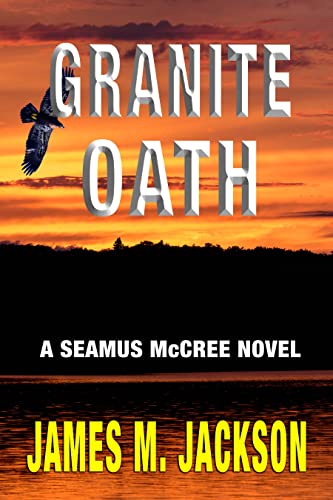
A Review of James M. Jackson's Granite Oath by E. B. Davis


On a Thursday afternoon, Kat Serrano leaves work early, briefly returns to her remote trailer deep in Michigan’s Upper Peninsula woods, and drives off with no explanation to her family. Two days later someone ransacks the trailer.


Kat is a Dreamer, and her mother won’t talk to the police for fear she’ll be deported and lose her 8-year-old granddaughter, Valeria.


Valeria is devastated by the events. She and her best friend from summer camp, Megan McCree, employ a “Pinky-swear” to get Megan’s grandfather Seamus McCree to learn what happened.


Seamus uncovers a tangled web of drugs, prostitution, and dummy corporations, and soon finds himself the target of killers. Anyone sane would wash his hands of the mess or turn it over to the police.


But Seamus has given his word, his granite oath, to learn the truth . . . even if it kills him.

  https://jamesmjackson.com/ 

____________________________________________________________________

Jim Jackson’s main character Seamus McCree gets himself into situations that are most unlikely, and yet, seem like natural consequences of a normal life. Maybe that’s why I like Seamus. He’s a normal, good guy—he tries to lead a moral life, isn’t a goody-two-shoes, and debates about what actions he’ll take that will damage his soul. In Granite Oath, Seamus babysits his granddaughter Megan at his U.P. residence while his son and daughter-in-law are on a rafting trip in Colorado. At a local art camp for kids, Megan meets Valeria, who is the child and grandchild of illegal aliens—there began his plot and my education.


I didn’t know what a Dreamer was, and, of course, had to try a few times before I got the right definition. Jackson assumes we know more than we do, but that’s okay because it forced me to look up various topics. He provides some explanations, but I wish he would spell out acronyms at least the first time he uses them so we have a clue. I learned about DACA, ICE, a lawsuit found against the state of Texas, Rembrandt, the difference between a pier and a dock (couldn’t confirm that difference via dictionaries), that female eagles are larger than male eagles, there are no poisonous snakes in the U.P. (hard to believe!), UPSET, a thirty-eight-acre fungus (nightmare?), and more. There’s a lot to learn and most of it is fun stuff.


Meth makers who steal propane from local properties used sporadically as vacation camps complicate Seamus’s investigation. Finding Valeria’s mom and protecting and hiding Valeria and her grandmother are Seamus’s main goals. He calls Niki, a former FBI undercover Special Agent and also his lover, to help investigate. Then his half-sister, Colleen, flies in from Boston to assist him by using her accounting skills to audit a business’s books and pole dance. As the plot unfolds, the pace picks up, which means by the time I was half way through the book, I was glued. Seamus’s mom, Trudy, my favorite character, makes an appearance.


I recommend reading Granite Oath. It’s fast paced. Even if you don’t always agree with Seamus’s opinions, you will learn a lot about our immigration laws, agency policies, and the realities of living in Michigan’s U.P.

                                                                                                                                                    E. B. Davis

Tuesday, August 16, 2022

Granite Oath, a New Seamus McCree Novel by James M. Jackson

Interview with Paula Gail Benson


James M. Jackson has written seven books featuring his financial crimes investigator, Seamus McCree. In Ant Farm, Seamus uncovers who poisoned thirty-eight retirees at a Labor Day picnic. His own home in Cincinnati is a crime scene in Bad Policy, and secrets about his father’s involvement in the IRA come to light. He retreats to Michigan’s Upper Peninsula in Cabin Fever only to discover a naked woman on his porch during a blizzard. Doubtful Relations finds him taking a road trip to Savannah to investigate his ex-wife’s missing current husband. In Empty Promises, he loses a witness he was hiding, his granddog finds a buried human bone, and the police uncover a dead body. He returns to Boston in False Bottom where, while serving as executor for his uncle’s will, he learns more family secrets.

In his latest adventure, Granite Oath, Seamus agrees by “pinkie swear” to “work” for his eight-year-old granddaughter and her best friend in order to find the best friend’s missing mother.

When he realizes he will have to provide refuge for the best friend and her grandmother, who speaks little English, Seamus consults his ex-wife Lizzie, who tells him, “One of the most lovable and most frustrating parts of you is your willingness to take on other people’s battles.” Further, she says, “You damn McCrees turn a pinkie swear into a granite oath that nothing less than a glacier can crush.”

Has Lizzie’s description accurately described Seamus character or is she simply expressing an ex-wife’s dubious perspective?

A little hyperbole never hurt anyone, right? But Lizzie has put her finger on one of Seamus’s core beliefs: his word is his bond. He’s imperfect, and he suffers greatly when he does not live up to his own expectations 


Most people wouldn’t think about illegal immigration being a problem in Michigan’s Upper Peninsula. Where did you get the idea for this book?

I wanted to write a story that involved Megan because that girl is going to change the world some day. She’s eight; how would she get Seamus involved in an investigation? What “problem” would be large enough to justify a novel. A friend’s missing mother worked, but then why involve Seamus and not the police?

Because the friend wouldn’t go to the police if they were afraid of them, which sadly is the situation in many places where bashing immigrants makes good political theater, and the threat of deportation is real.

What types of research did you do to learn about United States’ immigration law and policies and the problems faced by illegals in this country? What did you learn that surprised you?

I believe I first met illegal immigrants when I was working a summer job after high school supporting VISTA (Volunteers in Service to America) in migrant labor camps in Upstate New York. I have been interested in understanding how throughout the course of US history, in a “representative democracy” the wealthy have maintained a stranglehold on the reins of power. One of their levers has been to exploit cheap labor.

The cheapest labor comes from those with no ability to affect the political process and who have little legal recourse. In early years, businesses could utilize slaves, indentured servants, and child labor. Now they prey on illegal immigrants and often inmates (current through prison labor or former through restrictive laws).

I can’t say anything surprised me after seeing the horrific images over the last decade from our southern border and watching an ineffectual national political response. I had forgotten, though, that Massachusetts passed the first deportation Act in 1794 after it “suffered” a rush of poor Irish immigrants.


Seamus has a lovely relationship with his granddaughter Megan. Is that based on relationships you’ve had with grandchildren?

I get to claim Jan’s grandkids as mine. The youngest is a rising senior in high school. Their parents have raised independent-minded young people of whom I am proud. Whenever I could, I took it as my responsibility to stretch their boundaries in ways that brought no harm but may not have been kosher.


Many strong women, younger and older, inhabit
Granite Oath. What inspiration do you use to write female characters?

You stumped me, Paula. I’ve never thought about how I write female characters. I think I treat all my characters the same: each is an individual with desires and goals, strengths and weaknesses, varying ways of dealing with obstacles. That said, I can’t imagine Seamus wanting to be friends with anyone who didn’t have their own opinions or who followed three steps behind their partner, eyes focused on the ground. As a result, to become a continuing character (male or female) you must be strong.

Your setting is very much a part of your story. In the acknowledgments, you mention that you have created a number of the locations and businesses referenced. How do you determine what factual details to include and what to fictionalize?

I love reading stories that use real settings, especially if I have knowledge of them. My inclination is to use actual locations and businesses whenever I can, but not to allow geographic “facts” to hamstring the story. When I use real businesses, I make sure nothing bad happens in them, and that I never diss an owner. If an enterprise is at all controversial, I’ll create a fictitious one and locate it at some distance from any similar real enterprises.


As your editor, you call Jan Rubens your “first, last, and best reader.” What is your practice for working together? Does she see early drafts of your manuscripts?

The first time Jan sees a manuscript is after I think I have solved all the plot and character issues. That’s usually draft two, sometimes three. She puts on blinders to ignore my lousy writing and tells me what does not work or where action c-r-a-w-l-s. I make those changes, semi-polish, and send the manuscript to an outside developmental editor for an independent review. After I address whatever issues she finds, I polish, and then Jan copyedits. I take 90+% of her suggestions, and then we independently proofread. My faithful eagle-eyed readers then find all the stuff I missed (because when you are too close, you read through errors).

Then comes the relationship-challenging part of the process. I fix those typos, layout the book for print and Jan proofreads again—and finds things that need improving. By that point I want to be done, done, done with the book. After swearing I will never write another novel again, wondering what made me think I could write one in the first place, vowing that I’d rather drink lye than deal with one more improvement, I buckle down and make the changes. We both proof again (and find a couple more typos – and still there will be at least one in the book, I know).


One lovely part of your series is that you allow Seamus to experience parts of the country and world where you have lived or visited. Since you are taking a trip to Iceland, do you imagine that Seamus may follow in your footsteps?
             

I have no plans to take Seamus abroad. Although I have traveled to many interesting places, the thought of dealing with foreign laws is enough to squash any thought I might have. My plans for the next book in the series (assuming this one sells well enough to justify a next book) is to have Seamus and his nemesis the Happy Reaper meet and compete one last time.

BIO:

James M. Jackson authors the Seamus McCree series. Full of mystery and suspense, these domestic thrillers explore financial crimes, family relationships, and what happens when they mix. August 2022 brings publication of the 7th novel in the series, Granite Oath. (Click here for information and purchase links.)

Jim splits his time between the wilds of Michigan’s Upper Peninsula and the city life in Madison, WI. You can find more information about Jim and his books at https://jamesmjackson.com or contact him via email.

James M. Jackson


Monday, May 27, 2019

ON WORDS PROFANE AND NOT PROFANE by Nancy Eady


Profanity – Blasphemous or obscene language
Obscenity - An extremely offensive word or expression
From en.oxforddictionaries.com
            Among the controversies of the day, one issue rarely discussed any more is the use of obscene or profane language in fiction. Writers must decide what type of language their characters use. After all, a kindergarten teacher probably won’t use the same language as an inner-city cop working undercover on a drug case - if either of them spoke like the other, it wouldn’t be believable. The problem writers have is balancing realistic language with our readers' tolerance level. 
            That being said, I do NOT like books, TV shows or movies where profanity is used just to use it. On the other hand, neither will I refuse to read a book because some of the characters use the kind of four letter words my mother never expected to hear from my mouth. And, if I’m going to be completely honest, never have I hit my hand with a hammer or suffered some other painful injury and yelled, “Verily, verily, I hurt.” The day I slammed my hand in the door, not only my immediate neighbors but the ones three and four streets away received a rudimentary education in four letter words. Unfortunately, I slammed the door with my hand inside, and the rest of me outside, so the sound carried quite well.
            Mysteries come in all shapes and sizes, multiple genres, diverse settings, different language. For example, our own Jim Jackson has recently published his latest Seamus McCree novel, False Bottom. As Jim explains in his upcoming interview with Elaine Douts this Wednesday, “I tell gritty stories and many of my characters curse. I won’t change them.” That makes sense as the following quote from his character, the self-styled Happy Reaper, demonstrates:

He kept the radio tuned to news radio WBZ for anything useful related to Jerome Rozelle’s attack on Elisabeth. If he heard one more fucking political message, he’d shoot the jerks as a public service. Once he completed this job, he was vacationing abroad until the election was over. In his biography, Mark Twain had attributed to Prime Minister Disraeli the statement that there were three kinds of lies: lies, damned lies, and statistics. When today’s politicians spoke, it was a question only of which lie they chose. He supposed that since he didn’t vote, he shouldn’t complain—still, if political ads weren’t cruel and unusual punishment, what was?


James M. Jackson, False Bottom, Kindle Loc. 3521
            Equally, it makes sense in other settings and stories, the characters don’t curse. For example, my novel, Gambits and Games, (still seeking a home, by the way) is set in the small-town South where some men still apologize if they use curse words in front of a woman. (Really, they do; as recently as two weeks ago, I sat in a meeting where some strong language was used, only to have the sentence followed up immediately with an apology to me.)
            For example, my protagonist, Penny, makes the following observations about a politician as she walks into the courtroom:

A pit opened in my stomach when I saw Jim Krey, the state’s Attorney General, sitting at the prosecution table. Under normal circumstances, he wouldn’t stoop to handle a local prosecution. I wondered if he wanted to use William to punish me, but then dismissed the thought. Jim Krey had made it obvious for years he considered me beneath his and his family’s notice. A stranger observing him at the counsel table would see only a conscientious public servant. I knew better.
However, the unwritten rules of court etiquette in Alabama require opposing counsel to greet one another cordially, so as William sat, Boyd and I walked over to the prosecution table.

            But the fact that my characters in this book don’t use a lot of swear words doesn’t mean that down the road I won’t write another novel or story where characters do.
            The language our characters use gives the readers a clue both to the world the characters inhabit and to their own personality traits. The language the characters use both to speak with and to think with is an artistic choice the writer makes to help accomplish those twin goals.
            What is your tolerance for profanity? Would you refuse to read a book based upon the language used or not used? Have you read a book that is outside of your comfort zone where the language contains more or less swear words than you would normally encounter, and if so, what did you take away from the experience?

Sunday, April 21, 2019

A Seamus McCree Compendium

by James M. Jackson

It will come as no surprise to long-time readers of the WWK blog that my heart belongs in the northwoods. It’s where Jan and I retired and is our official residence. Because of the remoteness of our place in Michigan’s Upper Peninsula, we don’t live there the whole year. For at least a decade, Jan has called the place we live in during the winter months “home.” She calls our U.P. residence “camp”—it’s the name locals assign to any abode in the woods outside town, regardless of whether it is a tarpaper shack or a Rockefeller mansion.

I call our U.P place “home” and refer to our winter abode by the name of the city in which it is a part. “We’re going to our Madison place,” I say.

Because Seamus has wandered around since growing up in Boston, I’ve set novels in Ohio (Ant Farm & Bad Policy) and Michigan’s U.P. (Cabin Fever & Empty Promises). Doubtful Relations traveled from Ohio to New Jersey with stops in South Carolina, Georgia, and North Carolina in between. The novella, Low Tide at Tybee, occurred on Tybee Island, Georgia. I’ve set short stories featuring Seamus in the U.P. and Chicago.

When talking with readers, one question I often am asked is where I’ll set the next Seamus McCree novel. It turns out I’m not the only one with geographical preferences. Ohioans want a return to Cincinnati and Chillicothe. Those who love the northwoods want it set there. Others want Seamus to visit their favorite area to live in or read about. False Bottom (May 2019) takes place in the Boston area and includes a short side-trip to Cincinnati.

Northwoods fans are disappointed. I’ve also discovered in talking with them that they often read Cabin Fever first and jump to Empty Promises. Some will then pick up other books in the series. Others return to reading William Kent Krueger or Steve Hamilton or CJ Box with the promise that if I write another novel set up north, they promise to pick it up.

I have an idea for a seventh Seamus McCree, which I’ll set in the U.P. In the meantime, I prepared a compendium to satisfy new Seamus McCree readers who prefer stories set in the wilds. It will include Cabin Fever and Empty Promises, and two short stories. “Accidents Happen” was Seamus’s debut in print and takes place in the same area of the U.P. I plan to include a bonus story, “Homework.” It’s a coming of age story. While it doesn’t feature any of the McCree clan, it is set in the U.P., and Jan says it’s her favorite of my short stories.

The compendium experiment needs a title. I considered using the latitude of the nearest town to Seamus’s U.P. camp: 46°14’ and a subtitle like Seamus McCree in the Northwoods. Or maybe I should try Seamus McCree U.P. North, playing off the using the Upper Peninsula for “up” and moving Seamus McCree into the title. I’m accepting suggestions . . .

* * * * *

James M. Jackson authors the Seamus McCree mystery series. False Bottom, the sixth novel in the series—this one set in the Boston area—will be available in May. You can sign up for his newsletter and find more information about Jim and his books at https://jamesmjackson.com.

Sunday, August 12, 2018

Which Story Should Be Next?

by James M. Jackson

The sixth Seamus McCree novel, False Bottom, is with beta readers and soon will undergo my copyeditor’s red pen. For the first time, I have not already started another novel. I have three ideas, and I’d like your thoughts about which story I should pursue.

As followers of WWK know, I am a pantser, so when I start a novel, I know the inciting incident, but don’t really know where the story will take me. That said here are the three concepts:

Seamus McCree #7: It’s the “G” title in the series, and I already know what the title would be. (I’m not telling because my newsletter readers get that kind of news first!) Seamus’s granddaughter, Megan, is spending much of the summer at Seamus’s camp in the Upper Peninsula of Michigan. When he picks Megan up after a playdate in town, she wants to hire her grandfather to find out what happened to one of her playmates who has gone missing. Seamus eventually accepts Megan’s employ and discovers a child in desperate need, an underground economy he knew nothing about, and forces that will stop at nothing to protect their enterprise.

While the Seamus McCree novels have received very favorable reviews (the series averages 4.32 on Goodreads and 4.67 on Amazon), it isn’t exactly a best-seller.

Alternative two is to start a new series, and my idea is a spinoff from the Seamus McCree novels. Those who read Cabin Fever (Seamus McCree #3) met Niki (single name, spelled with a single ‘k’). [Spoiler alert] She’s an undercover FBI agent who would rather get the job done then kiss ass and play politics. Her background is murky, so what would happen if I gave her a billionaire father who believes his kids should make their own way in life. He’s in the middle of fending off a takeover of his business and is kidnapped.

Naturally, the FBI refuses to let her get involved because she’s family, and she goes rogue. She brings in Seamus McCree to help understand the financial aspects of the takeover when it turns out her father has given her power of attorney. Seamus is a minor character, though, since this would be the kickoff of a new thriller series staring Niki. The series titles would be something like Niki Goes (fill in the blank) – for example Niki Goes Rogue or maybe Niki’s (fill in the blank) – for example, Niki’s Billionaire Father.

The third alternative kicking around in my head is to switch from modern day suspense/thriller to a dystopian YA trilogy. I’ve been playing with this idea for some time. I know something about the world: The US has split into East and West with flyover country acting as a buffer. Split into enterprise zones, the middle of the continent supplies food and raw materials to the East and West. Interpretation of the US constitution has morphed so that only corporations have voting rights. The heroine will come from what used to be Michigan’s Upper Peninsula.

My problem with not working on this earlier continues to be that I try to be a plotter and scope out the trilogy before making any further false starts. (Several years ago, I wrote 30,000 words. It wasn’t working, and I stopped.) I am a committed pantser and will need to write the stories to learn what they are. One big difference in this case is I do know how the world changes by the end of book three, so I would be writing with that ending in mind. (Of course, by the time I am done, it might change!)

Given those three choices, which would you prefer I tackle? Vote in your comments:

[1] Seamus McCree #7 featuring granddaughter Megan and set in the U.P.

[2] Niki #1, a domestic thriller dealing with family, corporate power, and a take-no-prisoners heroine.

[3] Dystopian YA trilogy featuring a young woman in a world where the US has broken in two countries and corporations rule.

---------

James M. Jackson authors the Seamus McCree mystery series. Empty Promises, the fifth novel in the series—this one set in the deep woods of Michigan’s Upper Peninsula—is now available. You can sign up for his newsletter and find more information about Jim and his books at https://jamesmjackson.com.

Wednesday, April 4, 2018

James M. Jackson Interview by E. B. Davis


“My car’s parked around the corner,” I said. “Do you want to talk there? We’d
eliminate the interruptions, although I would understand if you didn’t want to
get into a car with someone you don’t know well.”

Again, she waved off my concern. “Oh fiddlesticks. You start anythin, I’ll just shoot ya.”
At my startled expression, she tapped her purse. “Concealed-carry permit.”
James M. Jackson, Empty Promises, Kindle Loc. 2726

If you love the suspense and plot twists of domestic thrillers, this page-turner is for you. Seamus McCree’s first solo bodyguard assignment goes from bad to worse. His client disappears. His granddog finds a buried human bone. Police find a fresh human body.
His client is to testify in a Chicago money laundering trial. He’s paranoid that with a price on his head, if the police know where he’s staying, the information will leak. Seamus promised his business partner and lover, Abigail Hancock, that he’d keep the witness safe at the McCree family camp located deep in the Upper Peninsula of Michigan’s woods.

Abigail is furious at his incompetence and their relationship flounders. Even his often-helpful son, Paddy, must put family safety ahead of helping his father. Seamus risks his own safety and freedom to turn amateur sleuth in hopes he can solve the crimes, fulfill his promise of protection, and win back Abigail. Wit and grit are on his side, but the clock is ticking . . . and the hit man is on his way.


Empty Promises is the fifth book in James M. Jackson’s Seamus McCree series. From page one, I was engrossed. There was no sagging middle. Jim kept up the tension and plot twists throughout, which was the first aspect of his writing that made me take notice.

The second? Writers talk about using setting as character, but it’s a rarity when that concept is illustrated on the page. When I got to the twenty percent mark in my Kindle version of Empty Promises, I had the desire to go for a beach drive. After the Nor’easter, the beach erosion and high surf didn’t make that a go-to place, but still, I had the urge. I realized then the basis of my desire. Jim’s book had me so enmeshed under the forest canopy, driving on Seamus’s ATV over logging roads of Michigan’s UP, that a beach gal like myself had to escape the dense vegetation to the open ocean. Setting as character—a quietly sinister and smothering one, Jim creates well. 

And the third? I can’t tell you. But I think Empty Promises is a pivotal book in the series. How will that play out? I’ll be reading and watching. This is an exciting series that’s gathering momentum. It’s also fun to see a friend develop his writing strength.                                                                    E. B. Davis

Like me, you set up house in a place that gives you peace—in Michigan’s UP. Although I love the beach and ocean, I also know that they are dangerous. Was it hard to render the menacing aspects of the forest from the lighter shades that you value, like its tranquility?

When the nearest doctor or hospital is forty-five minutes away, the dangers of our remote area must
be considered. Some people choose not to take the risk. The positives for me outweigh the possibility that if I experience an accident or medical issue that would be routine in the city, it could be fatal for me. I’d rather go that way than waste away in a nursing home. Everywhere and everything has light and dark aspects. Because it’s close at hand, I find it easy to tap into the darker nature of wilderness when it suits my writing needs.

Throughout the book, Seamus refers to the empty promises he’s made. But if he has made any, they are temporary, and he makes no promises he can’t keep. Why is he so mindful not to make empty promises or is he mindful because others have made empty promises to him?

Seamus, as do many sons who are young when their father dies, has issues with self-doubt and proving himself. His mindfulness of having made empty promises stems less from his own experience of others breaking their promises to him and more because he holds himself to a high standard regarding the value of giving his word.

“Everyone agrees that my decision to go into town that day cost one person his life.
Attribution for the other deaths wasn’t clear-cut, although I thought I also bore that guilt.” Kindle Loc. 1

I checked this statement throughout the book. I totally disagree! None of the deaths were his fault. Why does Seamus always take the blame? Who is “everyone?”

If something goes wrong while Seamus is in charge, he is quick—others would say too quick—to accept responsibility. Perhaps it’s hubris, but caused, I think, by that self-doubt we discussed earlier. That said, we should always be skeptical of hyperbole masked by statements that include everyone, always, never and other absolutes.

I don’t want to give away a key plot point by justifying his statement about the death that he attributes to his going into town that day. I’ll contact you privately with my response (and am happy to do so with anyone else who has already read the book!).

Abigail, Seamus’s business partner and long-term love, thinks in absolutes. Seamus works the angles and sees shades of gray. What is the attraction between the two when they think so differently?

The expression “opposites attract” might fit here. Besides the joint sexual attraction, Seamus appreciates strong, successful women. He truly seeks a life partner, not someone to dominate. Seamus is impressed by Abigail’s confidence in herself and her decisions—even to the extent of downplaying his more nuanced understanding of life.

Abigail assigns Seamus the task of guarding “Elliot,” who they later find out is really named Jason. Seamus “loses” Elliot when he goes to town. Abigail is so incensed, she breaks their business and personal relationship. Do you mix business and pleasure? If you have, did it work out?

I am incredibly impressed when couples can run a business together and stay married. It would have been hard for me to come home from work and not have someone to whom I could complain about how things went at the office. I dated a few coworkers when I was young, but that never worked out. Abigail built her bodyguarding business by herself and is proud of its reputation. But, as many successful entrepreneurs do, she wrapped her self-identity in it. She felt a lot of pressure having Seamus as both business and life partner, and this incident may have been the proverbial straw that broke the camel’s back.

Vocabulary Time! What are?

NIMBY: Not In My Back Yard—a person who objects to having something perceived as unpleasant or potentially dangerous placed in their own neighborhood (an open pit mine in this case), especially while raising no such objections to similar developments elsewhere.

moose tracks ice cream: Smooth vanilla ice cream with peanut butter cups and Moose Track fudge. I agree with Megan, yum!

generation-skipping estate tax move: Upon the death of the owner, assets skip their children and go to grandchildren (or great-grandchildren), ultimately saving on multiple layers of estate tax. Only needed by those with a lot of moolah.

widow-makers (trees?): Trees whose tops have broken off. The tops are held up by another tree. Eventually wind or gravity bring them to the ground, sometimes with fatal consequences.

popple (which means tumbling like boiling water-a verb) tree: In the Upper Peninsula of Michigan, aspen trees are called popple.

rainstick: A long, hollow tube filled with small nuts, beans, or stones. When you turn a rainstick on its end, the filling falls to the bottom, producing a sound like rain.

the composition of glacial debris: Glaciers pick up stones, rocks, and boulders as they move south. When they melt, they leave this glacial debris behind.

TOR, the Navy’s “onion router”: TOR is short for “The Onion Router.” TOR directs Internet traffic through a free, worldwide, volunteer overlay network consisting of more than seven thousand relays to conceal a user's location and usage. The original concept was developed by the Navy.

Pine Marten (a mammal?): Yep, they are about two-feet long from tip of nose to tip of tail. They’re
related to weasels and are great tree climbers.

Faraday bag: It blocks electromagnetic fields so signals from your electronic device can’t escape. For example, if you don’t want your cell phone tracked, which can happen even if you have it turned off, you can store it in a Faraday bag.

I was surprised the Happy Reaper, a hit man Seamus has encountered in previous books, could use drones effectively in the forest. I would have loved for your setting-character to have messed with him. Have you flown drones?

My drone knowledge comes from reading. Drones are used in a variety of ways by large forest owners to monitor forest conditions, inspect insect damage, direct wildfire management, and perform a host of other activities. The only real difficulty of using them in a forested area is taking off and landing; otherwise they fly above tree level.

Knowing bird behavior, Seamus uses bird watching as a guise to his advantage during surveillance. How does that help him?

Walk a dog in the suburbs and no one will report you to the police as a suspicious character. In rural areas you can use birdwatching to the same effect. Seamus’s birdwatching knowledge has also provided him clues others might not recognize. Throughout much of the world, birds are the first scavengers of dead animals—nature’s large-scale recyclers. In the winter, as was the case in Cabin Fever, Bald Eagles are the main scavengers. In Empty Promises, which takes place in summer, Turkey Vultures and Common Ravens play that role. Knowing that can lead the curious to discover dead animals.

Birds are aware of everything going on in the woods, and when something they don’t expect happens, their reaction is often to go silent and freeze in place until they can figure out whether they are in danger. Being aware of that behavior, as Seamus is, can tip you off to something unusual happening in the woods around you.

Seamus hates coffee and golf. Do you?

I don’t drink coffee, but during my working years, I used to play golf moderately well. For those who care, my handicap was 12. Once I retired, I stopped playing golf because I no longer needed an excuse to be outside.

Other than his skewed values as a hit man, the Happy Reaper seems an intelligent, logical, and well-rounded sort. He even likes coffee. Does this “normal” man have the makings of an archenemy?

If you forgive the Happy Reaper his profession, there is much to admire about him. He has reached the pinnacle of his profession through hard work and perseverance; he continues to hone his skills to stay on top; and he guarantees his results. He’s the epitome of the Protestant work ethic—other than that pesky detail about not killing. I hope I have made him a worthy antagonist.

“That’s enough excitement for one day. Right pumpkin?” [Seamus says to his granddaughter.]
“Right!” Megan parroted.
Except it wasn’t. Not even close.
Empty Promises, Kindle Loc 158

How do you know when and where to use foreshadowing effectively?

Until readers are fully hooked into a story, it’s important to encourage them into the habit of turning to the next page, next scene, next chapter, until at some point they are fully invested in your story. The first sentence must be good enough to make readers want to read the second sentence. The first paragraph must be strong enough to get them to read the second. For print books, I hope to layout the first page so it ends in the middle of a sentence, encouraging them to turn the page. (With electronic books, I don’t have this control because readers set their own margins and font size.)

If I’ve taken the reader with me over those first hurdles, the next big test comes at the end of the first chapter. That’s where the quoted lines come in. I hoped to accomplish several things with them. (1) Let people know that, even though when they turn the page they’ll discover a second point of view, the characters they have been following aren’t done for the day. (2) Introduce an expectation that further trauma is coming soon to the McCree clan. (3) Subtly suggest (and this is the foreshadowing aspect) that Seamus has no clue what is about to happen—and neither do you, dear reader, so please continue my magic carpet ride.

The technique is a bit of intrusion into the story. I’m borrowing future knowledge to try to convince the reader to stay with me by promising it will be worth their time. I felt I needed to take the risk of this intrusion because the next chapter would break the current storyline and introduce a new POV.

A little of this technique goes a long way. As a reader, I’m willing to grant an author this kind of intrusion once or twice early in the story. More often or later in the story, and my antennae go up—I begin to wonder if the story needs this kind of infused tension because there isn’t enough actual tension inherent in the story.

It reminds me of a story my minister told when he was looking through his father’s old sermons. In the margin of one was the note: raise voice here—point weak.

Do grandchildren remind grandparents of how important their lives are in terms of role models or in how they will be remembered? Is it a promise to the child—part of inheritance?

The cynical part of me thinks that how our grandchildren turn out reflects how well we raised our children, and so we invest in them to prove we did well by our own kids. Equally cynical is the thought that perhaps we are still in a power struggle with our children and spoiling our grandchildren is one way of doing battle. Then there is the issue of our impending mortality. We have meaning only as long as someone still remembers us. Our grandchildren will be around longer than our kids, so perhaps we are trying to promote a positive image to enhance our long-term status.

My less cynical self suggests that by the time most of us are grandparents, we know our ability to affect major changes is (almost) over. The world’s hope is the kids, and so we want to share our experience to try to give them a leg up as they search for their place in the world. And our subversive selves try to counteract the “errors” our children are making raising their children. That’s why we spoil them and teach them to drive a car when they’re 11.

Have you plotted your major characters’ arcs throughout the series?

I am a pantser and my characters continue to surprise me. For example, I had no clue until Cindy became pregnant that Paddy would become Mr. Mom, or that Seamus, who some have called a curmudgeon, would become a doting grandfather.

The one exception to that is Seamus’s mother. I’ve delved into her soul and plumbed her secrets. I understand just how far she will go to protect them. Those secrets and what she has and will do to protect them are the engine of McCree family dynamics. Despite the series consisting of suspense stories and thrillers, their heart is the McCree family—how they relate to each other, and how they change from those interactions.

“Breaking out of the woods several yards away from the vehicle, he [Happy Reaper] recognized its cant meant two flat tires. “Strike three,” he muttered. “No more Mr. Nice Guy.” (Kindle Loc. 3654) How would Seamus respond to this comment?

Seamus would not be surprised. He knows he has crossed a line that he can’t uncross when it comes to his relations with the Happy Reaper.

What’s next for Seamus and where will he be located?

The sixth Seamus McCree novel is titled False Bottom. It takes place shortly after the completion of Empty Promises. Uncle Mike O’Malley, Seamus’s surrogate father, is gunned down. Seamus returns to his Boston roots to handle the retired Boston police captain’s estate. He discovers Uncle Mike left him more than just stocks and bonds to worry about. The secrets and intrigue put the entire McCree clan at risk.