Showing posts with label Mary Feliz. Show all posts

Saturday, July 7, 2018

Books Worth Re-reading by Mary Feliz

What makes me drop everything and read? Fine writing. Clever plotting. Compelling characters. Intriguing settings. And, most of all, original combinations of all of the above.

The following is a list of some of my favorites. If I tried to create a similar list tomorrow, different books might be on it. But in creating the list I discovered something that had previously escaped me: I like books with a hopeful perspective and diverse characters.

So it should be no surprise that in my own books, I’ve recreated elements of the stories I love best—those with intelligent but flawed characters who value truth and justice. My story people aim to treat other people well, but sometimes fall short. They find their own strength when they remember they can’t do it all and they succeed only when they relinquish control and remember to value the contributions of others.

Understood Betsy, Dorothy Canfield Fisher

Its plot has become a cliché, but when I first read it, it was new to me and novel. Like Anne of Green Gables, Betsy is an odd child who comes to understand and treasure herself at the same time she’s struggling to be appreciated by those around her. It’s a story retold in everything from fairy tales to Harry Potter. I’ve loaned my copy to adolescents for years, but it’s one book I always insist they return.


Chitty-Chitty-Bang-Bang, Ian Fleming
Reading this book pops me right back onto the carpet in front of the fire in my childhood living room, listening to my father draw out the cliffhangers in delightfully painful fashion. It’s an episodic thriller, but it’s also the story of a family working together to solve problems, respecting the contributions of each family member. The movie was a mess, but the book is a treasure.

A Wrinkle in Time, Madeleine L’Engle
I fell in love with the Murry family, their kitchen, and Mrs. Murry’s laboratory and immediately searched for additional installments in the series. Each story person is complex and layered with positive and negative qualities. There are no easy answers to the struggles of the young people, but surrendering to the scary power of honesty and love moves them closer to their goals.


The Moonstone, Wilkie Collins
Considered first detective novel, this Victorian romp is multi-layered with subtle humor and a sleuth
determined to bring the guilty to justice. The story gives voice to those who weren’t always heard within the strict confines of 19th century class strucure. The mystery is revealed by eleven narrators, each with a unique voice and viewpoint.


The Black Echo, Michael Connelly
Vietnam Veteran, Tunnel Rat, and Los Angeles Detective Harry Bosch is a flawed man who breaks the rules and defies authority in pursuit of the truth, determined to uphold his code: “Everyone counts or no one counts.”


Still Life, Louise Penny
Like Bosch, Chief Inspector Armand Gamache is a man with a code, determined to teach his subordinates to wield four sentences taught to him by his own mentor: I was wrong, I'm sorry, I don't know, and I need help. Though Gamache himself sometimes struggles with those concepts, the detective and the books are hopeful, holding white-knuckled to the belief that love always wins in the end.

The Cold Moon, Jeffrey Deaver
Lincoln Rhyme is abrasive, impatient, and intolerant. He resolves every case with cold hard evidence. To solve one of his most difficult cases, Lincoln, who mistrusts all witness testimony, must join forces with Kathryn Dance of the California Bureau of Investigation who eschews easily tainted forensic details and relies on witness micro-expressions to solve crimes. Kathryn and Lincoln are two sides of the same demanding coin, but that makes it difficult for either one to appreciate the other’s perspective. But unless they join forces, they’ll never bring down the Watchmaker.


What books, movies, or television shows do you turn to again and again, like renewing an old friendship or indulging in comfort food?

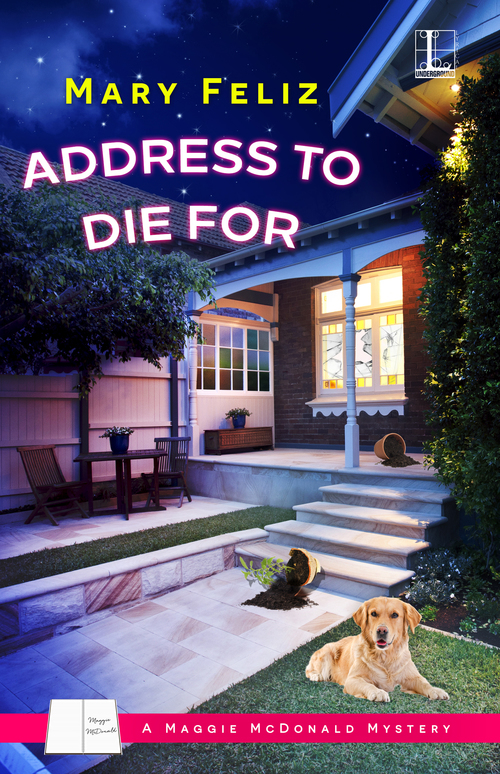
Mary Feliz writes the Maggie McDonald Mysteries featuring a Silicon Valley professional organizer and her sidekick golden retriever. She's worked for Fortune 500 firms and mom and pop enterprises, competed in whale boat races and done synchronized swimming. She attends organizing conferences in her character's stead, but Maggie's skills leave her in the dust. Address to Die For, the first book in the series, was named a Best Book of 2017 by Kirkus Reviews. All of her books have spent time on the Amazon best seller list. The fourth book, Disorderly Conduct, releases July 10, 2018. http://a.co/2T1QjVV

Wednesday, July 20, 2016

An Interview with Mary Feliz By E. B. Davis


Mary Feliz can’t like her main character, Maggie McDonald, very much. In the first few chapters, Mary throws so many problems at Maggie, she should be in a catatonic state. The cozy element in Address To Die For, released on July 17th, is in Maggie MacDonald’s mind. She yearns for a simple lifestyle for her family, a comfortable place to live (a few hundred miles away from her mother), being a supportive wife and mother, running her own business, and a porch rocker in which she can sit to plan and organize.

I can identify with Maggie. Since I just moved and started the construction of an addition to our home, chaos abounds. But unlike Maggie—we are body free—so far. Welcome to WWK, Mary.                                        E. B. Davis

Thanks for hosting me here, E.B. I just completed a remodel myself, so I can sympathize!

Maggie McDonald, your main character, is a professional organizer. I have a hard time comprehending that there is such a thing as the professional organizer profession. Does the National Association of Professional Organizers have an estimate of how many professional organizers practicing in the US? NAPO is a wonderful organization that works hard to make sure that their certified POs really know what they are doing and adhere to a high standard of ethics.  Their membership exceeds 4,000. POs don't all do the same thing. Some specialize in helping a move or downsizing effort go more smoothly, others will jump in and help you organize a big project--like going paperless or digitizing your photos or getting your garage, kitchen, closet, or attic under control. Or finding an organizational system that works for both parents and kids -- and minimizes arguments! Organizing is a skill that all of us are "supposed" to have, but many of us just don't -- or don't have the time to manage properly. POs can help streamline and guide the process.

Is Orchard View a real place? Orchard View is a mash-up of a number of Silicon Valley towns,including Los Altos, Los Altos Hills, Parts of Mountain View, Parts of Palo Alto, and parts completely fictional. I wanted to use real roads and landmarks to orient myself and the story, but I needed to make the town, businesses, police department, school system, politics, and characters completely my own. No person or organization in the book is meant to represent anything that exists in reality -- though I hope they seem very real. Even the landmarks that are real are placed in a fictional geography. For example, if there's an element of a small own that I want in Orchard View, I may pluck it from another location and set it down where I want it. I've placed Maggie's house and the public land behind it closer to Stanford University than reality might indicate.

The home Maggie McDonald’s family moves to, the house, barn, and two acres, is worth fifteen million dollars. Is this typical of the Silicon Valley area property prices? How does anyone afford to live there? I'm afraid so. You can check that on any one of a number of real estate apps. Relatively ordinary and modest homes on small lots can easily cost more than $1 million. It's one of the nightmares of Silicon Valley. Parents wonder how their children will ever be able to settle nearby. High-tech salaries and a lack of available land and housing drive the prices, but communities can't live on high-tech alone. Many people commute two hours or more to get to work. Many more may share housing locally and work long hours three days a week before returning to their homes many hours away.

Is Officer Paolo Bianchi suicidal or just a manic sports enthusiast? Hah! He's one of my favorite characters, and outfitting his Subaru was such fun. Paolo is typical of active young men in the area. The weather is conducive to outdoor activities year-round, with beaches and mountains easily reachable. Silicon Valley homes may be small compared to similarly priced housing in other areas, but we don't spend much time indoors!

My favorite character, Stephen Laird, seemed like Maggie’s fairy godfather. Tell our readers about him. Stephen and his dog, Munchkin, are both wonderful. But their story unfolds slowly and carefully as the plot progresses. I fought my editors to keep every bit of their story in the book, so I'd hate to spoil that balance by revealing any of it outside the confines of the book.

You start each chapter with professional organizer tips. Where did you come up with those? Apparently my mother, father, and grandmothers could have been professional organizers! All of the tips are things I grew up doing. I assure you, however, that between Maggie and me, Maggie is the organized one.

The gas company in Silicon Valley has the final word on where kids go to school? Not really, though it sometimes seems that way. Where you live determines which school district you attend. But the school district boundaries meander with no regard to town lines. So, the best way to make sure that students are in the right place is to require parents to bring their gas bill with them when they register. The school then verifies that the addressee matches up with the parent of the student and that the address is within their district.

If there is so much money in Silicon Valley, why aren’t school programs fully funded? California school funding is very complicated and has a number of problems, with an exponentially larger number of spirited political opinions regarding how to solve it. It would take an expert volumes to explain and I'm no expert. But I'll try. Back in the 1970s, California underwent massive tax reform with Proposition 13. Prop 13 limits property taxes and limits the rate at which they can grow--so the property tax base in "Orchard View" is much smaller than you might expect based on the price of housing. Prop 13 also raised the bar for establishing new taxes, requiring 67% approval, so those who'd like to increase school funding face an uphill battle. Education taxes are collected by the state and distributed via a complex formula that means small wealthy bedroom communities like the fictional Orchard View often receive much less funding per pupil than neighboring districts with more businesses might receive. The original intent of the laws was to eliminate inequities in funding between districts, but that's apparently a very difficult problem to solve and still requires a great deal of work. Whether the problem rests with Prop 13 is a matter of debate, but California public schools went from nearly the best in the nation to near the bottom in less than a generation.

Is Tess Olmos a Gemini, she seems to have a split personality? In an early character sketch, I noted
that Tess's birthday is in December, so she's not a Gemini. (I had to look that up.) I know a number of people whose work persona is very different from their "at home" personality, and I wanted Tess to be someone that Maggie would originally be turned off by, but who would eventually become her dearest friend. I played with those ideas to create the barest skeleton of the character who would become Tess. Tess ran with the idea from there...and, as she is wont to do, took it to an extreme.

How did Maggie’s cats, Watson and Holmes, get their names? Maggie and Max are big fans of Sir Arthur Conan Doyle and Masterpiece Mystery. Cats have personalities that match up well to the discerning persnicketiness of the great detective and his sidekick.

You had me guessing, Mary. I thought I had a handle on the case when the first body was found, but when Maggie finds the second body, I couldn’t fathom a connection between the two. Do you use any particular method to plot? Have you plotted your series? I plot each book one at a time, which is required by my publisher. Authors often make distinctions between whether they are "plotters" or "pantsers," but I think that both designations end up describing a similar process. Plotting, writing, and editing are all important steps that take place at various times throughout the creation of a novel. 

How did you obtain a publishing contract, Mary? Kensington was looking for cozy mysteries and accepting direct submissions. I submitted and they accepted. That makes it sound easy, but I assure you that I have a large collection of rejections and a resoundingly rejected manuscript that resides in a box in my closet. I hope at some point to revise it based on all I've learned in the fifteen years since I originally wrote it. It's a young adult historical.

Are you a beach or a mountain woman, Mary? I love both, but if I had to choose only one, it would definitely be the beach. I recently moved close enough to the beach to have the waves lull me to sleep at night and to have permanently sandy floors!