Showing posts with label Joyce Tremel. Show all posts

Wednesday, March 15, 2023

An Interview with Joyce St. Anthony By E. B. Davis


As World War II rages in Europe and the Pacific, the small town of Progress is doing its part for the soldiers in the field with a war bond drive at the annual county fair. Town gossip Ava Dempsey rumors that Clark Gable will be among the participating stars. Instead of Gable, the headliner is Freddie Harrison, a B-movie star. When Freddie turns up dead in the dunk tank, Irene Ingram, editor-in-chief of The Progress Herald, starts chasing the real headline.
 
There are plenty of suspects and little evidence. Ava’s sister Angel, who was married to the dead actor, is the most obvious. The couple had argued about his affair with the young starlet Belinda Fox, and Angel was the last person to see Freddie alive.
 
Irene discovers there’s more than one person who might have wanted Freddie dead. As Irene draws on her well-honed reporter’s instincts to find the killer—nothing is what it seems in Progress, and now her own deadline could be right around the corner.

Amazon.com


Death on a Deadline is the second book in Joyce St. Anthony’s (Joyce Tremel) Homefront News mystery series. I’m attracted to this series because it is set during WWII, which I know something about because my parents were in their twenties during this era. There are very few mystery series set during this time. Irene is a plucky main character groomed for her editor-in-chief job by her father, who volunteered to be a war correspondent. Like many young women who stood in for men during the war, it is a challenge and an opportunity for her, and she succeeds.


Please welcome Joyce back to WWK.  E. B. Davis


Thanks for having me!


What attracted you to this era to set your series?

     I’ve always loved the WWII era. I blame it on my mother listening to her Big Band records. Her favorite song was Glenn Miller’s String of Pearls. I grew up loving the sound, the clothes, the hairstyles—just about everything. I really wish those clothes would come back in style!


Like those new opportunities afforded women during WWI, WWII not only provided opportunities, but proved that women were indispensable to the war effort. Were they given more respect than the previous era?

     I think they were for the most part, but like some of the men in the newsroom at the Progress Herald, they didn’t like it much. It was more tolerated than respected at times. It opened a lot of eyes to what women could do.


If Irene’s parents had had a son, would Irene have been given the same opportunity to fill in for her father?

     That’s a tough question. I hadn’t really thought about it. I guess it would have depended on whether the son had an affinity for writing, editing, and running the paper. If he hadn’t worked there, I think Irene’s dad would still have put her in charge. He was pretty liberal for the times. It would also have depended on whether the son enlisted after Pearl Harbor, like most of the boys did. And I wrote the books, so I’d still put Irene in charge, lol.


Irene’s mother seems a quiet person, but she also has to be a product of the Victorian era. Is she supportive of Irene’s progressiveness or does she just stay out of the way?

     In the first book, Front Page Murder, Irene’s mother gives her a lot of grief over Irene working an “unladylike” job. She comes around a little bit in Death on a Deadline, but still expects Irene to quit the job as soon as the war is over, get married, and have babies. Irene’s not buying it.


Hollywood seems to have headed up the war bond drive. Was it done collectively by studio or actors guild?

     It was a collective effort by a lot of Hollywood stars. The Hollywood Victory Committee began on December 10, 1941, three days after the Japanese bombed Pearl Harbor. The idea was to give stars who weren’t in the military a chance to contribute to the war effort. They would do bond drives, USO shows, and radio shows among other things. The first chairman of the committee was Clark Gable, who enlisted other actors to join in the effort. If anyone reads Death on a Deadline, you’ll see him mentioned on the very first page. The actual Hollywood Victory Caravan travelled across the country for two weeks in late April and early May 1942. I fictionalized the caravan a bit so it would fit into the story. There’s a fantastic book by Christian Blauvelt called “Hollywood Victory: The Movies, Stars, and Stories of World War II” that I highly recommend.


There are a number of young male actors like Kirk and Freddie. Why weren’t they drafted into service like the rest of the men?

     Some probably were, and some enlisted. Those who weren’t inducted were able to contribute in other ways like the Victory Caravan, other war bond drives, making movies and documentaries about the war, etc.


When Hollywood starlet Belinda Fox dresses and acts in a provocative manner, Irene’s mother is offended. Was overt sexuality by women a form of rebellion?

     Not necessarily. Women back then—and even earlier—weren’t much different than now. There’s just not as much stigma attached to being overtly sexual these days.


And yet—due to the need to conserve materials and fabric for the war effort, weren’t shorter hemlines encouraged?

     Clothing definitely became more streamlined during the war. Dresses went from mid-calf to just below the knee, fuller skirts to A-line, smaller lapels on jackets, etc. No silk or nylon stockings.


Did you base the character of Greta Gray on Hedda Hopper? Unbelievably, Hedda was born to a Pennsylvania Dutch family in Hollidaysburg, PA.

     Only loosely. Hedda Hopper was more likable and wasn’t purposely malicious. Greta is a nasty piece of work.


One of the problems Irene has when interviewing the suspects, most of whom are actors, is

that she doesn’t know if they are acting or not. Is it hard for people to trust actors? Like fiction writers, if they are good, everything they say could be made up.

     I don’t know any actors, but if they were any good, I imagine it would be hard to know if they were being truthful or not.


What did they do with blue and gold stars displayed in windows? Did the mothers form clubs?

     A blue star designates that the household had a family member in the service. There would be a star for each service member. A gold star meant a family member had been killed in action. There are blue and gold star groups across the country even today. You’ll still see those flags in people’s windows.


You start each chapter with a news headline. Are most of them real?

     All the war related headlines are real. It was not only a way for me to keep track of what day it was in the book, I thought it was a good way to inform readers about what had happened on those days. I used the Google News Archive to check various newspapers. The only fictional headlines were the ones related to the town of Progress and the goings on there.


Irene’s neighbor Richie becomes a war casualty after the Battle of Midway. His mother is in denial, and his sister becomes enraged at old classmate Eugene/Kirk Allen, who became an actor participating in the war bond rally. She contends he encouraged Richie to become a flyer. I was surprised. Did people play the blame game during WWII?

     I don’t want to give anything away, but there was a little more to Richie becoming a pilot than that. Richie’s sister also hadn’t realized that he’d always wanted to fly and Kirk wasn’t to blame. I’m sure the blame game happened on occasion. We all think that everyone supported the war effort, but if you dig into history, it wasn’t the case. Even after the attack on Pearl Harbor, there were still citizens who thought we shouldn’t get involved, and many were still in support of Germany.


Cousin Donny isn’t as contemptuous of Irene in this book. What happened? Did his ego get a needed boost?

     It did! He has a girlfriend now, which makes all the difference.


Irene’s friend Peggy seems content to play the sidekick. Will she be happy to become a homemaker/mother/wife after the war is over? How about Irene?

     I can see Peggy being a stay at home mom if she has children—at least for a while. Irene would never be content with it. At one point in the book she thinks if she ever has children she’ll just add a nursery to the newsroom. She is way ahead of her time!


Were there incidents of war bond money getting stolen from rallies?

     I’m not really sure. It’s one of those things that could have happened, though.


What’s next for Irene?

     I wish I knew! I was only contracted for the two books and I’m still waiting to hear if the publisher wants more. I really, really want to write more. I have a third book outlined so if my current publisher doesn’t want it, I’ll have my agent shop it elsewhere. I do have a contemporary series releasing in January 2024. The first book in the Cider House Mysteries is called Deadly To The Core and features a young widow who inherits a fruit orchard and opens a cider house. When her orchard manager is murdered with her walking cane, she vows to find the killer. I’m waiting on edits for that book at the moment, which I’ll be afraid to open. It needed a lot of work, lol.


Wednesday, March 2, 2022

An Interview with Author Joyce St. Anthony by Annette Dashofy

“Irene, sometimes things have to get worse before they get better.”

“So I am making it worse.”

“That’s not what I’m saying. You can’t just stop writing the news because you think it might hurt someone.”

Joyce St. Anthony, Front Page Murder

In this World War II-era historical mystery series debut by Joyce St. Anthony, small-town editor Irene Ingram has a nose for news and an eye for clues.


Irene Ingram has written for her father’s newspaper, the Progress Herald, ever since she could grasp a pencil. Now she’s editor in chief, which doesn’t sit well with the men in the newsroom. But proving her journalistic bona fides is the least of Irene’s worries when crime reporter Moe Bauer, on the heels of a hot tip, turns up dead at the foot of his cellar stairs.
 
An accident? That’s what Police Chief Walt Turner thinks, and Irene is inclined to agree until she finds the note Moe discreetly left on her desk. He was on to a big story, he wrote. The robbery she’d assigned him to cover at Markowicz Hardware turned out to be something far more devious. A Jewish store owner in a small, provincial town, Sam Markowicz received a terrifying message from a stranger. Moe suspected that Sam is being threatened not only for who he is…but for what he knows.
 
Tenacious Irene senses there’s more to the Markowicz story, which she is all but certain led to Moe’s murder. When she’s not filling up column inches with the usual small-town fare—locals in uniform, victory gardens, and scrap drives—she and her best friend, scrappy secretary Peggy Reardon, search for clues. If they can find the killer, it’ll be a scoop to stop the presses. But if they can’t, Irene and Peggy may face an all-too-literal deadline.

                                                                                     Amazon.com

 *************************************************************************************************************************

 Front Page Murder is so loaded with twists and secrets, I had a hard time coming up with questions that didn’t involve spoilers! Please welcome Joyce St. Anthony (AKA Joyce Tremel) to Writers Who Kill.


Irene Ingram takes over her father’s newspaper while he goes off as a war correspondent. How common was it to have a woman in charge of a business in the 1940s?           

It wasn’t common, but there were more women than you’d think who defied convention. As the war went on and more and more men went overseas, it happened more often. The catch was that all of these women were expected to leave their jobs and go back to being housewives when the men came home. It didn’t sit well with a lot of them. In my opinion, that’s when the women’s movement actually began, not in the 60s and 70s. 

Is Progress a real Pennsylvania town? If not, what town is it inspired by or based on?           

It’s entirely fictional! I wanted it near Pittsburgh, since Pittsburgh was the hub of manufacturing for the war. The Jeep was invented in Butler, PA. Dravo and American Bridge in Pittsburgh were making ships and LSTs [Landing Ship, Tank.] I wanted Tabor Ironworks to be close so they could be making parts for these factories. I made up a town and plopped it down nearby. 


Irene tolerates a lot of guff from her cousin Donny, who works for the paper and shows her no respect. Why doesn’t she put her foot down and fire him?           

If Irene canned Donny, it would cause too many problems in the family. He’s not easy for her to deal with, but he’s good at his job. Deep down, I think he’s really insecure and being a jerk helps his ego. He does get a little better in the next book, which helps his relationship with Irene. 

Katherine Morningside moves in with Irene, her sister, and her mother as a boarder. Why would a family open their home to a total stranger, especially one as secretive and mysterious as Katherine?           

It was really common during the war. Families needed the money. With the main wage earner away, there wasn’t as much income because the military didn’t pay as well. There was also inflation and shortages because of rationing.


The newspaper’s investigative crime reporter, Moe Bauer, goes missing for quite a while. Why was no one showing much concern over his disappearance?           

Moe made a habit of disappearing for a day or so. Everyone figured he was out chasing a story. Irene only became worried when he was gone longer than usual and she hadn’t heard from him. 

I love all the tidbits of historical day-to-day life you’ve included. (Turning in the old toothpaste tube before you’re allowed to buy a new one! Wow!) Tell us about your research process. Where did you learn all this stuff?           

I’m constantly researching. I read a lot of old newspapers (Google news archive and the Library of Congress are my friends!). I’ve read books about day-to-day life during the war. I have timelines of what happened on what day bookmarked on my computer. The headlines I have at the beginning of each chapter are things that really happened on those days. I also keep in touch with some World War II historians when I have questions. 


Arnold Moss is quite the flirt. Irene’s engaged but that doesn’t have much effect on him. Why doesn’t she just shut him down?           

She does try! But she can’t shut him down completely because she needs information from him. 

Irene always expects people to point out she’s a bit young to be an editor, but frequently they don’t. Are her own insecurities showing?           

Absolutely. Although she knows the newspaper business because of her father and she’s been writing since she was a child, she’s only twenty-two. She’s more mature than a lot of women her age, but every once in a while, she has doubts. 

Why on earth would anyone eat a Limburger and onion sandwich?           

That’s a good question! My great aunt used to eat them sometimes, and it stunk up the entire house. So gross. 

Despite having a good relationship with the police chief, who also happens to be her future father-in-law, Irene still returns to a murder scene to snoop without telling him. Why would she do that?           

The chief didn’t think there was a murder. He thought it was an accident. He had already told Irene not to worry her pretty little head about it. She didn’t have any choice but to investigate on her own. 

Was there really a Duquesne Spy Ring?           

Oh, yes! Google it. It’s fascinating. And just wait until you learn about Operation Pastorius in the next book! 

Is Irene going to be able to give up her position of power when her dad gets home?           

She will, but it won’t be easy all the time. Her dad will understand though. I think Irene might be glad to give up some of the day-to-day stuff as long as she can continue reporting hard news and not have to go back to only writing household columns. 

What’s next for Irene?           

The next book is called Death on a Deadline, tentatively scheduled for release in November. A war bond rally comes to town during the week of the county fair. Irene finds the body of a B-movie actor in the dunk tank on the fairgrounds. Of course, she has to figure out who killed him. 

Thanks so much for hosting me on Writers Who Kill. I loved answering these great questions! 


Joyce St. Anthony was a police secretary for ten years and more than once envisioned the demise of certain co-workers, but settled on writing as a way to keep herself out of jail. In addition to the Homefront News Mysteries, she is the author of the Brewing Trouble Mysteries, written under her own name, Joyce Tremel. She lives in the beautiful Laurel Highlands of Pennsylvania with her husband.

Wednesday, August 22, 2018

An Interview With Joyce Tremel

by Grace Topping

It’s August and nothing appeals to me more than lying in a hammock with a cold drink and a good mystery. When that book includes characters brewing beer, it has me longing for a brew stronger than ice tea. Joyce Tremel’s A Brewing Trouble Mystery series introduces us to the world of brew pubs in Pittsburgh, a place made rich in beer selections thanks to immigrants to that area from countries renowned for their beers. Stir in a bit of murder and a dash of international spy intrigue into the mash, and you have the makings for a read perfect for a hot summer day. Joyce in her latest book, A Room With a Brew, adds an Oktoberfest celebration. What could be better?

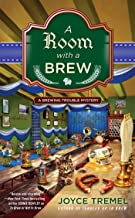
A Room With a Brew

It's Oktoberfest in Pittsburgh, and brew pub owner Maxine "Max" O'Hara is prepping for a busy month at the Allegheny Brew House. To create the perfect atmosphere for the boozy celebration, Max hires an oompah band. But when one of the members from the band turns up dead, it's up to Max to solve the murder before the festivities are ruined. 

Adding to the brewing trouble, Candy, Max's friend, is acting suspicious... Secrets from her past are fermenting under the surface, and Max must uncover the truth to prove her friend's innocence. To make matters worse, Jake's snooty ex-fiancée shows up in town for an art gallery opening, and she'll be nothing but a barrel of trouble for Max.
www.joycetremel.com

Welcome, Joyce, to Writers Who Kill.

In A Room With a Brew, Maxine “Max” O’Hara owns and operates a brew pub, creating a variety of beers. Before you started your series, did you know anything about brewing beer or running a brew pub?

Joyce Tremel
Other than drinking it, no! I made friends with a couple brewers who were very helpful answering questions about the brewing process and the best ways to kill someone in a brewery. I even helped keg beer one day—it was fun!

Writing about brewing beer must have required lots of visits to brew pubs and beer sampling. It’s tough, but someone has to do it. How did you go about your research?

I drink a lot, lol. Like I mentioned above, the brewers I met were very helpful. There’s a lot of stuff online as well. 

Do you have a favorite brew?

It’s hard to pick one. I like hefeweizens—a wheat beer that has a hint of a banana flavor due to the strain of yeast used. I also like brown ales, and you can’t beat a good stout or porter. Even if you’re not a beer drinker, try a chocolate stout. There’s a brewery in Pittsburgh that brews a chocolate raspberry stout. Yummy.

What inspired you write mysteries, especially ones featuring beer?

I’ve loved mysteries since I picked up my first Nancy Drew book. I’ve always liked to write, so it came naturally to me. The beer idea came about because I wanted a hook that no one had used before in a cozy mystery. I’m pretty sure I was drinking a beer at the time.

Did your years as a police secretary help you in writing about the crimes in your books?

Sort of. It makes researching procedures easier, although I do still have to check to make sure everything is current—that a procedure hasn’t changed over the years. I was in a suburban police department, which is different than one in a small town or a big city, so I still have to research those a bit. 

It’s often said that setting or location can be another character in a book. This is definitely the case with your setting in Pittsburgh. You write so authentically about Pittsburgh that it makes me want to visit. What is it about Pittsburgh that you find so appealing?

I’ve lived in the Pittsburgh area all my life, so I know it well. It’s gone through so many changes over the years. Some people still think it’s a smoky cesspool, which can’t be further from the truth. It’s a high-tech, growing city and the universities and medical centers are some of the best in the world. I also like the fact that each neighborhood is like its own small town. That was one reason I set the series in the Lawrenceville neighborhood. It’s a very close-knit community. And full of brew pubs!

Are any of the businesses you mention in your books, actual places?

No. I’ve had some people say they wish they were! I invented an entire block and plopped it down right in the middle of the very real Butler Street. Some places, like Most Holy Name Church and St. Anthony’s Chapel, the Pittsburgh Zoo, Allegheny Cemetery, etc., are actual places. 

In A Room With a Brew,you created a bit of a bridge between a cozy mystery and an intriguing spy thriller. What inspired this storyline?

Good question! I had hinted about Candy’s background in the first two books and I wanted to at least wrap up that storyline in case it was the last book in the series. I hate it when authors leave us hanging! I researched what was going on in the world at the time Candy would have been in her twenties and used that. I’d say more, but I don’t want to give it away for anyone who hasn’t read the series.

Your character Candy illustrates that we don’t always know the people around us as well as we think we do. That people often have things in their backgrounds they don’t want revealed—for whatever reason. Should that make us more cautious when making friends?

I don’t think so. Everyone has secrets—some good, some bad. 

Max talks about being cautioned by the nuns to be careful about what she did so that her actions didn’t get recorded in her permanent record. Lots of us were probably kept in line because of our fear of that permanent record. At what point does Max discover that there isn’t such a thing? Or is she still guided by it?

That was my twelve years of Catholic school talking, lol. I don’t think Max will get over that anytime soon. I’ve often thought that the good sisters should be in charge of everything. People would be so much better behaved!

Max’s love interest, Jake, works for her as a chef at the brew pub. Does having him as an employee create any problems for Max?

At first she was afraid it would, but they make a good team. 

Many cozy writers today are writing multiple series. Any plans to add another series?

My agent has two proposals on submission—one set in a cider house, and one set at a small town newspaper in the 1940s.  I’m working on another proposal that I’m keeping secret at the moment. 

What’s next for Max O’Hara?

Unfortunately, Max is in Limbo at the moment. The publisher didn’t offer to extend the series. My agent is looking into another publisher possibly picking it up, so we’ll see what happens. I’d love to write more. I have part of a fourth book written (I kill off a drunk Santa), and have ideas for two more after that.

Thank you, Joyce.

To learn more about Joyce and her Brewing Trouble Mystery series, visit www.joycetremel.com

The Brewing Trouble Mystery series is available at most independent and chain bookstores as well as online outlets.

Bio: Joyce is a native Pittsburgher, has two grown sons, and lives in the beautiful Laurel Highlands east of Pittsburgh with her husband. When coming up with the idea for this series, she thought her big city with the small town feel would be the perfect setting for Max's brew pub. She hopes "yinz" guys agree! 


Wednesday, March 30, 2016

An Interview with Joyce Tremel by E. B. Davis


The Allegheny Brew House is a dream come true for Maxine "Max" O'Hara,
who went all the way to Germany for her brewmaster certification and is
now preparing to open her own craft brew pub in a newly revitalized section
of Pittsburgh. But before she can start pouring stouts and lagers to thirsty throngs,
there's trouble on tap. Suspicious acts of sabotage culminate in Max finding
her assistant brewmaster and chef Kurt Schmidt strangled in one of the vats.

Between rescuing a stray gray tabby she names Hops and considering a handsome
ex-hockey player as her new chef, Max doesn't have a lot of time to solve a murder.
But with a homicide detective for a dad, she comes to criminal investigation naturally.
And if someone is desperate enough to kill to stop her from opening, Max needs to
act fast—before her brand new brew biz totally tanks...

I can’t remember when I first became acquainted with Joyce Tremel. It’s been years though, so when I discovered Berkley Prime Crime had released her first novel To Brew or Not To Brew (A Brewing Trouble Mystery Series) in December, I wanted to interview her. Since I knew a bit about Joyce’s background, her book surprised me. Read further—you’ll find out why.

Please welcome Joyce Tremel to WWK.       E. B. Davis

Joyce, you were a police secretary for years. I expected a more hardboiled subgenre—at least a police procedural—why a cozy?

The first books I wrote years ago, while not exactly procedurals, were procedural-like. They featured an ex-cop who was a martial arts instructor. I’m pretty sure they’ll never leave my hard drive. After I left the police department, I wrote a book with a police secretary protagonist called In Spite of Murder. That book landed me an agent who left the business, then it landed another agent who left the business, then landed my current agent who has been warned she’d better never leave agenting. Ever. Anyway, ISoM isn’t a procedural even though Irma Jean works at a police department. My first agent called it a cozy with an edge.

How did your series with Berkley occur?

My agent sent In Spite of Murder to several publishers, one of which was Berkley. The editor liked it and liked my writing, but it wasn’t cozy enough for their line. If you read Berkley’s books, you probably know what I mean. The books in their cozy line all have some kind of hook like a craft, food, etc. The editor told my agent that if I was interested in writing a cozy, that she’d love to take a look at it. Of course I said I’d love to give it a shot. I tried to figure out what kind of hook hadn’t been done yet and I came up with the brewpub idea. I wrote a proposal with a synopsis, ideas for subsequent books in the series, and three chapters, and sent it to my agent. A few months later I got the call that Berkley was offering me a three-book contract.

I know you’re from Pittsburgh. How much of the story comes from real life—Do you live in Lawrenceville, the section of Pittsburgh that serves as the setting?  Do you brew like your main character, Max O’Hara? Do you come from a large Irish-Catholic family, like Max?

I live in a suburb north of Pittsburgh, but it’s not far from Lawrenceville. My younger son lives in Bloomfield, which is right next to Lawrenceville. Whenever I’d drive through Lawrenceville to get to his place, I’d notice that just about every week there was a new store, restaurant, or brewpub opening up. I thought this would be a perfect spot for Max to open hers.

I don’t brew, but I do love beer. Real beer, that is—not the swill made by the corporate giants. Oops. I probably ticked off a few people by that comment. I had to learn about brewing by doing research online and visiting local craft breweries and talking to brewers. And trying their beer, of course.

I am a Catholic, but I’m not 100% Irish. I’m kind of a mutt—Irish and German on my mother’s side and Scottish and French on my dad’s side. I have three sisters—two older and one younger.

After Max finished her Masters in Chemistry, she went to Ireland to study whiskey distilling. How did she end up in Germany studying brewing?

Max had never been to Europe before, so she figured she’d visit a few countries before settling in Ireland. When she got to Germany, tasted the beer, and saw the brewing operations, she decided that was what she wanted to learn.

Your book reminded me of school field trips since I grew up in Pennsylvania. We visited a chocolate factory, a cheese-making shop, a bakery, a candy plant, etc. I loved the infusion of brewing terms—I could almost smell the yeasty mead. Explain the terms hefeweizen, stout, lager, dunkel, sparging, wort, and growlers (which I thought was another name for a hoagie).

Ha! We just call them hoagies here. Although I try to at least give a hint at what the brewing terms mean, I’m actually thinking of adding a page to my website with definitions. I just have to find the time to do it. Here you go:

Hefeweizen is a wheat beer. It has a nice, pale yellow color. It has a slight banana and clove taste to it even though there are no bananas or cloves in it. All the flavor comes from the varieties of grain, hops, and yeast that are used. Like Max, this is my favorite beer.
Stout is a dark beer (think Guinness). It’s usually very smooth with little or no bitterness from hops. It has a chocolatey, sometimes coffee-like character, that comes from the roasted barley. There’s nothing better than a piece of chocolate cake with a stout.
Lager is the typical “plain old” beer. Very drinkable, but ordinary.
Dunkel is a dark lager.
Sparging/lautering is the part of the process where hot water is poured on the mashed grains to extract the flavor. This flavorful liquid is the “wort” which is boiled and fermented to become beer.
Growler is a half-gallon glass jug that you get filled with your favorite beer. When it’s empty, you rinse it out and take it to your favorite brewer and get it refilled. Although they’ve been around for over a hundred years, they seem to be making a great comeback because they’re so environmentally friendly.

Max bought the old, out of commission Steel City Brewery and renovated the building to create her new Allegheny Brew House. But the old brewery had history for the city and the neighborhood. What was its history and how does that cause Max problems?

My fictional Steel City Brewery is loosely based on Iron City Brewing, which began in Pittsburgh in the 1800s. Like the fictional Steel City, Iron City moved operations out of Pittsburgh several years ago. There’s been talk lately of developing that property. It will be interesting to see what comes of it. Also like my fictional Steel City, Iron City made ice cream during prohibition.

When Max’s assistant Kurt is found dead in the brewery, she knows it was murder. Why doesn’t her police-detective father believe her?

I think he does deep down, but he’s a cop and has to go by the evidence and not by how he feels.

My favorite secondary character, Candy Sczypinski, is a baker in the neighborhood. She’s always knows things a baker shouldn’t know, and comes up with investigative ideas. She’s bound to have an interesting background. Will we get to know Candy better in other books? Did you find her last name in a Pittsburgh phone book?

In book 3, which I’m writing now (and I need a title—help!) we learn all about Candy’s background. It is really fun to write about what she did back in the late ‘60s. It’s quite shocking!

I wanted a Polish name for Candy, so I Googled “Pittsburgh Polish names” and that’s one that came up. I’ve finally learned how to spell it without checking my notes. It’s pronounced “Shipinski” by the way. You didn’t ask, but my favorite character is Elmer, my World War II vet.

Like most amateur sleuths, Max gets an idea of who the murderer is and who is vandalizing her brewery, but she gets it wrong when she finds her primary suspect dead in the brewery. Why doesn’t she throw in the suds and quit?

Good question. My husband says it’s a good thing he’s not a writer because he would have had Max chuck it all when Kurt was killed, lol. Max is just stubborn, I guess. She’s not about to give up her dream, although she did consider it a couple of times.

Is Hops, the stray cat she adopts, anything like your pet cat?

I borrowed the description of Hops from my cat, Layla. The cat on the cover doesn’t look quite like how I described her, but it’s close enough. Hops is way more adventurous than Layla, though. Layla’s a true scaredy cat. She hides from everything.

Kurt’s replacement chef is Jake Lambert. Why is Max shaken up by Jake?

Max has had a crush on Jake all her life. He’s her brother Mike’s best friend. When Jake comes back to town all those feelings surface again.

I know Pittsburgh is rabid for football and hockey. Is the issue of sports’ concussions a particularly sensitive subject in your town as it is growing into nationally?

I hate to say it, but I really don’t follow sports! I haven’t paid any attention to the subject of concussions. I shouldn’t admit this, but I’m probably the only Pittsburgher who dislikes the Steelers. Although I do like when they play—that’s when I do my grocery shopping because the store is empty!

Fran Donovan is a little-old-lady radical. She wants to close Max’s new pub down and make a museum of the old Steel City Brewery. But then, she helps Max. How does Max get her to change her perspective?

Fran finally saw that Max was trying to preserve the brewing heritage of the city and not tear it apart.

Among the growing restaurant menu featuring pierogies and kirschtorte, and the neighborhood bakery cupcakes and deli sandwiches, you presented a caloric array. Did your research include perusing the local restaurants, bars, and bakeries?

Although I visited a few places, I did a lot of the foodie research online. And I do try out different recipes to see what would fit in the book. Wait till you see the recipes in Tangled Up in Brew!

What’s next for Max and Jake?

BEER TODAY, GONE TOMORROW...

Brew pub owner Maxine “Max” O’Hara and her chef/boyfriend Jake Lambert are excited to be participating in the Three Rivers Brews and Burgers Festival. Max hopes to win the coveted Golden Stein for best craft beer—but even if she doesn’t, the festival will be great publicity for her Allegheny Brew House.

Or will it? When notoriously nasty food and beverage critic Reginald Mobley is drafted as a last-minute replacement judge, Max dreads a punishing review. Her fears are confirmed when Mobley literally spits out her beer, but things get even worse when the cranky critic drops dead right after trying one of Jake’s burgers.

Now an ambitious new police detective is determined to pin Mobley’s murder on Max and Jake, who must pore over the clues to protect their freedom and reputations—and to find the self-appointed judge, jury, and executioner.

What’s your dream destination vacation, Joyce?

My favorite place is Gettysburg. We started going there when our boys were 10 and 6 (the older one is now a historian, so the trip made an impact on him). We try to get back there once a year. For the last couple of years we’ve gone for World War II weekend, which has been a lot of fun. I’m a 40s buff and would love to someday write a book set in that era.