Showing posts with label #cozymystery #writing. Show all posts

Monday, August 17, 2026

Returning to CozyLand - The Joys and Challenges of Writing Cozies by Kassandra Lamb

Returning to CozyLand ~ The Joys and Challenges of Writing Cozies by Kassandra Lamb

I recently had a little chat with myself about whether I should retire from writing. My third series is winding down (four if you count the romantic suspense I’ve written as Jessica Dale), and I was debating where to go next. I decided to go back to writing “just for fun,” and not worry so much about the business end of things.

And “fun” writing meant cozies for me. Why do I enjoy them so much?

First, they are more lighthearted than other subgenres of mysteries. The characters don’t take themselves quite so seriously, even though they’re still trying to solve a murder (or two or three).

And this ties into my second reason. The main character can be spunky, sometimes even snarky. My second series, The Marcia Banks and Buddy Mysteries, were cozies, and the MC, a service dog trainer, even had an alter ego whom she dubbed Ms. Snark.

In this new series, The Aging Ain’t for Wimps Mysteries, the protagonist is seventy-one, so snark might not wear as well on her. But she can be spunky. When Amy Parker suddenly finds herself widowed, she

begins to realize how subtly controlling her husband was. As she starts to spread her wings (and sets out to solve a murder), she finds her spunk.

Third, writing the first draft seems to go faster with cozies. Maybe that’s partly because of number one above, the more lighthearted tone. It may also be because the plots are a little bit less complicated, especially less so than police procedurals (my third series, The C.o.P. on the Scene Mysteries).

And a faster first-drafting experience means I get to the part that I like best sooner—the editing. I love editing. Watching the story shape up, getting all the rough edges polished off, is so much fun.

Fourth, the world building is fun too. Cozies are usually set in small towns, and populating a fictional town is kind of cool. There’s the local law enforcement of course, the sheriff and his or her deputies. Then the merchants and professionals—the grocer, the librarian, the veterinarian, the auto shop owner—and the nosy but also supportive neighbors.

And fifth, the characters can be quirky. Indeed, some of them are expected to be quirky.

Which brings us to the sixth reason, the MC usually has a pet.

And Amy’s pet is my favorite quirky character in this new series. She’s a gray tabby cat that Amy inherits from her sister. Her sister called her Misty, but Amy’s name for her is Nuisance. Nuisance is not a very friendly cat, and Amy starts out barely tolerating her. But as the story unwinds, she warms up to her some, especially after discovering why the cat is so standoffish.

But there are some challenges to writing cozies as well.

The main one being the rule about no swear words. That can be tough to pull off, especially when law enforcement folks are around (cops swear!), and still have the story feel realistic.

The age of most of my characters, in their sixties and seventies, helps here. Older gentlemen, even older sheriffs, try not to cuss in front of women. Indeed, gray-haired, bushy-eyebrowed Sheriff Andy Taylor is my third favorite character so far in this series, after Amy and Nuisance. (And yes, he gets a lot of jokes about his name, like folks asking him if he’s from Mayberry).

The other two main rules regarding cozies are easier to follow—no on-screen sex and minimize the gore. I’m not a big fan of gore myself, so that last one is totally easy.

And while I enjoyed writing sex scenes in my first series—The Kate Huntington Mysteries, with a psychotherapist amateur sleuth—they are not easy to craft. I’m just as happy not to have to deal with them here.

Indeed, I haven’t even decided yet if Amy will have a love interest. She’s still grieving her husband and also enjoying her independence. 

And I’m having so much fun helping her do the latter.

Which do you prefer to read (or write)—regular whodunnits or cozy mysteries?

What does it say about you when your coming-of-age story begins at seventy-one?

Kassandra Lamb has two loves: writing and psychology. In her youth, she discovered that writers need day jobs in order to eat. Partial to food, she studied psychology. Now retired from a career as a psychotherapist and college professor, she spends most of her time in an alternate universe with her characters. The magic portal to this universe (i.e., her computer) is in Florida, where her husband and dog catch occasional glimpses of her. Kass has authored over 40 books, including four mystery series and a romantic suspense trilogy.

WEBSITE: https://kassandralamb.com 

Troubled Water, An Aging Ain’t for Wimps Mystery (#1 in a new series)

Amy Bridges Parker asks herself that question as she resists her domineering sister’s attempts to take over where her subtly controlling and recently deceased husband left off. Then her sister turns up dead, and the sheriff suspects a young man claiming to be the grandson of Amy’s first husband, who died in the Vietnam War. Amy, however, is not convinced. Her sister—a mean girl back in high school—had plenty of old enemies. But who hated her enough to actually kill her?

AMAZON:  https://www.amazon.com/dp/B0H7YZSQG3   

BARNES & NOBLE:  https://www.barnesandnoble.com/w/troubled-water-kassandra-lamb/1150617824?ean=2940196583292


Sunday, March 9, 2025

Cozy Mystery Writing Tip: Letting Readers Become Armchair Detectives

by Korina Moss

In each of the books in my Cheese Shop Mystery series, my protagonist Willa and Team Cheese—the three friends she solves mysteries with—always sit at the same hand-hewn picnic table in the kitchenette of her cheese shop to discuss the murder and the suspects. Readers of my series know this is the time when the suspects and their motives will be laid out, helping readers to keep track of what our sleuths have discovered, and allowing them to make their own guesses as to whodunit. 

Cozy Mystery Booktuber, the Beachbum Bookworm

This is part of the fun of reading a cozy mystery—trying to solve the puzzle along with the sleuth. Cozy mysteries play fair with the reader. They lay out clues, weaving in some red herrings. With the clues given, readers may be able to solve the mystery. It all depends on how clever the author is at distraction. Cozy writers need to have a big enough pool of suspects for readers to guess from but not too many to overwhelm them. Readers also need to be able to keep the suspects and their motives straight. Here is the way I help my readers do this. 

  • Soon after the murder is discovered, I write a scene cataloging who my sleuth thinks the suspects are. Every cozy should have five to six clear suspects. Your protagonist sleuth may not know who all of them are right away, but you should have a solid list of suspects very early in the book. 

  • Then after some investigating (between a third and halfway into the book), I revisit the suspects and what’s been discovered about them. Maybe I’ve dismissed one or added one or maybe the list remains the same. The sleuth may be feeling more strongly about some than others at this point, which can change again based on new evidence. Some suspects may have a strong motive for having murdered the victim, but it appears they didn’t have opportunity or vice-versa. More investigating will reveal new motives and secret opportunities to have committed the crime. 

  • As the book goes on, your protagonist’s investigation narrows down the suspect list until he or she is left with stronger suspicions about two or three of them. So, toward the end of the book, I’ll have a scene identifying the narrowed list of suspects and the reasons my sleuth thinks one of them may be the culprit.

Of course, all of these discoveries are also woven in throughout the story but stopping two or three times to write a scene discussing the suspects is helpful for the reader to play along and try to solve the mystery before the big reveal. As long as you’ve plotted your mystery carefully to keep even the savviest reader guessing, helping them become armchair detectives will help you gain a loyal readership. 

Readers: When reading a mystery, do you like to try to solve whodunnit? 

You can be an armchair detective when cozy mystery booktuber, the Beachbum Bookworm, discusses my Agatha Award-winning novel Cheddar Off Dead with her YouTube viewers during the last week of March (exact date to be announced). I'll be there too, so buy and read Cheddar Off Dead, go to her channel, subscribe and hit the notification button. Keep up with me on Facebook, Instagram, and my website so you won't miss it!

Cozy booktuber Sonia with an i


KORINA MOSS is the author of the Cheese Shop Mystery series set in the Sonoma Valley, California, which includes multiple Agatha Award nominated books for Best Contemporary Novel and the winner of the Agatha Award for Best First Novel, Cheddar Off Dead. Listed as one of USA Today’s Best Cozy Mystery Series, her books have also been featured in PARADE Magazine, Woman’s World, and Writer’s Digest. Korina is also a freelance developmental editor and book coach specializing in cozy mysteries. To learn more or subscribe to her free monthly #teamcheese newsletter, visit her website korinamossauthor.com.


Thursday, February 20, 2025

A Plotting Predicament by Marilyn Levinson

Plotting has always been an uneven experience for me. While the basic theme/idea of each book usually comes easily to mind, there are many times in my writing when I have to stop and figure out how to move on. After all, a mystery writer's cast of characters includes suspects, murder victims, and a murderer all of whom have secrets, tell lies, and present red herrings. Rather a complicated situation. Still, I believe those of us who write mysteries have somehow trained our minds to create and resolve solutions that might first seem unsolvable. I've learned to trust the process will reveal to me how my sleuth will identify the murderer, hopefully in a new and unique manner.

New and unique are the key words here, because after having written sixteen mystery and suspense novels, I don't want to repeat myself. Sure, certain themes like friendship, romance, and  family relationships appear in my work, but I want every story to be fresh and different. When I began writing Death on Dickens Island, the first book in my Books on the Beach series that I write as Allison Brook, I knew exactly what the main issue would be and how it causes conflict that lead to deadly secrets and murder. However, the second book presented a problem. I often develop two storylines that conjoin near the end of the book, but this wasn't happening. My characters simply weren't cooperating. I knew I wanted the murder to be connected to both a white collar crime and a romance gone wrong some years ago, and it all starts at a book club meeting in the Dickens General Store's Book Nook. But what crime would fit my plot?

While I don't have Beta Readers or critique partners, I am part of a group of mystery writers. For the past twenty years or so, we've been helping one another with suggestions--from handy murder items found in everyone's home to catchy book titles. A friend sent me a list of white collar crimes; others threw in possible ideas, and voilĂ ! I chose the non-violent deceitful crime that suits my future novel and fits right in with my series. Somehow knowing that, has allowed me to plot most of the novel.

For me, it's the crimes and time-lines that require deep thinking and the occasional suggestion from my writing pals. The problem is never my characters.  Since I write series, my characters are well-developed and new ones quickly take on a life of their own. I especially love to see how they interact and mature, how they cope with secrets from their past.

Plotting a mystery is a challenge. The more books you write, the greater the challenge to do something fresh and unique. To explore a new setting, a unique situation, an intriguing reason why one character murders another. What do you do to keep each book and story that you write distinctive?


Sunday, March 12, 2023

A WRITING RETREAT ON A CRUISE SHIP? GO FOR IT!

 by Korina Moss

When I’m feeling writer’s block or a deadline is nearing, I’ll sometimes search for a place to retreat to for a few days to spur my writing. A change of scenery gets me out of my routine, gives me permission to ignore most of my obligations, and tends to put the mojo back in my muse. I’m able to get a lot of writing done in a short amount of time. However, the most recent retreat I’d planned wasn’t intended to increase my word count—book 4 of my Cheese Shop Mystery series had been sent to my publisher the week prior. What I needed this time was to renew, refill, and recharge my creative energy. I was low on fuel from the intense month behind me and burning lower in anticipation of the busy months ahead. 

The release of book 3 in the series, CURDS OF PREY, on March 28th has filled my calendar with extra blog posts, podcast interviews, giveaways, and in-person and virtual events. My editor would soon be sending her feedback on that book 4 manuscript I’d just turned in, expecting my new revisions before the end of the month. And let’s not forget, the clock for my next book in the series has already begun ticking, which means brainstorming and outlining book 5 is also on the agenda. Thus, the need for all those aforementioned re words. A solo retreat was in order, but what kind would trigger my creative energy and preempt burnout? 

Nothing makes me feel better more quickly than being out at sea, but I’d never tried combining writing with cruising. After hesitating to try it for years, I finally decided to pull the trigger (sorry, it’s the mystery writer in me) and take a week-long solo writing retreat cruise. If you think a cruise is the last place to have a successful writing retreat, let me tell you why it worked for me. 

No responsibilities or decisions. Unless you count which food to eat or where to write, I was completely carefree. There was nothing to figure out, no meals to plan, buy, or cook, no dishes to wash, no chores to do. I didn’t even have to make my bed. 
Changes in Latitudes, Changes in Attitudes.
To borrow from Jimmy Buffett, new scenery and a warmer climate are good for the soul. Speaking for myself, a new perspective is good for my writing. Booking at a time when there were no school vacations and leaving from a northeast port made the cruise more convenient for me, less expensive, and less crowded. I could write wherever I wanted, whether it was outside by the pool or in the cozy wine bar, while listening to live music or in the solitary space of my balcony cabin, or while in the shade or soaking up some sun. And I got to be in the Bahamas in February. New attitude, here I come!
The vibe.
An atmosphere conducive to writing was achieved through good planning coupled with good luck. I chose Anthem of the Seas—not a small ship, but also not in Royal Caribbean’s fleet of largest ships. The research I did showed lots of cozy indoor and outdoor writing spots for cool and warm weather. This particular ship had three pools but no big slides, and all the children’s activities were in one central indoor gaming area. There was also an adults-only solarium providing wide vistas and a smaller, quiet cafĂ©. I felt all this would bode well for me to find adequate places to write and brainstorm and snack (an essential part to my writing and brainstorming). I’ve been on three-day cruises out of Miami, and I’ve been on school vacation cruises with my son. Both are as crazy and crowded as you’d expect them to be and wouldn’t have worked for my purposes. Luckily, the vibe on this cruise was decidedly chill—perfect for my retreat. I also chose a cruise with four sea days, and I skipped the two ports that didn’t entice me. This meant more time to settle into ship life and focus on my writing.

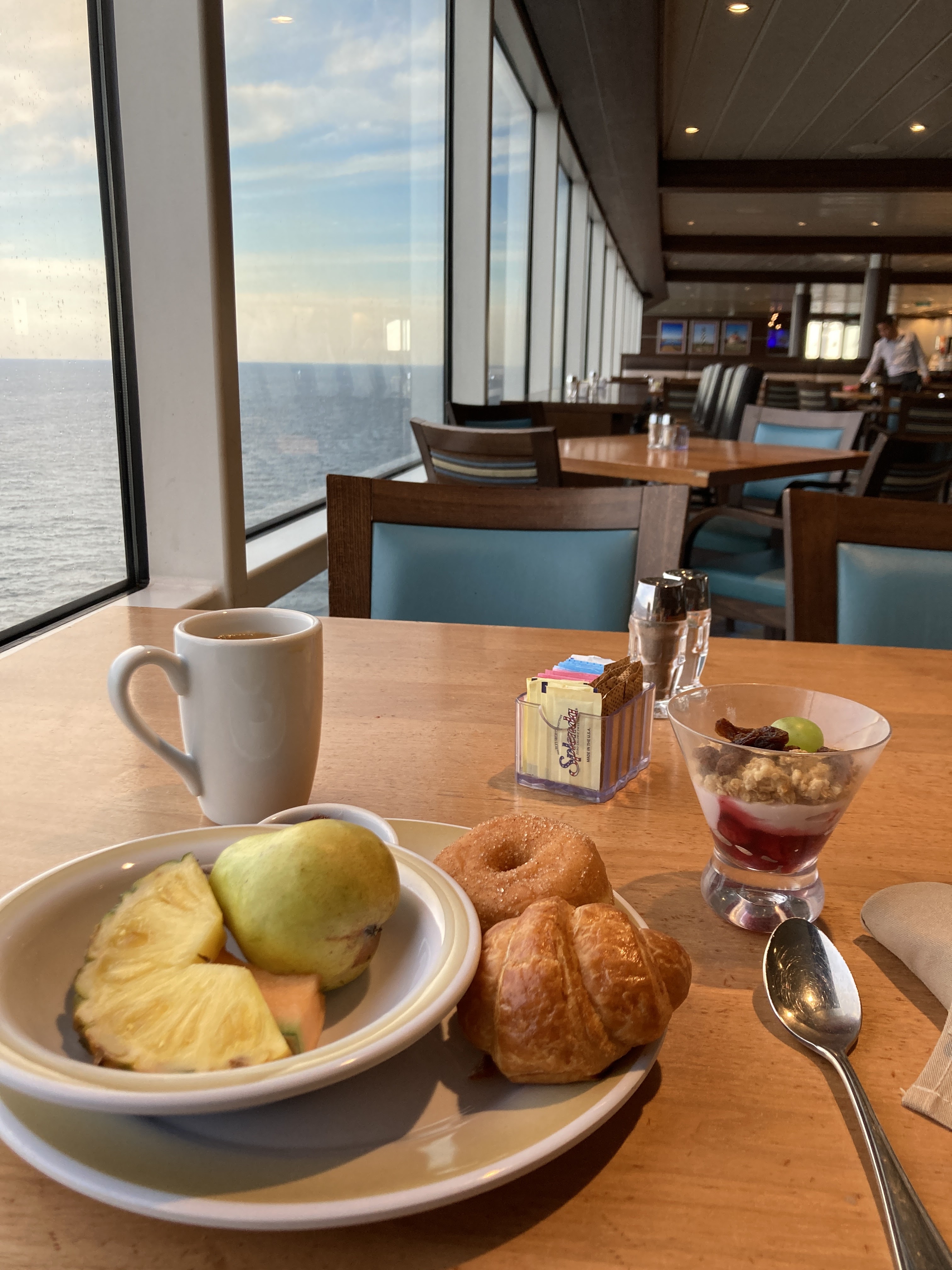
The view. Almost every spot on the ship had a great view. What better place for your imagination to roam than the expanse of the sea? Getting to be in a beautiful location sure made “working” easier. My balcony room instantly put me in the right frame of mind every morning, no meditation required. Going to sleep and waking up to the sights and sounds of the sea was a direct route to all those re words.
Limited internet.
It would’ve been best to eliminate internet entirely and really unplug for the week. However, I felt I had to be available to my editor and publicist for any inquiries that might come my way, since this was my book release month. (Sure enough, I had several events that needed to be scheduled.) I also enjoyed taking my friends and social media followers along on this trip with me, but I kept it in check, as there’s nothing more creativity crushing than spending time scrolling social media. The good news is that internet is slow and sometimes hard to access on a ship. I brought my laptop to post my retreat updates and I checked my email twice a day. The rest of the time, I only had a pen and notebook. Forcing plenty of quiet time on myself—time without talking, scrolling, mindless TV, or reading all day—focused my mind on creative pursuits. 


Time for play. How often do your daily writing breaks at home include purposeful recreation? With so much at my fingertips, I made my non-writing time count. I indulged in pool time, I attended a musical, I listened to the guitarist at the pub, I participated in a Sudoku challenge, I chatted with other cruisers, I enjoyed leisurely dinners, I read on my balcony at night under the stars… I even took a whole day off to enjoy the beach when we docked at the ship’s private island. If I’d come with someone else, I would’ve been too tempted to play all day. Cruising solo with my mind set on the trip as a retreat, my limited but purposeful “play” time was restorative.

My solo writing retreat cruise accomplished all the re words. It was the reset I needed to support my creativity and my mental health. I’d love to be able to take a cruise whenever I feel the pressures of a writing career unbalancing me, but alas, I have yet to win the lottery or a six-figure publishing deal. Until then, I’ll carry over some of the lessons learned from this retreat into my daily life at home. Now if I could only replicate that view…

Readers: Would you consider taking a solo cruise? Where would your dream retreat take place?

To read Korina's daily log from her solo retreat cruise and see more photos, go to her author FB page.

Korina Moss's latest book in the Cheese Shop Mystery series, CURDS OF PREY, releases March 28. To learn more, visit her website. 

Thursday, April 15, 2021

Having Faith In the Writing Process by Marilyn Levinson

Developing one's writing skills as a novelist is an ongoing process. I'm discovering that the way I write a novel is undergoing a process as well. In previous books, I always wrote as a plotter. I worked from an extensive outline, while allowing for changes as they arose to better suit my storyline. But with each book in my current series, I find myself becoming more of a pantser. Writing the most recent book, I have even become more daring. I outlined what would be the beginning chapters and I knew how I wanted the book to end, with the murderer firmly in my mind. This is especially important as I usually have two plotlines that converge at the end.

But I found myself doing things differently this time around. When I got beyond the opening chapters that I'd outlined, I mentally plotted out the next two or three scenes, which I then wrote. And so I continued.  It was kind of like swinging on a trapeze with no safety net below, but oddly enough it didn't make me anxious. 

A new character appeared, then another, and I found myself in the middle of the book with plenty of activity and no sagging middle in sight. New characters brought new elements to the book, and before long I found myself changing the identity of the murderer.

Why this growing confidence in the writing process? Partly, I suspect it's due to the fact that the more we write, the better we get at it. Not that it's easier, but we're honing skills that develop well below the surface of our minds. Another reason is my editor trusts me. I tell her what my next book is going to be about. Just to check in, not because she asks me to. And I've a wonderful group of mystery-writing friends who I can turn to whenever I get stuck. Even if I don't take any of their suggestions, somehow the act of asking for help and writing out the problem brings me the very answer I need to resolve my problem.

And then, of course, writing a series makes things easier. I know my protagonist well, along with her friends and family and the town they live in. Yes, I write cozies, but I deal with less-than-cozy issues like abandonment and dysfunctional families. I feel free to explore my characters' thoughts and feelings, without worrying about restrictions. All of these factors allow me to write more freely and to have faith in the writing process.


Thursday, June 25, 2020

Homesick For A Village That Doesn't Exist by Connie Berry


I do so hate finishing books. I would like to go on with them forever. Beatrix Potter

Finishing books—and leaving the world you've created—is always a kind of emotionally wrenching experience. I usually cry. Lauren Oliver


Last week I turned in the manuscript for The Art of Betrayal, the third book in the Kate Hamilton Mystery series. It's not finished. Rounds of edits come next, but pushing send is a milestone marking the end of something cherished. Here's a glimpse:

American antiques dealer Kate Hamilton is spending the month of May in the Suffolk village of Long Barston, filling in at her friend Ivor Tweedy's antiquities shop while he recovers from bilateral hip surgery. Kate is thrilled when a local recluse consigns a valuable Chinese pottery jar from the ancient Han dynasty—until the jar goes missing and a body turns up in the middle of a village pageant celebrating an eleventh-century folktale. As Detective Inspector Tom Mallory leads the investigation, Kate begins to see puzzling parallels between the crimes and the local legend. The more she learns, the more convinced she becomes that the solution to both crimes lies in the murky depths of Anglo-Saxon history and a generations-old pattern of betrayal.

After spending more than nine months with my characters, I'm feeling disoriented. And not a little homesick.


For me, the closest real-life parallel is the feeling I had when my oldest son left on the school bus for his first day of kindergarten. I waved madly (and cried) as the bus lumbered down the street, turned left, and vanished. My precious little boy was on his own.

My book will have to make its way in the world, too. Of course, I plan to help it along as much as I can. But months of living, breathing, and dreaming about this story have come to an end.

A fourth book is in the works—one that must be planned, plotted, written, and polished. That will take time, and I'll fall in love with that story, too.

But first I need a few days to mourn the book I've left behind.

Have you ever felt homesick for a book you've read or written?