Showing posts with label grammar. Show all posts

Friday, January 23, 2026

Evolution and Context by Nancy L. Eady

If you study nature, you can see the ongoing process of evolution all around you.  For example, in a city in Britain, there was a moth that was mainly white, although a few individuals were black.  But over time, as Britain became more industrialized, the moth’s primary color changed to black, the reason being that the blacker the streets, sidewalks, and surroundings became from smoke and oil residues, the easier it was for the moth’s predators to see the white moths before the black moths. 

Language and grammar evolve as well.  One of the beautiful things about English is the rate at which it conjures up new words, adds new meanings to existing words, and switches grammar rules around.  

For example, in English class in the 1970’s and early 1980’s, I was taught that if you were writing about a person who could be either male or female, you were supposed to just use the pronoun “he.”  “He” was understood to be inclusive of all genders.  

As I started writing briefs and studying the law in the 1990’s, I noticed that rather than just using “he,” many writers shifted to “he/she” or “he or she.”  

So, in the 1970’s, I would write the following sentence: 

“Mary Castlemayne got angry at the person who entered her house without wiping his shoes, no matter who he was.” 

In the 1990’s, that sentence morphed to: 

“Mary Castlemayne got angry at the person who entered her house without wiping his or her shoes, no matter who he or she was.”  

Or

“Mary Castlemayne got angry at the person who entered her house without wiping his/her shoes, no matter who he/she was.”  

In the 2000’s, as people become more aware of personal pronoun choices, that sentence then became: 

“Mary Castlemayne got angry at the person who entered her house without wiping his/her/their shoes, no matter who he/she/they were.”  

Now, in the 2020’s, I have noticed another shift, toward the sole use of the pronoun “they” in such situations.

“Mary Castlemayne got angry at the person who entered her house without wiping their shoes, no matter who they were.”  

I am torn by this latest iteration.  I do not hesitate to use it when it makes a sentence less cumbersome, but at the same time, part of me cringes whenever I do so because an atavistic voice in the back of my head keeps shouting that it’s wrong.  

So, to my official grammarians out there, and the many excellent writers who contribute to and read this blog, I would like to know if you have noticed this as a trend, and whether you think the 2020’s use of “they” instead of “he” or “he or she” or “he/she” or “he or she or they” or “he/she/they” is proper grammar?  Am I the only one who has noticed this change?  Is there another way to tackle this issue?  


Monday, July 22, 2024

Grammar by Nancy L. Eady

To me, grammar is a funny looking word. It is one letter away from being a palindrome – a word that is spelled the same forwards and backwards. It would be “grammarg” if some enterprising person wanted to change it to fit the palindrome mold. If you were trying to guess how to spell “grammar” without ever having seen it, the most likely first guess would be “grammer.” A person who studies and writes about grammar is called a “grammarian.” I am not such a person. 

I have a decent grasp of the basics of grammar, such as what is a noun, verb, adjective and adverb. (Those of you who, like me, are of a certain age, probably can’t think of the word “adverb” without hearing a song in your head that begins “Lolly, lolly, lolly, get your adverbs here.” Thank you, Schoolhouse Rock!) I remember from my school years that a preposition is something that we are not supposed to end sentences or phrases with, except that now it is okay to do so. Or, as Winston Churchill said once when criticized by a young proofreader on ending a sentence with a preposition, “This is the type of arrant pedantry up with which I will not put.” 

The best way to learn about the grammar of your language is to study another language. It wasn’t until I began learning Spanish that I realized the wide variety of verb tenses that exist. According to Google, English has twelve verb tenses: simple present tense, present continuous, present perfect, present perfect continuous, past simple, past continuous, past perfect tense, and past perfect continuous, future simple, future continuous tense, future perfect, and future perfect continuous tense. But at the same time, there is also the “participle” form of a verb, which is when a verb has a “-ing” thrown on it. My best guess is that the participle is folded within the continuous tenses, past, present, future.  I remember the phrase “present participle” because when we finally reached it in basic Spanish, I thought, “Huh, I didn’t know we had that.” 

I always despised English tests that involved grammar questions. They most often consisted of one sentence written incorrectly, with four choices from which you had to select the correct sentence. When I would read the sentences, I could think of several ways to communicate the same sentiment more effectively, but none of those would be in the four choices.

All that being said, grammar is important. A writers’ job is to communicate. If you attempt to communicate in English without following the basic rules English speakers use, chances are you will not succeed. Or, if the mistake is something like using the plural form of a verb with the single form of a noun, the reader will understand what you mean but the mistake will jar the reader out of your work. 

Most writers understand the rules of grammar at an instinctual level. We have a feeling for what is “good writing” versus “poor writing” and grammar plays an important role in that evaluation. But I have never diagrammed a sentence and if you held a gun to me, I still couldn’t name all twelve English verb tenses in spite of having written them out three paragraphs above. That doesn’t mean I’m not grateful for those warriors out there who do make the study of grammar their business. After all, someone needs to keep track of the rules! 

How much did you study grammar before writing? Have you ever diagrammed a sentence? What kind of grammar mistakes do you look for in your editing?  


Thursday, June 27, 2019

Confessions of an Ex-Punctuation Nazi

by Connie Berry

A period, a comma, and an exclamation point walk into a bar…


I wasn't always a punctuation Nazi. In my carefree youth, I used punctuation willy-nilly. I knew the basics—periods after complete, declaratory sentences and commas before conjunctions joining independent clauses—but further rules were fuzzy. Generally speaking, I tossed in commas whenever I felt a brief pause was needed. Then my world changed. I attended Katharine Gibbs' Executive Secretarial Course for College Women in New York City. 


Having graduated from DePauw University with a degree in pure English Literature (I say pure because my degree was untainted by anything useful, like teaching credentials), and since the job market for refined ladies reading great literature was small and terribly overstocked, my father insisted I learn skills that might one day earn me a living. As it happened, a friend from high school was on her way to Katharine Gibbs and asked me to join her. What could it hurt? With my fiancĂ© a year away from graduation and a stint in the Air Force facing us after that, at least I'd have a year in the Big Apple. 


Katie Gibbs occupied a high floor in what is now the MetLife building above Grand Central Station. The strategy (strongly implied, never stated) was to enter the corporate world as a secretary, rising rapidly through the glass ceiling through a combination of intelligence, hard work, determination, and proximity. How often that actually happened, I don't know. I do know that during those nine months I discovered five important truths:


1) I was never cut out to be a secretary.

2) Taking dictation is incredibly stressful.

3) My fingers were born for lightning-fast typing.

4) New York City is an exciting place to visit.

5) Punctuation has rules. Lots of them. 

Students at Katie Gibbs were given a style sheet that included an extensive list of punctuation rules. Not only were we asked to apply those rules, we were also expected to memorize the rule numbers. A frequent exercise required us to punctuate a business document before reading it aloud, stating the appropriate punctuation mark and the applicable rule number. It went something like this (I swear I'm not making this up):

Dear Mr. Hoving (comma, 8b),

Mr. Edward Jones (comma 8a), Esq (period 4a and comma 8a)., of Jones (comma 11a),
Fanshaw (comma 11a), and Hendricks (comma 12c), Attorneys At Law (comma 12c), will see you promptly at four o'clock on Tuesday (comma 11b) May 4 (comma 11b), 1988 (comma 11b) in his office on Park Avenue (period 1a). Should you be unable to make this meeting (comma 29a), please telephone the number listed below (comma 6a), and I will try to accommodate your schedule (period 1a).

Best regards (comma 8b),
Connie Berry (Executive Assistant)

In the interest of full disclosure, Rule 29a is the only number I actually remember, but the point is, I loved it. Not only did the punctuation rules feed my mild OCD disorder, they also gave me a sense of purpose. I would die on the hill of the Oxford comma. I would show the world how to use semi-colons. Later, I laughed my way through the book Eats, Shoots & Leaves: The Zero Tolerance Approach to Punctuation, secure in the knowledge that I was in the know.  

Then came the change in the two-space typing rule. Yikes. 

Rules, I learned, can evolve. They can even *gasp* be broken. Think Marcel Proust's 601-word sentence in the first volume of A Search for Lost Time. "Lost time isn’t the only thing searched for," remarked one scholar. "So is a full stop." The work killed him. Literally. He died while still working on the final volume. 

Anyway, once the chains were broken, I was free to comprehend the obvious: punctuation isn't an end to be served; rather it is a means to facilitate comprehension. Facilitating comprehension is something writers care about—or should. That's why the rules exist. One of my goals in editing is to rewrite any sentence that causes a reader to stop and reread. I ask my beta readers to place a check mark in the margin every time they stop reading to clarify. 

Raising questions in a mystery is good. Creating confusion is bad. 

Think of the confusion caused by the addition of two commas in the Second Amendment. In its present form, the amendment reads, "A well regulated Militia, being necessary to the security of a free State, the right of the people to keep and bears Arms, shall not be infringed." Upon arrival home from assignment in France, Thomas Jefferson was so shocked by the poor grammar in the sentence that he removed the first and third commas. Too late. The amendment had already been ratified and couldn't be changed (Bodenner, C. "The Most Consequential Comma in U.S History?" The Atlantic, January 25, 2016). Trust me, I make no political points here. Both sides in the controversy have cited the comma confusion to bolster their arguments.  

So let's get real. We all know the importance of a comma in the sentence, "Let's eat Grandma."

Bottom line, punctuation is no joke. Lives are at stake. 

Seriously, though, what is your attitude toward punctuation rules? 
Do poorly punctuated novels drive you crazy? 
Do you read Facebook posts with an imaginary red pencil? 
Have your thoughts changed over the years? 
Oh—and if anyone can think of a punch line for the joke I began with, do tell.

Saturday, January 12, 2019

Grammar Sex (How Dangling Your Participle Can Hurt Your Book Sales) by Robert Germaux

Okay, I got your attention with that grammar sex thing, right? I’m sure you already know that in the wild and crazy world of eBooks, getting people to look at your work is often more difficult than it was to actually write the thing in the first place. And I’m sure you also know why. It’s because there is an inordinate amount of simply awful writing out there, so much so that the sheer volume of it can easily overwhelm the relatively few really good books, books like yours. The best way to keep your artfully-crafted masterpiece from drowning in that sea of mediocrity is to do everything you can to separate it from those thousands of other books. Research shows, and here I’m talking my made-up research, but I’m sure actual research would back me up on this . . . anyway, research, real or otherwise, indicates that once you’ve grabbed your readers’ attention (by, for example, throwing the word sex into your title), the best way to keep them turning those pages is to present them with prose so superbly written, so free of errors in spelling and punctuation and syntax, that they simply lose themselves in your wonderful narrative.

So how do you go about guaranteeing that your book lands in the can’t-put-it-down category? There are several potential paths to that goal, a few of which I’ll list here.

1.     You can follow my example and spend thirty-one years as a high school English teacher before beginning your writing career. Frankly, unless you’re at a total loss about what to do with the next three decades of your life, I’d skip this option.
2.     Find out where the retired English teachers in your area hang out and pay them a visit. It wouldn’t hurt to pick up a couple boxes of donuts along the way and put them on a table off to one side of the room. The retirees might think they’re at yet another faculty meeting, and you could give them your manuscript to proofread while they enjoy the free pastries.
3.     Join a writers group and identify the best writer there. Then befriend that person (praise, pastries, whatever) and be completely open to every comment, suggestion or criticism that individual has to offer.
4.     Go Google crazy. The problem here, of course, is that you’d have to at least know what was wrong and then Google a solution. Plus, contrary to what you might have heard, you really can’t trust everything you read on the Net. (True story: The Wikipedia entry for one of my college roommates, who went on to become a best-selling author, says he was born in 1951, which would have made Richard twelve our freshman year. I’m pretty sure I would have noticed.)

In the end, the how isn’t as important as the what. One way or another, get help. Even the best writers occasionally hit a literary speed bump, and it’s nice to have someone around to pick you up and point you in the right direction when that happens.

A final word of advice, something I used to tell my high school students. There’s no such thing as good writing, just good rewriting. So good luck with your writing and, especially, your rewriting.

About the Author
Robert Germaux has written several mysteries, one book of humorous essays and a love story, The Backup Husband, which includes a chapter or two explaining that whole grammar sex thing. You can find information on both Bob and his books by going to his Amazon Author Page.

Sunday, July 20, 2014

Word Crimes and Blurred Lines


My Twitter feed blew up Tuesday with a bit of pop culture genius from none other than Weird Al Yankovic.

Maybe you’ve seen it, or maybe you haven’t, but Weird Al released a parody of Robin Thicke’s “Blurred Lines” made specifically for grammar nerds called “Word Crimes.” And, because Blogger seems to hate video embeds, here’s the link: https://www.youtube.com/watch?v=8Gv0H-vPoDc

Basically, the video highlights, in a very funny way, some of the writing world’s favorite grammar lightening rods, including: apostrophes in words that aren’t possessive, “could care less” (we all know it should be couldn’t, right?), and the good, ol’ Oxford comma.

As someone with a long editorial background (first newspapers, and now freelance), I, of course, watched the video and geeked out just like everyone else. But I also caught myself hoping there’d be a sequel that included some of the mistakes I see time and time again while editing, beta reading, and critiquing.

There are many I can think of, but my top three are below (though I have no idea how to put them to music):

1. Hyphenating modifiers that already have an “-ly” suffix. This one is wrong ALL THE TIME. If a modifer ends in “-ly,” you do NOT hyphenate it with the word after it. So, there should be no “carefully-placed flowers” or “fortunately-timed appearance.” None of that. Drop the hyphen.

2. Using “due to” and “prior to.” This one has firmly driven me nuts since my high school journalism days. When writers use “due to” or “prior to,” they mostly seem to do so because those phrases sound more high brow than, say, “because of “ or “before.” But those phrases are incorrect and plain, old “because of” and “before” are what you should be using.

Both due and prior modify words. Do not attach a “to” to them and hope you sound smarter. You don’t. It’s just like those people you silently correct in your head who use “I” instead of “me” because they’re trying to sound smarter. When you use these two phrases, you’re acting in the very same way.

3. Forego and forgo: Learn the difference. Forego is to go before. Forgo is to go without. They are not interchangeable. The one with an “e” isn’t the Old English spelling. If you swap one for the other, you’re doing it wrong.

The same goes for further/farther and assure/ensure/insure. Learn them. Use them correctly.

What are some of your grammar pet peeves?

Wednesday, March 20, 2013

The Fall of the Grammar Empire

I'm going to release my inner curmudgeon for a moment here and complain about the state of our language.

I know that I’m not alone in being bothered by this, and as a writer I’m sure we’re more worried about this than, say, an ad executive, but this is something that affects all of us, not to mention future generations.  We already have people who don’t pronounce the “r” in February, or those who use “of” instead of “have” alongside “could,” “should,” or “would” because that’s how the contractions sound when spoken.  But we need to teach current and future generations the proper spellings and usage of these words, or our language will morph into something completely unrecognizable.

I have a friend who teaches English as a second language over in China.  He's been doing this for nearly 10 years now.  Yet every time he sends me an email, there's very little punctuation, and none of his sentences (or proper nouns) are capitalized.  It's like reading a long letter written by e.e. cummings.  It bothers me that someone who's teaching English to others doesn't use it properly himself.

It bothers me even more to see the many misspellings and lack of proper punctuation used on Facebook.  In this new age of laziness, it's one of the things that has gone by the wayside.  People don't seem to want to "waste" an extra two seconds to type an apostrophe in their contractions when they're texting people or sharing something through social media that they think is funny. 

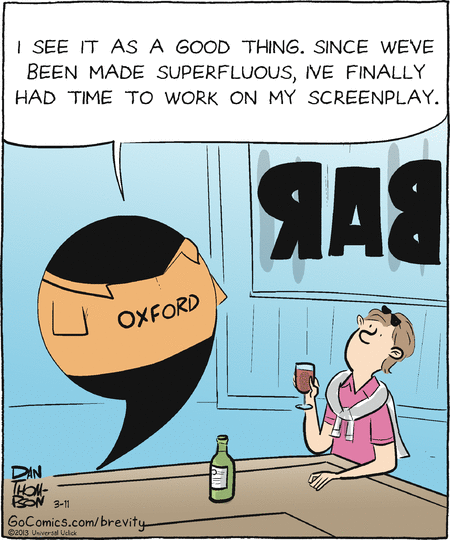
Thank you, Dan Thompson, for helping me
make my point. (Hint: look at the contractions.)

Sometimes they even omit letters altogether in order to get their text or Tweet out faster, or worse, turn everything into an acronym.  I will admit that I've used OMG (Oh My God) or IMO (In My Opinion) everyone once in a while myself, so I can't complain about those too much, but you should see the “accepted” list of acronyms and shortcuts.  I've even actually heard young kids SAY "OMG" in conversation.  Honestly?  The average human speaks 120-150 words per minute.  Have we become so lazy that we feel the need to shorten our speech that much?!

It’s also come to my attention that some schools aren't teaching kids cursive (I think it was called script before my time).  And when I've commented on my step daughter's spelling, she's said on a couple occasions that her school doesn't care about spelling too much.  Hearing that nearly sends me into an apoplectic fit.  Maybe spelling was a bigger deal in my household than most, but I just don't think a nine year old should have trouble spelling "Daddy."

As I've written before, I'm a fan of shortcuts, so I can understand the draw of using them for your Twitter feed or for texting a friend.  What worries me is that, when these become the norm, many people won't know the proper spelling of the actual words.  That will cause us as a society to dumb down even more so that everyone can be on the same level.

Yes, I'm sure there were some just as upset about the invention of contractions as I am of this new strain of word-shortening, and we survived that, so maybe my worrying about this is all for naught, but I can't help envisioning a future where we'll see this advertisement in a newspaper: "Bg wite sl @ JC Pnnys 2moro."  

That honestly scares me.