

One day last week on my morning walk in the woods with my beautiful collie,
Maggie, I suddenly heard what sounded like a baby crying behind me. I turned around and a tiny little spotted
fawn on matchstick legs came running towards me and then veered off to its
right and got tangled in some dead branches for a moment before breaking loose
and traveling on with Maggie trotting behind it. She wasn’t barking or
threatening the little creature in any way. She was just curious. I waited
until the little one was far enough away that my voice wouldn’t alarm it and
then called Maggie. She ignored me at first, and then stopped and watched it
travel on for a while before she turned and returned to me expecting a treat,
of course.

Like
almost everyone else, I grew up reading or having it read to me, Bambi, a Life in the Woods by Felix Salton, an Austrian who wrote
it in 1923. Since that time it has been translated and published in twenty
languages around the world. It was first published in North America in 1928. Of
course, by the time it came to this country, I think it was only titled Bambi, and then Walt Disney created the
movie in 1942. The book is considered a classic. What child didn’t love Bambi,
and grieve with him when his mother was killed. The story introduced the realities
of life to children. I shed many a tear when I read the book more than once and
watched the movie many times.

Over
the years I’ve seen many does with their fawn or fawns – they can have as many
as three at a time – but usually only through a car window, although sometimes
they’d come through a campground. We’d often walk in the evenings on trails
because that was the time of day we’d be more likely to see deer, too.
My
first close up sighting of a young fawn was when I was backpacking with my
sister and niece. They’d left the woods to cross a large meadow before me. I
tend to stop and check out things and dawdle along behind on hikes. They were
already disappearing into the woods on the other side of the meadow when I saw
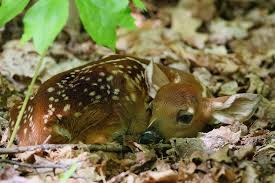
a little fawn curled up in the taller grass beside the path. Although its eyes
were wide open, it didn’t move a muscle or even blink. It’s something fawns are
good at doing while their mother is out foraging for food. It must be an
inherent instinct because I have no idea how a doe would train her youngster to
lie so still without moving.
 |
| I did not use the picture of a decapitated man. |
However,
as sweet and innocent fawns are, they grow up to become a problem in many
communities. They eat people’s hostas, rhododendrons and other plants. They can
wreak havoc in vegetable garden, too. Even worse, are people seriously injured
or who die from hitting deer with their vehicles, especially at night. I’ve
certainly heard about the accidents, but when I looked for images of car wrecks
from deer for this blog, I was appalled at the damage done to cars, deer, and
even worse to people. Over in Cuyahoga Valley National Park, the deer are
eating all the underbrush causing many song birds that nest there to have
become rare or even absent from the area. Many towns close to the valley have
deer roaming through the town streets even in the daytime. One day as I was
driving through a town just south of Cleveland, I had to hit my brakes suddenly
when two deer ran out in front of me, and this was in a well populated town
with sidewalks and small businesses in addition to homes.

A
few years ago, Cuyahoga Valley National Park hired sharpshooters to cull the
herd, and a huge Bambi contingent came out to save the deer. Now I don’t have a
gun, I’ve never been hunting, and I only shot a gun once when I was a teenager
and my brother and two male cousins talked me into firing a shotgun. OUCH! My
shoulder was bruised and sore for days. Although, I have no desire to hunt or
even own a gun, I’m not against cutting down the deer population through
hunting. Not only because of the damage they do to the landscape and cars, but
in many places they’re starving because they’ve wiped out the food sources because
they’ve become so plentiful. When I was a kid, I remember my grandmother
spotting a few deer in the field. We were so excited because we’d never seen a
deer before. Now it’s the rare person who doesn’t often see a deer even sometimes
in cities.

Another
problem is CWD (chronic wasting disease) that started in Colorado and is moving
east and has now come to Ohio. The disease attacks deer and elk and is one of a
family of fatal neurological disorders known as mad cow disease, which kills
people who consume beef from cattle infected with mad cow. The disease attacks
and alters the brain. Symptoms include excessive salivation, trouble
swallowing, difficulty judging distance, a lack of coordination and drooping
ears. It’s always fatal. Meanwhile, scientists are collecting the brains of
dead deer and using high-powered microscopes and special stains are analyzing
tissue slices looking for tiny, sponge like holes in the tissue to check for
CWD.
Deer
hunting in Ohio is a $230 million dollar industry, a lot less than that in
Wisconsin which is a $1 billion dollar industry. Ohio hunters killed 165,124
deer last year, Wisconsin 450,000 deer, and still our state of Ohio has a huge
population of deer, many of them killed by cars as I can attest to because I
not only see them dead beside the road, I’ve also had them dash out in front of
my car day or night.

Meanwhile,
I’m hoping the Bambi I saw was reunited with its mother and will live a long
and healthy life away from traffic.
Was
Bambi one of your favorite stories?
How
do you feel about deer today?
