“It
is only those who doubt who cannot see.”
Lori
Roberts Herbst, Photo Finished,
Kindle Loc. 3313
When
a visit to a Colorado dude ranch turns deadly, it's up to photographer Callie
Cassidy to corral the killer...
As maid of honor (aka grande dame) in her best friend's upcoming wedding,
Callie wants to plan the perfect bridal shower. And what could be better than a
girls' trip with their posse of friends?
The women jump at the idea and suggest a destination—Moonglow Ranch, a serenity
retreat-slash-dude ranch owned by one friend's aunt and uncle.
When they arrive, Callie is less than enthusiastic. Serenity doesn't come
easily to a former investigative photojournalist. Plus, her horse is stubborn
as...well, a mule. She's warned to be on the lookout for snakes. Worst of
all—gasp!—Moonglow only serves healthy food. Still, her friends are having a
great time, and even Callie's golden retriever Woody and tabby cat Carl seem
right at home on the ranch. For their sake, she tries to tap into her inner Zen.
Then the conniving wife of the town's most powerful man interrupts the party
and threatens the ranch's proprietors. Callie worries the trip is destined for
disaster.
Later, Callie finds the woman's body in the stable, apparently trampled by a
horse. Or did she die from a snakebite? Or—as Callie suspects—could something
even more sinister be at work?
Answers are as difficult to find as a needle in the haystack. And when the
police chief accuses the ranch owners of murder, Callie realizes she'll need to
lasso the real outlaw—before the wrong people end up in the pokey.
Amazon.com
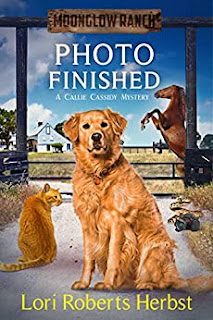
Photo Finished is the fourth book in the Callie Cassidy mystery series.
How I wish it were the first! Reading a series out of order frustrates me to no
end, and I hope my questions don’t have too many roots in previous books. But
this series is on Kindle Unlimited so I have no excuse for not catching up, at
least for the next in series. Unfortunately, I didn’t have time for this
interview.
Lori
and my short stories were in the anthology, The
Fish That Got Away. I’m pleased to be able to introduce Lori’s long fiction
to our readers. Lori starts blogging with us at WWK on September 29th.
Please drop in and give Lori a warm welcome! E. B. Davis
Before
we discuss Photo Finished, why did
you decide to self-publish? Did winning a Silver Falchion and Chanticleer Awards
give you enough confidence to go it alone?
Though the awards definitely boosted
my confidence, they actually came after I'd begun self-publishing. I was in my
late 50s when I finished the first book in the series, and I simply wasn't
patient enough to take the traditional route. (Plus, I'm a bit of a control
freak...) As a former journalism teacher, I had a strong background in writing,
publishing, and marketing, so I figured I'd be able to learn what I needed to
know to make it work. There's been a lot to learn, certainly, but no regrets.
I've discovered so many supportive people and wonderful resources along the
journey.
Main
character Callie and her best friend, Tonya, are in their mid-forties. Is this
Tonya’s first marriage?
Yes. Neither of the friends has ever been married.
Bridal
showers used to be a few hours on a weekend afternoon. Tonya is having a bridal
shower week. I was surprised the mothers came along—at least the main
character, Callie’s, and by mistake, Tonya’s mother. Why don’t Tonya and her
mother get along? How many times has her mother, Lydia, been married?
It was Callie's goal to create a non-typical celebration
for her friend. In the last book, the two of them went through a bit of a rough
patch, so Callie feels compelled to show Tonya how much she means to her.
Maggie Cassidy, Callie's mom, has always been very close to Tonya, so Tonya
would naturally want her present at such a meaningful event. Lydia, on the
other hand, has never successfully formed such a bond with her daughter. I
think Lydia loves Tonya to the best of her ability, but she struggles with
self-esteem issues and a touch of narcissism. She's been married—and
divorced—three times, all in a quest to find a man to make her
"whole." Tonya can't understand or relate to that.
Why
does Tonya, a lifelong friend of Callie, call her “sugarplum” at times? Is this
a reference to Callie’s weight?
Oh, no, not at all. It's a term of endearment. Throughout
the series, Tonya calls Callie by little pet names, and her favorite happens to
be "sugarplum."
Summer
can be annoying. Her comments can inflame rather than soothe. And at times, she
demands like a child, even if on behalf of her aunt and uncle who own the dude
ranch. Why doesn’t anyone comment on her behavior, especially her wife, Jessica?
As an author, it's so interesting how differently readers
can perceive characters—from other readers and even from my perspective as
their creator. As a yoga and meditation instructor, Summer is usually quite
chill—though from time to time she carries an edge about her. In this book,
she's especially protective of her aunt, whom she adores. She feels an
overwhelming desire to "fix it," and when she can't, that sense of
powerlessness elicits a frustration she can't meditate her way out of.
The
healthy food served at the Moonglow Ranch actually sounded good, even if Callie
is more of a burger girl. But I was baffled by what a Chinese custard tart
would be. Is there a difference between regular old custard and Chinese
custard?
A Chinese custard tart is made using Chinese puff pastry.
I'm not a chef (though I do microwave a mean Lean Cuisine), but I'm told the
pastry is less oily than Western versions and has a more floury texture.
They're often served in dim sum restaurants.
I
know there are donkey sanctuaries, but are there sanctuaries for old
racehorses, too?
Sure! They're all over the world. Moonglow Ranch isn't a
racehorse sanctuary, per se, but Amaryllis has a passion for saving the animals
from the fate that might await them once they're no longer useful.
Carmen
gives psychic readings, but she calls herself a healer. She seems like the real
deal, since she knew something about Tonya that even Callie didn’t know. Is she
a sham or the real deal?
Hmm...I think readers will need to come to their own
conclusions about that. The jury's still out. (Hint: she may show up in a
future book.)
"…I turned my attention to the
cat, taking a moment to fill him in
on the police chief’s antics. He
pretended to be disinterested, but I could see
from his twitching whiskers he was
listening intently.”
Kindle Loc. 774
Does
Callie have a special relationship with her “creatures,” as she calls them? Why
does she call them that, and can she communicate with them in a more
sophisticated way than humans usually do with dogs and cats? It seems almost
paranormal.
Perhaps it's projection on my part, but I've looked into
the eyes of my pets and believed they understood my thoughts and emotions. I
think many of us who live with dogs and cats experience the same phenomenon.
Callie calls Woody and Carl "creatures" because she doesn't want the
relationship defined with her as their "owner." To her, they are a
family, each holding the same value. Are the golden retriever and tabby cat a
bit...exceptional? Perhaps. Or maybe all creatures are exceptional if we had
the awareness to see it. (Then again, I'm remembering a certain dog who spent
fifteen minutes barking at his own shadow...)
Did
you purposely name Colby after a cheese?
Ha! No, the truth is even "cheesier." I'm a
long-time fan of the reality show Survivor.
One of my all-time favorite contestants was Colby Donaldson, from the
Australian Outback season. He always gave off a cowboy vibe, so the name just
came to me.
Why
do Tonya and Callie call themselves “sisters in insensitivity?”
As journalists, the two of them have developed a somewhat
tough veneer. They both hold a bit of a cynical worldview, and it's nice for
them to turn to each other for an understanding of that.
Mrs.
Finney is an interesting character. How did they find out she was former CIA?
Does she always use a fake British accent?
Mrs. Finney's CIA background came to light in book 1,
Suitable for Framing, but I won't say
much more about that for those who haven't read it yet. I will say that when I
started the series, I didn't intend Mrs. Finney to be a returning character,
but I just fell in love with her, as did the people of Rock Creek Village.
Why do Callie and Tonya call their mothers by their first
names?
Callie calls her mother "Mom." Maggie is a
loving, nurturing woman and has earned the moniker. Tonya has never had that
type of relationship with her own mother. Since she doesn't feel that bond, she
refers to her mother by her first name. It's a way of maintaining a distance.
Are
scrambled egg whites any good, even if lathered with salsa?
I like them—especially with mushrooms, onions, tomatoes,
and a pat of butter! Oh, and cheese... (there goes the health food aspect).
Callie
uses visualization to test her different suspect inquiries. How does that help
her investigation?
Callie spent twenty-five years as an investigative
photojournalist, so she's trained in interpreting the details of a visual
scene. She knows what makes sense and what doesn't. If she can't make a
hypothetical scenario work in her brain, it's a good bet it wouldn't work in
real life.
I
was surprised by Callie’s lack of place setting knowledge. Her mother seems
knowledgeable and would have taught her. Callie was an award-winning
photojournalist—one would think she would have a bit more sophistication. Why
doesn’t she know an appetizer plate from a dessert plate, a dinner fork from a
dessert spoon? Why would Tonya have more acumen?
One of Callie's character flaws has always been the
unwillingness to invest much time or energy in things that don't seem important
to her. As an investigative photojournalist, she was more apt to be found in a
war zone than a banquet room, so she never cared much for formalities. For
Tonya, social niceties hold more interest, as evidenced by her love of fashion.
Why
is it that even when we disbelieve in magic/psychic skills, like Callie, we
still want to believe? Does it have something to do with faith?
What a thought-provoking question! Perhaps it is an human
quality to desire answers, to want everything to make sense and fall into
place. If someone can claim to hold that power, we long to believe them. It's
like reading a good mystery—there's just a sense of satisfaction knowing that
everything will be wrapped up by the end.
Callie
hired two social influencers, whom she gives credit for boosting her business.
Do they really help? Is there data?
Absolutely! And yes, there's substantial data to back it
up. The main article I used for my research was in Forbes. The right social influencers can steer their audience
toward certain businesses.
Are
there studies showing that fish experience physical and emotional pain when
caught?
Well, you'll find differing opinions on this. Most
scientists agree fish don't possess the capacity to experience emotional pain
in the same way as humans. But physical pain is a different story. Fish have
neuroreceptors that react to painful stimuli, but their perception of that pain
is open for debate.
Do
you think people project qualities, both good and bad, on people that they want
to see in them whether or not true?
For me, there's no a doubt about that. I've always been
fascinated with the tendency toward confirmation bias, in which we search out
information with the specific goal of supporting our pre-held opinions, rather
than forming our opinions based on a wide scope of information. That applies to
our views of other people, too, I think. I've watched enough Dateline that it no longer surprises me
when someone says of a serial killer, "Well, he was always nice to me."
What’s
next for Callie and the gang?
I'm in the very early stages of Book 5, tentatively
titled Negative Reaction. The gang
will be back in Rock Creek Village, where someone ends up poisoned with
darkroom chemicals. Details to follow!


