Showing posts with label St. Paul's Players. Show all posts

Tuesday, January 20, 2026

A Little History for the Holiday

 by Paula Gail Benson


Martin and Katie Luther

My first experience onstage (at age ten) was with the St. Paul’s Players at my church, St. Paul’s Lutheran in Columbia, South Carolina. Now, I’ve taken on duties as director and writer for the group. Each year, in addition to other presentations, we have a Christmas/holiday dinner theatre production in early December.

This year, we offered The Love Letters of Katie and Martin Luther. For those unfamiliar with their story, Martin became a monk whose teachings led to the Reformation. One idea he wrote about was that monks and nuns could break their vows of celibacy and marry without sin, because those vows were an illegitimate and vain attempt to win salvation. Katie, who had lived in a convent since she was five years old and became a nun, heard his message and with eleven other nuns escaped to have families of their own. When Martin could find no other male Katie would accept as a husband, she suggested that he marry her. Together, they made a home in the Black Cloister, had six children (four of whom lived to be adults), and entertained guests and students.

For our production, five actors participated in a readers theatre style program (where the actors do not have lines memorized, but read from scripts, letting their spoken inflections and interpretations rather than physical actions be the focus). Because the presentation concentrated on the language, the audience could listen to the the history of and some of the words spoken by Katie and Martin, their daughter Margaretha (the only daughter who survived beyond childhood), Martin’s father Hans (who hoped his son might become a lawyer), Pope Leo X (who argued with Martin over his 95 theses and ultimately excommunicated him), and Leonhard Koppe (a merchant who bravely rescued Katie and eleven other nuns—risking his own life if he had been caught).


John Arnold, who has played various roles in previous St. Paul’s Players’ productions, including Sherlock Holmes and Santa Claus, took on the role of Martin. Penry Gustaufson, in her first role with the Players, brought spirit, frankness, and charm to Katie, enchanting us all by singing “From Heav’n Above to Earth I Come,” a hymn written by Luther for his family to sing at Christmas. As Margaretha, Janie Fulmer, asked questions about how the Luthers met and married. Olin Jenkins, as the Pope, took the mallet from Luther’s hand to gavel the order of excommunication. Scott Stepp took on two roles, as Hans Luther and as Leonhard Koppe, changing his voice subtly to indicate the difference in status of the men. Susan Moffitt provided pre-show music and accompanied Penry during the hymn while Billy Itter handled lights and sound. Tim Scott did a marvelous job catering the function.

Readers theatre was a new approach for us, but it worked well for this play by keeping the audience focused on concepts rather than staging. Also, for a year when we all had lots of added responsibilities, rehearsals were easier to accommodate using a readers format.

For each production, we select a “cast project” to seek donations from our audience. This year, we chose Food for the Soul, a ministry providing free meal programs, emergency overnight sheltering, and year-round homeless sheltering for people in need in Kershaw County, South Carolina. We were grateful to raise $600.

If you are not familiar with the story of Katie and Martin Luther, you might wish to read Michelle DeRusha’s Katharina and Martin Luther: The Radical Marriage of a Runaway Nun and a Renegade Monk (Baker Books 2017) or Ruth A. Tucker’s Katie Luther: First Lady of the Reformation (Harper Collins/Zondervan 2017).

Did you discover or participate in any unique historical holiday traditions this year? Did any involve the theatre?

The Luther Rose


Tuesday, January 21, 2025

The Wise Men’s Gifts

by Paula Gail Benson


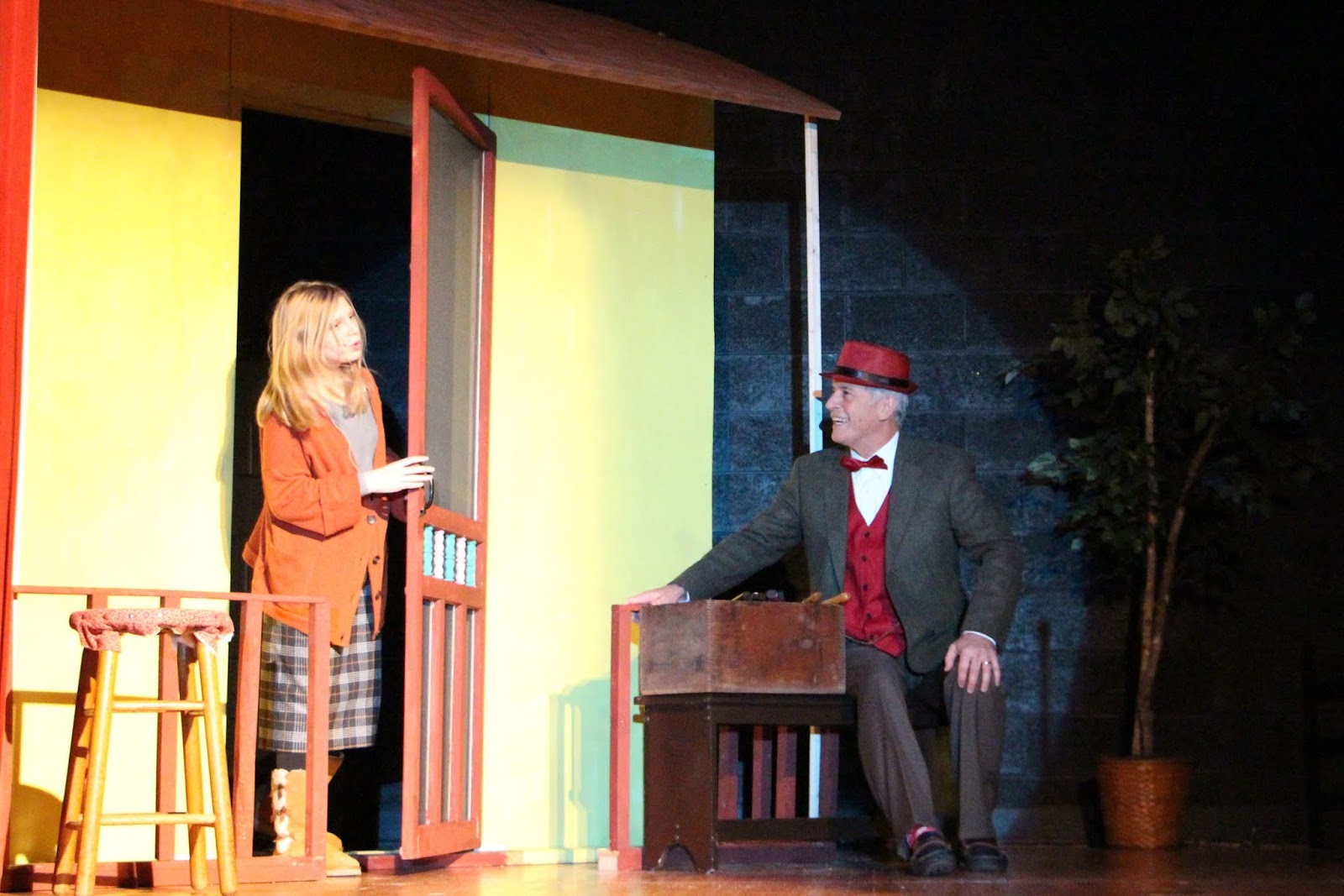
Each year, I delight to work with my St. Paul’s Players drama ministry (at St. Paul’s Lutheran Church in Columbia, S.C.) to create a dinner theater event to celebrate the holiday season. Our effort this year was called THE CHRISTMAS HOUSE, based on a short story by Judge Bert Goolsby, “The Gift House.” A family’s summer ritual, during the hottest days to keep cooler, is pondering what might have happened to the three gifts (gold, frankincense, and myrrh) the wise men or kings brought to the baby Jesus in the cold of winter at his birth in Bethlehem.

In his story, Judge Goolsby tells the tale as a remembrance. For our production, I had a Pastor give the account as part of his Christmas Eve sermon. He stood at a podium and behind him, our actors first played out a summer’s evening on the porch, discussing as family members what might have happened to the gifts. Then, they took on separate roles as historical characters as the Pastor gave that narrative.

While over time, the gifts have taken on symbolic meanings (gold for kingship, frankincense for priesthood, and myrrh for burial), according to the story, there is no clear record of what happened to those gifts and whether the Holy Family had time to take them along when they traveled to Egypt to avoid Herod’s slaughter of the innocents (to eliminate a potential rival king). Over the years, people speculated about the house where the Holy Family had been living and whether the gifts might have been hidden there. When an Arab named Abdullah acquired the house, he received money to let people search the house. No gifts were ever found.

Then, during the crusades, a Knight, Sir Robert, arrived in Bethlehem. He always questioned if he had fulfilled his destiny. When he discovered he had become a leper, he was encouraged to go the house where the Holy Family had lived to see if he could find the gifts. Like those who had searched before him, he found nothing. However, when the owner Abdullah saw Sir Robert’s leprosy, he offered to help. Abdullah brought out a container of ointment that had been hidden away in the house (and perhaps was the wise men’s gift of myrrh). The ointment cured Sir Robert’s leprosy.

Our cast featured: Sid Ballentine (Uncle Ned/Abdullah), Brenda Byrd (Mother/Miriam), Janie Fulmer (Aunt Dora/Naomi), Olin Jenkins (Pastor), Randy Nolff (Uncle Jed/Sir Geoffrey), and Mark Wade (Uncle Fred/Sir Robert). Lights and sound were managed by Billy Itter. Carol Rabon Itter assisted with box office. Pat Itter prepared our programs. Our church secretary, Alice Richardson, cooked a wonderful meal of lasagna (meat or vegetable), salad, garlic bread, desserts, and beverages. All were delicious!

For each production, we select a cast project or local entity or charity for which to collect funds. This year, the program was Linda’s Love, operated by Lexington Medical Center Foundation and providing holistic emotional and psychological support for patients and their families. The fund was established by Jeffrey Angstadt in memory of his late wife Linda, a breast cancer survivor with a bachelor’s degree in psychology and a unique understanding of the value of compassionate care. Contributions provided for programs to assist suicide prevention, behavioral health collaborations, cancer transitions, perinatal loss, and caregivers. We were incredibly pleased to raise over $500 for Linda’s Love.


Photo of Cast and Crew by Heather Coats

Do you look forward to a special event to celebrate the holidays? 

Tuesday, January 16, 2024

Back to "Trodding the Boards"

by Paula Gail Benson 


COVID changed a lot of activities, including one that is dear to me: working with our actors and crew in our church’s drama ministry. In 2020, we had to cancel our bi-annual production of the Living Last Supper (just after we had received a new back drop for the stage) and our last December presentation was given in 2019.

Finally, this year, we were able to resume the Living Last Supper at Easter. As the Fall approached, I began getting a lot of questions about what we would be doing for the holiday season.


I had planned to write a new musical based on a short story by a good friend, retired Judge Bert Goolsby. I spoke with him and his wife Prue in the summer and both were enthusiastic to see his “A Christmas Tale,” in which a drunken Santa Claus must be defended by a disgraced attorney, presented on stage.

Then, in October, I received a call that Prue was in the hospital. She had pancreatic cancer.

I went with a friend and former co-worker to visit her. We were fortunate that she was still able to communicate with us. Again, I mentioned writing a play from Bert’s short story. He and Prue encouraged me to do so. In fact, Bert asked if there was a role for him.


Since it takes place in a courtroom, we needed a judge. Bert was a natural.

There wasn’t time to write music, so I concentrated on developing a one act, which I called A Santa Claus Story. Then, I received word that Prue passed away.


Bert continued to say he wanted to go forward with the play. I assembled a group of actors. We had numerous obstacles to overcome. One actor had COVID and did not test negative for the virus until the end of our rehearsal period. Fortunately, he was a quick study. Another actor was helping as a care giver for a person in another state. It became difficult to get everyone together for a run through, but we persevered.


We presented the production as a dinner theater. The price of the meal had gone up by a third, but we kept the charge to the audience low and subsidized the remaining costs with contributions.

In addition, as we usually do, we selected a “cast project” for which we solicited donations. This year, the project was the Veteran Experience Action Center (VEAC), a program sponsored by the American Legion Department of South Carolina in partnership with the SC Department of Veteran Affairs and US Veteran Affairs Regional Office, that assists eligible veterans and their dependents with any questions they have about VA healthcare benefits including VA disability claims, appeals, or other healthcare issues. We were incredibly pleased to raise $700 for the VEAC.

Thanks to several co-workers who volunteered their time, talents, and items they found and created, we were able to decorate the set and the tables, giving our auditorium a festive atmosphere. Our cast included: John Arnold as Nickie Claus; Mark Wade as the attorney Alva Fortuna; Tim Clark and Janie Fulmer as members of the Manger Society (collecting for charities); Jan Jenny and Brenda Brinkley Byrd as a couple engaged for 15 years; Sid Ballentine as the arresting and prosecuting officer; and Bert Goolsby as the judge. Billy Itter ran lights and sound.

 Have you been able to resume theatrical activities since COVID?

Tuesday, January 19, 2021

A Year without Theater

by Paula Gaill Benson

Usually, my first message of the new year is a recap of the preparation and production of an original Christmas musical that I write and direct for my church’s drama ministry. A group of us have collaborated on a number of these projects and find they are both creatively fulfilling and a wonderful way to celebrate the holidays.

In 2020, due to the Covid 19 pandemic, not only were we unable to put on a Christmas musical, but in March, we had to halt the rehearsals that had begun for our biannual production of The Living Last Supper, a program we usually present the week before Easter. Thanks to our Pastor’s editing skills, we were able to put together an online service of Bible readings, monologues, and hymns that was presented midday on Good Friday.

The past year has been lonelier without the companionship of actors and backstage workers. I’ve missed seeing an interpretation emerge that I hadn’t recognized in the writing. Just as Auntie Mame sings, “We need a little Christmas now,” I’ve thought how wonderful it would be once again to enjoy the collective experience of watching a play and listening to the audience reaction.

During this time of social separation, I’ve found myself succumbing to binge watching televised series, some I had seen and others that were new to me. Following a season’s programs in rapid succession gives you a different perspective of the show. You make connections that weren’t apparent earlier and notice story arc structures. Sometimes, you even watch an episode again to verify how a theme or plot device was developed.

Meanwhile, in my own writing, I’ve found myself sinking more deeply into describing character reactions. My first drafts often have a lot of nods in agreement or shrugs to indicate not knowing or indifference. This past year, those have diversified into short, curt head bobs and throwing up one’s hands in frustration. I’ve considered the movement of eyebrows, lips, hands, and silence to express emotions.

In other words, I’ve become both actor and director, which I guess I always was, but the actor’s craft is getting a little more focus.

When Craig Johnson of Longmire fame spoke at Murder in the Magic City, he mentioned that his audio book narrator had complimented him because his writing made it easy to understand which character was speaking or acting. Craig said he aimed for that kind of seamlessness in his text in order to keep his readers engaged.

Acting brought me into the theater. I’ve always loved being on stage, creating a world with other actors.

This past year, I’ve renewed my joy in acting by bringing it to the page. In doing so, I’ve found new dimensions for portraying motive, passion, love, and even cynicism.

One of the stories I wrote this past year was my most complex yet for plotting and characterization. It took a lot of time to come together. I found the weaving of its elements frustrating because so much was conveyed through subtext, and that’s more difficult on the page than through body movement and expression on stage and in film.

I was delighted that the story has been accepted for an anthology. When I told a friend about it, he asked if he could read it. After I sent it to him, he responded with an email full of questions about the characters, their motivations, and his interpretations. I’m grateful he became so involved in the story and saw it on several levels. I truly appreciate his sharing his reaction with me. I very much needed to make that connection with a reader/viewer.

Hopefully, 2021 will give us the chance to experience theater and social gatherings again. Meanwhile, how have you found your writing, reading, and viewing influenced by a year of isolation?

Tuesday, January 21, 2020

With A Lot of Help From My Friends


by Paula Gail Benson

Each year, I write a Christmas musical that is performed as a dinner theater at my church, St. Paul’s Lutheran in Columbia, S.C., during the first two Fridays following Thanksgiving. I thought I was ahead of the game this year. By mid-summer, I had worked out a story about a hobo storytelling contest during the Great Depression and developed roles that fit the folks in our company of St. Paul’s Players. I even had many of the musical numbers ready.

Then, one of my Players had a terrible accident, falling from a ladder and breaking ribs. He kept telling me he was working to recover, but those kind of injuries take time. By the end of summer, he regretfully told me that he would not be able to participate.

He encouraged me to cast someone else, but I’d written one key role with him in mind and wanted him to have the chance to play it. About that time, I went to Killer Nashville and, with friends, attended God Help Us!, a show starring Ed Asner in the title role at the Franklin Theater.
Libby Penland, Jillian Carey Bigony, Kristen Coulter, Brenda Byrd, Jim Jarvis, Reggie Hall, Tim Clark, Janie Fulmer
Among the group were Debra Goldstein, Nancy Sartor and her husband Dave, Marianne Donley, Carol Wright, and Carol’s husband Bruce Murphy. Marianne and Carol are members of the Bethlehem Writers Roundtable and edit the group’s online quarterly. In addition, both are excellent short story writers. When I mentioned my dilemma with my Christmas production, they suggested I read a story that Carol had written for the group’s anthology, Untethered: Sweet, Funny, and Strange Tales of the Paranormal. Carol’s story took place during the Depression era and was called “The Man from Hooverville.” They encouraged me to consider turning it into a musical.
Janie Fulmer, Tim Clark, Margaret Davis

I read Carol’s story and liked it very much, but its main character was a thirteen-year-old girl. My company of Players were all adults.
Jillian Carey Bigony, Kristen Coulter, Libby Penland, Brenda Byrd
After returning home, I was consulting with a co-worker at the office when her brother stopped by to visit. He turned to me and asked if I was working on my Christmas production. After saying I was trying to, he said, “Well, I have a thirteen-year-old daughter and she would love to be in it.”
Libby Penland, John Arnold
If I made up this story, no one would believe it, but I’ve learned to expect this kind of “coincidence” to occur each year as I work on our production. Our producer for many years, John Henry, and I used to talk about it as divine intervention, proving that we were on the right track. Since John passed away two summers ago, I now imagine him sitting at God’s elbow, whispering, “You need to get Paula moving with this year’s musical.” Due to John’s estate planning, he continues with us through funding as well as spiritually. His faith in our efforts is a great sustainer and means more than I can say.
Jillian Carey Bigony, Kristen Coulter, Jim Jarvis, brenda Byrd, Libby Penland, John Arnold, Reggie Hall, Tim Clark
So, I asked Carol if she would trust her story to me and she graciously agreed. Her story had three characters: the young girl, her mother, and a mysterious stranger who seemed to come from the Hooverville. I asked Carol questions, like what was the mother’s name and could I expand the story to include other characters, residents of the town and the Hooverville? She agreed to my expansion and, as I shared drafts with her, she told me that I had developed it in ways she considered as she was writing the original story. Talk about a feeling of validation! There is no higher praise for a story adapter than having the original author say you captured her vision. I cannot tell Carol how grateful I am for her encouragement and support for turning her short story into the musical Always with Us.

This year, I truly experienced “if you build it, they will come.” Members of the company brought friends and family members to join us. Our cast increased to nine people, John Arnold (the mysterious man), Jillian Carey Bigony (the mother), Brenda Byrd, Tim Clark, Kristen Coulter, Janie Fulmer, Reggie Hall, Jim Jarvis (members of the town and Hooverville, which I named BeHooven), and Libby Penland as our thirteen-year-old Patty Shepherd. Margaret Davis made me believe I had some talent as a song writer. She helped me organize the music and took on a solo. Malechi Doren and William Paddock signed on as our accompanists and musical transcribers. Dean Long provided lights and sound and Billy Itter ran our spotlight.

Our audiences responded lovingly to the heartfelt nature of the story. We received some of the kindest compliments we have ever had.

In one last dramatic turn, our videographer had a stroke before she could film the production. Fortunately, she received the immediate care she needed and is recovering. (Thank you, Heather Coats, for the photos in this message. We love you and hope the healing process is speedy!) I found a group on Facebook and put out an urgent appeal for help. In true show business fashion, the show went on and we have it taped for posterity and for Carol, who cheered us on from a distance. We’ve held off our cast party hoping she and Bruce can come celebrate with us.

So, another opening, another show. This time, with a great deal of help from my friends.

Any theater groupies out there? PS thanks for our posters Susan Craft!

Tuesday, January 23, 2018

The Game’s Afoot. Again.


by Paula Gail Benson
Asa Arnold, John Arnold, Jinny Davis Nantz, and me waiting for the show to start!


John Arnold as Holmes
For my first WWK message of each New Year, I enjoy sharing the adventures my church’s drama group had with its holiday production. This year, our St. Paul’s Players asked if we could revisit some territory we previously explored: an adaptation of a Sherlock Holmes story.


In 2013, we did a musical version of what I believe is the only Sherlock Holmes Christmas story that Arthur Conan Doyle wrote. “The Adventure of the Blue Carbuncle” is a mystery involving a lost hat and Christmas goose. Because the owner is not found, the goose is cooked for a holiday dinner and when it is carved open, a stolen precious jewel is discovered inside. The theme of the story is redemption. After discovering the thief, who admits his crime, Holmes lets him go. Holmes justifies his action by telling Watson, “I suppose that I am commuting a felony, but it is just possible that I am saving a soul. This fellow will not go wrong again; he is too terribly frightened. Send him to jail now, and you make him a jail-bird for life. Besides, it is the season of forgiveness.”

Asa and John Arnold

Jim Jarvis as Watson
During the summer, I began looking over other Holmes’ adventures, searching for one that was no longer protected by copyright and had an appropriate holiday theme. When I came across “The Adventure of the Copper Beeches,” which actually mentions the blue carbuncle, I took that as a sign I found my story.


The Copper Beeches is a stately country home inhabited by a strange family. Mr. Jethro Rucastle, while jovial, has a mean streak and a secret. His wife is stern and complicit. His son has the talent of being able to kill cockroaches with his shoe.


When Miss Violet Hunter is offered the job as governess, for an exorbitant salary, she seeks Sherlock Holmes advice: should she take the job? Holmes agrees that the requirements she cut her hair, wear a particular dress, and sit in a certain chair in the parlor sound ominous, but if she accepts employment, he agrees to investigate if she sends for him. She very quickly does.

Margaret Davis, Olin Jenkins, and Andy Fiffick in rehearsal
Our adaptation was titled Christmas with Holmes and Watson. Our incredible photographer was Colleen Fannin Arnold, who also was a member of our cast, along with her husband John, who played Holmes, and son Asa, who played Young Master Rucastle.


Brenda Byrd and Reggie Hall
For any Holmes aficionados, you know that many of the stories are more talk than action. Analyzing the crime becomes the focus, which is fine for reading while sipping tea or a hot toddy by the fireplace.


However, on the stage, too much talking can be deadly. And not in an entertaining way.


The first thing I needed to do was figure out how to open up the story. I decided to have a “Greek chorus” of sorts that I called “the Baker Street Irregulars.” While a handful of actors had single roles, such as Holmes, Watson, Violet Hunter, and Jethro Rucastle, the majority served as utility players, each taking on several parts. For music, we used traditional English carols with story appropriate lyrics.


LaTynia and Sydnie Taylor
Holmes purists probably would be skeptical about our adaptation, which evolved from the folks playing the roles. Reggie Hall, the laughing, but mysterious Mr. Rucastle, looks exactly like Santa Claus. In fact, he is a proud graduate of a professional Santa Claus School in Michigan. So, throughout our story, we made some illusions to Mr. Rucastle’s Santa-like appearance and by the conclusion, had him dressed in the American traditional red suit with his wife decked out as Mrs. Claus. To match him, Sherlock Holmes took his curtain call dressed as Father Christmas.


I’m so very grateful to our cast and crew who give their time through the fall in rehearsals and spend the first two Friday nights of December performing for a dinner theatre audience. I’m proud to say both performances were full houses. In addition, we collected almost $1,000 for our selected cast project charity, the Palmetto Health Children’s Hospital Foundation.


John Arnold and Reggie Hall
Now, my question for the New Year is, what shall we do next?

Tuesday, January 17, 2017

Bringing a Little Heaven to Earth


by Paula Gail Benson

Poster by Susan F. Craft
My first WWK message for the New Year is usually a recap of the holiday production I write and direct for my church’s drama ministry, the St. Paul’s Players (SPP). It’s a particularly meaningful post for me in that my initial appearance on stage was in the chorus of SPP’s The Mikado, and now I’ve come full circle by being able to create our plays and help bring them to life. It’s always both a challenge and a true joy.

This year, I received a lot of questions about where the idea for our show, Tales from the Celestial Nursery, originated. There were two sources. One was a production of One Bethlehem Night, a Broadway-style musical written by Jeff Atwood, John Lemonis, and Ed Kee. My producer, John W. Henry, and I had found it on the web and actually spoke with the authors about presenting it. After doing more research, we decided that it was more than we would be able to handle. But, I was thrilled when the drama ministries at Spring Valley Baptist Church in Columbia, S.C., decided to take it on with my good friend Scott Stepp in the lead. It’s a great retelling of the Nativity story from the viewpoint of the innkeeper. The songs are lovely, very reminiscent of music from Fiddler on the Roof. If you ever have the chance to see a performance of One Bethlehem Night, please attend or check out the clips available on the web.

I really liked the thought of telling the story from the innkeeper’s perspective. Marianne Jordan also did that in her novel A Miser, A Manger, A Miracle -- the First Christmas Carol. What Jordan does is recast the innkeeper as an earlier-in-time Scrooge. Her work also debuted as a play she wrote for her church.

Okay, so how do I bring my own viewpoint to the innkeeper’s story? Have you ever seen the 1940 Twentieth Century Fox film, The Blue Bird? It was based on a 1908 play by Maurice Maeterlinck, and came out the year after The Wizard of Oz, filmed similarly in both black and white and technicolor. It starred Shirley Temple as a young girl searching for happiness.
Shirley Temple in The Blue Bird
Part of the journey in The Blue Bird takes Shirley to the land of unborn souls. In a particularly poignant scene, two children (playing unborn souls) cling to each other because one is being sent to earth and the other will not arrive there until the first has departed.

I have never managed to get that scene out of my head. It became the second inspiration for Tales from the Celestial Nursery.
Angels, Story Tellers, and Unborn Souls (Photo by Carrie Nicholson)

What if the Unborn Souls wait in the celestial nursery until they are born on earth? Two Guardian Angels, Sophia and Serena, could watch over them and the Story Tellers, Alpha and Omega, would tell them the stories of earth . . . until they decided to become human and take part by going to earth themselves. Because the unborn souls are all babies (even though played by youth and adults), they sing in nursery rhymes, so “Old McDonald” becomes “Old King Herod,” and “Three Blind Mice” becomes “Three Wise Kings.” And, of course, there was a version of “Twinkle, Twinkle Little Star.”

Rap Number (Photo by Carrie Nicholson)
After listening to the Broadway musical Hamilton all summer, I couldn’t resist including a rap number. Here’s a little sample:

“Here we are in the celestial nursery.
Floating on the clouds is the place you wanna be.
Dreaming happy dreams above the distant earth,
Not sure we understand this thing called ‘birth.’
For now, just call us the unborn souls,
And don’t confuse us with thoughts of having human roles.”

Photo by John Henry
Photo by John Henry
We had a terrific cast and crew. These are some shots of us at the cast party. I’m very proud to say that we raised over $1,000 in donations for an organization called Sistercare, which helps victims of domestic abuse.

As always, those of us involved in the production benefited as much as those coming to see it. I must admit I found it especially gratifying to welcome some audience members to both performances.

Have you ever participated in a play or musical? What did you enjoy best about the experience?

Curtain Call (Photo by Carrie Nicholson)