
by Linda Rodriguez
I have recently been
asked by a number of people how to find time to write novels. I
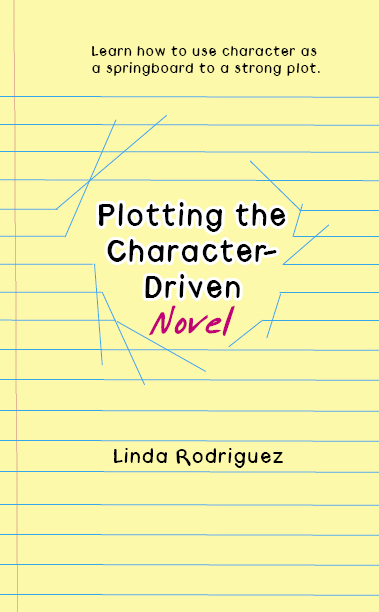
decided to offer a free excerpt from my book, Plotting the
Character-Driven Novel, that deals with precisely that problem to
the Writers Who Kill readers. I hope our readers will find it
helpful.
Book Excerpt from
Plotting the Character-Driven Novel
Writing a novel
requires several things—time, motivation, the willingness to keep
learning the craft of fiction, and an ability or process to access
your creative thoughts. We’ll deal with the first two in this
chapter briefly since they’re mostly beyond the purview of this
book, and the rest of the book will concern itself with elements of
the craft of fiction and a process for accessing your own inner
knowledge of your novel by freewriting, brainstorming by yourself,
and thinking on paper. I will be including samples of actual work
documents I have used with this process to create published novels in
order to give you examples of how these techniques and tools work—and
also to show that behind those perfect books you pick up at the
bookstore lies a great deal of hard work, messy process, and flailing
around. This book is designed to help you keep the flailing around to
the minimum.
How
do you find time to write the novels which are your vocation in the
midst of job and career demands, family and housework demands,
community and societal demands? When everyone else expects so much
from you that there’s nothing left for your own dreams, what can
you do about it?
First,
we have to change our terminology from “finding time to write” to
“making time to write.” The sad truth is that no one finds time
to write. There aren’t big pockets of time just lying around
waiting to be picked up and used in most of our lives. For most of
us, we’ll have to give up some comfort or pleasure to make real
time to write—in some cases, to make any bits of time to write at
all.
The
first step is to make the decision to own your own life. Time is not
a commodity--the time we’re talking about is the substance of your
life. When it’s gone, so are you. If you want to write anything,
you have to claim your own life and find out what you want.
How
do you find those pieces of time and the regular schedule for writing
that leads to a body of work? The trick is to create order and make a
tourniquet for a time hemorrhage, but first you must destroy all of
those 'shoulds' and 'what will people thinks' that are standing in
your way. Make it easy on yourself by asking for help and accepting
help when it’s offered to you. Take the time to de-stress. When
you’re not frazzled by stress, you’ll find it easier to set
limits and boundaries and hold to them.
Whenever
you find your desk or day becoming chaotic, take time to reorganize.
It will repay in more time that you can steal for your illicit love
affair with the novel. To make sure you stay on track with those
things that absolutely must be done, make a brief list of the way
your time was spent at the end of each day and week. Check it for
places where you abandoned time reserved for writing or other truly
necessary tasks to engage with lower priority urgencies or comfort
activities. After a disastrous day, sit down with a notebook and
figure out how to handle things differently if you face the same
situations again. Review the situation and just what happened step by
step, pinpointing the spot(s) at which you could and should have made
a different decision or taken a stand against someone else's urgency
with your time. Figure out a strategy for dealing with this situation
when it next arises, and write it down. Then forget the day and
relax.
Worrying
about the myriad things, some great but most small to tiny, that we
must take care of wears us down. When you find yourself doing this
rather than being able to write or revise the passage you want to
work on, keep an ongoing master list and write down each task or
obligation the moment you think about it. Get it out of your head and
onto paper to free your mind and stop the energy drain. Then, later,
you can decide which tasks can be delegated to someone else and
arrange the remaining tasks in the order that will allow them to be
done quickest and most easily.
We
can also free up energy by developing habits and systems to take care
of the mindless stuff. We already do this every day, brushing teeth,
driving to work, without having to make decisions for each tiny
action that comprises these tasks. Develop a system for handling
things that recur, and stick with it for twenty-one days. Then it
will be a habit, and you can forget it and set your mind free to be
more creative.
Much
time use is sheer habit. Work smarter. Find the ways in which you
want and need to spend time. Steal those minutes and hours from
low-priority tasks. Break down everything on your to-do list into
small tasks and estimate the minimum time to accomplish them. (Double
all time estimates!) Schedule into your calendar. If they won't all
fit in the time allotted, then something must go. Nothing is fixed in
stone--renegotiate and eliminate whatever you can. Of the rest, what
can you successfully delegate? It pays to invest time (and money, if
possible) in training someone to do it.
Become
assertive. Don't be afraid to approach someone with a request, and
don’t take it personally if they refuse you. Learn to say 'no'
kindly and firmly and to receive a 'no' without letting it affect
your self-esteem or your relationship. Be secure.
Author
of many published novels and teacher of writing, Holly Lisle, says it
the best way I’ve ever seen it. “Realize that real writers who
write multiple books and who make a living at it have systems they
use. A process for brainstorming, a consistent way of outlining a
story, a certain number of words or pages a day, a way of plotting, a
way of revising, a way of finishing. Writing is work. It doesn't fall
out of your head by magic. It doesn't just happen because you want it
to.”

 Linda Rodriguez's Dark Sister: Poems
has just been released. Plotting the Character-Driven Novel,
based on her popular workshop, and The World Is One Place: Native
American Poets Visit the Middle East, an anthology she co-edited,
were published to high praise in 2017. Every Family Doubt,
her fourth mystery novel featuring Cherokee campus police chief,
Skeet Bannion, and Revising the Character-Driven Novel will
be published in 2019. Her three earlier Skeet novels—Every
Hidden Fear, Every Broken Trust, and Every Last
Secret—and her books of
poetry—Skin Hunger
and Heart's Migration—have
received critical recognition and awards, such as St. Martin's
Press/Malice Domestic Best First Novel, International
Latino Book Award, Latina Book Club Best Book of 2014, Midwest Voices
& Visions, Elvira Cordero Cisneros Award, Thorpe Menn Award, and
Ragdale and Macondo fellowships. Her short story, “The Good
Neighbor,” published in the anthology, Kansas City Noir, has
been optioned for film.
Linda Rodriguez's Dark Sister: Poems
has just been released. Plotting the Character-Driven Novel,
based on her popular workshop, and The World Is One Place: Native
American Poets Visit the Middle East, an anthology she co-edited,
were published to high praise in 2017. Every Family Doubt,
her fourth mystery novel featuring Cherokee campus police chief,
Skeet Bannion, and Revising the Character-Driven Novel will
be published in 2019. Her three earlier Skeet novels—Every
Hidden Fear, Every Broken Trust, and Every Last
Secret—and her books of
poetry—Skin Hunger
and Heart's Migration—have
received critical recognition and awards, such as St. Martin's
Press/Malice Domestic Best First Novel, International
Latino Book Award, Latina Book Club Best Book of 2014, Midwest Voices
& Visions, Elvira Cordero Cisneros Award, Thorpe Menn Award, and
Ragdale and Macondo fellowships. Her short story, “The Good
Neighbor,” published in the anthology, Kansas City Noir, has
been optioned for film.
Rodriguez is past chair of the AWP
Indigenous Writer’s Caucus, past president of Border Crimes chapter
of Sisters in Crime, founding board member of Latino Writers
Collective and The Writers Place, and a member of International
Thriller Writers, Wordcraft Circle of Native American Writers and
Storytellers, and Kansas City Cherokee Community. Visit her at
http://lindarodriguezwrites.blogspot.com

