by Paula Gail Benson
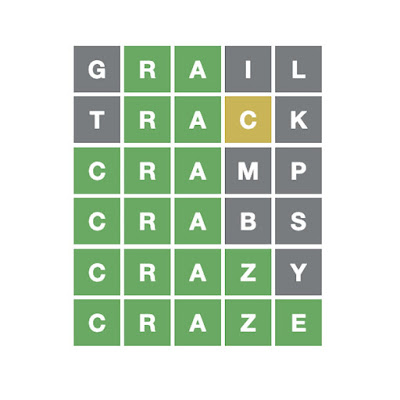
A few weeks ago, I noticed my Facebook friends playing a puzzle game called Wordle. My aunt had been a great proponent of working puzzles and this one intrigued me. It involved a chart giving the player six attempts to come up with the selected daily five-letter word.
The player begins by selecting any five-letter word. The game generator then indicates if the letters in the player’s selection are within the daily word the player is trying to guess. If a letter on the chart turns green, it’s in the correct position in the daily word. If it turns yellow, it’s in the word, but at a different position. If it is gray, it’s not in the word.

With each new word, the player hopes to learn more about the letters and their positions in the daily word. When the player correctly guesses the daily word, he gets a score indicating how many attempts it took to reach the correct result. 3/6 means the player found the daily word on the third try.
The game was created by Brooklyn-based software engineer Josh Wardle as a gift in October 2021. (Some accounts indicate Wardle developed the game to entertain his partner, Palak Shah, during Covid.)
So, who could be surprised that at the end of January the New York Times purchased Wordle for “the low seven figures” in an effort to build its digital readership to ten million by 2025?
Yes, Virginia, words matter. They can matter big time.
Initially, Josh Wardle identified 12,500 five-letter words. Palak Shah helped him whittle the list down to 2,500 more recognizable terms, which should keep players happy for a few years, although some have already protested that “REBUS” and “TAPIR” were too obscure.
Players’ strategies vary. For my initial guess, I like to select vowel heavy words, like “sepia” and “arose.” Some folks start out with the same initial word each time or with the winning word from the last round.
Next, I consider consonant combinations that occur at the beginning and ending of words, like “pl” or “nd.” Sometimes rhyming words help and other times they confuse me. I hate it when I know four of the five letters in order and there are too many rhymes to select from with the remaining tries.
If you’d like to build your skills, there is a free online version of Wordle for practicing. Also, apps are available that allow you to determine the number of letters you want to play. Some are timed, so you have to reach the correct solution within a prescribed period. Those make me a little nervous.
Maybe I’m a purist. I prefer Josh Wardle’s original concept, where it’s just you and your mind figuring out the puzzle.
Thanks, Josh and Palak, for giving all us word nerds a spiffy literary Valentine!
Have you joined the Wordle world?