Showing posts with label Dreamwalker Series. Show all posts

Wednesday, August 12, 2020

An Interview with Author Maggie Toussaint by E. B. Davis


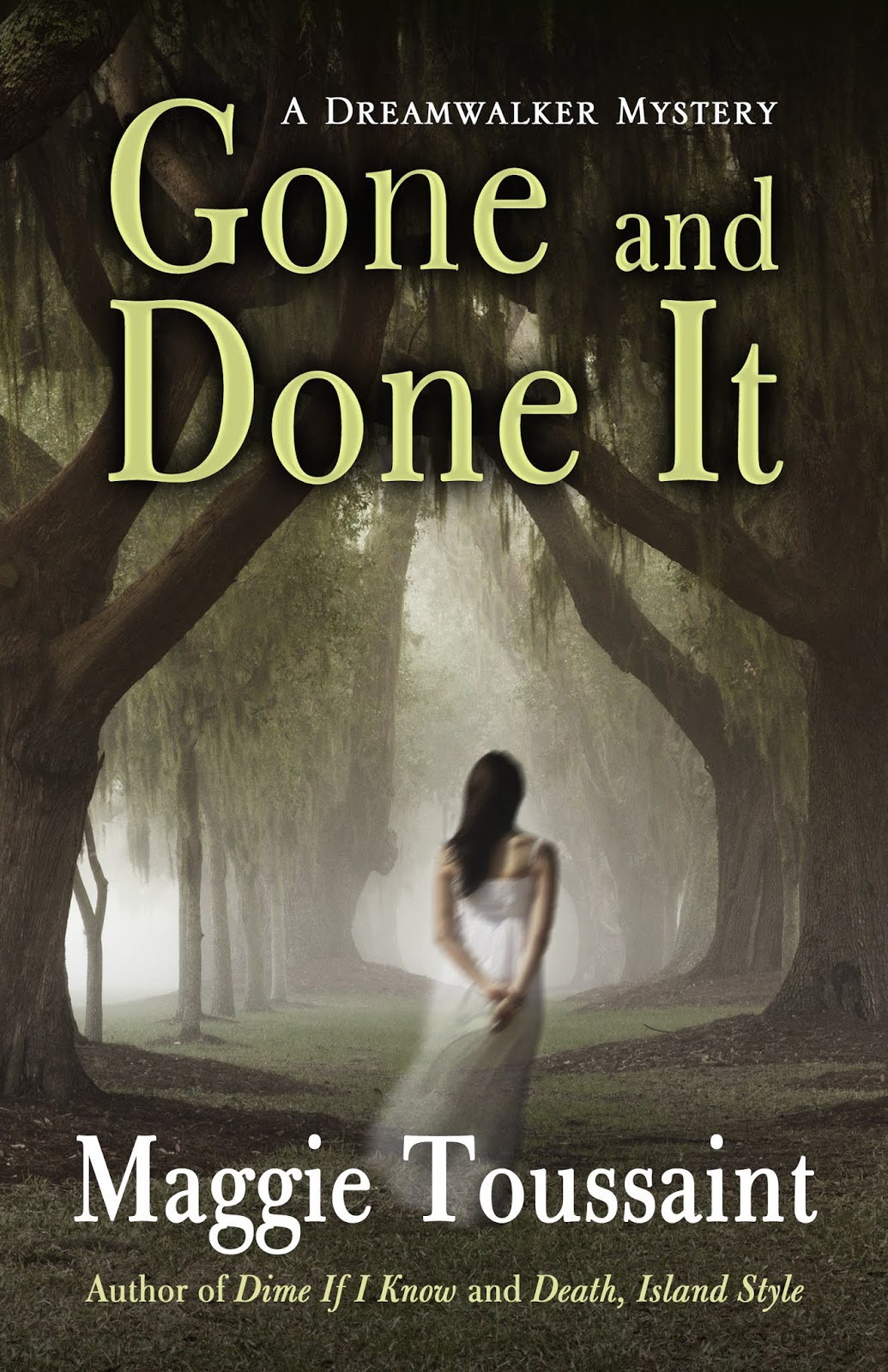
A Jane Doe jogger homicide near the swamp mystifies Dreamwalker Baxley Powell. The petite woman carried no ID, and no one recognizes her. Worse, a shadow passes from the body to a deputy, rendering him unconscious. The deputy and the corpse are dispatched to the hospital and morgue, respectively.

With summer heat and pending childbirth on her mind, Baxley’s dreamwalks into the spirit world fail to yield leads, frustrating Baxley and her deputy husband, Native American Sam Mayes. Days later, Jane Doe’s description matches a missing Mississippi woman. Turns out, her new husband is missing too. Jane’s sketchy brother-in-law and her aunt arrive, full of secrets. At Jane’s campsite, the team encounters a terrifying anomaly, nullifying Baxley’s senses. With such danger present, they must protect their unborn child. No more dreamwalks will occur until Baxley gives birth.

When her friend Bubba Paxton vanishes, Baxley sights him in a mirror, trapped between worlds with other souls.

Meanwhile, the shadow invades other hosts, demanding to see Baxley. Mayes and Baxley ignore the shadow as they rescue Bubba, untangle the Jane Doe case, and handle missing persons reports.

To free the trapped people, Baxley must outwit a powerful foe. Can she stop this super villain before he steals her soul?

In this 7th Dreamwalker Mystery, female sleuth and psychic crime consultant Baxley Powell works a homicide case that leads straight to an evil force in the spirit world. The stakes? Her soul, her unborn child, and humanity’s freedom.

Perhaps because both of my children were born in August, I identified with main character Baxley Powell’s ninth-month pregnancy condition. The hot and humid coastal Georgia weather played a role in All Done With It, and I read it during continuous days of plus ninety degree heat of NC. Perhaps Maggie has children born in August too because Baxley’s physical condition was very well portrayed.

Baxley’s extended family also have roles in this story that comes full circle—laying some ghosts to rest and bringing new life into the family legacy.

Please welcome Maggie Toussaint back to WWK.           E. B. Davis 
The victim, later known as Fabrina, was found in the swamp. What is it about the swamp that unnerves Baxley? For Baxley and her dreamwalking family and friends, the swamp wreaks havoc with their senses. And the more extrasensory perception one has, the more disorientation occurs. She’s had to be in the swamp in another book in the series (Doggone It) and something terrible happened then too. In this story world, the swamp represents a thin line between the living and the dead, a line that can be breached.

While assessing the crime scene, Sheriff Wayne confesses that Baxley and her husband Mayes have caused him marital issues. How do they have anything to do with the Sheriff’s marriage? We’ve all seen couples in the flush of love. They always meet each other’s glances and often are physically touching. The glow of love envelops them so much that it radiates from them in a tangible way. In the case of Mayes and Baxley, that’s exactly what happens, and the sheriff’s wife wants her husband to look at her that way. Only, he’s never felt that way about her, and he can’t make his wife happy.

Wayne’s wife has taken out a restraining order against him. Baxley gives him strong advice. Most people would keep their mouth’s shut. Why doesn’t she? Wayne seeks her out to ask her advice, and since Wayne helped her out in a similar situation in another book, she owes him. Wayne, a former high school football standout, is hurt by his wife’s betrayal. Baxley tells him to man up if he ever wants to see his kids again. Further, she reminds him that this is no time to ignore an unpleasant situation. He needs to act now, for his kids’ sake.

But after trusting Baxley with marital advice, when she sees a shadow cross from the body of the victim to Deputy Ronnie’s unconscious body, Wayne discounts her sighting thinking she’s a hysterical pregnant woman. Obviously, something happened to Ronnie. I remember getting that response from people when pregnant. (“Pregnancy hormones,” said with a dismissive tone.) Why do people do that? I have two responses to this. Here’s the easy answer: People tend to get uncomfortable when the status quo alters. Not all men, but a good many, are skittish around pregnant women, fearing they will suddenly be required to deal with childbirth. The deeper answer is that not only does a pregnant woman’s body accommodate a growing baby, other bodily changes occur as well. Elaine already mentioned pregnancy hormones, which are a biological way the body makes that child-on-board accommodation, but sensory perceptions change too. Strong scents, loud noises, and bold flavorings trigger negative reactions from non-sensitive women. In Baxley’s case, her extrasensory perceptions ramp into a higher gear, which is her body’s response to protecting herself and her baby. Men who are already squeamish about very pregnant women are reluctant to accept enhanced psychic abilities from said women because it is out of the realm of everyday explanations. And, for the record, I did birth an August baby during a heat wave a long time ago. It’s not something I’ll ever forget.

Baxley and Mayes have dreamwalked with their unborn son. They know he identifies with the wolf as a symbol. How does an unborn child communicate? In utero, a baby moves around in the womb. Some babies kick when distressed, so that’s a means of communication. In the case of this fictional infant who is also a sensitive, he doesn’t have the use of language but he shares images with his parents in the slipstream of consciousness.

After the shadow goes into Ronnie, a tattoo on the victim’s hand disappears. Why do Mayes and Baxley think the shadow wants their unborn son? As mentioned above, the swamp isn’t a sensitive-friendly environment. In addition to disorientation, Baxley’s normal perceptions fade, and she can’t feel her baby. Her stress level is off-the-charts high. Plus, Baxley and Mayes have a strong association with tattoos and an otherworld figure named Rose, who served as Baxley’s mentor as she came up to speed in her Dreamwalker abilities. When they see a tattoo vanish on its own, they think of Rose and her kind.

During a dreamwalk using the victim’s clothing, Baxley encounters the Wolf. Why do they decide it’s too dangerous for Baxley to dreamwalk? In general, wolves are wily creatures in nature and legend. (Who doesn’t remember quaking in fear at the Big Bad Wolf as a child?) Wolves are tenacious, aggressive, and avid hunters. In this story, Wolf is a supernatural creature. Given his ability to imprint his tattoo on humans from beyond this world, Baxley and Mayes were right to fear him. In a sleeping dream, Wolf threatened Baxley. As the story unfolds, we learn he’s threatened other dreamwalkers who have subsequently perished. Baxley’s dreamwalks put her and her baby in jeopardy, and that’s a risk neither Baxley nor Mayes are willing to take.

Why are Baxley, Mayes, and Baxley’s daughter Larissa living with Baxley’s parents, not in her home? The Nesbitt cottage in the woods is a safe haven for all, and it’s where Baxley intends to deliver her baby. With an elevated paranormal event occurrence rate in Sinclair County, her parents’ home is the safest place to be.

Baxley’s parent’s friends Running Bear and Gentle Dove are the last Cherokees left on the Georgia coast. How vast was the Cherokee nation? A few historical facts first: In 1838, over 60,000 Cherokee in the southeast were forced to relocate west of the Mississippi on the infamous Trail of Tears. Not all Cherokee were forced to move, as those in marriages with whites, especially with whites as head of the household, were allowed to stay. Consequently, the tribal remnant clung to their traditions, mostly in private, for generations, and a large segment of that population in Georgia congregated in northeast corner of the state. They are officially recognized as the Georgia Tribe of Eastern Cherokee. I used those facts, along with the fact that the original settlers of the Georgia coast were Native American, to create the characters of Running Bear and Gentle Dove. It seemed quite natural to me that people who live in close communion with nature would befriend Baxley’s dreamwalker family.

After the shadow in Ronnie goes after her unborn son and Mayes protects her, the shadow crosses into Doctor Sugar, a doctor whose license was revoked. Once hospitalized, he starts drawing circles, similar to what Larissa drew in art camp. What do the circles symbolize? The circles are meant to add depth and intrigue to the mystery, but since you asked, I will do a mini-reveal here at Writers Who Kill. The spirit-inspired images are depicted individually and in overlapping positions. Baxley didn’t recognize them as clues to disappearances at first, merely a strange coincidence. Then she’s shown a glimpse of the Wherever, a closed chamber full of frightened people, and the darkened heads resemble circles. She realizes the circles link to that chamber of horrors and that the threat to humanity is dire.

How did Baxley’s mother end up with the right to name their son? While Baxley and Mayes bring different cultures to the marriage, they’re united in their desire to blend those cultures. The Cherokee tradition is that the maternal grandmother names the couple’s child. This sets up conflict in the story and helps propel the plot.

People in the county start to disappear, including Bubba Paxton. Baxley sees Bubba in a mirror. He is in a place where people amble about, but can’t communicate with each other. Where are they? To access the chamber where Bubba is being held, Baxley must use her paranormal abilities. Hence, she realizes the location is not on earth and not on the Other Side but in a tween space. None of her family or friends has ever encountered this particular space between worlds, so Baxley coins a name for this place, the Wherever.

Why does Baxley’s mother continuously monitor the weather? Ah, this has been a series-long secret. I’ve already revealed one secret of the book and this one will remain hidden, though I will say that sensitives tend to embrace things that make them stronger.

Although Baxley no longer dreamwalks, she sees the victim, who they’ve identified as Fabrina, and communicates with her in regular sleep dreams. Fabrina has a rose tattoo like Baxley and has a white stripe of hair. Is she a dreamwalker, too? This is a story point as well, though not a pivotal one. Fabrina is a Dreamwalker, but unlike Baxley she grew up in a culture where she had to hide her abilities and lived in constant fear of discovery. Denying her nature for so long made her easy prey for the man she married, the man she thought had money to burn and offered her a life of travel to escape her repressive life.

I had sympathy for Fabrina’s Aunt Inez, even though she is demanding and aggressive. Baxley, too, has her sympathy. Aside from losing her niece, why? Inez is a complex character who has had more than her fair share of pitfalls in life. Like Fabrina, she inherited dreamwalker abilities, but she hid them her entire life, fearing she’d become the victim of a witch hunt. She had a hand in raising Fabrina and loves her like a daughter. All she wants is to take Fabrina home. Losing Fabrina is a huge blow, and she’s hurting. As a mother, Baxley empathizes with her.

Are a lot of babies born during storms? Does it have to do with barometric pressure changes? I was raised with this old wives’ tale that babies are often born during storms. In addition, growing up in a coastal area with frequent thunderstorms and several hurricane threats a year, I couldn’t help but notice how I felt when a storm came through. (High barometric pressure on sunny days, low barometric pressure during storms) To this day, I stop what I’m doing to watch a storm, not because they fascinate me but because I don’t want to be caught unaware. The scientific community isn’t convinced of the positive correlation of storms/barometric pressure drops and onset of childbirth. They suggest that it’s the stress of preparing for a storm that increases birth rate during storms. In any event, I am a believer in the if-then convention of storms leading to childbirth.

What is a skinwalker? It is a Native American shapeshifter legend. Though this is typically associated with the Navaho culture, I used artistic license to have the Cherokee in my series familiar with it. A Navaho skinwalker is one of several types of witches who live alongside tribe members by day and prowl at night, though a skinwalker is considered the most volatile and the most dangerous of these witches. It is a tradition among The People that there are places where good and evil may be harnessed and those powers can be used at the person’s discretion. Skinwalkers often transform into animals such as wolves, bear, coyote, and dogs to do a task or to escape a predator. In All Done With It, I didn’t hold strictly to that specific convention, but I believe you’ll be interested in my variation.

You’ve brought the series full circle. Is this the last Dreamwalker book or is it a new beginning? This one completes the series arc. Though I’ve enjoyed lingering in this story world for nine years, I’m moving on with a new culinary cozy series set on an island. In a recent bout of introspection, I realized my mystery protagonists are justice-seeking women who stand up for underdogs and the oppressed. They have no investigative training, just a network of associates and a heart for the task. This realization prompts me to suggest that if you enjoy one of my series, you’ll most likely enjoy others I write. I invite you to browse at my website, https://maggietoussaint.com/books

Thank you, Elaine, for another wonderful interview packed with insightful questions. It is always a pleasure to be here with you and the other authors at Writers Who Kill. 

Wednesday, September 25, 2019

An Interview with Maggie Toussaint by E. B. Davis


The fall from superstar to worker bee in a matter of seconds
felt meteoric, but truthfully it was another day at the office.
I was the sheriff’s new app. Instead of point
and click, I’d become point and sniff.
Maggie Toussaint, Dreamed It, (Kindle Loc. 1266)

Justice for the dead and solace for the living is Baxley Powell’s creed, but she faces uncharted territory in this sixth book of the Dreamwalker Mystery Series. The Suitcase Killer has struck again, only this big city menace is now a problem for Baxley’s hometown. As that investigation heats up, a local woman is reported missing. The sheriff orders Baxley to work the missing person’s case. Listening to the dead is familiar ground for Baxley but finding a missing young lady isn’t in her skill set. Besides, her dreams rarely follow a timeline. With the clock ticking, can this crime consultant discover a way to reach the living? Her main source of help in the afterlife, a mentor named Rose, is unavailable. Instead, Baxley must rely on her wits and her Native American boyfriend, Deputy Sam Mayes, to find leads. Each shared dreamwalk and energy transfer binds them closer together, creating another issue. Mayes wants to marry Baxley but it isn’t that easy. They’re hampered by their community roles in opposite ends of the state. Baxley juggles the pressure of two high-profile cases, a determined suitor, and expanding her limits. One thing is certain. Without her extrasensory sleuthing, the missing woman will die.

If you’ve followed Maggie Toussaint’s Dreamwalker series, this cover shows changes the new sixth novel Dreamed It introduce. While previous covers had color, few had a human figure on them let alone full face. It’s not Baxley Powell, Maggie’s dreamwalker main character, because she doesn’t have white hair.

Baxley has solved the riddles of her past and made peace with them. She still has ongoing issues with her mentor, Rose, who is curiously absent in this book. I can’t say I missed her. Although Baxley’s dreamwalks help solve the mystery, most of the action takes place in reality—real world dilemmas that are life threatening.

Dreamed It is one of the best reads in this series. I loved the others, but this one realigned the series. It’s powerful. It’s a balance between Baxley and Sam Mayes, her boyfriend, between Mayes and Sheriff Wayne, and hopefully will become a balance between the dreamwalkers and Rose.  We’ll see what Maggie brings us next!

Please welcome back Maggie Toussaint back to WWK.                                                    E. B. Davis   

Thank you, E.B. Davis, for the opportunity to visit Writers Who Kill. I always love coming here and your interviews are so much fun.

At the start, Baxley and Sam wake up from a dreamwalk they don’t remember, but they also find that they are in a different place. Although they eventually figure out what happened, they don’t know who is responsible. If it had been Rose, wouldn’t one of Baxley’s tattoos Rose seared on Baxley’s arm disappear or change in some way indicating she owed Rose less time?

Based on the rules of this story world, one assumes that would happen. However, as you’ve mentioned some key elements are shifting in this saga. There’s still that dichotomy of “is Rose really what she says she is” playing out, i.e., is she really an angel masquerading as a demon? Baxley doesn’t exactly trust her Other World mentor, but she relies on Rose for help in the afterlife so she is allied with her.

When a body of a woman is found inside a suitcase near a closed stripper bar, Sam Mayes calls his boss, a sheriff from a northern Georgia county, to get reassigned so he can stay near to Baxley and also get involved in the high-profile case. How can another sheriff reassign personnel to another county without a request?

In this fictional world where Mayes’ boss is running for governor, anything is possible. Baxley’s boss, Sheriff Wayne Thomson, is savvy enough to realize he doesn’t want to be on the wrong side of the future governor of Georgia. Though Wayne is all-about-Wayne, he agrees to have Mayes temporarily reassigned to his unit. After all, he requested Maye’s help in a previous case (Confound It), so there is already a precedent set wherein all the players have established a cooperation basis.

Mayes contacts an agent in the Georgia Bureau of Investigation (GBI) without getting Wayne’s permission. He knows the agent has been collecting data about the Suitcase Killer. Was it an inadvertent gaff or was it done “accidently on purpose?”

Those new to the series might not know that Mayes is being groomed for Sheriff Blair’s job in North Georgia. He’s used to running his own investigations and working without close supervision. However, Sheriff Wayne Thompson keeps all of his staff on a short leash. To Mayes, contacting the GBI agent was the next step, and since they were acquainted, it was expedient for Mayes to initiate contact. Wayne did not take that well, and overreacted, which put Baxley in a near-death situation.

A missing-person’s report is filed on a young woman in Baxley’s county. After Baxley is over stimulated and passes out from exposure to the stripper bar, Sheriff Wayne assigns her to the missing-person case. How does Baxley contact the living?

As an author, this was a fun problem to have! In each book of the series, Baxley has been opening herself to accepting all of her psychic powers. She’s gone from only dreaming in her sleep, to dreaming in a meditative state, to touch readings, and more. In this book, she struggles to access the missing woman. What she is able to first detect through touch readings is the woman’s despair and loneliness. Her ghost dog also helps track the missing woman, so she doesn’t have to do this by herself.

Is Mayes’s Native American name for Baxley, Walks with Ghosts, a misnomer? She seems to be able to walk with the living as well.

Mayes gave her that nickname because he knew that Oliver, an earthbound dog spirit, was attached to her. In language and religion, there are times when the words ghost and spirit are used interchangeably. I favor this usage, and by extension, have Baxley contacting the spirit portion of a living person in addition to her communion with spirits of the dead. However, as with learning any new skill, there are speedbumps and errors along the way.

What does u ge-yu-di mean? Why won’t Mayes tell Baxley what it means?

It means lovely. And he does tell her. He’s also sneaky about using her ignorance of his cultural traditions to get them engaged Native American style before he asks her parents for her hand in marriage. Mayes knows a good thing when he sees it, and he’s made no secret of the fact that Baxley is the life mate he wants by his side.

You made up the embarrassing tale involving the embezzlement of public funds and the mayor of Tampa, FL, right?

Absolutely! One hundred percent fiction. In the first book of the series, Rose had Baxley contact a woman in Tampa as a test. When I needed someplace for Baxley to go in Dreamed It, Tampa was the logical alternative. As for mayor scandals, there are a good many reported online from other cities.

Why doesn’t Baxley like surprise gifts?

A long time ago, she got the terrible surprise of sitting in an uncle’s chair and getting trapped in the rift. Not knowing how to traverse the area between the living and the dead, she tumbled out of control until someone noticed her plight. Ever since then, she’s very guarded and prefers to have order in her already chaotic life.

Baxley asks good questions. Mayes makes good deductions. Is that why they are a good team?

It’s part of the dynamic. Mayes is also a dreamwalker so they can work together in this world or the next. His skillset is slightly different, and one of the things he can do is generate energy to recharge Baxley when she overdoes it. Basically, he speaks her language on every plane of existence.

Baxley and Mayes get into an awkward situation at the morgue. Because the ME bleached the victim’s bones, they must team up to dreamwalk because the connection is too weak. To do so, Baxley lays down on top of Mayes while each of them holds a bone of the victim to tap into her memories. But they are caught by the morgue staff, who thinks they are doing something kinky. Why is Baxley so adamant to rectify their perception and Mayes doesn’t seem to care?

As a local crime consultant, Baxley can’t afford to have avenues of investigation closed to her. Plus she’s mortified that the M.E. thought she would do anything unprofessional in the morgue. Mayes is more pragmatic. The M.E. has a closed mind and nothing Mayes says or does will change that. It’s cultural. Baxley dreams of universal acceptance while Mayes feels that some people’s prejudice’s run too deep for acceptance.
 
Does Cherokee custom mandate the prospective groom ask for the bride’s mother’s permission to marry?

Yes. Cherokee have a matriarchal society.

When Wayne gets into trouble with the FBI, Mayes seems eager to take over the sheriff’s position, and yet, when Wayne covers for them, Mayes is fine with Wayne taking credit for finding the serial killer. I find that a bit hard to believe. Doesn’t Mayes want credit?

Mayes is quite comfortable in the role of acting sheriff due to being groomed to take over as sheriff in his home county in north Georgia. One thing to remember about Mayes. He isn’t a lawman for the glory of it. It’s one more tool in his skillset to fight the evil in this world. Like Baxley, he’d prefer to stay out of the limelight. In Dreamed It, Mayes and Baxley grapple with their careers being in opposite ends of the state. Mayes would give up being a deputy if it meant he got Baxley.

Will Baxley learn much from her dreamwalker grandmother’s journals?

Baxley struggles with her unusual skill set, wanting a normal life for her daughter, and community acceptance. The journals represent a way for her to see how an ancestress dealt with similar issues. There is a bond that occurs when people share the same journey and the net effect is to give Baxley a clearer view of who and what she is.

“Perception versus truth” is a big element of Dreamed It. Why and how does it apply?

Authors rarely write in a vacuum, and I have found that larger scale events in reality can sneak into my work. I don’t have a degree in sociology, so apologies if I misstate this principle. “Like attracts like” is a real thing. If a room was filled with orange people and there were two blue people at opposite ends of the room, more than likely the blue people would seek each other out. The reason for this is that people in general are comfortable with people who look like us, act like us, and think like us. People with different customs, manners, behaviors, and more take us out of our comfort zone. Further, some people value perception over truth. In our nation and the world, we see that playing out over and over again. In Dreamed It (and other Dreamwalker novels), Baxley and Mayes face people willing to believe perception and unwilling to hear uncomfortable truths. Sound familiar?

What’s next for Baxley?

In fall of 2020, book seven of this series, All Done With It, will release. Writing this book challenged me in ways I couldn’t imagine before I started on it. My goal for this book is for everyone to have a sense of closure as various elements of the series come together and reprise in a new way. I don’t want to say too much and give away the plot but I think it’s pretty darn awesome.

Wednesday, June 6, 2018

An Interview with Maggie Toussaint by E. B. Davis


While hosting out-of-town guests at her Georgia home, Dreamwalker Baxley Powell is called upon to help investigate a suspicious fire. One of her guests, close friend and fellow dreamwalker Deputy Sam Mayes, accompanies her to the scene.

A meth cook is dead, and when Baxley visits her beyond the Veil of Life, she determines that the woman was murdered. Baxley pities Mandy Patterson, a single mother with aspirations for her teenage son Doodle. Unconcerned about the death of a criminal, the authorities pursue the drug-supply chain angle. Baxley worries about Doodle and vows to find out who killed his mother.

As the case grows more baffling, Baxley struggles against her attraction to Sam. Although her husband is missing and declared dead, she does not feel free to love again until she is sure of his fate.

Two suspects have the strongest motive, but Baxley has reason to believe they are pawns in a deeper game. And unless she can stop them, the world will never be the same.
Confound It is the fifth book in Maggie Toussaint’s Dreamwalker series. In every book, I get surprises. Sometimes the surprise is how a character acts or reacts. Other times, the surprise involves the world that Maggie’s built in this paranormal series. But all of the surprises capture my interest. I think most readers of paranormal would enjoy the downhome feel of main character Baxley Powell’s Georgia hometown as it contrasts to the dreamwalks she takes on the other side of the veil.

Baxley is a modern, Southern woman, mother, and wife. She has the same worries, fears, and pride of every woman, but her trials go beyond what most women have to contend with. For financial stability, she consults for the local police department, trying to solve murders by contacting the victims. As a dreamwalker, what she sees is often selected by the spirit she seeks. The selection limits her ability to see what the spirit doesn’t show her. Is the omission a lie? Is the omission the most important part that will enable her to solve a case? Baxley doesn’t know, but with greater experience, she now knows what questions to ask herself. She’s a better evaluator of her dreamwalks.

Please welcome Maggie Toussaint back to WWK.                                                             E. B. Davis

Maggie—although Baxley has more experience as a dreamwalker, can perceive lies, and doesn’t seem as naïve as she once was—she still can’t perceive or sense evil?

Hi Elaine, and thanks for the warm welcome back to Writers Who Kill. As for your question, Baxley grows in powers in every book, but one thing that never changes is her unsinkable spirit. When bad things happen, she doesn’t sit around and say, “why me?” Baxley is a take-action kind of female sleuth. However, even with her many extrasensory talents, she doesn’t register evil. That lack is part of the story world construct. If she knew who the bad guy was on the first page, there’d be no story. Instead, the solution to the mystery takes shape in layers, giving the reader and Baxley ample time to figure out the ending.

Charlotte, Baxley’s best friend, seemed to have her priorities focused at the end of the last book. But in this one, Charlotte goes from one end of the emotional scale to the other. Why is she so emotionally unstable?

Charlotte finally got a love interest in Dadgummit, book 4 of this series. In Confound It, Duncan pressures her to take their relationship to the next level. He expects her to leave her job and move six hours away from her hometown so that they can be together. Poor Charlotte. She’s a mess because she wants to grab this brass ring, but her gears get stuck in all the pros and cons. Having never been in love before, she can’t evaluate if this is the real deal.

Why does Charlotte hoard?

Charlotte spent most of her childhood at Baxley’s house because her parents didn’t care if she was around or not. As she acquired belongings as an adult, including a relative’s estate, those items became wholly hers. Having had little as a child, Charlotte hoards because her self-worth is tied to her material possessions.

Meth labs can be portable? Like in backpacks? Is this a problem schools, malls, and other social gathering places face, given the volatility of the ingredients?

Absolutely it’s a problem, and it’s hard to detect unless something goes wrong. The “shake and bake” method of making meth in soda bottles made the process mobile. Sometimes addicts do this to ensure a fix. As for why anyone else would do it, I can only speculate: money, illicit thrill, or someone made them do it.

Mayes and Sheriff Wayne Thompson face off like territorial dogs over Baxley. Thompson and Baxley were never romantically involved. Why is Thompson territorial over Baxley?

Sheriff Thompson considers Baxley his Golden Ticket. With her help, he solves all his cases and he can brag to his law enforcement buddies about his clearance rate. A lifelong lady’s man, the sheriff would love to date Baxley, but she’s not interested.

I was surprised that the State Bureau of Investigation was brought into a homicide because that’s not the jurisdiction of the FBI, which I assume is a parallel Federal agency. But then, the SBI did seem more interested in the case from the drug angle than the murder. Why did they get involved?

The Georgia Bureau of Investigation got involved because of the drug trafficking. It’s a jurisdictional thing, and it nicely added conflict.

The victim and her son had potbellied pigs for pets. Do potbellied pigs like dog food? Why is dog food better than pig food?

Pigs will eat anything, but dog food is not an acceptable snack for them, according to the North American Potbelly Association. Once Petunia and Patches made an escape from their home, they just followed their nose to the forbidden dog food stash and “pigged out.” It happens.

The police seemed to have a party-like attitude with regard to Tasers. Is this common?

This flippant attitude is what happens (in fiction) when a little power goes to a good ole boy’s head. Virg used his Taser once before on Baxley (Gone and Done It), and she doesn’t wish that on anyone.

“Somebody’s done put the root on you.” (Kindle Loc. 577) What does this mean?

Putting “the root” on someone is a voodoo practice that is still common in certain circles. It involves obtaining a personal item from someone and then working a spell with the items to achieve the desired result.

When the series first started, Baxley needed a possession of the deceased or needed to touch the deceased to enter their dreamwalk. She doesn’t need to do that now—why? What’s changed?

One of the delights of this series is that with each book Baxley learns how to access more of her extrasensory talents. Obviously, she didn’t know she could enter a dreamwalk without a personal item-until it happened in Confound It.

And yet—none of those affected wanted Baxley to touch them. If they aren’t dead, she can’t dreamwalk with them. Why their fear of her? And why isn’t she suspicious?

Ignorance breeds fear. People who are afraid of Baxley have heard about her lie detecting ability. They fear her touch will put all their secrets on public display.

I was outraged by Rose, Baxley’s otherworld mentor, inserting her own wants in Baxley’s sex life. Rose’s boss gives Baxley back a lousy fifteen minutes of the three hours she owes Rose. Rose should have had her wings clipped, and Baxley should have been given all of her hours back. Why was the penalty so light?

The thing about a series is that not all the answers are revealed in one book. There are layered hidden agendas here. Rose experiences a total fall from grace in Book 6, but don’t tell anyone I told you.

The unintended sexual encounter between Mayes and Baxley sets up expectations in both of them, which annoys Baxley since it was unintended. But it forces her to evaluate her marriage with more honesty. Had Baxley put rose-colored glasses on her relationship with Roland since he was declared dead by the US Army?

Oftentimes people carry around a burden and it becomes part of who they are. Baxley is unwilling to give up on her marriage and husband because she has no hard and fast answer to what happened to Roland. It’s easier to keep the status quo instead of accepting the fact her husband is never coming home.

What’s this “binding” concept all about? I agreed with Baxley. It seems intrusive even if the intensions are good. But then Baxley also wonders if she and Mayes are “bound,” is Mayes bound to Rose as well—bad enough she is.

Legal documents are binding. Seam bindings keep fabric from unraveling. So “binding” joins two or more things together in a permanent or semi-permanent fashion. Uniting and having access to two powerful dreamwalkers is a great boon for Rose, Baxley’s Otherworld Mentor.

Why does assimilation hurt tribes? Don’t people have to live and make a living in the twenty-first century?

With assimilation comes the acceptance of another culture, another way of doing everything. As the Native American population wanes, assimilation focuses attention on two cultures at the same time. Many who embrace the new ways do not faithfully practice the old ways, watering down cultural identity.

Would or will Baxley be discriminated against by the tribe if she gets together with Mayes in a more formal way, as his standing girlfriend or wife?

Baxley and Mayes are paranormal rock stars to his tribe. They are very happy to have access to Baxley.

Baxley’s attitude toward guns has changed over the last five books. Why?

She’s been threatened by people with guns too many times. Since that first happened, she learned about gun safety and became weapons proficient.

How did Mayes find out that Roland was involved in military dream research?

He had an in with someone in that field.

Doesn’t knowing Roland isn’t dead and he was involved in military dream research motivate Baxley to get to the bottom of it? No one would probably acknowledge such a thing in the military, but I’m surprised she isn’t more active in seeking the truth.

Baxley is a pragmatist, plus once she realized she was keeping him from moving on, she let him go. Her thoughts are like this: all spirits are on journeys, bodies are merely temporary vessels.

Can Larissa dreamwalk? I knew she could “talk” to Baxley, but was this her first dreamwalk?

Larissa’s talents are still forming. She once had dreams about her missing friend, but those are the only visions she’s had. Baxley’s plan is for Larissa to have a normal childhood for as long as is possible.

Will the military give her Roland’s body?

No.

Do you think people can become possessed by demons or other spirits?

I think anything is possible. It’s probably not as likely as, say, a car accident, but it could happen.

What’s next for Baxley?

Some big changes are coming down the pike for Baxley now that she’s a single woman again. Look for her next book, Dreamed It, tentatively scheduled for June 2019.

And now the most important question—why hasn’t Baxley washed her drapes in forever?

Ha Ha! Who puts washing the drapes on their to-do list? I don’t remember my mom ever washing our curtains when I was growing up. Baxley inherited her house from her grandmother, so those curtains have been gathering dust for a really, really long time. Also, many old-timey drapery materials are dry-clean only, and until recently, Baxley scraped together every penny to put food on the table.

Elaine, thanks so much for this visit. Your insightful questions certainly kept me on my toes.