Showing posts with label An American in Paris Mystery. Show all posts

Wednesday, May 14, 2025

Colleen Cambridge's A Fashionably French Murder Review by E. B. Davis


A Fashionably French Murder is the third book in An American in Paris mystery series by Colleen Cambridge. The series splices real life events in Julia Child’s life with the fiction of the author’s mystery solving main character, Tabitha Knight. I’ve interviewed Collen before, and because I love this series, I had to review her book. I learn so much from Colleen.


This book focuses on the fashion industry in Paris. I had no idea it was actually regulated by the French government’s Chambre Syndicale, who, much like in the country’s wine industry, sets regulations and standards for defining haute couture. Which means that an atelier, designer’s workshop, must have sufficient financial backing to meet the standards set by the Chambre Syndicale. 


The book takes place a few years after WWII has ended. Julia Child and her husband lived in Paris during this time. Julia has just started her culinary career by taking cooking classes, which she practices on her younger American friend, Tabitha, who is new to Paris and new to cooking. Tabitha lives in a mansion across the street from Julia’s apartment building with her grandfather and her “uncle,” who is not relative, but a close friend of her grandfather’s. She cooks for the elderly gentlemen, but she’s a novice cook. Tabitha is Julia’s first student.


We learn more about Tabitha’s grandfather’s and “uncle’s” curious relationship in this book, and find out why her grandmother emigrated to Michigan during Tabitha’s youth. She grew up in a bilingual home. After working in a Michigan war factory, Tabitha is laid off and decides to visit her grandfather and find her way in life. She earns her living in Paris teaching French to other Americans and Brits who want to speak the language, which brings her to an atelier.


Juia knows an American woman who needs a Mother-of-the-Bride dress, but has not learned enough French to buy from an atelier. Tabitha volunteers to translate with the promise of a future student. As it turns out, Tabitha’s skills with the language are very much needed. After the woman chooses a dress modeled by a “mannequin,” or live model, it is denied to her when the designer finds out that the wedding will be held in Paris. Because she was an American, they assumed that the wedding would be held in the USA. “When haute couture pieces are sold, they’re exclusive to the buyer. So no one else can buy the same piece and potentially be seen in it. Each designer has their own rules, but here is a definite exclusivity to all of them.” (Kindle Loc. 297) The chosen dress had already been sold to a Parisian woman.


Later in the day, Tabitha returns to the establishment to find her lost glove only to discover the designer murdered.


One weird fact: Property taxes in Paris were then calculated not by size or location but by how well or expensively furnished the building was appointed. Because of that, only the “company” rooms were well furnished while the private rooms were austere to cut down on taxes.  


Another weird fact: After WWII, the police were held with suspicion because some had cooperated with the Nazis while they occupied the city, which is one reason people go to Tabitha requesting she solve crimes committed against them. Her crime-solving reputation has spread, and she is trusted.


If you haven’t tried this series and you are a cozy culinary mystery/Julia Child fan, it’s a must. I love hearing about what Julia is cooking and following Tabitha, with American eyes, seeing Paris in its return to glory. Here’s the jacket copy.


American expat Tabitha Knight has found a new life in postwar Paris, along with a delightful friend in aspiring chef Julia Child. Yet there are perils in peacetime too, as a killer infiltrates one of the city’s most famous fashion houses.

If there’s one art the French have mastered as well as fine cuisine, it’s haute couture. Tabitha and Julia are already accustomed to sampling the delights of the former. Now fashion is returning to the forefront in Paris, as the somber hues of wartime are replaced by vibrant colors and ultra-feminine silhouettes, influenced by Christian Dior’s “New Look.”

Tabitha and Julia join a friend for a private showing at an exclusive fashion atelier, Maison Lannet. The event goes well, but when Tabitha returns later that evening to search for a lost glove, she finds the lights still on—and the couturier dead, strangled by a length of lace. The shop manager suspects that a jealous rival—perhaps Dior himself—committed the crime. Tabitha dismisses that idea, but when another body is found, it’s apparent that someone is targeting employees of Maison Lannet.

Meanwhile, Tabitha’s Grand-père and Oncle Rafe are in the midst of their own design-related fracas, as they squabble over how to decorate their new restaurant. And there are strange break-ins at a nearby shoe store—but are the crimes related? It’s up to Tabitha to don her investigative hat and find answers before someone commits another fatal fashion faux pas.

Amazon.com


Wednesday, April 26, 2023

An Interview with Colleen Cambridge By E. B. Davis


Julia had a rule for managing husbands: feed them, flatter them, and er,

fornicate with them. (She usually used a different f-word when

mentioning the last item of the Rule of the Three Fs.)

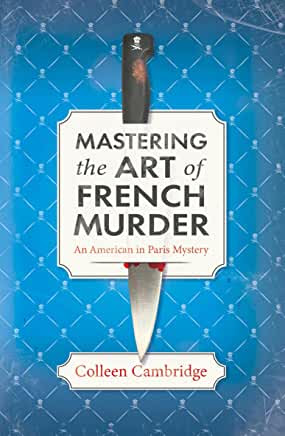
Colleen Cambridge, Mastering the Art of French Murder, Kindle Loc. 3464


As Paris rediscovers its joie de vivre, Tabitha Knight, recently arrived from Detroit for an extended stay with her French grandfather, is on her own journey of discovery. Paris isn’t just the City of Light; it’s the city of history, romance, stunning architecture . . . and food. Thanks to her neighbor and friend Julia Child, another ex-pat who’s fallen head over heels for Paris, Tabitha is learning how to cook for her Grandpère and Oncle Rafe.
 
Between tutoring Americans in French, visiting the market, and eagerly sampling the results of Julia’s studies at Le Cordon Bleu cooking school, Tabitha’s sojourn is proving thoroughly delightful. That is, until the cold December day they return to Julia’s building and learn that a body has been found in the cellar. Tabitha recognizes the victim as a woman she’d met only the night before, at a party given by Julia’s sister, Dort. The murder weapon found nearby is recognizable too—a knife from Julia’s kitchen.
 
Tabitha is eager to help the investigation, but is shocked when Inspector Merveille reveals that a note, in Tabitha’s handwriting, was found in the dead woman’s pocket. Is this murder a case of international intrigue, or something far more personal? From the shadows of the Tour Eiffel at midnight, to the tiny third-floor Child kitchen, to the grungy streets of Montmartre, Tabitha navigates through the city hoping to find the real killer before she or one of her friends ends up in prison . . . or worse.

Amazon.com


I found Mastering the Art of French Murder intriguing from the Paris setting, the post WWII era, and the characters—fictitious main character Tabitha Knight and very real Julia Child, no less! Two independent American women secure in their situations befriend each other. Julia older than Tabitha Knight becomes a mentor of sorts, and yet they also have a symbiotic relationship.


Colleen Cambridge must have done an enormous amount of research to write this book. But I can also imagine that the research was fun. She brings Julia to life as a progressive woman and hints that her past life during the war with the State Department is best left buried. But as the above quote reveals, Julia was unequivocal.


Please welcome Colleen Cambridge to WWK.             E. B. Davis


In your Phyllida Bright mystery series, you team an ordinary housekeeper with her boss, Agatha Christie. In this An American in Paris mystery series, you pair Tabitha Knight with Julia Child, a fun pairing. What summoned the idea of placing talented, but amateur, fictional sleuths with famous and strong real women of the past?


Well, to be honest, it was something my editor and publishing team came up with. I love writing historical mysteries, and had written a series featuring an aide of Abraham Lincoln (the Lincoln’s White House Mysteries, writing as CM Gleason) and one day my editor called and asked if I’d be interested in doing a similar sort of thing with Agatha Christie’s housekeeper. I jumped on that chance and haven’t looked back.


The fun part about making the protagonist be the friend of the historical person is that I can do whatever I want with the protagonist’s character, life, story, etc. Everyone knows Agatha Christie’s and Abe Lincoln’s and Julia Childs’ stories…but now people get to experience that piece of history through the eyes of Phyllida Bright and Adam Quinn and Tabitha Knight…and I can give them their own lives.


Are there any legal rules about putting real historical people into fiction? Do heirs have to give their approval?


Not unless you write something libelous, which of course I wouldn’t do. J


Did Julia really have a “potty” mouth?


Absolutely! She was very earthy and relaxed and bawdy, enthusiastic about learning and experiencing new things—and I’m certain that was part of why Paul, her husband, and her many friends were attracted to being with her.


Julia becomes enamored by French food and its history. She starts taking classes at Le Cordon Bleu. The action takes place in 1949 after Julia’s husband Paul is transferred to Paris by the US Information Service as a diplomat. Did that department become or was the precursor to something we know of today?


Yes. The US Information Service became the US Information Agency in the late 1950s, I believe.


Tabitha is a transplant to Paris from Detroit. What happened that brought her to Paris? What skills does she have from her war experience?


Tabitha’s mother is French, and her grandfather still lives in Paris. When he invites her to come and live with him, she eagerly leaves the US for one of the most intriguing cities in the world. She’d worked as a Rosie-the-Riveter at the Willow Run Bomber Plant in the Detroit suburbs, and since the war ended, she has been at loose ends. She’s not the sort of woman who wants to get married and have children (at least, not yet), and she’s not really interested in the other traditional female occupations of nurse or teacher. And so she is eager.


Why does Tabitha think that cooking will be like fixing an engine?


Because she figures everything just fits into place, each part, like the parts to a mechanical thing.


Did Julia’s six-foot, two-inch robust frame affect her trajectory in the cooking arena? Did men have less of an intimidation factor on her?


In her kitchen, the counters and the stove were low enough that she would have to bend over a little. Must have been hell on her back!


I have no idea whether she ever felt intimidated by men because of her height; from everything I’ve read about Julia it’s that she wasn’t shy and she wasn’t retiring, and wasn’t easily intimidated. I will say that the thing that intimidated her at first in Paris was not being able to speak the language, and feeling left out of conversations.


I loved your descriptions of what American food consisted of during the mid 20th century. Grilled Spam topped with pineapple slices was considered a fancy appetizer. Condensed soup as sauces, and instant coffee! Those descriptions show just how much Julia Child changed American cooking and culinary standards. Did you look at old cookbooks to find these “recipes?”


No, not at all. Some of them are simply from my growing up and knowing what my parents ate. And some of them were things mentioned specifically by Julia in her autobiography as what she’d grown up eating as well.


What is a suspended food box? (What did they do in summer if they didn’t have an icebox?)


Basically it’s a box hung outside the window. I don’t know what the Childs’ did in the summer without an icebox! Julia never says…probably never bought things that would go bad quickly without being refrigerated.


What is Tabitha’s sprite?


It’s her internal curiousness, her tendency to want to stir things up, to find out more, to have adventures and do fun and different things.


If a woman wore pants in Paris, except when bike or horse riding, it was illegal. What did they do to women who wore pants—lock them up? How could they justify this ridiculousness?


Well, I don’t think the women were ticketed very often, if at all. But the law was still on the books, and it was unusual for women to wear pants…though not unheard of. Especially in the more bohemian areas like Saint-Germain La Prés, you would see lots of the Existentialist women wearing slacks.


What was “Coca-Colonization?”


It was the fear that Coca-Cola would take over in France, ruining or affecting the wine industry, and helping to make France too “American” and “capitalistic.” The promotion of Coca-Colonization was mainly from the Communist Party, which was a very powerful force in France at the time.


Did Julia and Paul meet during the war when they both worked for the Office of Strategic Services, which was then our intelligence department? What did they do?


Yes, Julia and Paul met while working at the precursor to the CIA. They were both stationed in Ceylon for a time. Julia was a secretary, managing the files and data on the employees—including any that were spies. Part of Paul’s role was to help design war rooms, as he was an architect and also very artistic. Who knows if either of them did anything else…


What is a képi hat?


A képi hat is the familiar stove-pipe shaped cap worn by Parisian police with the slanted top and a little brim. Think Inspector Clouseau. ;-)


What’s next for Tabitha and Julia?

 I’ve just finished the second book in the series, titled A Murder Most French (May 2024). In this book, Tabitha accompanies Julia to a cooking demonstration at Le Cordon Bleu. The chef doing the demonstration opens a very rare and expensive bottle of wine, takes a taste, and promptly drops dead.